
Safety
General information, not medical advice
Your prescriber and the leaflet in your pack know your situation. This page does not.
- Follow your prescriber and the leaflet
- Don't start, stop, or change a dose on your own
- Doses and warnings differ by country and product
Eletriptan Tablet: Uses, Dosage, Side Effects, Precautions and Alternates
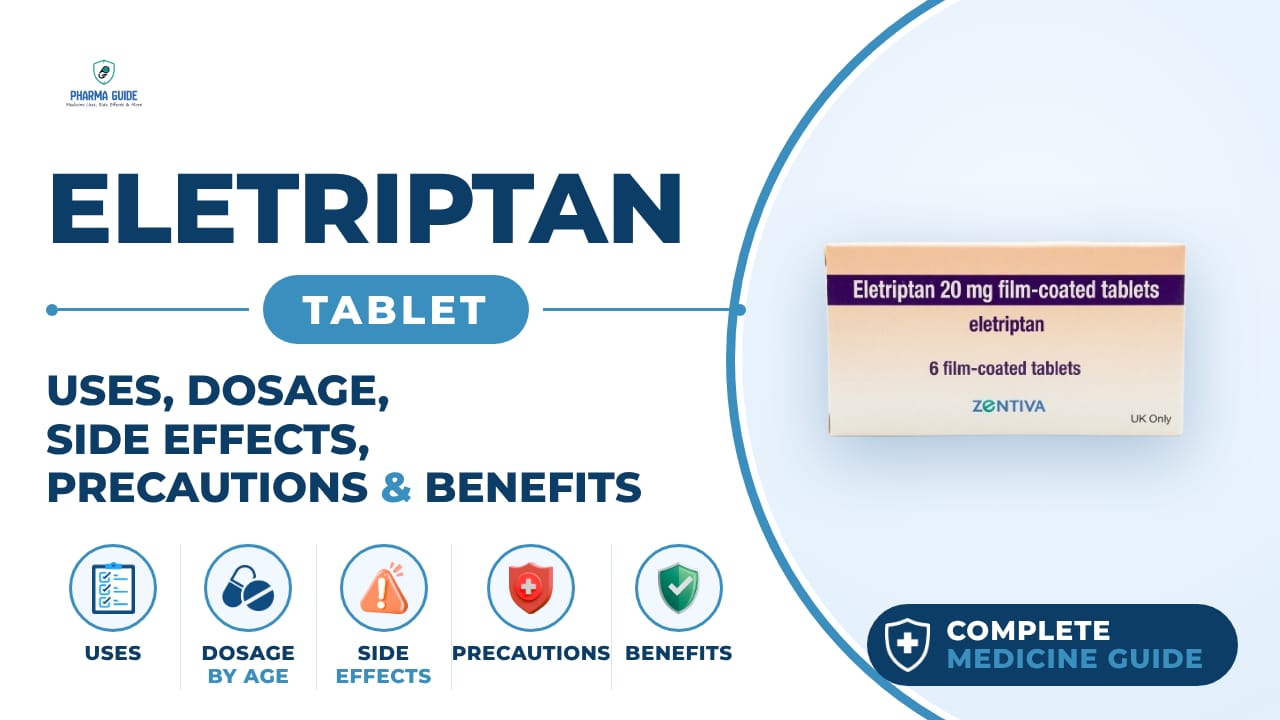
| Generic name | Eletriptan hydrobromide |
|---|---|
| Drug class | Serotonin (5-HT1) receptor agonist (triptan) |
| Forms | 20 mg oral tablets, 40 mg oral tablets |

Quick overview
Eletriptan Tablet (eletriptan hydrobromide) is a prescription triptan medicine used to treat acute migraine headaches, with or without aura, in adults. It helps relieve headache pain, nausea, and sensitivity to light and sound during a migraine attack. It is taken as a single dose when a migraine begins and should not be used more than 10 days in a month. It does not prevent migraines from starting or reduce how often they occur.
What is Eletriptan Tablet
Eletriptan is a prescription tablet used to treat acute migraine headaches with or without aura in adults. It belongs to a group of medicines called triptans.
Eletriptan Tablet uses
- Acute migraine with aura.
- Acute migraine without aura.
- Migraine-related headache.
- Migraine-associated nausea.
- Migraine-associated sensitivity to light and sound.
Benefits of Eletriptan Tablet
- Relieves migraine pain.
- Reduces headache severity.
- Helps relieve nausea associated with migraine.
- Reduces sensitivity to light and sound.
- Helps improve daily functioning during migraine.
How Eletriptan Tablet works
During a migraine, blood vessels in and around the brain widen and become inflamed, causing pain and other symptoms. Eletriptan works by narrowing these blood vessels and blocking the release of substances that cause pain, nausea, and sensitivity to light and sound. It does not stop migraines from starting or reduce how often they happen.
Eletriptan Tablet dosage
Take one tablet as soon as you feel a migraine coming on, by mouth. Take exactly as prescribed; do not take more or less, or more often, than directed. If your symptoms improve but come back after two hours or more, you may take a second tablet. If your symptoms do not improve after the first tablet, do not take a second tablet without first talking to your doctor. Do not use this medicine, or any other headache medicine, for more than 10 days in a month, as overuse can make headaches worse. Call your doctor if you need to treat more than 3 headaches in a one-month period. Can be taken with or without food. Keep a diary or use an app to track your headaches and when you take this medicine, to help your doctor see how well it is working.
| Age group | Dose |
|---|---|
| Under 18 years | Not recommended |
| 18–64 years | 20–40 mg, once/day |
| 65+ years | 20–40 mg, once/day |
Available forms and strengths
- 20 mg oral tablets
- 40 mg oral tablets
Side effects of Eletriptan Tablet
Common
- Dizziness
- Nausea
- Weakness or tiredness
- Drowsiness
- Upset stomach
- Heartburn
- Dry mouth
- Feeling warm or cold
- Headache
Serious
- Signs of a heart attack: chest pain or pressure, pain in arms, back, neck, jaw, or stomach, shortness of breath, cold sweat, nausea or vomiting, feeling lightheaded
- Signs of stroke: sudden weakness on one side of the body, slurred or difficult speech, sudden severe headache
- Irregular or rapid heartbeat, fainting, or signs of heart rhythm changes
- Signs of serotonin syndrome: hallucinations, agitation, fast heartbeat, changes in blood pressure, high body temperature, tight muscles, trouble walking, nausea, vomiting, or diarrhea
- Signs of poor blood flow (Raynaud's syndrome): color or sensation changes, numbness, or tingling in fingers and toes
- Stomach or bowel problems: sudden or severe stomach pain, stomach pain after eating, weight loss, bloody diarrhea, constipation, fever
- Signs of severely high blood pressure: sudden severe headache, chest pain, confusion, trouble breathing, vision changes
- Severe allergic reaction: swelling of face, lips, mouth, tongue, or throat, trouble breathing or swallowing, hives, rash, or itching
- Medicine overuse headache (headaches that happen more often or get worse)
Warnings and precautions
- Do not take this medicine if you have heart problems, a history of heart problems, stroke, or circulation problems, or if you have hemiplegic or basilar migraines, uncontrolled high blood pressure, or ischemic bowel disease.
- Do not take this medicine within 24 hours of another triptan or an ergot-type medicine, or within 72 hours of certain other drugs like ketoconazole, itraconazole, nefazodone, troleandomycin, clarithromycin, ritonavir, or nelfinavir, since these combinations raise the risk of serious side effects.
- This medicine can cause serious heart problems, including heart attack, which can lead to death, especially in people with risk factors for heart disease.
- This medicine can cause serotonin syndrome, a serious and life-threatening condition, especially when combined with certain antidepressants (SSRIs or SNRIs).
- Taking this medicine more often than prescribed can cause headaches to happen more often or get worse (medication overuse headache).
- It is not known if eletriptan is safe during pregnancy or if it could harm an unborn baby. Tell your doctor if you are or plan to become pregnant.
- Eletriptan passes into breast milk and may harm your baby. Talk to your doctor about the best way to feed your baby if you take this medicine.
- Tell your doctor if you have kidney problems before taking this medicine.
- Tell your doctor if you have liver problems. This medicine is not recommended for people with severe liver impairment.
- It is not known exactly how alcohol affects this medicine, but drinking alcohol may increase dizziness and drowsiness, and alcohol can also trigger migraines in some people. Talk to your doctor before drinking alcohol.
- This medicine can cause dizziness, weakness, or drowsiness. Do not drive a car, use machinery, or do anything that requires alertness until you know how this medicine affects you.
Storage
- Store at room temperature, between 68°F to 77°F (20°C to 25°C)
- Can be exposed to temperatures between 59°F to 86°F (15°C to 30°C) for shorter periods, such as during transport
- Store in a cool, dry place, away from excess heat and moisture, and not in the bathroom
- Keep the medication in the container it came in, tightly closed, and out of the sight and reach of children
- Dispose of unneeded medicine through a medicine take-back program; do not flush it down the toilet
When to see a doctor
- Stop taking this medicine and get emergency help right away if you have symptoms of a heart attack, such as chest discomfort or pressure, pain in the arms, back, neck, jaw, or stomach, shortness of breath, cold sweat, nausea or vomiting, or feeling lightheaded.
- Call your doctor right away if you have symptoms of serotonin syndrome, such as hallucinations, agitation, coma, fast heartbeat, changes in blood pressure, high body temperature, tight muscles, trouble walking, or nausea, vomiting, or diarrhea.
- Get medical help for stomach or intestinal problems such as sudden or severe stomach pain, stomach pain after meals, weight loss, nausea or vomiting, constipation or diarrhea, bloody diarrhea, or fever.
- Get medical help for signs of poor blood flow to the legs and feet, such as cramping or pain in the legs or hips, heaviness or tightness in the leg muscles, burning or aching pain in the feet or toes, numbness or tingling in the legs, or cold or color changes in the legs or feet.
- If you take too much of this medicine, call your doctor or go to the nearest hospital emergency room right away.
- Call your doctor if your headaches get worse or happen more often after taking this medicine.
Alternatives
- Zolmitriptan
- Rizatriptan
- Sumatriptan
Watch the video
FAQs
What is Eletriptan Tablet used for?
It is a prescription triptan used to treat acute migraine headaches with or without aura in adults, relieving headache pain, nausea, and sensitivity to light and sound.
How do you take Eletriptan Tablet?
Take one tablet by mouth as soon as a migraine begins. If symptoms improve but return after two hours or more, a second tablet may be taken. Do not take a second tablet if the first did not help, without talking to your doctor. It can be taken with or without food.
How often can I use Eletriptan Tablet?
Do not use this medicine, or any other headache medicine, for more than 10 days in a month, as overuse can make headaches worse. Call your doctor if you need to treat more than 3 headaches in a one-month period.
What are the serious side effects of Eletriptan Tablet?
Serious effects include signs of heart attack or stroke, irregular or rapid heartbeat, serotonin syndrome, poor blood flow (Raynaud's syndrome), stomach or bowel problems, severely high blood pressure, severe allergic reaction, and medicine overuse headache.
What are the alternatives to Eletriptan Tablet?
Alternatives mentioned include zolmitriptan, rizatriptan, and sumatriptan.
General information, not medical advice
Your prescriber and the leaflet in your pack know your situation. This page does not.
- Follow your prescriber and the leaflet
- Don't start, stop, or change a dose on your own
- Doses and warnings differ by country and product
Sources
Video
Related medicines
Frova Tablet: Uses, Dosage, Side Effects, Precautions and Alternates
serotonin (5-HT1) receptor agonist, triptan
Frova Tablet (frovatriptan) treats acute migraine attacks in adults by narrowing brain blood vessels. Learn dosage, side effects, and warnings.
Axert Tablet: Uses, Dosage, Side Effects, Precautions and Alternates
serotonin (5-HT1) receptor agonist, triptan
Axert Tablet (almotriptan) treats migraine attacks already in progress by narrowing blood vessels and blocking pain signals. Learn dosage, side effects, and