
Safety
General information, not medical advice
Your prescriber and the leaflet in your pack know your situation. This page does not.
- Follow your prescriber and the leaflet
- Don't start, stop, or change a dose on your own
- Doses and warnings differ by country and product
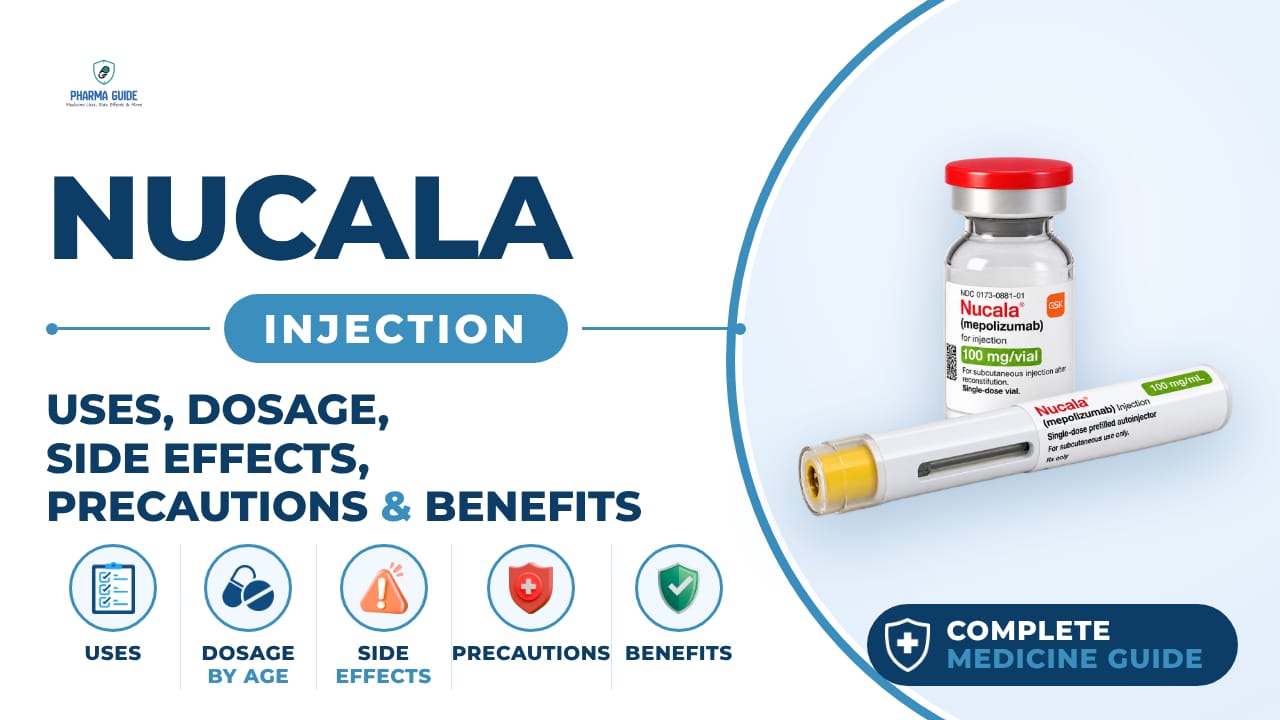
Nucala Injection: Uses, Dosage, Side Effects, Precautions and Alternates
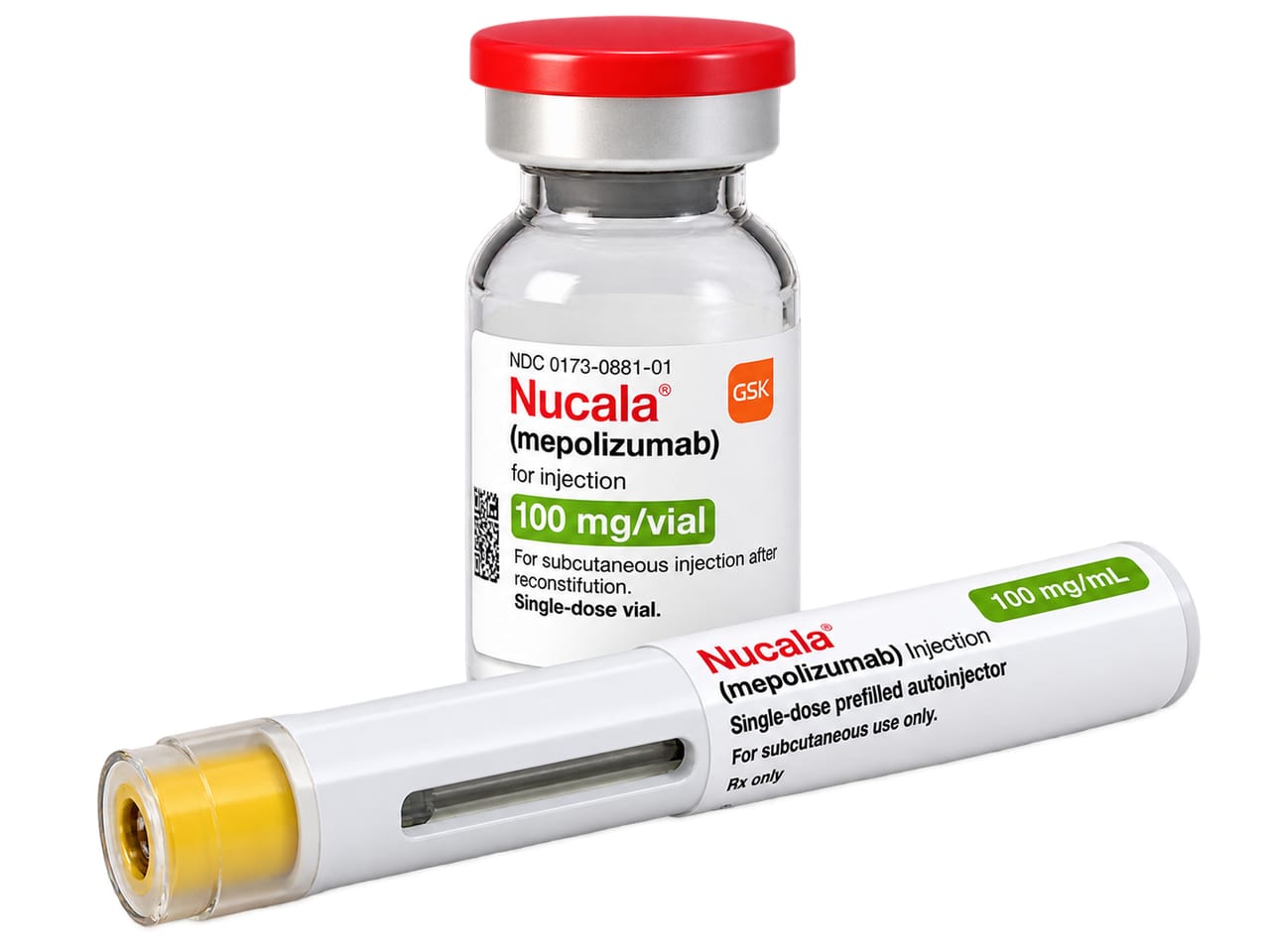
| Generic name | mepolizumab |
|---|---|
| Drug class | monoclonal antibody |
| Forms | Solution for injection in pre-filled pen (auto-injector), Solution for injection in pre-filled syringe (safety syringe), Lyophilized powder in a single-dose vial for reconstitution |
Quick overview
Nucala Injection contains mepolizumab, a monoclonal antibody that blocks interleukin-5 (IL-5) to lower eosinophil levels in the body. It is given as an add-on maintenance treatment for several conditions linked to high eosinophils, including severe eosinophilic asthma, chronic rhinosinusitis with nasal polyps, eosinophilic COPD, eosinophilic granulomatosis with polyangiitis (EGPA), and hypereosinophilic syndrome (HES). It is administered by subcutaneous injection on a schedule determined by age and condition. As with any prescription medicine, it should be used exactly as directed by a doctor.
What is Nucala Injection
Nucala is a prescription injectable medicine that contains mepolizumab, an antibody that blocks a protein called interleukin-5 (IL-5). It is used to reduce high levels of eosinophils, a type of white blood cell linked to inflammation in several conditions.
Nucala Injection uses
- Add-on maintenance treatment of severe eosinophilic asthma in adults and children aged 6 years and older
- Add-on maintenance treatment of chronic rhinosinusitis with nasal polyps (CRSwNP) in adults
- Add-on maintenance treatment of chronic obstructive pulmonary disease (COPD) with an eosinophilic phenotype in adults
- Treatment of eosinophilic granulomatosis with polyangiitis (EGPA) in adults
- Treatment of hypereosinophilic syndrome (HES) in adults and children aged 12 years and older
Benefits of Nucala Injection
- Helps control severe eosinophilic asthma
- Reduces asthma exacerbations
- Treats hypereosinophilic syndrome
- Treats eosinophilic granulomatosis with polyangiitis
- Helps manage chronic rhinosinusitis with nasal polyps
- Helps reduce exacerbations in eligible adults with eosinophilic COPD
How Nucala Injection works
Nucala blocks a protein called interleukin-5 (IL-5), which the body uses to make eosinophils, a type of white blood cell involved in inflammation. By blocking IL-5, Nucala lowers the number of eosinophils in the blood and tissues, which reduces inflammation and related symptoms.
Nucala Injection dosage
Nucala is given as an injection under the skin (subcutaneous) in the stomach area (abdomen), thigh, or upper arm (if given by a caregiver). It should not be injected into areas of skin that are tender, bruised, red, or hard. If more than one injection is needed to complete a dose, each injection site should be kept apart from the others.
Nucala does not treat sudden asthma or COPD attacks; a rescue or reliever inhaler should be used for sudden breathing problems. Corticosteroids should not be stopped suddenly after starting Nucala; any reduction must be done gradually under a doctor's supervision.
The prefilled pen or syringe should be allowed to sit at room temperature for about 30 minutes before use, and used within a few hours of taking it out of the fridge. If a dose is missed, give the injection as soon as remembered, then continue on the regular schedule; if it is almost time for the next dose, skip the missed one and continue as planned.
| Age group | Dose |
|---|---|
| 6–11 years | 40 mg subcutaneously once every 4 weeks for severe eosinophilic asthma |
| 12–17 years | 100 mg subcutaneously once every 4 weeks for severe eosinophilic asthma; 300 mg every 4 weeks for HES |
| 18–64 years | Usually 100 mg every 4 weeks for severe asthma, CRSwNP, or eosinophilic COPD; 300 mg every 4 weeks for EGPA or HES |
Available forms and strengths
- Solution for injection in pre-filled pen (auto-injector)
- Solution for injection in pre-filled syringe (safety syringe)
- Lyophilized powder in a single-dose vial for reconstitution
Side effects of Nucala Injection
Common
- Headache
- Injection-site reaction (pain, redness, swelling, itching, burning)
- Back pain
- Fatigue/tiredness
- Sore throat (pharyngitis)
- Lower respiratory tract infection
- Nasal congestion (stuffy nose)
- Upper abdominal pain
- Urinary tract infection
- Fever
- Mouth and throat pain and joint pain (in rhinosinusitis patients)
- Diarrhea and cough (in COPD patients)
Serious
- Allergic reaction, including anaphylaxis
- Herpes zoster infection (shingles)
Warnings and precautions
- Do not use Nucala if you are allergic to mepolizumab or any of its ingredients.
- Nucala does not treat sudden asthma attacks or sudden breathing problems, so it should not be used for this purpose.
- Do not stop taking corticosteroids suddenly after starting Nucala; any reduction must be gradual and supervised by your doctor.
- If you have a parasitic (helminth) infection, it should be treated before you start Nucala.
- Shingles (herpes zoster) infections have happened in people taking Nucala; vaccination may be considered if appropriate.
- If you are pregnant or think you may be pregnant, talk to your doctor before using Nucala. Your doctor will weigh the benefits and risks for you and your baby.
- Check with your doctor before using Nucala if you are breastfeeding, as it is not known whether it passes into breast milk.
- There are no specific warnings against drinking alcohol while using Nucala, but alcohol could make a headache side effect worse.
- Nucala is not expected to affect your ability to drive or use machines, but it is sensible to be careful until you know how it affects you.
Storage
- Store at 2°C to 8°C (Refrigerate. Do not freeze)
- The pre-filled pen or pre-filled syringe can be removed from the refrigerator and kept in its unopened pack for up to 7 days at room temperature (up to 30°C), when protected from light
- The pre-filled pen or pre-filled syringe must be administered within 8 hours once the pack is opened
- Do not store NUCALA or any other medicine in the bathroom or near a sink. Do not leave it on a window sill or in the car
- Keep it where children cannot reach it
- Do not use NUCALA after the expiry date shown on the pack
When to see a doctor
- Get emergency help right away if you have signs of a serious allergic reaction, such as swelling of the face, lips or tongue, chest tightness, wheezing, trouble breathing, fainting, dizziness, or a widespread rash or hives.
- If you think you are having an allergic reaction to Nucala, stop using it and tell your doctor or a nurse immediately, or go to the Emergency Department at your nearest hospital.
- Seek medical advice if your asthma or COPD symptoms remain uncontrolled or get worse after starting Nucala treatment.
Alternatives
- Benralizumab
- Dupilumab
- Omalizumab
Watch the video
FAQs
What is Nucala Injection used for?
Nucala is used as add-on maintenance treatment for severe eosinophilic asthma, chronic rhinosinusitis with nasal polyps, eosinophilic COPD, eosinophilic granulomatosis with polyangiitis (EGPA), and hypereosinophilic syndrome (HES).
How does Nucala Injection work?
Nucala contains mepolizumab, which blocks interleukin-5 (IL-5), a protein the body uses to make eosinophils. This lowers eosinophil levels in the blood and tissues, reducing inflammation and related symptoms.
What is the dosage of Nucala Injection?
Dosage depends on age and condition. For example, children 6–11 years receive 40 mg every 4 weeks for severe eosinophilic asthma, while adults typically receive 100 mg every 4 weeks for asthma, CRSwNP, or eosinophilic COPD, or 300 mg every 4 weeks for EGPA or HES.
What are the common side effects of Nucala Injection?
Common side effects include headache, injection-site reactions, back pain, fatigue, sore throat, lower respiratory tract infection, nasal congestion, upper abdominal pain, urinary tract infection, and fever.
Can Nucala Injection be used for sudden asthma attacks?
No, Nucala does not treat sudden asthma or COPD attacks. A rescue or reliever inhaler should be used for sudden breathing problems.
General information, not medical advice
Your prescriber and the leaflet in your pack know your situation. This page does not.
- Follow your prescriber and the leaflet
- Don't start, stop, or change a dose on your own
- Doses and warnings differ by country and product
Sources
Video
Related medicines
Darzalex Injection: Uses, Dosage, Side Effects, Precautions and Alternates
monoclonal antibody
Darzalex Injection (daratumumab) treats multiple myeloma and AL amyloidosis by targeting CD38 on abnormal cells. Learn uses, dosage, side effects, and warnings.
Trastuzumab Injection: Uses, Dosage, Side Effects, Precautions and Alternates
Monoclonal antibody
Trastuzumab Injection targets HER2-positive breast and stomach cancers. Learn how it works, dosage, side effects, warnings, and when to see a doctor.