
Safety
General information, not medical advice
Your prescriber and the leaflet in your pack know your situation. This page does not.
- Follow your prescriber and the leaflet
- Don't start, stop, or change a dose on your own
- Doses and warnings differ by country and product
Alprax Tablet: Uses, Dosage, Side Effects, Precautions and Alternates
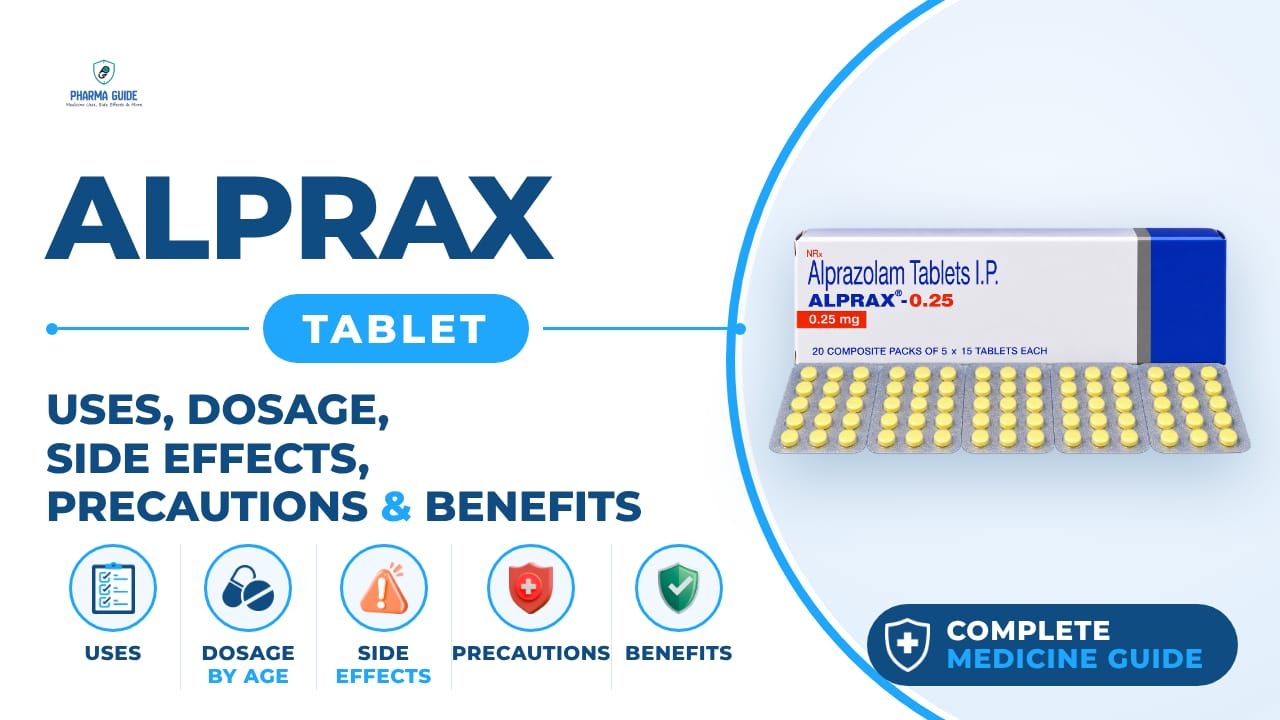
| Generic name | alprazolam |
|---|---|
| Drug class | Benzodiazepines |
| Forms | Tablet (including standard and SR/sustained-release tablets) |

Quick overview
Alprax Tablet contains alprazolam, a medicine belonging to the benzodiazepine class. It is prescribed for anxiety and panic attacks/panic disorder, and is thought to work by acting on brain chemicals to produce a calming effect. It is generally intended for short-term use and should be taken exactly as prescribed by a doctor.
What is Alprax Tablet
Alprax is a prescription medicine containing alprazolam. It belongs to a group of medicines called benzodiazepines, which are thought to work by their action on brain chemicals to produce a calming effect.
Alprax Tablet uses
- Anxiety
- Panic attacks/panic disorder
Benefits of Alprax Tablet
- Anxiety Relief: Helps reduce symptoms of anxiety.
- Panic Disorder Support: Can help reduce panic symptoms.
- Calming Effect: Decreases excessive nervous-system activity.
- Short-Term Symptom Control: May provide relatively rapid relief when prescribed appropriately.
- Sleep Support: Its sedative effect may help with sleep difficulties associated with anxiety, when specifically prescribed.
How Alprax Tablet works
Alprax attaches to certain receptors in the brain and nervous system and boosts the activity of a brain chemical called GABA, which produces a calming effect.
Alprax Tablet dosage
Swallow the tablets with a glass of water. They can be taken with or without food. Do not break, chew, or crush the tablet; swallow it whole with a glass of water. Try to take it at the same time every day to help you remember.
If you forget a dose, skip the missed dose if it is almost time for your next one, or take it as soon as you remember otherwise; do not take a double dose to make up for a missed one.
Keep taking it for as long as your doctor recommends; in general it should be taken for short periods only, such as 2 to 4 weeks, and continuous long-term use is not recommended unless your doctor advises it. Do not stop taking it or lower the dose without checking with your doctor first, since the dose may need to be reduced gradually to avoid unwanted effects. Not recommended for use in children.
| Age group | Dose |
|---|---|
| Under 18 Years | Only under specialist medical supervision |
| Adults (18–64 Years) | Usually 0.25–0.5 mg 2–3 times daily, as prescribed |
| Older Adults (65+ Years) | Usually 0.25 mg 2–3 times daily initially, adjusted by a doctor |
Available forms and strengths
- Tablet (including standard and SR/sustained-release tablets)
Side effects of Alprax Tablet
Common
- Drowsiness, tiredness
- Dizziness, lightheadedness, confusion
- Memory problems
- Unsteadiness, clumsiness
- Slurred speech
- Blurred vision
- Tremor
- Changes in weight
- Impaired sexual function
- Anxiety, irritability and sleep problems after stopping the medicine
- Nausea, vomiting, headache
- Dry mouth, constipation
- Changes in speech pattern
- Loss of coordination
- Abdominal pain
- Difficult or painful urination
- Chest pain
- Irregular menstrual periods
- Decreased appetite
- Double vision
- Sudden sweating
- Acid or sour stomach, heartburn
Serious
- Unusual feelings of anger, excitement or overactivity
- Yellowing of the eyes or skin (jaundice)
- Respiratory depression (slowed or stopped breathing), which can lead to coma or life-threatening conditions
- Suicidal ideation
- Seizures
- Hallucinations
- Urinary retention
Warnings and precautions
- Tell your doctor if you are pregnant or plan to become pregnant. Alprax is not recommended for use during pregnancy as it may cause serious harm to the baby, including birth abnormalities or miscarriage.
- Alprax may pass into breast milk and cause drowsiness and feeding difficulties in the baby, so it is not recommended while breastfeeding.
- Use with caution if you have kidney disease; your doctor may want to monitor your kidney function while you take this medicine.
- Use with caution if you have liver disease; your doctor may want to monitor your liver function while you take this medicine.
- Be careful with alcohol while taking this medicine, as combining them can make you more sleepy, dizzy or lightheaded, and increases the risk of serious side effects like breathing difficulties.
- Do not drive or operate machinery until you know how this medicine affects you, since it can cause drowsiness or dizziness.
- This medicine can lead to dependence, especially with long-term use, and should generally be taken for short periods only.
- Stopping the medicine suddenly can cause severe withdrawal symptoms such as rebound anxiety, trouble sleeping, and tremors.
- Never combine this medicine with alcohol, opioids, or other sedatives, as this can cause severe, life-threatening breathing problems.
- Elderly patients, or those who are unwell or taking other medicines, may be more likely to have side effects such as drowsiness, confusion, dizziness and unsteadiness, raising the risk of falls.
- Do not take this medicine if you have severe and chronic lung disease or severe muscle weakness (myasthenia gravis).
Storage
- Keep it where children cannot reach it. A locked cupboard at least one-and-a-half metres above the ground is a good place to store medicines.
- Keep your blister pack of tablets in a cool dry place where the temperature stays below 25°C.
- Keep your bottle of tablets in a cool dry place where the temperature stays below 30°C.
- Do not store ALPRAX or any other medicine in the bathroom or near a sink.
- Do not leave it in the car or on window sills. Heat and dampness can destroy some medicines.
- If your doctor tells you to stop taking this medicine, or your tablets have passed their expiry date, ask your pharmacist what to do with any that are left over.
When to see a doctor
- Get urgent medical help right away if you think you or someone else may have taken too much of this medicine, even if there are no symptoms yet. Signs of overdose include drowsiness, tiredness, confusion, dizziness, breathing trouble, weakness, or becoming unconscious.
- Tell your doctor immediately or go to the emergency department if you notice unusual anger, excitement or overactivity, or yellowing of the eyes or skin.
- Seek immediate medical attention if you notice signs of an allergic reaction such as skin rash, itching or swelling of the face, tongue or throat, severe dizziness, or breathing difficulty.
Alternatives
- Alprax Mt 0.5 MG Tablet
- Alprazolam 0.5 MG Tablet (Zydus Cadila)
- Altzibarem 0.5 MG Tablet (Glenmark Pharmaceuticals Ltd.)
- Tranquil 0.5 MG Tablet (Cipla Ltd.)
- Zoldac 0.5 MG Tablet (Zydus Cadila)
Watch the video
FAQs
What is Alprax Tablet used for?
Alprax Tablet is used to treat anxiety and panic attacks/panic disorder. It belongs to the benzodiazepine class and works by acting on brain chemicals to produce a calming effect.
How should Alprax Tablet be taken?
Swallow the tablet whole with a glass of water, with or without food. Do not break, chew, or crush it. Try to take it at the same time every day, and only for as long as your doctor recommends, generally 2 to 4 weeks.
What are the common side effects of Alprax Tablet?
Common side effects include drowsiness, tiredness, dizziness, confusion, memory problems, unsteadiness, slurred speech, blurred vision, tremor, weight changes, nausea, vomiting, headache, and dry mouth.
Can I stop taking Alprax Tablet suddenly?
No, you should not stop taking it or lower the dose without checking with your doctor first, as it may need to be reduced gradually. Stopping suddenly can cause severe withdrawal symptoms such as rebound anxiety, trouble sleeping, and tremors.
Is Alprax Tablet safe during pregnancy or breastfeeding?
Alprax is not recommended during pregnancy as it may cause serious harm to the baby, including birth abnormalities or miscarriage. It may also pass into breast milk and cause drowsiness and feeding difficulties in the baby, so it is not recommended while breastfeeding.
General information, not medical advice
Your prescriber and the leaflet in your pack know your situation. This page does not.
- Follow your prescriber and the leaflet
- Don't start, stop, or change a dose on your own
- Doses and warnings differ by country and product
Sources
Video
Related medicines

Alprazolam Tablet: Uses, Dosage, Side Effects, Precautions and Alternates
Benzodiazepines
Alprazolam Tablet treats anxiety and panic disorder by calming brain activity. Learn about dosage, forms, side effects, warnings, and alternatives.
Restyl Tablet: Uses, Dosage, Side Effects, Precautions and Alternates
Benzodiazepines
Restyl Tablet (Alprazolam) treats anxiety, panic disorder, and anxiety with depression. Learn its uses, dosage, side effects, and precautions.