
Safety
General information, not medical advice
Your prescriber and the leaflet in your pack know your situation. This page does not.
- Follow your prescriber and the leaflet
- Don't start, stop, or change a dose on your own
- Doses and warnings differ by country and product
Betamethasone Valerate Cream: Uses, Dosage, Side Effects, Precautions and Alternates
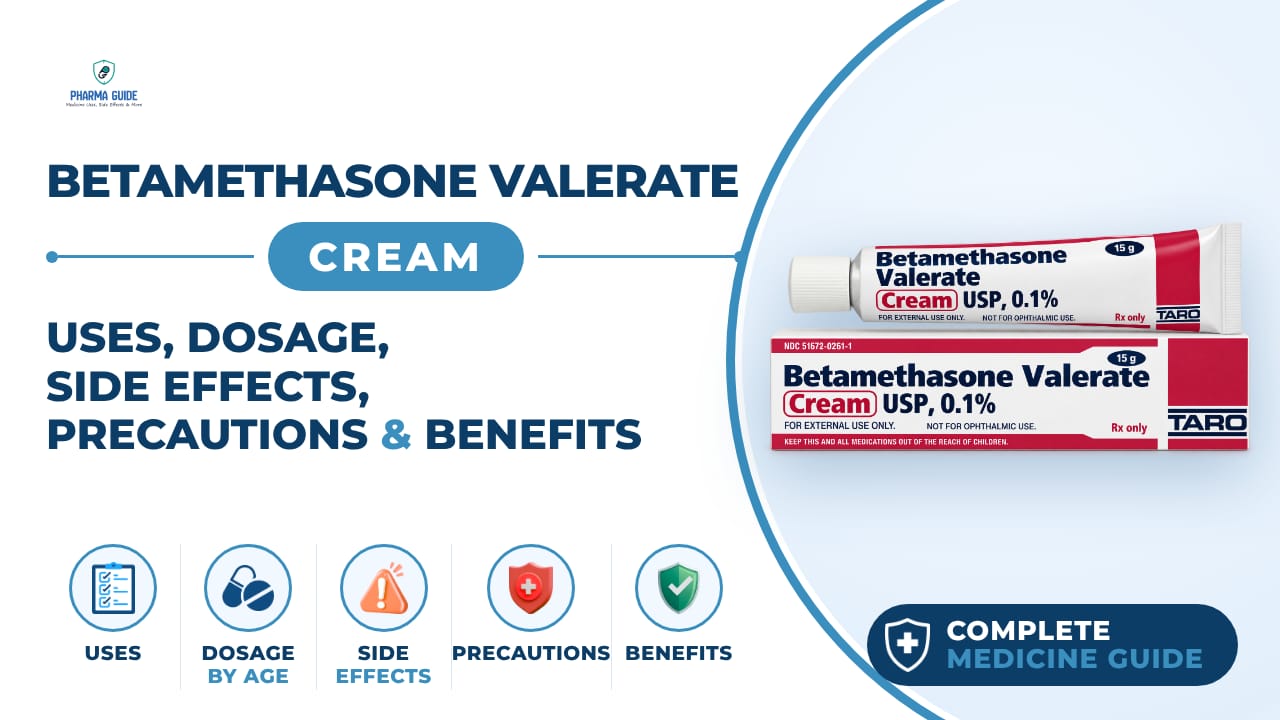
| Generic name | Betamethasone valerate |
|---|---|
| Drug class | Corticosteroid (topical steroid) |
| Forms | Cream, Ointment, Scalp application (lotion), Foam, Lotion |
Quick overview
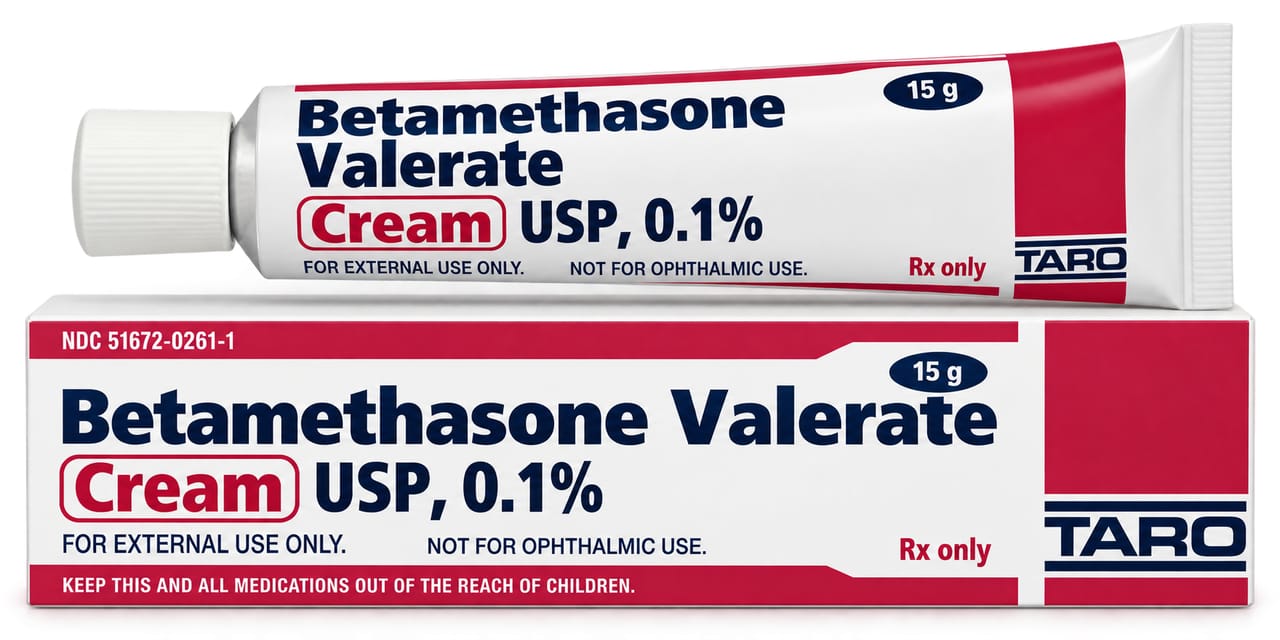
Betamethasone Valerate Cream contains betamethasone valerate, a topical corticosteroid used to reduce redness, swelling, irritation, and itching of the skin. It is a prescription medicine, different from the anabolic steroids used by bodybuilders or athletes. It is applied to the affected skin area and is used for a range of inflammatory skin conditions.
What is Betamethasone Valerate Cream
Betamethasone valerate cream is a prescription topical corticosteroid. It belongs to a group of medicines called steroids that reduce redness, swelling, irritation, and itching of the skin. It is different from the anabolic steroids used by bodybuilders or athletes.
Betamethasone Valerate Cream uses
- Eczema and other types of dermatitis
- Psoriasis (thickened, scaly red patches), excluding widespread plaque psoriasis
- Prurigo nodularis (itchy nodules on the arms or legs)
- Lichen simplex chronicus (thickened itchy skin from scratching)
- Lichen planus (itchy reddish-purple bumps)
- Seborrhoeic dermatitis
- Discoid lupus erythematosus
- Allergic or irritant contact dermatitis
- Used together with oral or injectable steroids for erythroderma
- Insect bites
- Prickly heat
Benefits of Betamethasone Valerate Cream
- Helps reduce redness and itchiness of certain skin problems
- Helps relieve the redness, swelling, itching and discomfort of various skin problems
- Provides local anti-inflammatory activity
- Helps relieve itching and irritation
- Reduces redness and swelling
How Betamethasone Valerate Cream works
The steroid in this cream reduces inflammation and itching in the skin. It works by acting on skin cells to decrease swelling, redness, and irritation, partly by blocking substances in the body that cause inflammation.
Betamethasone Valerate Cream dosage
Apply a thin layer to the affected area and gently rub it in until it disappears. It is usually applied once or twice a day, and this may be reduced as the skin improves. This medicine is for use on the skin only, and you should not use more than the amount your doctor has prescribed.
Wash your hands before applying, and again afterward unless treating the hands. If using an emollient (moisturizer), allow time for the cream to be absorbed before applying the emollient. Do not use on large areas of the body for a long time unless your doctor tells you to, and do not apply just before a bath, shower, or swimming, as this may reduce how well it works.
Only apply to the face if your doctor specifically tells you to, and for no more than 5 days, avoiding contact with the eyes. If someone else applies the cream for you, they should wash their hands afterward or wear gloves.
Talk to your doctor if your skin problem does not improve within 2 to 4 weeks. This medicine should not be used every day for more than 4 weeks at a time.
Use a smaller amount for children, measured using an adult fingertip as a guide. Do not use on children under 1 year of age. A course of treatment for a child should not normally last more than 5 days unless your doctor says otherwise.
If you forget a dose, apply it as soon as you remember, but if it is almost time for the next dose, skip the missed one. Do not apply extra cream to make up for a missed dose. Talk to your doctor before stopping regular use, as your condition may worsen if stopped suddenly.
| Age group | Dose |
|---|---|
| 2–11 years | Apply a thin film to the affected area 1–3 times daily |
| 12–17 years | Apply a thin film 1–3 times daily |
| 18–64 years | Apply a thin film 1–3 times daily |
Available forms and strengths
- Cream
- Ointment
- Scalp application (lotion)
- Foam
- Lotion
Side effects of Betamethasone Valerate Cream
Common
- Itchy skin
- Local skin burning, pain, or irritation where applied
- Redness
Serious
- Skin thinning (atrophy) and stretch marks
- Appearance of blood vessels under the skin surface
- Changes in skin colour
- Increased or decreased body hair growth, or hair loss
- Allergic reaction at the application site, rash or hives
- Skin infection or worsening of infection
- Pustular psoriasis (raised bumps with pus under the skin)
- Cushing's syndrome: weight gain, rounding of the face (moon face), obesity
- Decreased cortisol levels in the blood
- Increased blood sugar or sugar in the urine
- High blood pressure
- Cataract (cloudy lens in the eye)
- Glaucoma (increased eye pressure)
- Osteoporosis (weakening of the bones)
- Blurred vision
- Delayed weight gain or slow growth in children
Warnings and precautions
- Do not use on skin infections caused by viruses (like herpes or chickenpox), bacteria, fungi, or parasites, or on skin affected by tuberculosis or syphilis, since the medicine can hide or worsen these infections.
- Do not use this cream on acne, rosacea, the red rash around the mouth, itching without inflammation, or itching around the anus or genitals, as it could make these conditions worse.
- Using this medicine under airtight dressings, for long periods, over large areas, or on broken or thin skin increases the amount absorbed into the body and raises the risk of serious side effects.
- Stop using this medicine and tell your doctor right away if your skin condition gets worse, becomes swollen, or if you develop raised bumps with pus (a type of psoriasis) during treatment.
- Using large amounts over a long time, especially under airtight dressings, can cause the body to absorb the steroid and lead to serious hormone-related problems, including Cushing's syndrome.
- Do not smoke or go near open flames while using some formulations, as treated fabric can catch fire easily.
- This medicine should not be used on children under 1 year old, and should be used carefully in young children because of higher risk of absorption and growth effects.
- There is limited information about using this medicine during pregnancy. It should only be used if your doctor decides the benefit to you outweighs any possible risk to your baby, using the smallest amount for the shortest time.
- It isn't known for certain if this medicine passes into breast milk in meaningful amounts. If you use it while breastfeeding, avoid applying it to the breast area so your baby does not accidentally swallow it.
- If you have kidney problems, your doctor may want you to use the smallest amount for the shortest time, since the body may take longer to clear the medicine if it gets into the bloodstream.
- If you have liver problems, this medicine should be used with caution, using the smallest amount for the shortest time needed.
- No major direct interaction is expected with alcohol when used topically.
- No studies have looked at how this medicine affects driving or using machines, and based on its known side effects, it is not expected to affect these activities.
Storage
- Keep this medicine out of the sight and reach of children
- Do not use after the expiry date stated on the tube or carton
- Do not store above 25°C
- Do not throw away medicines via wastewater or household waste; ask your pharmacist how to dispose of medicines you no longer use
When to see a doctor
- Get medical help right away if you notice signs of an allergic reaction, such as rash, hives, or swelling of the skin.
- Contact your doctor if you notice signs of Cushing's syndrome, such as weight gain or a rounded 'moon' face.
- Seek medical attention if you think you have used too much of this medicine, even if you do not have any symptoms.
- If you swallow this medicine by accident, rinse your mouth with water and contact your doctor or pharmacist for advice.
- Contact your doctor if you experience blurred vision or other visual changes while using this medicine.
- Tell your doctor immediately if you notice signs of an allergic reaction such as wheezing, swelling of the face/lips/mouth, hives, tightness in the chest, or fainting, or go to the emergency department.
Alternatives
- Hydrocortisone cream
- Desonide cream
- Triamcinolone cream
- Mometasone cream
Watch the video
FAQs
What is Betamethasone Valerate Cream used for?
It is used for eczema and other dermatitis, psoriasis (excluding widespread plaque psoriasis), prurigo nodularis, lichen simplex chronicus, lichen planus, seborrhoeic dermatitis, discoid lupus erythematosus, allergic or irritant contact dermatitis, insect bites, and prickly heat, among other inflammatory skin conditions.
How should I apply Betamethasone Valerate Cream?
Apply a thin layer to the affected area and rub it in gently until it disappears, usually once or twice a day. Wash your hands before and after applying unless treating the hands, and avoid applying just before a bath, shower, or swimming.
Can Betamethasone Valerate Cream be used on the face or in children?
It should only be applied to the face if a doctor specifically says to, and for no more than 5 days while avoiding the eyes. It should not be used on children under 1 year old, and children should use a smaller amount for no more than 5 days unless the doctor advises otherwise.
How long can I use Betamethasone Valerate Cream?
Talk to your doctor if your skin problem does not improve within 2 to 4 weeks, as this medicine should not be used every day for more than 4 weeks at a time.
What are the serious side effects of Betamethasone Valerate Cream?
Serious side effects include skin thinning and stretch marks, changes in skin colour, allergic reactions, skin infections, pustular psoriasis, Cushing's syndrome, high blood sugar, high blood pressure, cataracts, glaucoma, osteoporosis, and slowed growth in children.
General information, not medical advice
Your prescriber and the leaflet in your pack know your situation. This page does not.
- Follow your prescriber and the leaflet
- Don't start, stop, or change a dose on your own
- Doses and warnings differ by country and product
Sources
Video
Related medicines
Anusol-HC Cream: Uses, Dosage, Side Effects, Precautions and Alternates
Corticosteroid (topical steroid)
Anusol-HC Cream is a hydrocortisone treatment for hemorrhoid itching, swelling, and irritation. Learn dosage, side effects, and safety warnings.

Injectafer Injection: Uses, Dosage, Side Effects, Precautions and Alternates
Iron products
Injectafer (ferric carboxymaltose) treats iron deficiency anemia and heart failure-related iron deficiency via IV. Learn uses, dosage, side effects, and