
Safety
General information, not medical advice
Your prescriber and the leaflet in your pack know your situation. This page does not.
- Follow your prescriber and the leaflet
- Don't start, stop, or change a dose on your own
- Doses and warnings differ by country and product
Budesonide Nasal Spray: Uses, Dosage, Side Effects, Precautions and Alternates
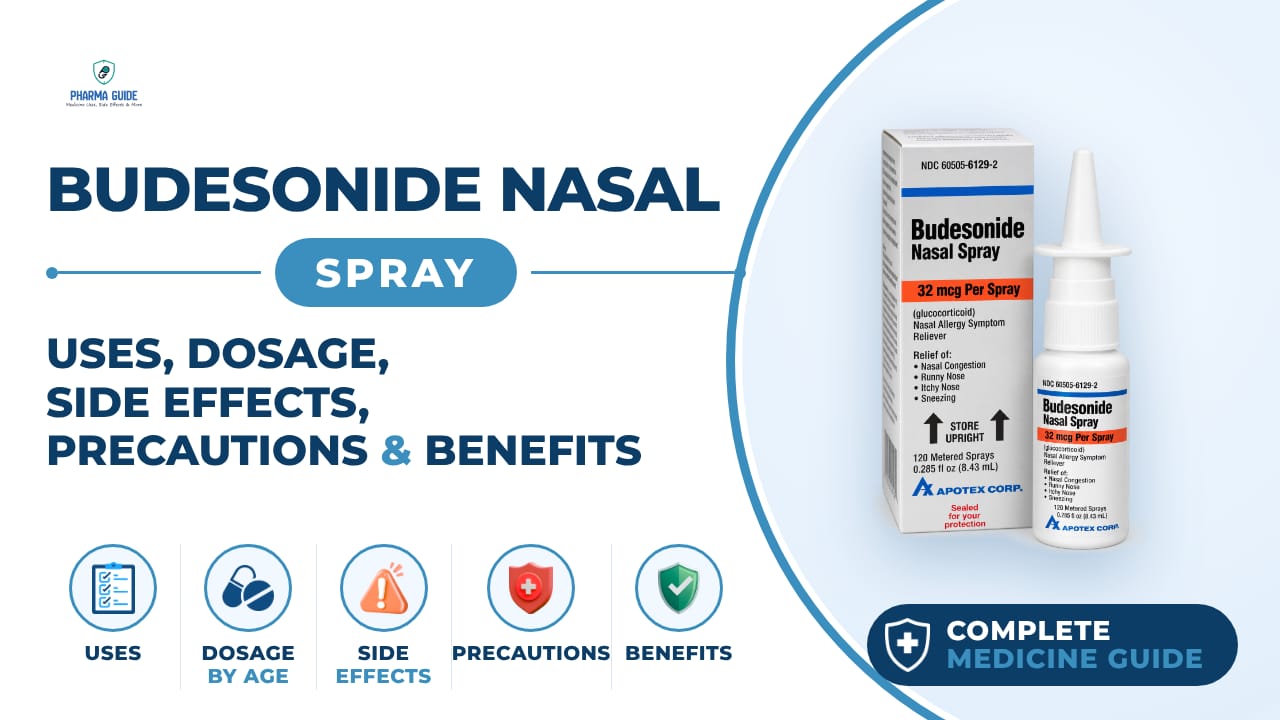
| Generic name | budesonide |
|---|---|
| Drug class | corticosteroid |
| Forms | Nasal spray (suspension) |
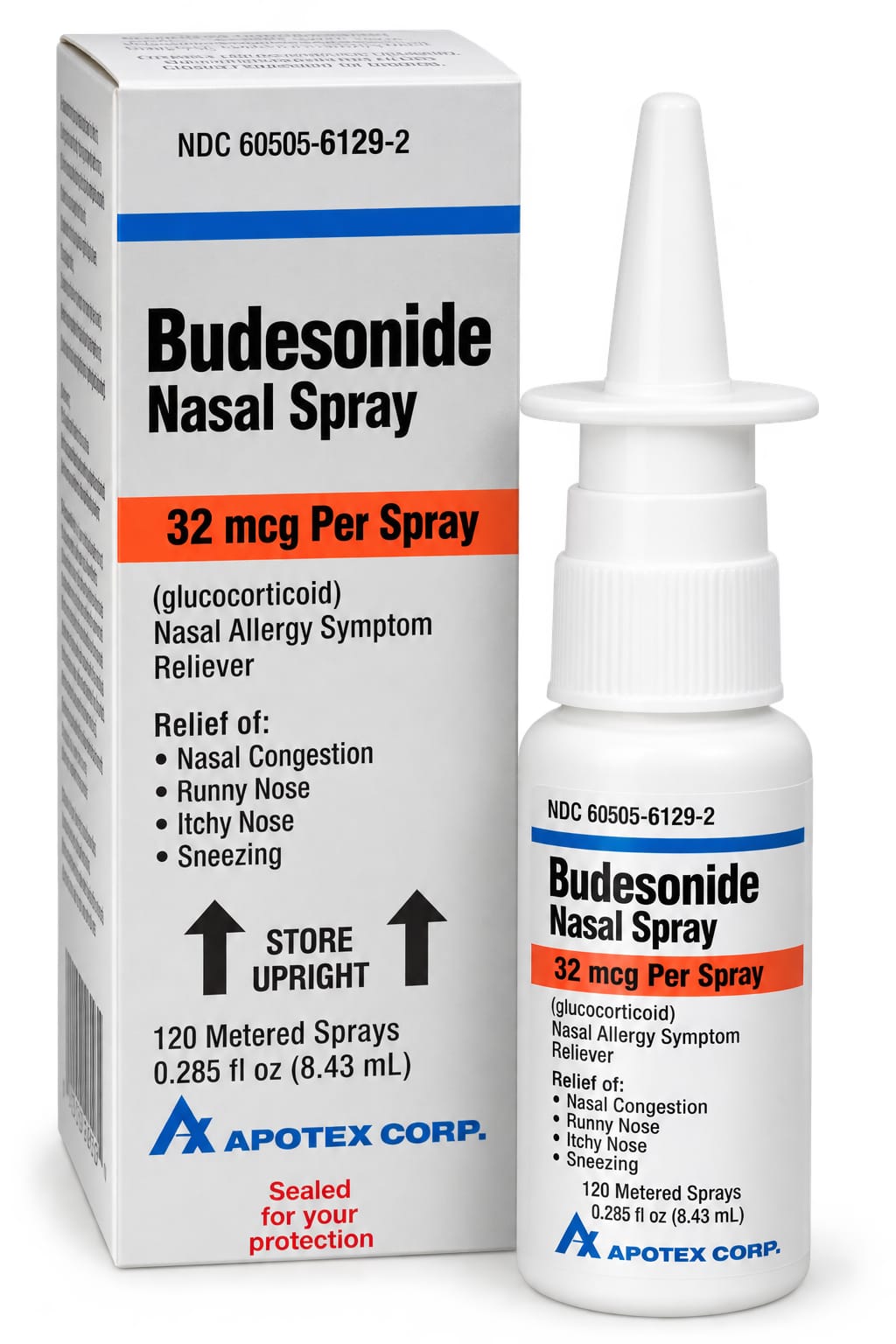
Quick overview
Budesonide Nasal Spray is a corticosteroid medicine, available by prescription and in some forms over the counter, used to relieve sneezing and a runny, stuffy, or itchy nose caused by hay fever or other allergies. It works by calming inflammation inside the nose and may also help reduce nasal polyps. It should be used regularly and on a consistent schedule, following your doctor's or the product label's dosing instructions.
What is Budesonide Nasal Spray
Budesonide nasal spray is a steroid medicine sprayed into the nose. It is available by prescription and, in some forms, over the counter. It comes as a liquid suspension in a spray bottle.
Budesonide Nasal Spray uses
- Relieves sneezing, and a runny, stuffy, or itchy nose caused by hay fever or other allergies (such as allergies to pollen, mold, dust, or pets)
- Treats nasal symptoms of seasonal or year-round (perennial) allergic rhinitis
- May help reduce nasal polyps (growths inside the nose) and improve breathing
- Should not be used to treat symptoms caused by the common cold
Benefits of Budesonide Nasal Spray
- Reduces sneezing, runny nose, stuffy nose, and itching from allergies
- Controls allergy symptoms, though it does not cure the underlying allergy
- Symptoms may start to improve 1 to 2 days after starting use, with full benefit in up to 2 weeks
- Provides 24-hour allergy symptom relief
- Reduces inflammation inside the nose
How Budesonide Nasal Spray works
This medicine is a corticosteroid. It works by calming inflammation and blocking the release of certain natural substances in the body that cause allergy symptoms, which reduces swelling and irritation in the nose.
Budesonide Nasal Spray dosage
Use this medicine only in the nose. Do not swallow it and avoid getting it in your eyes or mouth. Shake the bottle gently before each use.
Before using it the first time, or if you haven't used it for 2 or more days in a row, you need to prime the pump by pressing it a set number of times until a fine spray appears. If you haven't used the spray for more than 14 days, rinse the tip and prime it again.
Blow your nose to clear your nostrils before spraying. Close one nostril, tilt your head slightly forward, and spray into the other nostril while breathing in gently. Avoid blowing your nose for about 15 minutes after using the spray. Wipe the tip clean with a tissue and replace the cap after use.
Use this medicine regularly and on a consistent schedule for it to work well, not just when symptoms appear. An adult should help children younger than 12 years old use this nasal spray. Children younger than 6 years old should not use this medicine.
Adults usually start with a higher dose that is decreased once symptoms improve, while children usually start with a lower dose that may be increased if symptoms don't improve. Keep track of the number of sprays used from each bottle, since the medicine amount in later sprays may not be accurate once the labeled number of sprays has been reached. Do not share your bottle of nasal spray with anyone else, even if they have similar symptoms, because this can spread germs.
Call your doctor if your symptoms do not improve, or get worse, after using the spray daily for two weeks.
| Age group | Dose |
|---|---|
| Under 6 years | Do not use; safety and effectiveness are not established for standard OTC use |
| 6–11 years | Start with 1 spray in each nostril once daily = 64 mcg/day; if needed, may increase to 2 sprays in each nostril once daily = 128 mcg/day |
| 12–17 years | Usually 1–2 sprays in each nostril once daily = 64–128 mcg/day for OTC products |
| 18–64 years | Usually 2 sprays in each nostril once daily = 128 mcg/day; reduce to 1 spray per nostril daily once symptoms improve |
Available forms and strengths
- Nasal spray (suspension)
Side effects of Budesonide Nasal Spray
Common
- Nosebleeds
- Sore throat or throat infections
- Dryness, stinging, burning, or irritation in the nose
- Tiredness or weakness
- Nausea or vomiting
- Joint or muscle pain
- Cough
- Unpleasant taste or smell
Serious
- Signs of a severe allergic reaction: breathing problems or wheezing, racing heart, fever, swollen lymph nodes, swelling of the face, lips, mouth, tongue, or throat, trouble swallowing or throat tightness, itching, rash, or hives, dizziness or fainting, stomach cramps, joint pain
- Severe or frequent nosebleeds, or sores inside the nose (nasal ulceration), or a hole in the nasal cartilage (nasal septal perforation)
- A whistling sound when breathing through the nose
- White patches or pain when swallowing, which may mean a fungal (yeast) infection in the nose or throat
- Changes in vision, which could signal glaucoma or cataracts
- Signs of infection, such as fever, chills, or sore throat
- Slowed growth in children and teens who use this medicine long-term
- Signs of adrenal gland problems: darkening of the skin, diarrhea, dizziness, fainting, loss of appetite, depression, nausea, skin rash, unusual tiredness or weakness, or weight loss
Warnings and precautions
- Do not use this medicine if you have recently had nose surgery, a nose injury, or sores in your nose, since it may slow healing of these conditions.
- This medicine can cause serious allergic reactions, including anaphylaxis, hives, rash, and swelling.
- This medicine can weaken your immune system, making infections worse or harder to fight off, including chickenpox, measles, and tuberculosis.
- Using too much of this medicine, or using it for a long time, can affect your adrenal glands' ability to make natural steroid hormones.
- This medicine may slow growth in children and teenagers who use it long-term. Growth should be checked regularly.
- Long-term use may raise the risk of eye problems like glaucoma and cataracts.
- Do not use this medicine if you are allergic to budesonide or any of its ingredients.
- Children younger than 6 years old should not use this medicine, since its safety and effectiveness haven't been established in this age group.
- It isn't known for certain whether this medicine can harm an unborn baby. Studies suggest the chance of harm is low, but you should use it during pregnancy only if your doctor says it's clearly needed. Tell your doctor if you are pregnant or plan to become pregnant.
- This medicine passes into breast milk in small amounts. Talk to your doctor about the benefits and risks before using it while breastfeeding; using the lowest effective dose and spraying right after breastfeeding may lower how much the baby is exposed to.
- No routine renal dose adjustment is generally required.
- People with liver disease should use this medicine with caution, since the liver clears the drug from the body and liver problems may cause it to build up.
- It isn't known whether drinking alcohol affects this medicine.
- Budesonide nasal spray normally does not impair driving.
Storage
- Store at room temperature, between 68°F and 77°F (20°C and 25°C)
- Can be exposed to temperatures between 59°F and 86°F (15°C and 30°C) for shorter periods, such as during travel
- Store in a cool, dry place, away from light
- Do not store in the bathroom
- Do not freeze
- Keep the container tightly closed and out of the reach of children
- Throw away the bottle after using the labeled number of sprays, even if some liquid remains
- Dispose of unneeded medication through a medicine take-back program rather than throwing it in household trash or flushing it down the toilet
When to see a doctor
- Stop using this medicine and get medical help right away if you notice signs of a severe allergic reaction, such as trouble breathing, wheezing, swelling of the face, lips, mouth, tongue, or throat, trouble swallowing, hives, or a rash.
- Call your doctor right away if you have severe or frequent nosebleeds, sores in your nose, or a whistling sound when you breathe.
- Tell your doctor right away if you notice white patches in your mouth, throat, or nose, or pain when eating or swallowing, as this may be a fungal infection.
- Get medical help right away if you have symptoms of infection such as fever, chills, or sore throat, especially if you've been near someone with chickenpox or measles.
- Check with your doctor right away if you notice blurred vision, difficulty reading, or any other changes in your vision.
- Talk to your doctor if you or your child have signs of adrenal gland problems, such as unusual tiredness, nausea, dizziness, fainting, or weight loss.
- If you think you or someone else has used too much of this medicine, get medical help right away or contact a poison control center.
Alternatives
- Fluticasone nasal spray
- Mometasone nasal spray
- Triamcinolone nasal spray
- Beclomethasone nasal spray
Watch the video
FAQs
How long does it take for Budesonide Nasal Spray to work?
Symptoms may start to improve 1 to 2 days after starting use, with full benefit in up to 2 weeks, and it provides 24-hour allergy symptom relief.
Can children use Budesonide Nasal Spray?
Children younger than 6 years old should not use this medicine. Children 6 to 11 years old can start with 1 spray in each nostril once daily, and an adult should help children younger than 12 use the spray.
Can Budesonide Nasal Spray be used for a common cold?
No, it should not be used to treat symptoms caused by the common cold. It is meant for sneezing and runny, stuffy, or itchy nose caused by hay fever or other allergies.
What should I do if my symptoms don't improve with Budesonide Nasal Spray?
Call your doctor if your symptoms do not improve, or get worse, after using the spray daily for two weeks.
What are the serious side effects of Budesonide Nasal Spray?
Serious side effects include severe allergic reactions, severe or frequent nosebleeds, nasal ulceration or septal perforation, whistling nasal breathing, fungal infections, vision changes like glaucoma or cataracts, slowed growth in children, and adrenal gland problems.
General information, not medical advice
Your prescriber and the leaflet in your pack know your situation. This page does not.
- Follow your prescriber and the leaflet
- Don't start, stop, or change a dose on your own
- Doses and warnings differ by country and product
Sources
Video
Related medicines
Fludrocortisone Tablet: Uses, Dosage, Side Effects, Precautions and Alternates
corticosteroid
Fludrocortisone Tablet helps treat Addison's disease and salt-losing adrenogenital syndrome by helping the body retain sodium and water. Learn uses, dosage,
Anusol-HC Suppository: Uses, Dosage, Side Effects, Precautions and Alternates
Corticosteroid
Anusol-HC Suppository is a short-term steroid treatment for hemorrhoid itching, swelling, and irritation. Learn uses, dosage, side effects, and warnings.