
Safety
General information, not medical advice
Your prescriber and the leaflet in your pack know your situation. This page does not.
- Follow your prescriber and the leaflet
- Don't start, stop, or change a dose on your own
- Doses and warnings differ by country and product
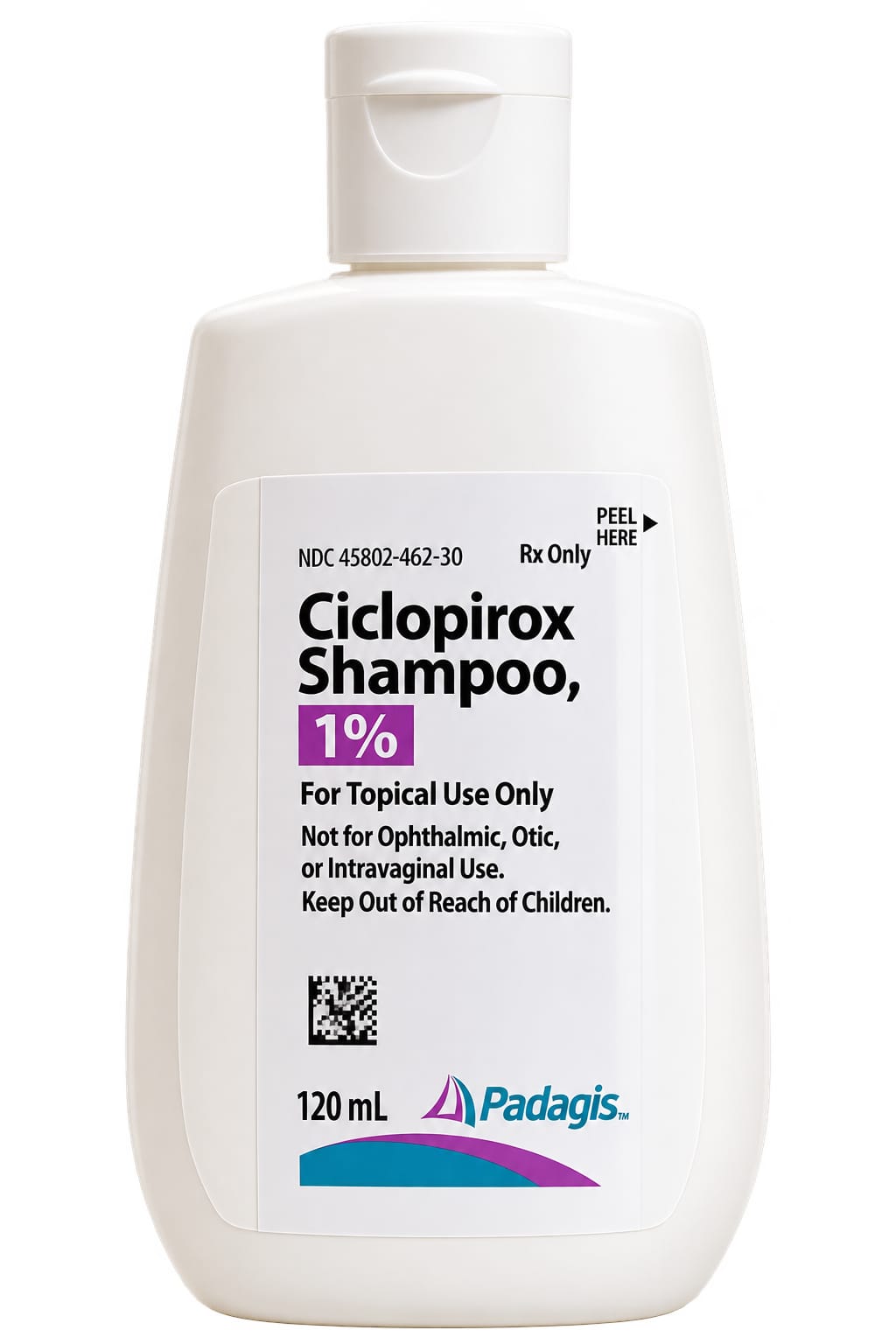
Ciclopirox Shampoo: Uses, Dosage, Side Effects, Precautions and Alternates

| Generic name | ciclopirox |
|---|---|
| Drug class | topical antifungal |
| Forms | Shampoo (1%), Cream (0.77%), Gel (0.77%), Suspension/lotion (0.77%) |
Quick overview
Ciclopirox shampoo is a prescription topical antifungal medicine used on the scalp to treat seborrheic dermatitis, a condition that causes itching, redness, and flaking. It is applied twice weekly and left on the scalp for 3 minutes before rinsing, typically for a 4-week course. Common side effects include scalp itching, burning, and redness, and it has limited absorption into the body when used correctly.
What is Ciclopirox Shampoo
Ciclopirox shampoo is a prescription antifungal medicine used on the scalp to treat seborrheic dermatitis, a skin condition that causes itching, redness, and flaking.
Ciclopirox Shampoo uses
- Treats seborrheic dermatitis of the scalp
- Reduces scalp flaking
- Helps reduce itching
- Helps control fungal involvement associated with dandruff/seborrheic dermatitis
Benefits of Ciclopirox Shampoo
- Provides topical antifungal treatment
- Requires treatment only twice weekly
- Helps reduce scalp irritation and scaling
- Has limited systemic exposure when used correctly
How Ciclopirox Shampoo works
Ciclopirox is an antifungal medicine. It works by binding to certain metals the fungus needs, which blocks enzymes that help protect the fungus, though it's not fully known why this helps with seborrheic dermatitis specifically.
Ciclopirox Shampoo dosage
Use only on the scalp. Do not use in the eyes, mouth, or vagina, and do not swallow it.
Wet your hair before applying the shampoo. Lather the shampoo into your hair and scalp and leave it on for 3 minutes before rinsing; a timer may help.
Wash with this shampoo twice a week, with at least 3 days between each use. Continue using the shampoo for the full 4-week treatment time even if your symptoms improve.
Tell your doctor if your scalp condition has not improved after 4 weeks of use.
If you miss a dose, use it as soon as you remember, but skip it if it is almost time for your next dose — do not double up.
This shampoo has not been studied in people younger than 16 years old.
| Age group | Dose |
|---|---|
| Under 16 years | Safety and effectiveness are not established |
| 18–39 years | Apply about 5 mL (1 teaspoon) to the wet scalp twice weekly for 4 weeks |
| 40–64 years | 5 mL twice weekly for 4 weeks |
Available forms and strengths
- Shampoo (1%)
- Cream (0.77%)
- Gel (0.77%)
- Suspension/lotion (0.77%)
Side effects of Ciclopirox Shampoo
Common
- Itching of the scalp
- Burning of the scalp
- Redness of the scalp
Serious
- Signs of increased irritation such as redness, itching, burning, blistering, swelling, or oozing at the application site
- Hair discoloration, especially in people with lighter hair color
- Changes in hair texture or hair loss (reported after the medicine became available, though it's not confirmed the shampoo caused this)
- Signs of a severe allergic reaction, such as breathing problems or wheezing, a racing heart, fever, swollen lymph nodes, swelling of the face, lips, mouth, tongue, or throat, trouble swallowing, hives, nausea or vomiting, dizziness or fainting, stomach cramps, or joint pain
Warnings and precautions
- If you notice signs of irritation or a sensitivity reaction, stop using this shampoo and contact your doctor.
- Avoid getting this shampoo in your eyes. If it does get in your eyes, rinse them well with water right away.
- This shampoo can change hair color, particularly in people with lighter-colored hair.
- This medicine has not been tested in children under 16 years old, so its safety and effectiveness in that age group are not known.
- It isn't known if this shampoo is safe for an unborn baby. Tell your doctor if you are pregnant or plan to become pregnant, so you can discuss whether the benefits outweigh the possible risks.
- It isn't known if this medicine passes into breast milk, so caution is advised if you are breastfeeding.
- No routine kidney-specific dose adjustment is required for topical shampoo.
- No routine liver-specific adjustment is generally required.
- It isn't known if alcohol affects this medicine, but heavy drinking can weaken your immune system and make it harder for your body to fight infections.
- Ciclopirox shampoo does not usually affect driving.
Storage
- Store ciclopirox shampoo at room temperature, between 59°F to 86°F (15°C to 30°C).
- Safely throw away any unused ciclopirox shampoo after you finish your treatment.
- Keep ciclopirox shampoo and all medicines out of the reach of children.
When to see a doctor
- Tell your doctor if the treated area becomes more irritated, with increased redness, itching, burning, blistering, swelling, or oozing.
- Contact your doctor if your scalp condition has not improved after using the shampoo for the full 4-week course.
- Stop using ciclopirox and get medical help right away if you notice signs of a serious allergic reaction, such as breathing problems, swelling of the face or throat, or a fast heartbeat.
- If you or someone else uses too much of this medicine, get medical help right away or contact a poison control center.
Alternatives
- Zinc pyrithione shampoo
- Selenium sulfide shampoo
- Ketoconazole shampoo
Watch the video
FAQs
How often should I use Ciclopirox Shampoo?
Use it twice a week, with at least 3 days between applications, for a full 4-week treatment course.
How long should I leave Ciclopirox Shampoo on my scalp?
Lather it into wet hair and scalp and leave it on for 3 minutes before rinsing; a timer may help.
What are the common side effects of Ciclopirox Shampoo?
Common side effects include itching, burning, and redness of the scalp.
Can Ciclopirox Shampoo change hair color?
Yes, it can change hair color, particularly in people with lighter-colored hair.
What should I do if my scalp condition doesn't improve?
Tell your doctor if your scalp condition has not improved after using the shampoo for the full 4-week course.
General information, not medical advice
Your prescriber and the leaflet in your pack know your situation. This page does not.
- Follow your prescriber and the leaflet
- Don't start, stop, or change a dose on your own
- Doses and warnings differ by country and product
Sources
Video
Related medicines

Naftifine Cream: Uses, Dosage, Side Effects, Precautions and Alternates
Topical antifungal
Naftifine Cream is a prescription antifungal that treats athlete's foot, jock itch, and ringworm. Learn how it works, dosage tips, side effects, and warnings.

Loprox Cream: Uses, Dosage, Side Effects, Precautions and Alternates
Topical antifungal
Loprox Cream (ciclopirox) is a prescription antifungal used for athlete's foot, jock itch, ringworm, and tinea versicolor. Learn dosage, uses, and side effects.