
Safety
General information, not medical advice
Your prescriber and the leaflet in your pack know your situation. This page does not.
- Follow your prescriber and the leaflet
- Don't start, stop, or change a dose on your own
- Doses and warnings differ by country and product
Dextromethorphan Syrup: Uses, Dosage, Side Effects, Precautions and Alternates
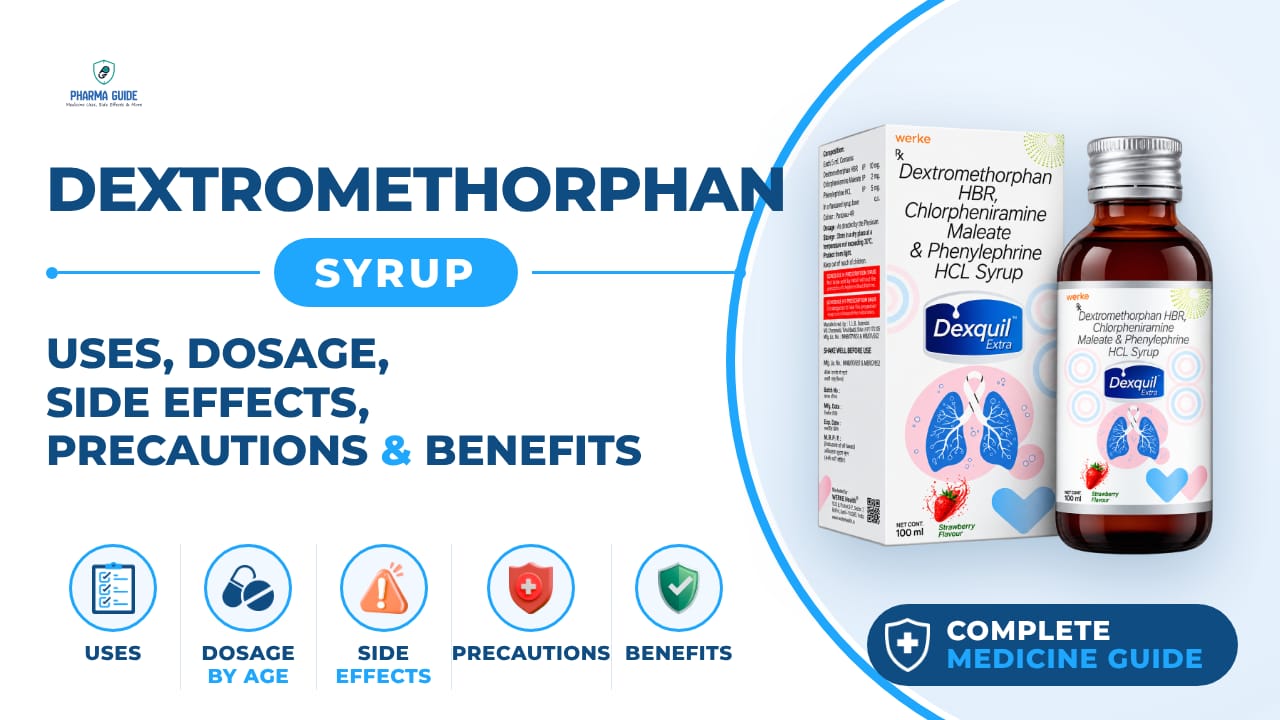
| Generic name | Dextromethorphan (dextromethorphan hydrobromide) |
|---|---|
| Drug class | Antitussive (cough suppressant) |
| Forms | Liquid-filled capsule, Chewable tablet, Dissolving strip, Solution (liquid), Extended-release (long-acting) suspension, Lozenge, Oral solution |
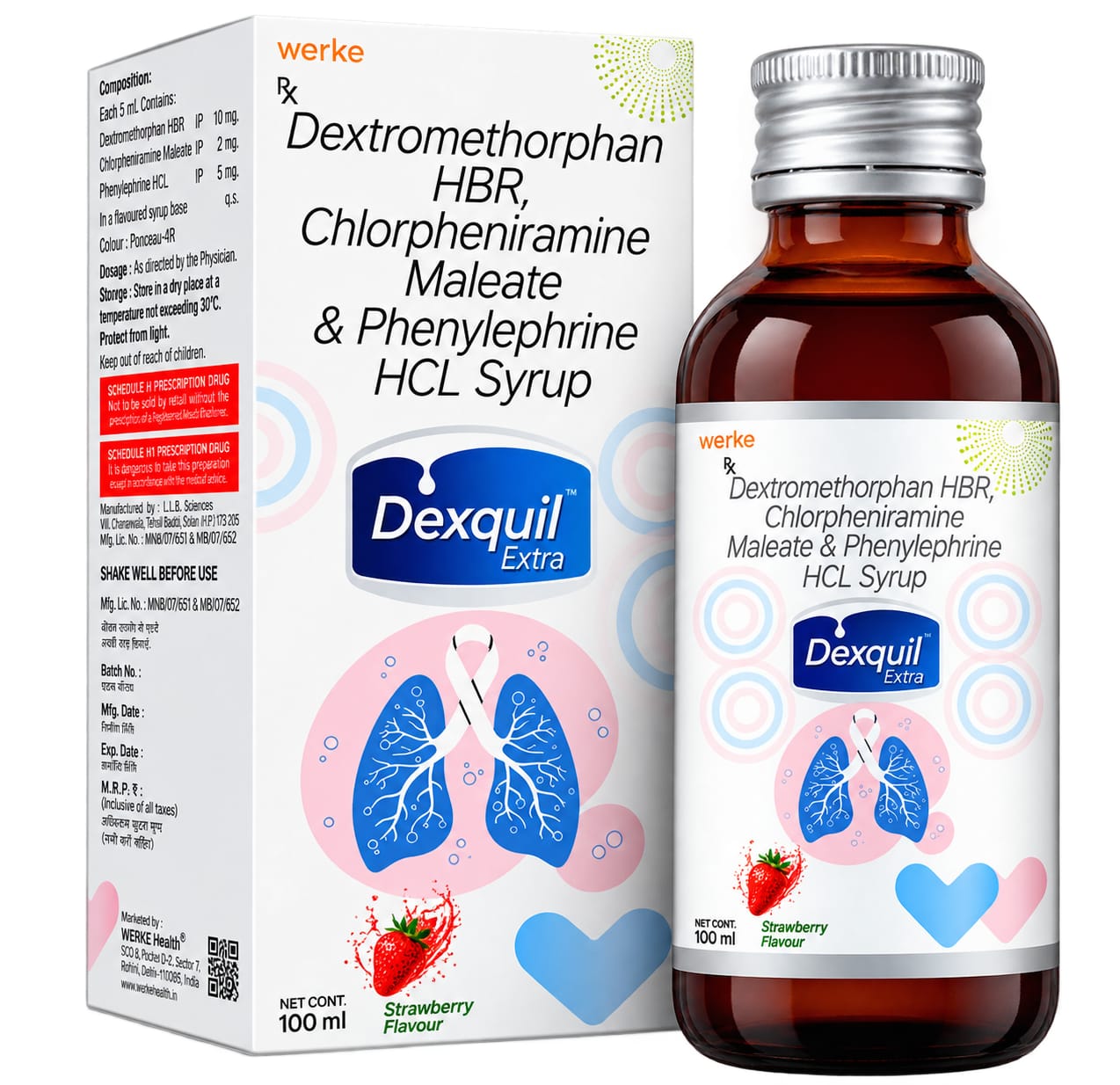
Quick overview
Dextromethorphan Syrup is an over-the-counter antitussive (cough suppressant) containing dextromethorphan hydrobromide. It is used to temporarily relieve cough caused by the common cold, flu, bronchitis, sinusitis, or other minor throat and bronchial irritation. It works on the brain to reduce the cough reflex without the sedative effects typically associated with opioid medicines. It is generally used in patients aged 4 years and older, following specific product labeling and age guidance.
What is Dextromethorphan Syrup
Dextromethorphan is an over-the-counter medicine used to relieve cough. It is a synthetic morphine-derived compound that acts on the brain to reduce coughing without the sedative effects of opioids.
Dextromethorphan Syrup uses
- Temporarily relieves cough caused by the common cold, the flu, or other minor throat and bronchial irritation
- Suppresses dry, hacking, non-productive coughs
- Used for symptoms associated with the common cold, bronchitis, and sinusitis
- Helps reduce coughing fits, allowing for better sleep and rest
- Can be used in patients aged 4 years and older (check specific product labeling for age limits)
Benefits of Dextromethorphan Syrup
- Provides temporary relief from coughing so you can rest more comfortably
- Does not usually cause the drowsiness associated with some other cough treatments when used as directed
How Dextromethorphan Syrup works
Dextromethorphan works by reducing activity in the part of the brain that controls the cough reflex, which lowers the urge to cough.
Dextromethorphan Syrup dosage
Take by mouth following the directions on the package or prescription label carefully. It is usually taken as needed, with dosing spaced apart through the day as directed on the label. Do not take more than the recommended amount in a 24-hour period.
If using the liquid, measure your dose with the measuring spoon or cup provided, not a household spoon. If using an extended-release suspension, shake the bottle well before each use to mix the medication evenly. If using dissolving strips, place on the tongue and swallow after they melt. If using chewable tablets, they can be allowed to melt in the mouth or chewed before swallowing. If using lozenges, allow them to slowly melt in the mouth.
Check cough and cold product labels carefully before using two or more products together, since they may contain the same ingredient and cause an overdose. Do not give adult products to children; check the package label to be sure the product is right for a child's age. Use caution with children age 4 to 11, following package directions carefully; do not give to children younger than 4 years of age.
If you experience nausea during the day, taking your dose with food or milk may help ease that side effect. Stop taking this medicine and contact your doctor if your cough does not improve within 5 to 7 days, if it goes away and comes back, or if it occurs with fever, rash, or headache.
| Age group | Dose |
|---|---|
| Under 4 years | Do not use OTC unless specifically directed by a doctor |
| 4–5 years | 7.5 mg every 6–8 hours when medically directed |
| 6–11 years | 5–10 mg every 4 hours or 15 mg every 6–8 hours; max 60 mg/day |
| 12–17 years | 10–20 mg every 4 hours or 30 mg every 6–8 hours; max 120 mg/day |
| 18–64 years | Same adult dose: 10–20 mg every 4 hours or 30 mg every 6–8 hours; max 120 mg/day |
Available forms and strengths
- Liquid-filled capsule
- Chewable tablet
- Dissolving strip
- Solution (liquid)
- Extended-release (long-acting) suspension
- Lozenge
- Oral solution
Side effects of Dextromethorphan Syrup
Common
- Dizziness
- Lightheadedness
- Drowsiness
- Nervousness
- Restlessness
- Nausea
- Vomiting
- Stomach pain
- Constipation or gastrointestinal disturbance
- Dry mouth
- Difficulty urinating
- Confusion or disorientation
Serious
- Rash or allergic skin reactions
- Severe allergic reaction with swelling or trouble breathing
- Hallucinations (seeing or hearing things that are not real)
- Seizures or convulsions
- Fast heartbeat
- Difficulty breathing
- Changes in vision
- Unsteadiness or coordination problems
- Coma (loss of consciousness)
- Psychosis with visual hallucinations
- Serotonin syndrome (mental status changes such as agitation, hallucinations, or coma, along with fever, fast heart rate, unstable blood pressure, muscle rigidity, or gastrointestinal symptoms) when combined with certain medicines
Warnings and precautions
- Do not take dextromethorphan if you are taking or have recently taken (within about 2 weeks) a monoamine oxidase inhibitor (MAOI), as this combination can be dangerous.
- Nonprescription cough and cold products containing dextromethorphan can cause serious side effects or death in young children and should not be given to children younger than 4 years old.
- Taking large amounts of dextromethorphan can cause serious side effects or death, so never exceed the recommended dose.
- This medicine can cause dependence, so treatment should only be used for a short time.
- Do not use this medicine if you have a cough that produces mucus (a productive cough), severe breathing problems, or asthma, without talking to a doctor first.
- There is a risk of misuse and dependence with this medicine because of how it acts in the brain, even though it is not a controlled substance.
- Tell your doctor if you are pregnant or plan to become pregnant. Some sources state this medicine is not recommended during pregnancy as a precaution.
- Dextromethorphan passes into breast milk, so it is not recommended for breastfeeding women.
- People with kidney problems may need a reduced starting dose, since this can affect how the drug is cleared from the body.
- People with liver problems may need a reduced starting dose, since dextromethorphan is processed by the liver.
- Avoid drinking alcohol while taking this medicine, as it can increase drowsiness and other side effects.
- This medicine can cause drowsiness and dizziness, so be careful when driving or using machinery until you know how it affects you.
Storage
- Keep this medication in the container it came in, tightly closed, and out of reach of children
- Store it at room temperature and away from excess heat and moisture (not in the bathroom)
- Do not flush this medication down the toilet; use a medicine take-back program instead
- Keep all medication out of sight and reach of children, and always lock safety caps
- This medicinal product does not require any special storage conditions; store it in the original package
- Do not use after the expiry date stated on the bottle label and carton
- Do not take the oral solution if it becomes turbid (cloudy)
- Do not throw away any medicines via wastewater or household waste; ask your pharmacist how to dispose of medicines you no longer use
When to see a doctor
- Stop taking this medicine and call your doctor if your cough does not get better within about a week, if it goes away and comes back, or if it happens along with fever, rash, or headache.
- Call your doctor right away if you develop a rash while taking this medicine.
- If someone has taken too much of this medicine and has collapsed, had a seizure, is having trouble breathing, or cannot be woken up, get emergency medical help immediately.
- If you think someone has taken an overdose, contact your local poison control center or seek emergency medical care right away.
- Get emergency help right away for a severe allergic reaction, such as swelling or trouble breathing.
- Contact your doctor or hospital right away if you take more than the recommended amount and experience symptoms like severe vomiting, confusion, rapid heartbeat, hallucinations, or coordination problems.
- Talk to a doctor if you do not feel better, or if you feel worse, after 5 days of treatment.
Alternatives
- Honey (for patients over 1 year)
- Benzonatate
- Diphenhydramine
- Guaifenesin
- Bromhexine
Watch the video
FAQs
What is Dextromethorphan Syrup used for?
It temporarily relieves cough caused by the common cold, flu, bronchitis, sinusitis, or other minor throat and bronchial irritation, and suppresses dry, hacking, non-productive coughs.
What is the dosage of Dextromethorphan Syrup for children?
Children aged 4–5 years may take 7.5 mg every 6–8 hours when medically directed, while children 6–11 years may take 5–10 mg every 4 hours or 15 mg every 6–8 hours, with a maximum of 60 mg per day.
What is the adult dosage of Dextromethorphan Syrup?
Adults aged 18–64 years typically take 10–20 mg every 4 hours or 30 mg every 6–8 hours, not exceeding 120 mg per day.
What are the side effects of Dextromethorphan Syrup?
Common side effects include dizziness, drowsiness, nausea, vomiting, stomach pain, and dry mouth, while serious effects include hallucinations, seizures, fast heartbeat, and serotonin syndrome when combined with certain medicines.
When should I see a doctor while taking Dextromethorphan Syrup?
See a doctor if your cough does not improve within 5 to 7 days, returns after going away, or occurs with fever, rash, or headache, or seek emergency help for signs of overdose or severe allergic reaction.
General information, not medical advice
Your prescriber and the leaflet in your pack know your situation. This page does not.
- Follow your prescriber and the leaflet
- Don't start, stop, or change a dose on your own
- Doses and warnings differ by country and product
Sources
- https://medlineplus.gov/druginfo/meds/a682492.html
- https://healthwire.pk/pharmacy/medicine/dextromethorphan-syp
- file:///C:/Users/thede/Downloads/PIL_MA865%2001201.pdf
Video
Related medicines

Delsym Syrup: Uses, Dosage, Side Effects, Precautions and Alternates
Antitussive (cough suppressant)
Delsym Syrup is an OTC cough suppressant with dextromethorphan that relieves dry coughs for up to 12 hours. Learn dosage, side effects, and warnings.

Injectafer Injection: Uses, Dosage, Side Effects, Precautions and Alternates
Iron products
Injectafer (ferric carboxymaltose) treats iron deficiency anemia and heart failure-related iron deficiency via IV. Learn uses, dosage, side effects, and