
Safety
General information, not medical advice
Your prescriber and the leaflet in your pack know your situation. This page does not.
- Follow your prescriber and the leaflet
- Don't start, stop, or change a dose on your own
- Doses and warnings differ by country and product
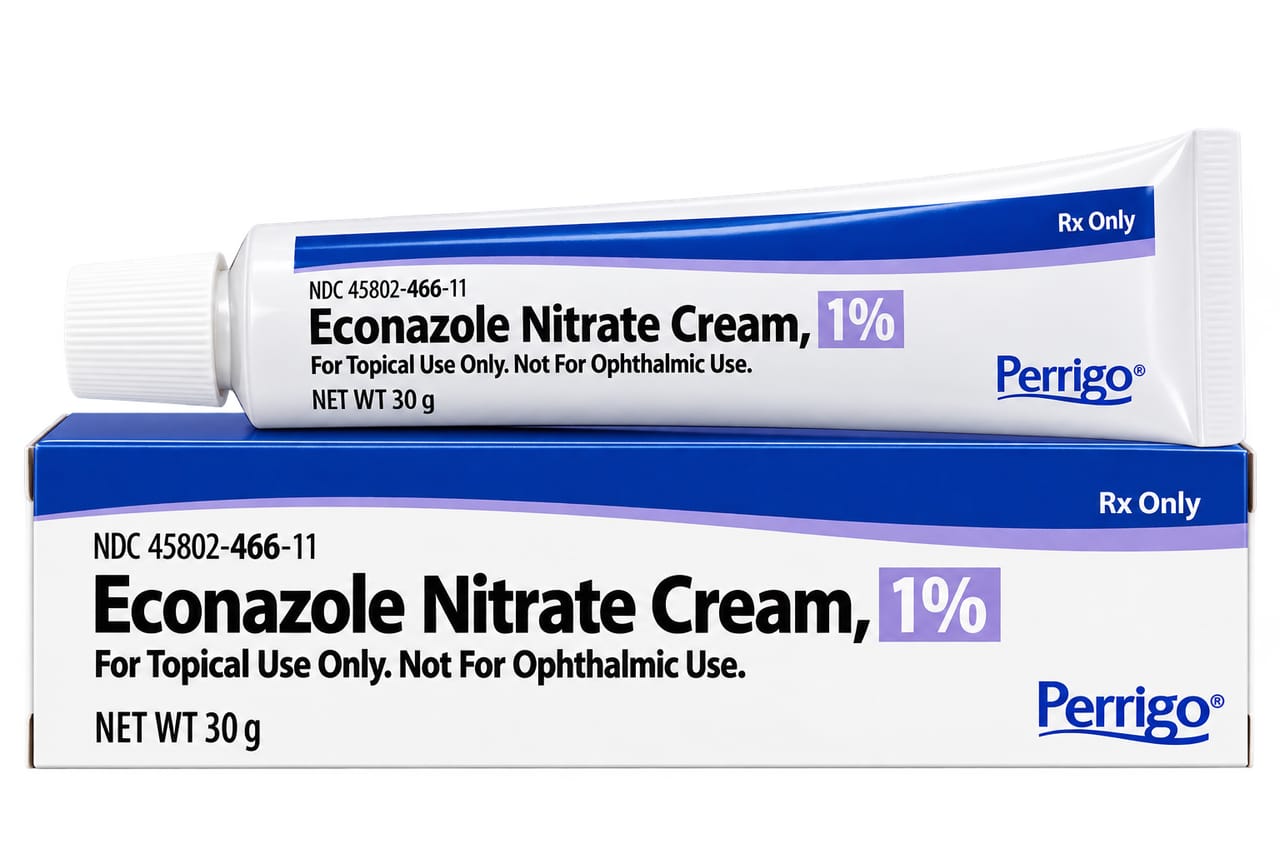
Econazole Cream: Uses, Dosage, Side Effects, Precautions and Alternates

| Generic name | econazole nitrate |
|---|---|
| Drug class | topical antifungal |
| Forms | Cream (1%), Foam (1%, for athlete's foot) |
Quick overview
Econazole Cream (econazole nitrate) is a prescription topical antifungal applied to the skin to treat infections caused by fungus or yeast. It is not used for bacterial or viral infections. It works by damaging fungal and yeast cell membranes, and most patients see clinical improvement when the full prescribed course is completed.
What is Econazole Cream
Econazole Cream is a prescription antifungal cream applied to the skin. It treats infections caused by fungus or yeast and is not used for bacterial or viral infections.
Econazole Cream uses
- Athlete's foot (tinea pedis)
- Jock itch (tinea cruris)
- Ringworm of the body (tinea corporis)
- Cutaneous candidiasis (a skin yeast infection)
- Tinea versicolor (a yeast infection causing discolored skin patches)
Benefits of Econazole Cream
- Most patients experience early relief of symptoms, and clinical improvement may be seen fairly soon after treatment is begun
- Clinical studies show high clearance rates (around 90%) when used for the full prescribed course
- Acts directly against fungal organisms
- Provides localized treatment
- Usually has low systemic absorption
How Econazole Cream works
Econazole stops fungi and yeast from growing by damaging their cell membranes and blocking the production of a substance (ergosterol) the cell membrane needs, which changes how the membrane works.
Econazole Cream dosage
Apply to the skin only; do not use in or near the eyes, nose, mouth, or vagina, and do not swallow it. Wash your hands before and after applying the cream (if treating your hands, wash only before use). Thoroughly clean the infected area and let it dry, then gently rub in the cream until most of it disappears, covering just the affected area.
For most infections the cream is applied once a day; for cutaneous candidiasis it is applied twice a day, morning and evening. Continue using the cream for the full course of treatment even if your symptoms improve; do not stop early without talking to your doctor. If you miss a dose, apply it as soon as you remember, but if it is almost time for your next dose, skip the missed one and do not double up.
Do not apply cosmetics, lotions, or other skin medications to the treated area unless your doctor tells you to. Treatment is usually continued for about two weeks for candidiasis, jock itch, and ringworm, and about one month (up to six weeks in some cases) for athlete's foot. Children: use and dosing for the cream must be determined by a doctor, since safety and effectiveness have not been established in children.
| Age group | Dose |
|---|---|
| Under 12 years | No standard age-specific dose is established |
| 12–17 years | Apply a thin layer to the affected skin once or twice daily |
| 18–64 years | Apply a thin layer once or twice daily to the affected area and surrounding skin |
Available forms and strengths
- Cream (1%)
- Foam (1%, for athlete's foot)
Side effects of Econazole Cream
Common
- Burning
- Itching
- Stinging
- Redness
- Rash
- Skin irritation
- Dryness, peeling, or crusting of treated skin
Serious
- Severe allergic reaction symptoms such as breathing problems or wheezing, racing heart, fever, swollen lymph nodes, swelling of the face, lips, mouth, tongue, or throat, trouble swallowing, hives, dizziness, or fainting
- Significant blistering or oozing at the application site
Warnings and precautions
- This cream is for use on the skin only and should not be used in or near the eyes.
- If you have a reaction that suggests sensitivity or chemical irritation, stop using the cream.
- Do not use this medicine for a skin problem that hasn't been checked by your doctor, and let your doctor know if the problem doesn't improve or gets worse.
- Tell your doctor if you are taking warfarin (a blood thinner), as this medicine may interact with it.
- It isn't fully known how this medicine affects pregnancy. It should only be used in the first trimester if your doctor feels it's truly necessary, and only if clearly needed in the second and third trimesters. Tell your doctor if you are or might become pregnant.
- It isn't known if this medicine passes into breast milk in humans, so caution is advised if you are breastfeeding.
- No routine kidney adjustment is generally required because systemic absorption is minimal. No routine liver-specific adjustment is generally required.
- It isn't known whether drinking alcohol affects this medicine. Econazole cream does not normally affect driving.
Storage
- Store Econazole Nitrate 1% Cream below 86°F (30°C)
- Keep this medication in the container it came in, tightly closed, and out of reach of children
- Store it at room temperature and away from excess heat and moisture (not in the bathroom)
- Dispose of unneeded medication through a medicine take-back program rather than flushing it down the toilet
When to see a doctor
- Stop using the medicine and get medical help right away if you have signs of a serious allergic reaction, such as breathing problems, wheezing, a racing heart, fever, swollen lymph nodes, swelling of the face, lips, mouth, tongue or throat, trouble swallowing, hives, dizziness, or fainting.
- Check with your doctor right away if you develop a skin rash, burning, stinging, swelling, redness, or irritation on the skin.
- If you think you have used too much of this medicine, contact a poison control center or go to an emergency room right away.
Alternatives
- Clotrimazole cream
- Miconazole cream
- Ketoconazole cream
Watch the video
FAQs
What is Econazole Cream used for?
It treats fungal and yeast skin infections, including athlete's foot, jock itch, ringworm of the body, cutaneous candidiasis, and tinea versicolor.
How often should Econazole Cream be applied?
For most infections it is applied once a day, but for cutaneous candidiasis it is applied twice a day, morning and evening.
How long does treatment with Econazole Cream usually last?
Treatment is usually about two weeks for candidiasis, jock itch, and ringworm, and about one month (up to six weeks in some cases) for athlete's foot.
What are the common side effects of Econazole Cream?
Common side effects include burning, itching, stinging, redness, rash, skin irritation, and dryness, peeling, or crusting of treated skin.
Can Econazole Cream be used near the eyes or in children?
No, it should not be used in or near the eyes, nose, mouth, or vagina, and use in children must be determined by a doctor since safety and effectiveness haven't been established.
General information, not medical advice
Your prescriber and the leaflet in your pack know your situation. This page does not.
- Follow your prescriber and the leaflet
- Don't start, stop, or change a dose on your own
- Doses and warnings differ by country and product
Sources
Video
Related medicines

Naftifine Cream: Uses, Dosage, Side Effects, Precautions and Alternates
Topical antifungal
Naftifine Cream is a prescription antifungal that treats athlete's foot, jock itch, and ringworm. Learn how it works, dosage tips, side effects, and warnings.

Loprox Cream: Uses, Dosage, Side Effects, Precautions and Alternates
Topical antifungal
Loprox Cream (ciclopirox) is a prescription antifungal used for athlete's foot, jock itch, ringworm, and tinea versicolor. Learn dosage, uses, and side effects.