
Safety
General information, not medical advice
Your prescriber and the leaflet in your pack know your situation. This page does not.
- Follow your prescriber and the leaflet
- Don't start, stop, or change a dose on your own
- Doses and warnings differ by country and product
Goserelin Injection: Uses, Dosage, Side Effects, Precautions and Alternates
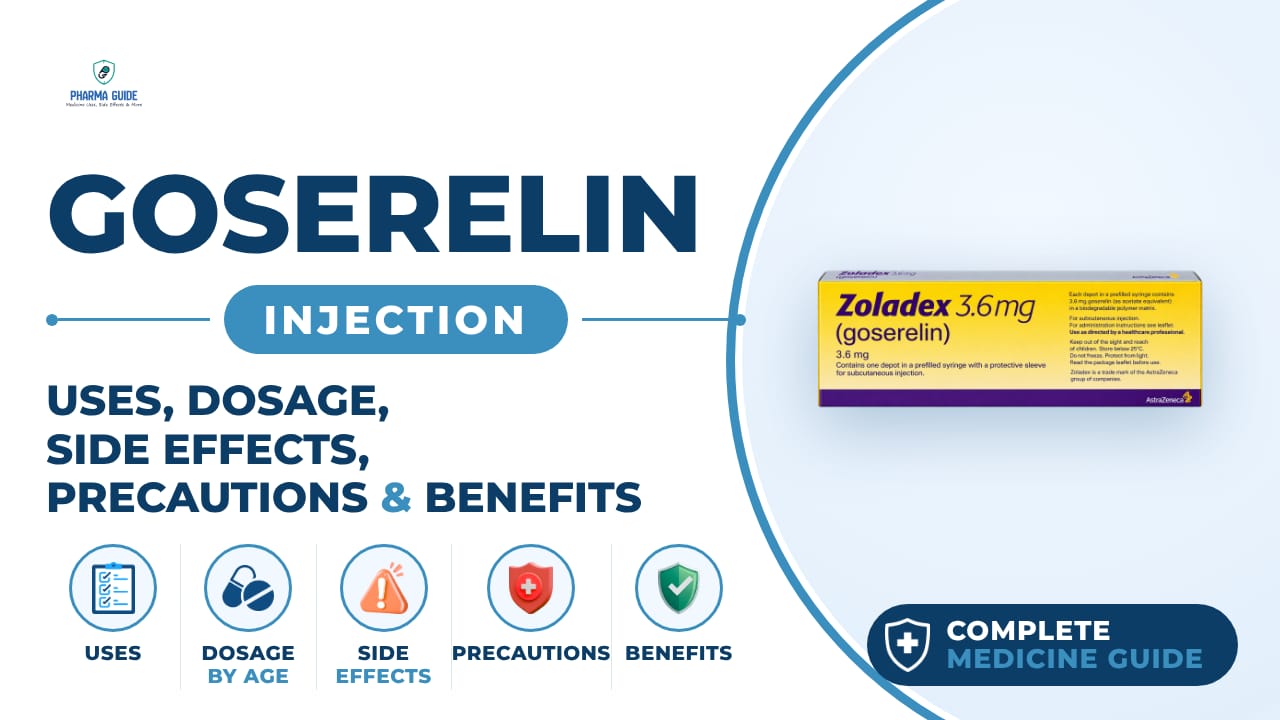
| Generic name | Goserelin acetate |
|---|---|
| Drug class | Gonadotropin Releasing Hormone (GnRH) agonist |
| Forms | Subcutaneous implant (3.6 mg) |

Quick overview
Goserelin Injection (goserelin acetate) is a GnRH agonist given as a small implant placed under the skin of the abdomen. It is used to treat certain hormone-sensitive cancers, including prostate and advanced breast cancer, as well as endometriosis and endometrial thinning before ablation. It works by lowering sex hormone levels in the body, and it must be administered by a doctor or nurse on a regular schedule.
What is Goserelin Injection
Goserelin is a hormone therapy medicine given as a small implant placed under the skin of the abdomen. It is used to treat certain hormone-sensitive cancers and some gynecological conditions by lowering certain hormone levels in the body.
Goserelin Injection uses
- Combination therapy with flutamide for locally confined prostate cancer
- Palliative treatment of advanced prostate cancer
- Management of endometriosis, including pain relief and reduction of endometrial lesions
- Endometrial-thinning before endometrial ablation for dysfunctional uterine bleeding
- Palliative treatment of advanced breast cancer in pre- and perimenopausal women
Benefits of Goserelin Injection
- Reduces pain and other symptoms of endometriosis
- Shrinks endometrial lesions during treatment
- Thins the uterine lining before ablation surgery
- Lowers testosterone to levels similar to surgical castration in men with prostate cancer
- Suppresses production of certain sex hormones
- Can help control symptoms of advanced breast cancer in certain women
How Goserelin Injection works
Goserelin is a man-made version of a natural hormone called GnRH. With regular use it turns down the pituitary gland's signals that tell the ovaries or testicles to make sex hormones. This lowers testosterone in men to levels similar to surgical removal of the testicles, and lowers estrogen in women to levels similar to menopause, which can slow hormone-sensitive tumors and reduce endometriosis symptoms.
Goserelin Injection dosage
Goserelin is given as an implant placed under the skin of the lower abdomen by a doctor or nurse; it is not a medicine you take yourself. It is administered every 4 weeks (or every 12 weeks for the long-acting form), and it's important to keep to this schedule as closely as possible.
In the first few weeks, this medicine can temporarily raise certain hormone levels and may cause a brief worsening of symptoms, so your doctor will watch you closely during this time. If you miss or need to reschedule an implant appointment, contact your healthcare provider right away to arrange a new appointment.
No special diet is needed while using this medicine unless your doctor says otherwise. No dose adjustment is needed for people with kidney or liver problems. No dose adjustment is needed for older men; this medicine has not been studied in women over 65.
| Age group | Dose |
|---|---|
| Under 18 years | No established routine pediatric dosage |
| 18–39 years | Commonly 3.6 mg subcutaneously every 28 days, depending on indication |
| 40–64 years | Commonly 3.6 mg every 28 days; some prostate-cancer regimens may use 10.8 mg every 12 weeks |
Available forms and strengths
- Subcutaneous implant (3.6 mg)
Side effects of Goserelin Injection
Common
- Hot flashes/flushes and sweating
- Headache
- Decreased sex drive (libido)
- Difficulty getting or keeping an erection
- Acne, scaly or red patches on skin, dandruff
- Decrease in breast size (in women)
- Vaginal discharge, dryness, or itching
- Swelling of hands, feet, ankles, or lower legs
- Mood changes, emotional ups and downs
- Pain, itching, swelling, or redness at the implant site
- Bone pain
- Lower urinary tract symptoms
Serious
- Signs of allergic reaction: hives, rash, itching, difficulty breathing or swallowing, swelling of the face
- Signs of spinal cord pressure: back pain, numbness, pins and needles in toes/fingers/buttocks, unsteadiness, difficulty walking, legs giving way, loss of bladder or bowel control
- Signs of a blocked urinary tube: painful or difficult urination, frequent urination
- Signs of high blood sugar: extreme thirst, dry mouth, weakness, blurred vision, nausea, vomiting, fruity-smelling breath, decreased consciousness
- Signs of heart or blood vessel problems: chest pain, shortness of breath, dizziness, pain in arms/back/neck/jaw
- Signs of stroke: slow or difficult speech, weakness or numbness of an arm or leg, confusion
- New or worsening depression
- Stomach pain or bloating
- Decreased bone density leading to higher risk of fractures
- Signs of pituitary gland problems: sudden severe headache, vomiting, vision changes, confusion
- Blood clot in the lung: chest pain and breathlessness
- Signs of liver problems: yellowing of skin or eyes
- Seeing, hearing, or feeling things that are not there (very rare)
Warnings and precautions
- This medicine is not for use in pregnant women, except for treating advanced breast cancer, because it can harm the baby and raise the chance of pregnancy loss. A pregnancy test may be required before starting treatment, and effective non-hormonal birth control must be used during treatment and for 12 weeks after it ends.
- In the first weeks of treatment, hormone levels can temporarily rise, which may briefly worsen cancer symptoms, including rare cases of urinary tube blockage or spinal cord compression. Your doctor will watch for this closely.
- This medicine can raise blood sugar or worsen diabetes control, so blood sugar should be monitored.
- High calcium levels in the blood have occurred in some people with bone-spreading cancer who take this medicine and need monitoring and treatment if they occur.
- Serious allergic reactions, including anaphylaxis, have occurred with this medicine.
- This medicine can reduce bone density over time, increasing the chance of fractures.
- Should not be started in women with unexplained abnormal vaginal bleeding or known allergy to any component of the medicine.
- It is not known if this medicine passes into human breast milk. Because of the potential for serious side effects in a nursing infant, you and your doctor should decide whether to stop breastfeeding or stop the medicine.
- No dose change is needed for people with kidney problems, based on studies of this medicine. No dose change is needed for people with moderate liver problems; there isn't enough information on use in people with severe liver disease.
- Tell your doctor if you have a history of long-term alcohol use, since this may affect your risk of bone thinning with this medicine.
- Dizziness or weakness may affect driving; avoid driving if affected.
Storage
- Store at room temperature (do not exceed 25°C [77°F])
- The implant is supplied sterile in a sealed, light- and moisture-proof foil pouch with a desiccant capsule; do not use if the pouch or syringe is damaged
- Dispose of the used syringe in an approved sharps collector
When to see a doctor
- Get medical help right away if you have signs of a serious allergic reaction, such as hives, rash, itching, or trouble breathing or swallowing.
- Seek immediate care for symptoms of a possible heart problem or stroke, such as chest pain, shortness of breath, dizziness, pain spreading to the arm/back/neck/jaw, slurred speech, weakness or numbness, or confusion.
- Contact your doctor immediately if you have difficulty or pain when urinating, which could signal a urinary blockage.
- Get medical help right away for signs of very high blood sugar, such as extreme thirst, dry mouth, weakness, blurred vision, nausea, vomiting, fruity-smelling breath, or decreased alertness.
- Call your healthcare team promptly if you notice new or worsening back pain, numbness or tingling in your toes, fingers, or buttocks, trouble walking, legs giving way, or loss of bladder or bowel control, as this can mean pressure on the spinal cord.
- Seek medical care immediately if you have chest pain and sudden breathlessness, which could be a blood clot in the lung.
- Tell your doctor right away if you think you may have become pregnant during treatment.
Alternatives
- Enzalutamide
- Apalutamide
- Darolutamide
Watch the video
FAQs
How often is Goserelin Injection given?
It is administered every 4 weeks, or every 12 weeks for the long-acting form, as an implant placed under the skin of the lower abdomen by a doctor or nurse.
What is Goserelin Injection used for?
It is used to treat prostate cancer (often with flutamide), advanced breast cancer in pre- and perimenopausal women, endometriosis, and for thinning the endometrium before ablation surgery.
How does Goserelin Injection work?
It is a man-made version of GnRH that reduces the pituitary gland's signals to the ovaries or testicles, lowering testosterone in men to castration-like levels and estrogen in women to menopause-like levels.
What are common side effects of Goserelin Injection?
Common side effects include hot flashes, headache, decreased libido, erectile difficulty, acne, mood changes, implant site reactions, bone pain, and swelling of the hands, feet, ankles, or lower legs.
Can Goserelin Injection be used during pregnancy?
It is not for use in pregnant women except for treating advanced breast cancer, since it can harm the baby; effective non-hormonal birth control is needed during treatment and for 12 weeks after.
General information, not medical advice
Your prescriber and the leaflet in your pack know your situation. This page does not.
- Follow your prescriber and the leaflet
- Don't start, stop, or change a dose on your own
- Doses and warnings differ by country and product
Sources
Video
Related medicines
Zoladex Injection: Uses, Dosage, Side Effects, Precautions and Alternates
Gonadotropin-releasing hormone (GnRH) agonist
Zoladex Injection (goserelin) is an implant used for prostate cancer, breast cancer, endometriosis, and fibroids. Learn dosage, side effects, and warnings.

Injectafer Injection: Uses, Dosage, Side Effects, Precautions and Alternates
Iron products
Injectafer (ferric carboxymaltose) treats iron deficiency anemia and heart failure-related iron deficiency via IV. Learn uses, dosage, side effects, and