
Safety
General information, not medical advice
Your prescriber and the leaflet in your pack know your situation. This page does not.
- Follow your prescriber and the leaflet
- Don't start, stop, or change a dose on your own
- Doses and warnings differ by country and product
Omeprazole Injection: Uses, Dosage, Side Effects, Precautions and Alternates

| Generic name | Omeprazole |
|---|---|
| Drug class | Proton pump inhibitor |
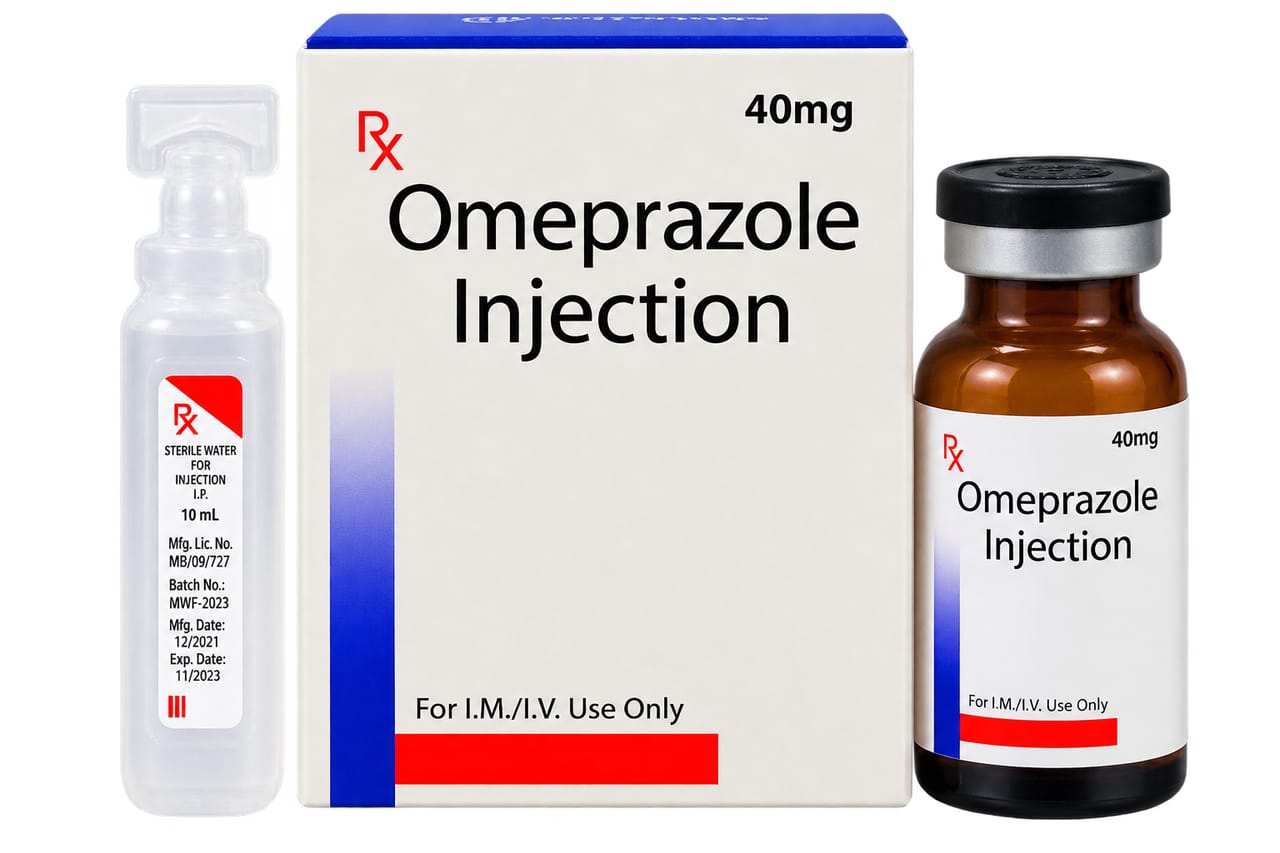
| Forms | Powder for solution for infusion (vial) |
Quick overview
Omeprazole Injection contains omeprazole, a proton pump inhibitor that reduces the amount of acid the stomach produces. It is given as an infusion into a vein when oral treatment is not possible or suitable. It is used for acid-related conditions such as stomach and duodenal ulcers, bleeding ulcers, gastroesophageal reflux disease, and Zollinger-Ellison syndrome.
What is Omeprazole Injection
Omeprazole powder for solution for infusion contains the active substance omeprazole, a proton pump inhibitor that reduces the amount of acid the stomach produces. It is given as an alternative to oral therapy when oral treatment is not possible.
Omeprazole Injection uses
- Treating conditions where the stomach makes too much acid, such as stomach and duodenal ulcers
- Treating bleeding or severe erosions caused by active gastric or duodenal ulcers
- Treating gastroesophageal reflux disease (GERD) when oral medicine is not suitable
- Treating Zollinger-Ellison syndrome
- Used as an alternative to oral omeprazole therapy, including in patients unable to take it by mouth or with damage to the esophagus
Benefits of Omeprazole Injection
- Reduces stomach acid production
- Helps accelerate healing of ulcers
- Can be used when oral treatment is not possible or ineffective
How Omeprazole Injection works
Omeprazole blocks the acid pump in the stomach, reducing how much acid it makes so that irritated or damaged tissue can heal.
Omeprazole Injection dosage
This medicine is given to you by a doctor as an infusion into one of your veins. It can be given to adults, including elderly patients. There is limited experience using it in children by this route. Once mixed for use, the solution should be used right away for safety reasons.
| Age group | Dose |
|---|---|
| Under 1 year | Specialist/doctor supervision required |
| 1–11 years | Dose determined by doctor based on indication |
| 12–17 years | 20–40 mg IV once daily for certain acid-related conditions |
| Adults | 20–40 mg IV once daily for certain indications |
Available forms and strengths
- Powder for solution for infusion (vial)
Side effects of Omeprazole Injection
Common
- Headache
- Diarrhoea
- Stomach pain
- Constipation
- Wind (flatulence)
- Benign polyps in the stomach
- Nausea or vomiting
- Pain at the injection site
- Dizziness
Serious
- Sudden wheezing, swelling of lips, tongue, throat or body, rash, fainting or difficulty swallowing (severe allergic reaction)
- Reddening of the skin with blisters or peeling, possibly with bleeding in the lips, eyes, mouth, nose and genitals (Stevens-Johnson syndrome or toxic epidermal necrolysis)
- Yellow skin, dark urine and tiredness (possible liver problems)
- Severe kidney problems (interstitial nephritis)
- Fracture of the hip, wrist or spine
- Blood problems such as reduced white cells or platelets, causing weakness, bruising, or more infections
- Low levels of sodium in the blood causing weakness, vomiting and cramps
- Feeling agitated, confused or depressed
- Suddenly feeling wheezy or short of breath (bronchospasm)
- Severe liver problems leading to liver failure and inflammation of the brain
- Changes in blood count including agranulocytosis (lack of white blood cells)
- Aggression
- Hallucinations
- Muscle weakness
- Enlarged breasts in men
- Low magnesium levels causing fatigue, involuntary muscle contractions, disorientation, convulsions, dizziness, increased heart rate
- Irreversible visual impairment reported in isolated cases of critically ill patients receiving intravenous omeprazole, especially at high doses
- Irregular heartbeat
- Increased risk of infections, especially with long-term use
Warnings and precautions
- Do not use this medicine if you are allergic to omeprazole, other proton pump inhibitors, or if you are taking nelfinavir for HIV.
- This medicine may hide symptoms of other serious conditions, so tell your doctor right away about unexplained weight loss, swallowing problems, stomach pain, vomiting blood, black stools, or severe diarrhoea.
- Long-term use of this medicine, especially over one year, may slightly raise the risk of bone fractures in the hip, wrist, or spine.
- If you develop a skin rash, especially in areas exposed to sunlight, tell your doctor right away, as you may need to stop treatment.
- Using a proton pump inhibitor for more than three months may lower magnesium levels in the blood, which can also affect potassium or calcium levels.
- This medicine can worsen or cause new symptoms of lupus, shown as joint pain and a skin rash on the cheeks or arms that gets worse in sunlight.
- People with osteoporosis, or those taking corticosteroids, should tell their doctor since this medicine may add to bone-thinning risk.
- Tell your doctor if you are pregnant or trying to become pregnant before you are given this medicine; your doctor will decide if it is appropriate for you.
- Omeprazole passes into breast milk but is not expected to affect the baby at normal therapeutic doses; your doctor will decide if you can use it while breastfeeding.
- Omeprazole can cause kidney problems; tell your doctor if you notice reduced urination or blood in your urine.
- People with severe liver problems should tell their doctor before receiving this medicine, since the liver plays a role in how omeprazole is processed and severe liver disease requires caution.
- The effect of alcohol with this injection is not well known, so check with your doctor before drinking alcohol while using it.
- This medicine is not likely to affect your ability to drive or use machines, but if you experience dizziness or vision problems, you should avoid driving or operating machinery.
Storage
- Keep this medicine out of the sight and reach of children
- Do not use this medicine after the expiry date which is stated on the vial and on the box; the expiry date refers to the last day of that month
- Before opening: Do not store above 25°C. Store in the original package in order to protect from light
- Chemical and physical in-use stability has been demonstrated for 12 hours after reconstitution in 0.9% sodium chloride and for 6 hours after reconstitution in 5% glucose at 25°C
- However, from a microbiological point of view, the product should be used immediately after reconstitution
- Do not throw away any medicines via wastewater or household waste. Ask your pharmacist how to throw away medicines you no longer use
When to see a doctor
- Get medical help immediately if you notice signs of a severe allergic reaction, such as sudden wheezing, swelling of lips, tongue, throat or body, rash, fainting, or trouble swallowing.
- Seek help right away if you notice skin reddening with blisters or peeling, which could be a serious skin reaction.
- Contact your doctor immediately if you notice yellow skin, dark urine, and tiredness, which can be signs of liver problems.
- If you think you have received too much of this medicine, tell your doctor right away.
- Talk to your doctor promptly if you notice symptoms of low magnesium, such as tiredness, muscle twitching, confusion, seizures, dizziness, or fast heartbeat.
- See a doctor as soon as possible if you have signs of infection like fever with feeling very unwell, or fever with throat, mouth, or urinary symptoms, since these could indicate a serious drop in white blood cells.
- Call your doctor if you have watery or bloody diarrhea, as it could signal a new infection.
Alternatives
Omeprazole is chemically similar to esomeprazole; medicines containing esomeprazole should not be used together with omeprazole. Other related proton pump inhibitor medicines include pantoprazole, lansoprazole, rabeprazole, and esomeprazole.
- Pantoprazole Injection
- Esomeprazole Injection
Watch the video
FAQs
What is Omeprazole Injection used for?
It treats conditions with excess stomach acid, including stomach and duodenal ulcers, bleeding ulcers, gastroesophageal reflux disease, and Zollinger-Ellison syndrome, especially when oral treatment is not possible or suitable.
How is Omeprazole Injection given?
It is given by a doctor as an infusion into a vein. The usual adult dose is 20–40 mg IV once daily depending on the condition being treated.
What are the common side effects of Omeprazole Injection?
Common side effects include headache, diarrhoea, stomach pain, constipation, flatulence, benign stomach polyps, nausea or vomiting, pain at the injection site, and dizziness.
Can Omeprazole Injection be used in children?
There is limited experience using it in children by this route. For ages 1–11 years, the dose is determined by the doctor based on the condition, while those 12–17 years may receive 20–40 mg IV once daily for certain conditions.
Does long-term use of Omeprazole Injection have risks?
Yes, long-term use, especially over one year, may slightly raise the risk of bone fractures in the hip, wrist, or spine, and use beyond three months may lower blood magnesium levels.
General information, not medical advice
Your prescriber and the leaflet in your pack know your situation. This page does not.
- Follow your prescriber and the leaflet
- Don't start, stop, or change a dose on your own
- Doses and warnings differ by country and product
Sources
Video
Related medicines

Aciphex Tablet: Uses, Dosage, Side Effects, Precautions and Alternates
Proton Pump Inhibitor
Aciphex Tablet (rabeprazole) is a PPI that reduces stomach acid to treat GERD, heartburn, and duodenal ulcers. Learn dosage, uses, side effects, and
Espra Tablet: Uses, Dosage, Side Effects, Precautions and Alternates
Proton Pump Inhibitor
Espra Tablet contains esomeprazole, a proton pump inhibitor used for acid reflux, peptic ulcers, and esophagitis. Learn dosage, side effects, and precautions.