
Safety
General information, not medical advice
Your prescriber and the leaflet in your pack know your situation. This page does not.
- Follow your prescriber and the leaflet
- Don't start, stop, or change a dose on your own
- Doses and warnings differ by country and product
Perjeta Injection: Uses, Dosage, Side Effects, Precautions and Alternates
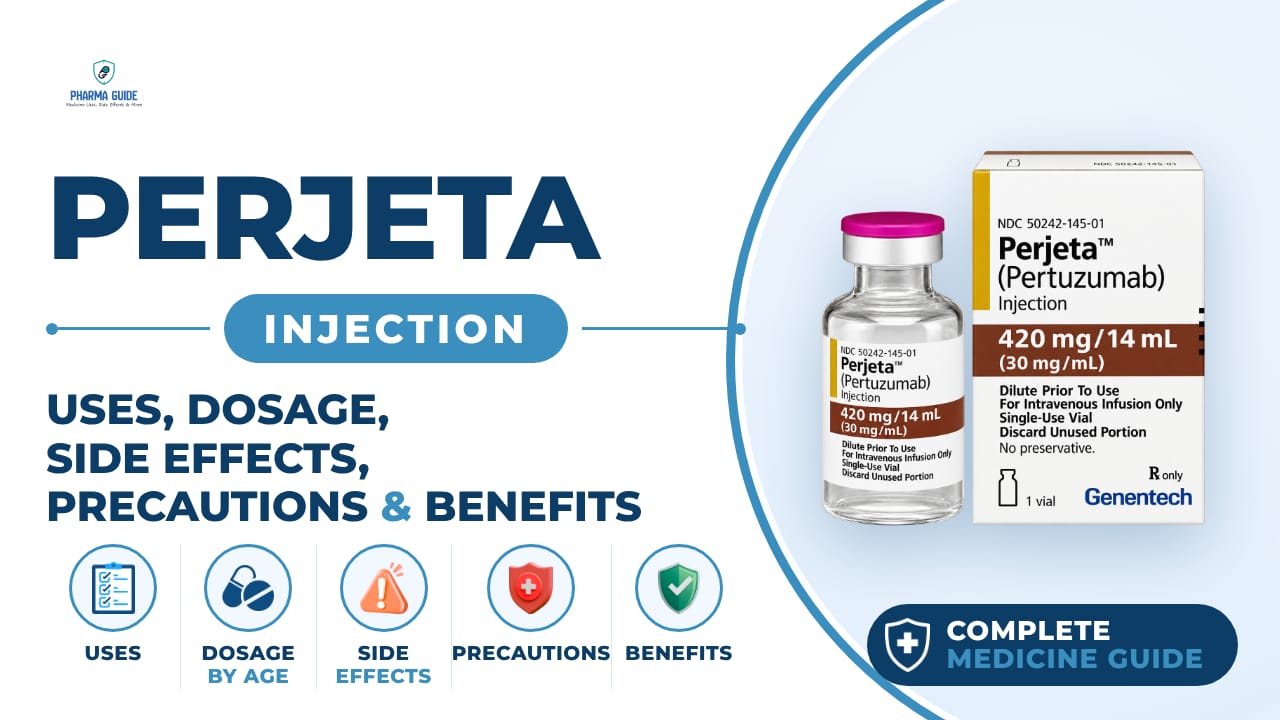
| Generic name | pertuzumab |
|---|---|
| Drug class | HER2/neu receptor antagonist (monoclonal antibody) |
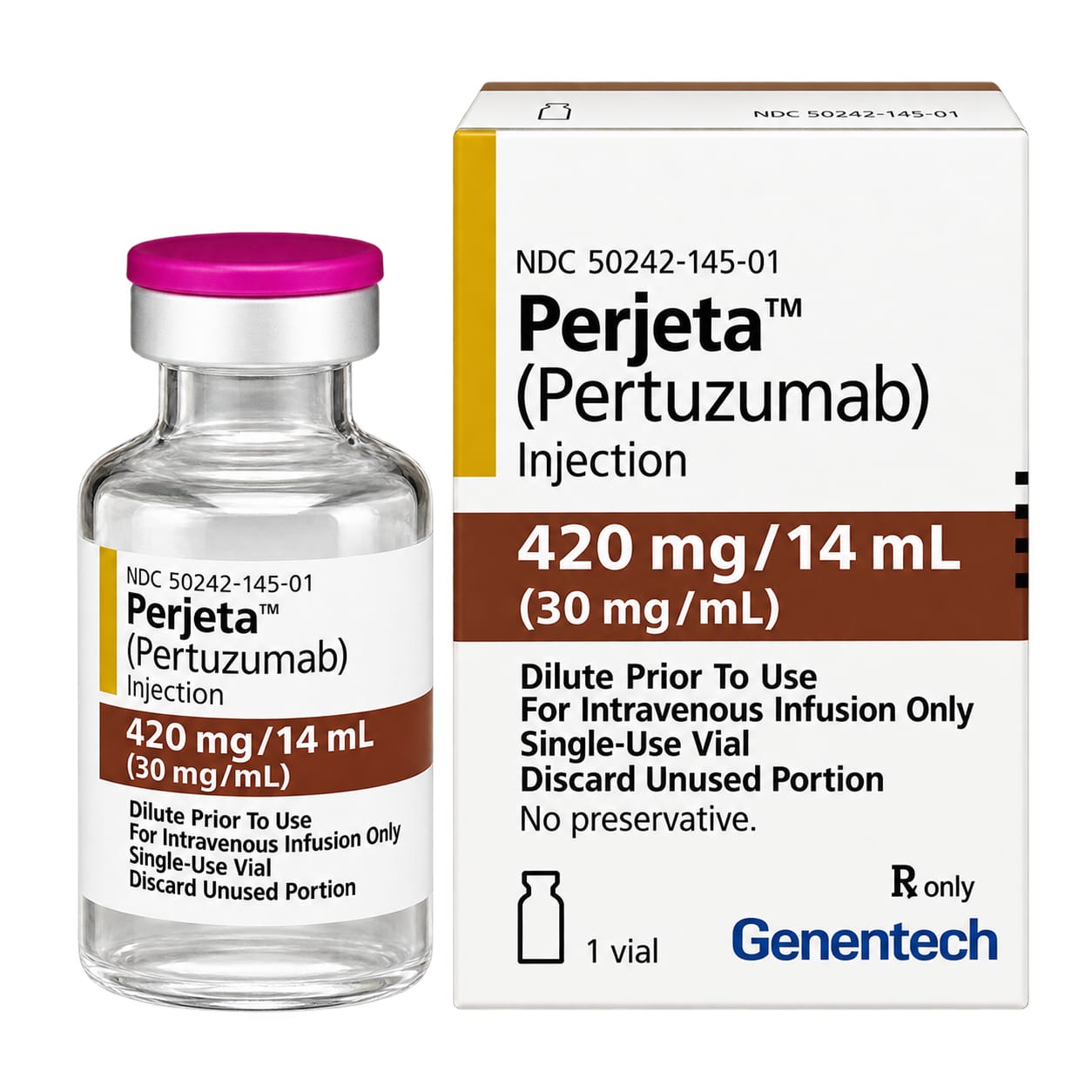
| Forms | Concentrate for solution for infusion, 420 mg/14 mL (30 mg/mL) single-use vial |
Quick overview
Perjeta Injection (pertuzumab) is a HER2/neu receptor antagonist, a type of monoclonal antibody, given by IV infusion. It is used together with trastuzumab and chemotherapy to treat HER2-positive breast cancer, including metastatic, locally advanced, inflammatory, early stage, and high-risk early breast cancer. It works by blocking the HER2 protein on cancer cells to slow or stop their growth. It is given as an infusion by a healthcare provider, with an initial dose followed by regular maintenance doses.
What is Perjeta Injection
Perjeta is a monoclonal antibody medicine given by IV infusion that targets the HER2 protein found on some breast cancer cells. It is used together with other cancer medicines to treat HER2-positive breast cancer.
Perjeta Injection uses
- Use in combination with trastuzumab and docetaxel for treatment of patients with HER2-positive metastatic breast cancer (MBC) who have not received prior anti-HER2 therapy or chemotherapy for metastatic disease.
- Use in combination with trastuzumab and docetaxel as neoadjuvant treatment of patients with HER2-positive, locally advanced, inflammatory, or early stage breast cancer (either greater than 2 cm in diameter or node positive) as part of a complete treatment regimen for early breast cancer.
- Adjuvant treatment of patients with HER-2 positive early breast cancer at high risk of recurrence (in combination with trastuzumab and chemotherapy).
Benefits of Perjeta Injection
- Treats HER2-positive metastatic breast cancer
- Used in certain early HER2-positive breast cancers
- Commonly combined with trastuzumab and chemotherapy
- Can reduce recurrence risk in appropriately selected high-risk patients
How Perjeta Injection works
Perjeta attaches to a protein called HER2 on the surface of some cancer cells, where it normally stimulates growth. By blocking HER2, Perjeta can slow or stop the cancer cells from growing, or may kill them. It works on a different part of HER2 than trastuzumab, so the two medicines are believed to work together.
Perjeta Injection dosage
Perjeta is given as an intravenous infusion only; it must not be given as an intravenous push or bolus. It is given together with trastuzumab and chemotherapy (such as docetaxel), administered sequentially; Perjeta and trastuzumab can be given in any order, but docetaxel should be given after Perjeta and trastuzumab.
An observation period of 30 to 60 minutes is recommended after each Perjeta infusion and before any subsequent infusion of trastuzumab or chemotherapy. Patients should be observed closely for 60 minutes after the first infusion and for 30 to 60 minutes after subsequent infusions.
In patients receiving an anthracycline-based regimen, Perjeta and trastuzumab should be given after the entire anthracycline regimen is completed.
If a dose is delayed by less than 6 weeks, the regular maintenance dose should be given as soon as possible rather than waiting for the next planned dose; if 6 weeks or more have passed, treatment restarts with the higher initial dose.
No dose adjustment is required for elderly patients, although they may have a higher risk of diarrhea and other side effects. The safety and effectiveness of Perjeta in children and adolescents under 18 years of age have not been established.
| Age group | Dose |
|---|---|
| 18–64 years | Initial dose: 840 mg IV once, followed by 420 mg IV every 3 weeks |
Available forms and strengths
- Concentrate for solution for infusion, 420 mg/14 mL (30 mg/mL) single-use vial
Side effects of Perjeta Injection
Common
- Diarrhea
- Hair loss (alopecia)
- Low white blood cell count (neutropenia)
- Nausea
- Fatigue
- Rash
- Peripheral neuropathy
- Vomiting
- Decreased appetite
- Headache
- Altered taste (dysgeusia)
- Constipation
- Joint pain (arthralgia)
- Muscle pain (myalgia)
- Insomnia
- Dizziness
- Increased tearing
- Nosebleeds (epistaxis)
- Nail disorders
- Dry skin
- Itching
Serious
- Left ventricular dysfunction and congestive heart failure
- Infusion-related reactions, including fatal cases
- Severe hypersensitivity reactions and anaphylaxis, including fatal cases
- Febrile neutropenia (low white blood cells with fever)
- Severe or persistent diarrhea
- Tumor lysis syndrome
- Embryo-fetal death and birth defects if used during pregnancy
Warnings and precautions
- Perjeta can cause heart problems, including weakening of the heart muscle and heart failure. Heart function is checked before and during treatment, and treatment may be stopped if heart function drops significantly.
- Exposure to Perjeta can cause death of the unborn baby and birth defects; effective contraception is needed during and after treatment.
- Infusion reactions can occur during or shortly after a Perjeta infusion; patients are monitored and the infusion may be slowed, interrupted, or stopped if a reaction occurs.
- Severe allergic reactions, including life-threatening anaphylaxis, have occurred with Perjeta. The infusion must be stopped immediately if a severe reaction occurs.
- Patients receiving Perjeta with trastuzumab and docetaxel have a higher risk of fever with low white blood cell counts (febrile neutropenia), especially if they also have mouth sores or diarrhea.
- Perjeta can cause severe diarrhea, and older patients are at higher risk than younger patients.
- A condition called tumor lysis syndrome, caused by rapid breakdown of cancer cells, has been reported after starting treatment in the post-marketing setting.
- Perjeta should not be used during pregnancy, as it can cause serious harm or death to an unborn baby. Pregnancy status should be checked before starting treatment, and effective birth control should be used during treatment and for several months after the last dose.
- It is not known if Perjeta passes into breast milk, but because of possible harm to a nursing baby, a decision should be made whether to stop breastfeeding or stop the medicine, considering the importance of treatment to the mother.
- No dose changes are needed for mild or moderate kidney problems, but there isn't enough information to recommend a dose for patients with severe kidney impairment.
- Perjeta has not been studied in people with liver problems, so no specific guidance is available.
- Perjeta has only a minor effect on the ability to drive or use machines, but dizziness can occur, so patients should wait until symptoms go away before driving or using machinery.
Storage
- Store vials in a refrigerator at 2°C to 8°C (36°F to 46°F) until time of use.
- Keep vial in the outer carton in order to protect from light.
- DO NOT FREEZE. DO NOT SHAKE.
- Unused or expired medicine should be returned to a pharmacy for disposal.
When to see a doctor
- Get medical help right away for signs of a severe allergic reaction, such as swelling of the face or throat and trouble breathing.
- Contact your doctor immediately if you have signs of heart problems, such as cough, shortness of breath, or swelling in your legs or arms.
- Seek help right away if you have very severe or ongoing diarrhea (7 or more stools a day).
- Tell a doctor or nurse immediately if you notice symptoms of tumor lysis syndrome, such as kidney problems, heart rhythm changes, seizures, vomiting, diarrhea, or tingling in the mouth, hands, or feet.
- Tell your doctor right away if you think you might be pregnant during treatment.
- Report any infusion-related symptoms like fever, chills, fatigue, headache, nausea, vomiting, or a fast heartbeat to your caregiver right away during treatment.
Alternatives
- Trastuzumab (Herceptin)
- Phesgo
- Enhertu
Watch the video
FAQs
What is Perjeta Injection used for?
Perjeta is used with trastuzumab and chemotherapy to treat HER2-positive breast cancer, including metastatic, locally advanced, inflammatory, early stage, and high-risk early breast cancer.
How does Perjeta work?
Perjeta attaches to the HER2 protein on cancer cells, blocking its growth-stimulating signal and slowing or stopping cancer cell growth. It works on a different part of HER2 than trastuzumab, so the two are believed to work together.
What is the dosage for Perjeta Injection?
Perjeta is given as an IV infusion with an initial dose of 840 mg, followed by 420 mg every 3 weeks, in combination with trastuzumab and chemotherapy.
What are the serious side effects of Perjeta?
Serious side effects include left ventricular dysfunction and congestive heart failure, infusion-related reactions, severe hypersensitivity reactions and anaphylaxis, febrile neutropenia, severe diarrhea, tumor lysis syndrome, and embryo-fetal death and birth defects if used during pregnancy.
Can Perjeta be used during pregnancy?
No, Perjeta should not be used during pregnancy as it can cause serious harm or death to an unborn baby. Pregnancy status should be checked before starting treatment, and effective birth control should be used during and for several months after treatment.
General information, not medical advice
Your prescriber and the leaflet in your pack know your situation. This page does not.
- Follow your prescriber and the leaflet
- Don't start, stop, or change a dose on your own
- Doses and warnings differ by country and product
Sources
Video
Related medicines
Herceptin Injection: Uses, Dosage, Side Effects, Precautions and Alternates
HER2/neu receptor antagonist (monoclonal antibody)
Herceptin Injection (trastuzumab) treats HER2-positive breast and stomach cancers via IV infusion. Learn uses, dosage, side effects, and heart-related warnings.

Injectafer Injection: Uses, Dosage, Side Effects, Precautions and Alternates
Iron products
Injectafer (ferric carboxymaltose) treats iron deficiency anemia and heart failure-related iron deficiency via IV. Learn uses, dosage, side effects, and