Rocephin Injection: Uses, Dosage, Side Effects, Precautions and Alternates

| Generic name | Ceftriaxone |
|---|---|
| Drug class | Third generation cephalosporins |
| Forms | Powder for solution for infusion, Powder and solvent for solution for injection |
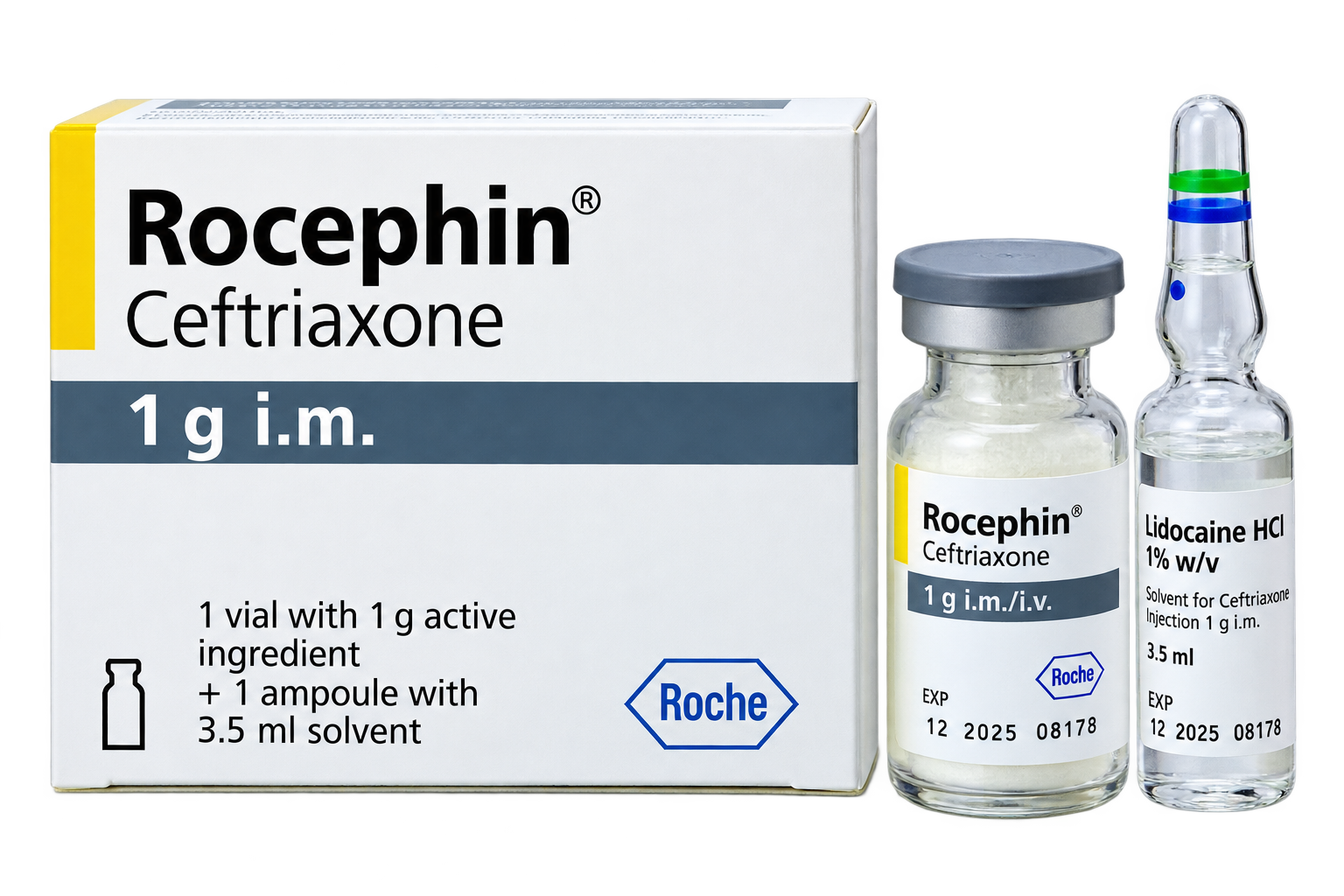
Quick overview
Rocephin Injection contains the generic medicine ceftriaxone, a third-generation cephalosporin antibiotic. It is given to adults and children, including newborn babies, to treat a wide range of bacterial infections by killing the bacteria that cause them. It is administered by a doctor or nurse as an intravenous infusion, an intravenous injection, or an injection into a muscle.
What is Rocephin Injection
Rocephin is an antibiotic given to adults and children, including newborn babies. It works by killing bacteria that cause infections. It belongs to a group of medicines called cephalosporins.
Rocephin Injection uses
- Treats bacterial meningitis (an infection of the brain)
- Treats lung infections such as pneumonia
- Treats middle ear infections
- Treats infections of the abdomen and abdominal wall
- Treats urinary tract and kidney infections
- Treats bone and joint infections
- Treats skin and soft tissue infections
- Treats blood infections
- Treats heart infections (endocarditis)
- Treats certain sexually transmitted infections (gonorrhoea and syphilis)
- Treats fever in patients with low white blood cell counts due to a suspected bacterial infection
- Treats chest infections in adults with chronic bronchitis
- Treats Lyme disease caused by tick bites
- Helps prevent infections during surgery
Benefits of Rocephin Injection
- Fights many kinds of bacterial infections, including severe or life-threatening ones
- Can be used to prevent infection in people having certain types of surgery
How Rocephin Injection works
Rocephin stops bacteria from building their cell walls. This causes the bacteria to break apart and die.
Rocephin Injection dosage
Rocephin is usually given by a doctor or nurse. It can be given as a drip (intravenous infusion), as an injection directly into a vein, or as an injection into a muscle. An intravenous infusion is usually given over at least 30 minutes, which is the preferred route. A slow intravenous injection may be given over a few minutes.
Rocephin must not be mixed with, or given at the same time as, calcium-containing injections. Use this medicine for the full prescribed length of time, even if your symptoms quickly improve. Skipping doses can increase the risk of an infection that resists treatment. Rocephin will not treat a viral infection such as the flu or a common cold.
Prepare an injection only when you are ready to give it. Do not use if the medicine has changed colour or has particles in it. If you use other injectable medicines, flush your intravenous catheter between each medicine. Do not stop taking Rocephin unless your doctor tells you to.
| Age group | Dose |
|---|---|
| Newborns (0–28 days) | Usually 20–50 mg/kg once daily; specialist supervision is required |
| 1 month–11 years | Commonly 20–80 mg/kg once daily, depending on the infection |
| 12–17 years | Often 1–2 g once daily, depending on the infection and body weight |
| 18–64 years | Commonly 1–2 g once daily; serious infections may require higher doses |
| 65+ years | Usually the same adult dosing, with medical assessment when appropriate |
Available forms and strengths
- Powder for solution for infusion
- Powder and solvent for solution for injection
Side effects of Rocephin Injection
Common
- Abnormalities in white blood cells and platelets
- Loose stools or diarrhoea
- Changes in blood tests for liver function
- Rash
Serious
- Severe allergic reaction with sudden swelling of the face, throat, lips or mouth that makes it hard to breathe or swallow, or sudden swelling of the hands, feet and ankles
- Severe skin rash that develops quickly, with blisters or peeling of the skin and possibly blisters in the mouth
- Inflammation of the large bowel with diarrhoea, usually with blood and mucus, stomach pain and fever
- Difficulty breathing (bronchospasm)
- A form of anaemia where red blood cells are destroyed (haemolytic anaemia)
- Severe decrease in white blood cells (agranulocytosis)
- Convulsions
- Inflammation of the pancreas, with severe stomach pain spreading to the back
- Gallbladder problems causing pain, feeling sick and being sick
- Kidney problems caused by calcium deposits, with pain passing urine or low urine output
Warnings and precautions
- Do not use Rocephin if you have ever had a severe allergic reaction to any cephalosporin antibiotic or to penicillin and similar antibiotics.
- Rocephin must never be given to a premature baby, or to a newborn baby who has jaundice (yellowing of the skin or eyes) or certain blood problems.
- Rocephin must not be mixed with or given at the same time as any calcium-containing intravenous solution, including total parenteral nutrition (TPN), because a harmful precipitate can form. This can be dangerous, especially in newborn babies. Antibiotics like Rocephin can cause diarrhoea that may signal a new infection. Do not use anti-diarrhoea medicine unless your doctor tells you to. If Rocephin is given as an injection into a muscle using lidocaine as the solvent, it must never be given into a vein.
- Tell your doctor if you are pregnant or think you may be pregnant. Rocephin should only be used during pregnancy, and especially in the first trimester, if the benefit outweighs the risk. Your doctor will weigh the benefit against any risk to your baby.
- Ceftriaxone passes into breast milk in low amounts. No effects on breastfed infants are expected at normal doses, but a risk of diarrhoea and fungal infection cannot be ruled out. Your doctor will help you decide whether to stop breastfeeding or the medicine.
- Tell your doctor if you have kidney problems. Usually the dose does not need to be reduced if liver function is normal, but in severe kidney failure the daily dose should not exceed a set limit. Close monitoring may be advised.
- Tell your doctor if you have liver problems. No dose change is usually needed for mild or moderate liver problems as long as kidney function is normal. Close monitoring is advised if both liver and kidney function are severely impaired.
- Rocephin can cause dizziness. If you feel dizzy, do not drive or use any tools or machines. Talk to your doctor if you experience these symptoms.
Storage
- Store at 20–25°C (68–77°F)
- Keep the vial protected from light
- Stability depends on the diluent, concentration, and temperature
- Follow the product-specific storage period; refrigeration may extend stability
- Avoid calcium-containing diluents such as Ringer's or Hartmann's solution
When to see a doctor
Get emergency medical help if you have signs of an allergic reaction such as hives, difficulty breathing, or swelling of your face or throat, or a severe skin reaction with fever, sore throat, burning eyes, skin pain, or a spreading rash that blisters and peels.
Call your doctor at once if you have severe stomach pain, watery or bloody diarrhoea (even months after your last dose), new signs of infection such as fever or chills, vomiting with upper stomach pain that spreads to your back, pale or yellowed skin, dark urine, breathing problems, or kidney or bladder problems.
If you accidentally receive more Rocephin than prescribed, contact your doctor or nearest hospital straight away. You can also call your local poison control center.
Alternatives
- Cefotaxime Injection
- Cefepime Injection
- Ceftazidime Injection
- Cefuroxime Injection
- Cefazolin Injection
- Ampicillin Injection
- Amoxicillin-Clavulanate Injection
FAQs
What is Rocephin Injection used for
Rocephin is an antibiotic used to treat bacterial infections including meningitis, pneumonia, middle ear infections, abdominal infections, urinary tract and kidney infections, bone and joint infections, skin infections, blood infections, heart infections, certain STIs like gonorrhoea and syphilis, Lyme disease, and to prevent infections during surgery.
How is Rocephin Injection given
Rocephin is given by a doctor or nurse as an intravenous infusion over at least 30 minutes (the preferred route), as a slow intravenous injection over a few minutes, or as an injection into a muscle.
Can Rocephin be mixed with calcium-containing solutions
No, Rocephin must not be mixed with or given at the same time as calcium-containing injections, including total parenteral nutrition, because a harmful precipitate can form, which can be especially dangerous in newborn babies.
What are the serious side effects of Rocephin Injection
Serious side effects include severe allergic reactions with swelling of the face, throat or limbs, severe skin reactions with blistering or peeling, inflammation of the large bowel with bloody diarrhoea, difficulty breathing, haemolytic anaemia, agranulocytosis, convulsions, pancreatitis, gallbladder problems, and kidney problems from calcium deposits.
Is Rocephin Injection safe during pregnancy and breastfeeding
Rocephin should only be used during pregnancy, especially in the first trimester, if the benefit outweighs the risk. It passes into breast milk in low amounts, and while no effects are expected at normal doses, a risk of diarrhoea and fungal infection in the infant cannot be ruled out.