
Safety
General information, not medical advice
Your prescriber and the leaflet in your pack know your situation. This page does not.
- Follow your prescriber and the leaflet
- Don't start, stop, or change a dose on your own
- Doses and warnings differ by country and product
Stemetil Tablet: Uses, Dosage, Side Effects, Precautions and Alternates

| Generic name | Prochlorperazine (as maleate/mesylate) |
|---|---|
| Drug class | Phenothiazine antipsychotic/antiemetic |
| Forms | Tablet, Syrup, Injection, Suppository |
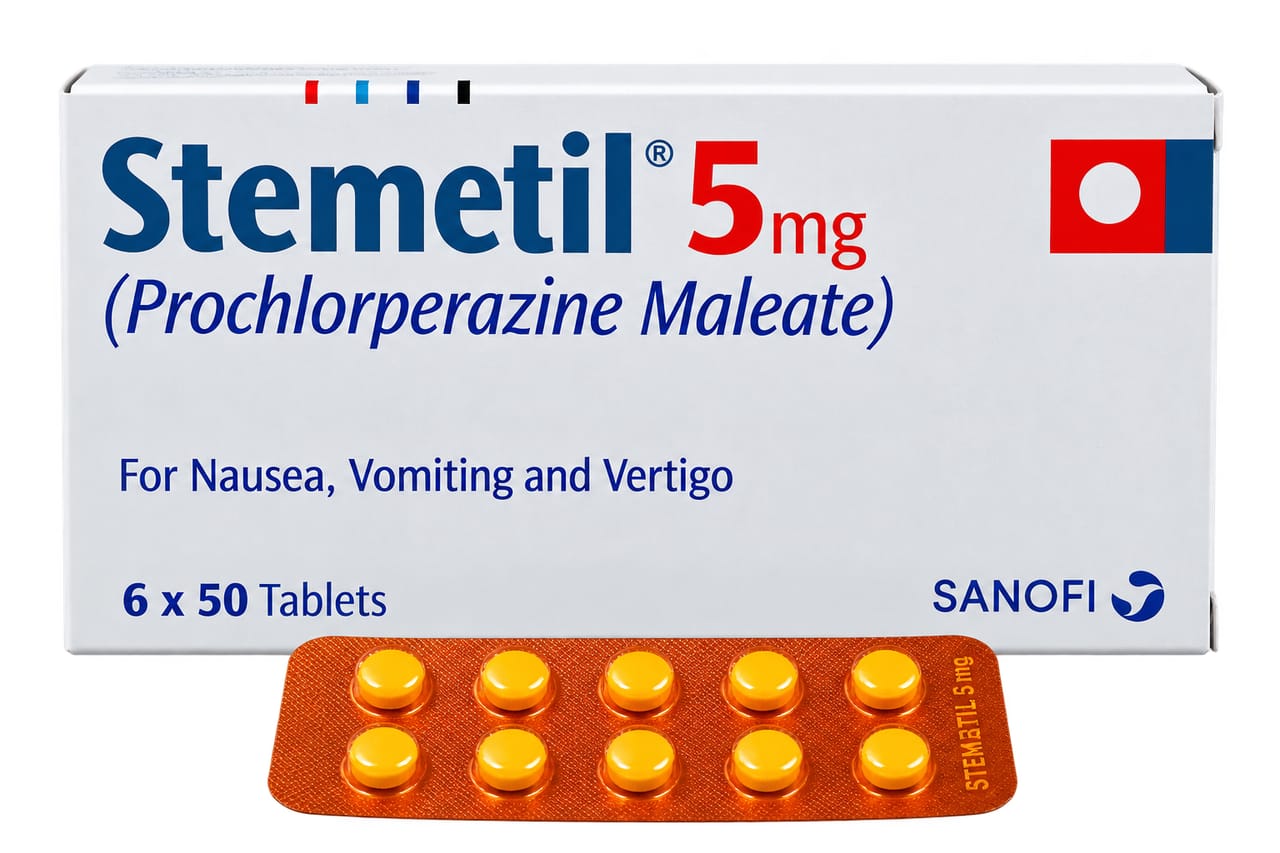
Quick overview
Stemetil Tablet contains prochlorperazine, a phenothiazine antipsychotic and antiemetic medicine. It is used to treat nausea, vomiting, dizziness and vertigo, as well as schizophrenia, mania, and short-term anxiety when used alongside other medicines. It works by blocking the effects of a brain chemical called dopamine. It should be taken exactly as prescribed by your doctor.
What is Stemetil Tablet
Stemetil Tablets contain prochlorperazine, a medicine from a group called phenothiazine antipsychotics. It works by blocking the effects of a chemical in the brain, and is used to control nausea, vomiting, dizziness, and certain mental health conditions.
Stemetil Tablet uses
- Treat balance problems or dizziness (vertigo), including inner-ear problems such as Meniere's Syndrome or labyrinthitis
- Stop nausea (feeling sick) or vomiting (being sick) from any cause including migraines
- Treat schizophrenia
- Treat over-active behaviour or thoughts (mania)
- Treat anxiety in the short-term, when used in addition to other medicines
Benefits of Stemetil Tablet
- Relieves nausea and vomiting from motion sickness and migraine
- Eases severe dizziness and vertigo from inner-ear disorders
- Helps with labyrinthitis and Ménière's disease
How Stemetil Tablet works
Stemetil contains prochlorperazine, which belongs to a group of medicines called phenothiazines. It works by blocking the effects of a chemical in the brain called dopamine, which helps reduce nausea, vomiting, and dizziness.
Stemetil Tablet dosage
Take this medicine by mouth, exactly as your doctor has told you. It does not matter if you take it before or after food. Do not give to children under 1 year of age or who weigh less than 10kg. Do not let the tablets touch your skin for very long, as this may cause skin redness, swelling and itching.
Do not change your dose yourself if you feel the effect is too weak or too strong; ask your doctor first. If you forget a dose, take it as soon as you remember; if it is nearly time for the next dose, skip the missed dose and do not double up. Keep taking this medicine until your doctor tells you to stop; do not stop suddenly or lower the dose without checking with your doctor first.
Elderly patients may be given a lower dose and should take care in very hot or very cold weather. For the orally disintegrating (MD) form, place the tablet in the mouth without swallowing and let it dissolve without water; avoid handling with wet hands.
| Age group | Dose |
|---|---|
| Under 1 Year | Not recommended |
| 1–11 Years | Dose determined by doctor according to age, weight, and condition |
| 12–17 Years | Usually 5–10 mg, as prescribed |
| Adults (18+ Years) | Usually 5–10 mg, 2–3 times daily, depending on the condition |
| Older Adults (65+ Years) | Lower dose may be required; use under medical supervision |
Available forms and strengths
- Tablet
- Syrup
- Injection
- Suppository
Side effects of Stemetil Tablet
Common
- Constipation
- Dry mouth
- Drowsiness
- Restlessness
- Trembling, rigid posture, mask-like face, slow movements and a shuffling unbalanced walk
- Twitching
- Blurred vision
- Headache
- Dizziness
Serious
- Allergic reaction: shortness of breath, wheezing, difficulty breathing or swallowing, swelling of the face, lips, throat or tongue, rash, itching or hives on the skin
- Neuroleptic malignant syndrome: pale complexion, sweating, high temperature, fast heartbeat, stiff muscles, fast breathing, confusion, drowsiness or agitation
- Frequent infections such as fever, sore throat or mouth ulcers (possible blood problem called leucopenia)
- Getting infections more easily than usual (possible blood disorder called agranulocytosis)
- Yellowing of the skin or eyes (jaundice), possible liver problems
- Very fast, uneven or forceful heartbeats with breathing problems such as wheezing, shortness of breath, tightness in the chest and chest pain
- Blood clots in the veins, especially in the legs, which may travel to the lungs causing chest pain and difficulty breathing
- Rigid or stiff muscles, trembling or shaking, unusual eye movements, difficulty moving, or loss of muscle power
- Uncontrolled movements of the tongue, face, mouth or jaw such as puffing of the cheeks, puckering of the mouth or chewing movements (tardive dyskinesia)
Warnings and precautions
- Stemetil is not recommended during pregnancy unless your doctor believes it is essential, as it may affect the developing baby. Babies born to mothers who used it late in pregnancy may show shaking, muscle stiffness or weakness, sleepiness, agitation, breathing problems, and feeding difficulties. Stemetil is not recommended while breastfeeding or planning to breastfeed.
- People with kidney problems should talk to their doctor before taking Stemetil, as caution is needed and dose or monitoring may need to be adjusted. People with liver problems should talk to their doctor before taking Stemetil, as caution is needed and dose or monitoring may need to be adjusted.
- Do not drink alcohol while taking Stemetil, as alcohol can add to its effects and may cause serious breathing difficulties. You may feel sleepy after taking this medicine. If this happens, do not drive or use tools or machines.
- Call your doctor straight away if you notice uncontrolled movements of the tongue, face, mouth or jaw, such as puffing of the cheeks, puckering of the mouth or chewing movements, as these can be signs of a rare and sometimes permanent condition called tardive dyskinesia.
- Do not stop using this medicine suddenly or reduce the dose, even if you feel better, without checking with your doctor first, as your condition may worsen or you may be more likely to get side effects.
- Do not take any medicines that cause drowsiness while taking this medicine.
- This medicine can make your skin much more sensitive to sunlight; avoid direct sun exposure, wear protective clothing, and use at least a 15+ sunscreen if outdoors.
- There have been very rare reports of sudden death, possibly due to heart problems, with this and similar medicines. Elderly people with dementia taking antipsychotic medicines have shown a small increase in risk of death compared with those not taking them.
Storage
- Keep out of the sight and reach of children
- Do not store above 25°C
- Store in the original package/carton to protect from light
- Do not use after the expiry date printed on the carton or blister
- Do not throw away medicines via wastewater or household waste; ask your pharmacist how to dispose of medicines no longer needed
When to see a doctor
- Get emergency help right away for signs of an allergic reaction such as rash, swallowing or breathing problems, or swelling of the lips, face, throat or tongue.
- Get emergency help if you notice pale skin, sweating, high fever, fast heartbeat, stiff muscles, fast breathing, and confusion, drowsiness or agitation — these may be neuroleptic malignant syndrome.
- Get medical help if you have frequent infections such as fever, sore throat, or mouth ulcers, as these could be signs of a blood problem.
- Get medical help if your skin or eyes turn yellow, as this could indicate liver problems.
- Get medical help for very fast, uneven or forceful heartbeats along with breathing problems like wheezing, shortness of breath, chest tightness or chest pain.
- Seek medical advice immediately if you notice signs of a blood clot, such as swelling, pain and redness in the leg, or symptoms of a clot reaching the lungs such as chest pain and difficulty breathing.
- If you think you have taken too much of this medicine, get urgent medical attention immediately even if you feel fine, and take the medicine pack with you.
Alternatives
- Ondansetron
- Metoclopramide
- Meclizine
Watch the video
FAQs
What is Stemetil Tablet used for?
It is used to treat balance problems or dizziness (vertigo) including Meniere's Syndrome or labyrinthitis, nausea and vomiting from any cause including migraines, schizophrenia, mania, and short-term anxiety when used with other medicines.
How does Stemetil Tablet work?
It contains prochlorperazine, a phenothiazine antipsychotic that works by blocking the effects of a brain chemical called dopamine, which helps reduce nausea, vomiting, and dizziness.
What is the usual adult dose of Stemetil Tablet?
Adults usually take 5–10 mg, 2–3 times daily, depending on the condition being treated, exactly as prescribed by a doctor.
What are the common side effects of Stemetil Tablet?
Common side effects include constipation, dry mouth, drowsiness, restlessness, trembling, rigid posture, twitching, blurred vision, headache, and dizziness.
Can Stemetil Tablet be taken during pregnancy or breastfeeding?
It is not recommended during pregnancy unless your doctor believes it is essential, as it may affect the developing baby, and it is not recommended while breastfeeding or planning to breastfeed.
General information, not medical advice
Your prescriber and the leaflet in your pack know your situation. This page does not.
- Follow your prescriber and the leaflet
- Don't start, stop, or change a dose on your own
- Doses and warnings differ by country and product
Sources
- KD. Tripathi. NSAIDs and Antipyretic-Analgesics. Essentials of Medical Pharmacology. Seventh edition. 2013.
- Stemetil 5 mg Tablets - Summary of Product Characteristics (SmPC) - (emc)
- Prochlorperazine [Internet]. Ncbi.nlm.nih.gov. 2021
- Stemetil [Internet]. Cdscoonline.gov.in. 2021
- Prochlorperazine: MedlinePlus Drug Information
- Prochlorperazine - DrugBank
Video
Related medicines
Prochlorperazine Tablet: Uses, Dosage, Side Effects, Precautions and Alternates
Phenothiazine (antipsychotic/antiemetic)
Prochlorperazine Tablet treats nausea, vomiting, dizziness and certain mental health conditions. Learn uses, dosage, side effects and precautions.

Injectafer Injection: Uses, Dosage, Side Effects, Precautions and Alternates
Iron products
Injectafer (ferric carboxymaltose) treats iron deficiency anemia and heart failure-related iron deficiency via IV. Learn uses, dosage, side effects, and