
Safety
General information, not medical advice
Your prescriber and the leaflet in your pack know your situation. This page does not.
- Follow your prescriber and the leaflet
- Don't start, stop, or change a dose on your own
- Doses and warnings differ by country and product
Taclonex Ointment: Uses, Dosage, Side Effects, Precautions and Alternates
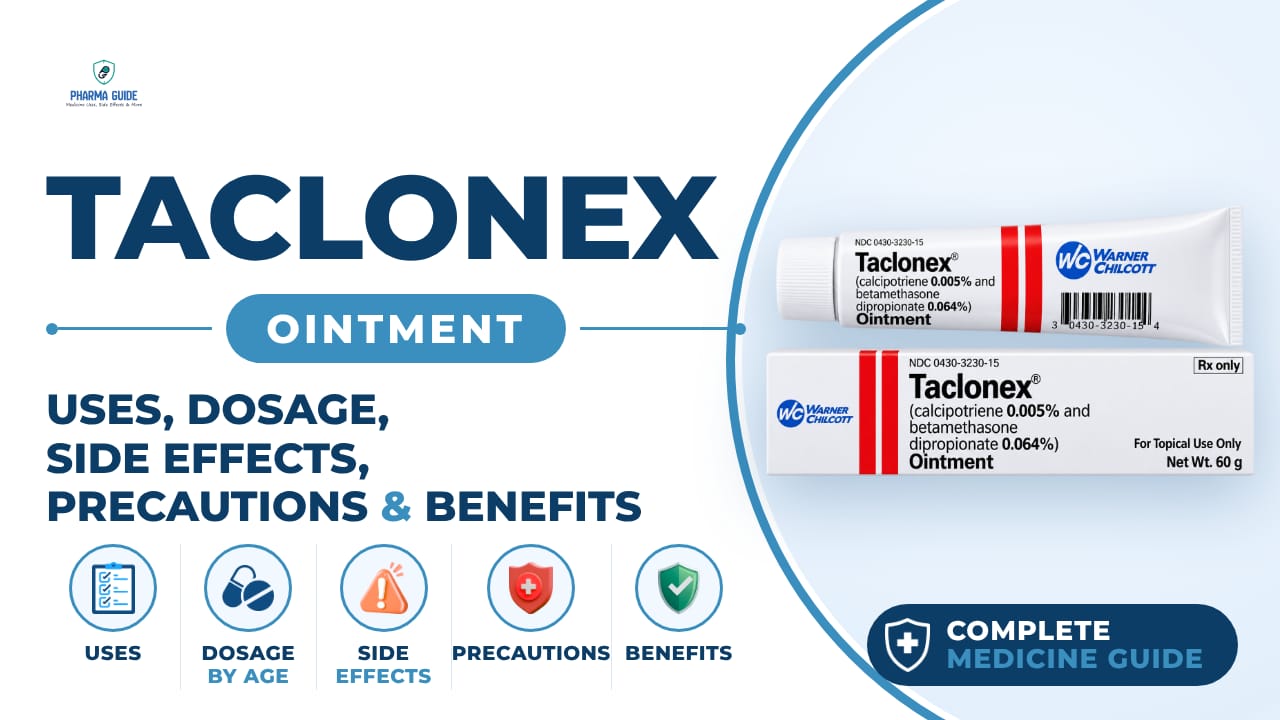
| Generic name | betamethasone and calcipotriene topical |
|---|---|
| Drug class | Topical antipsoriatics |
| Forms | Ointment, Topical suspension (liquid) |
Quick overview
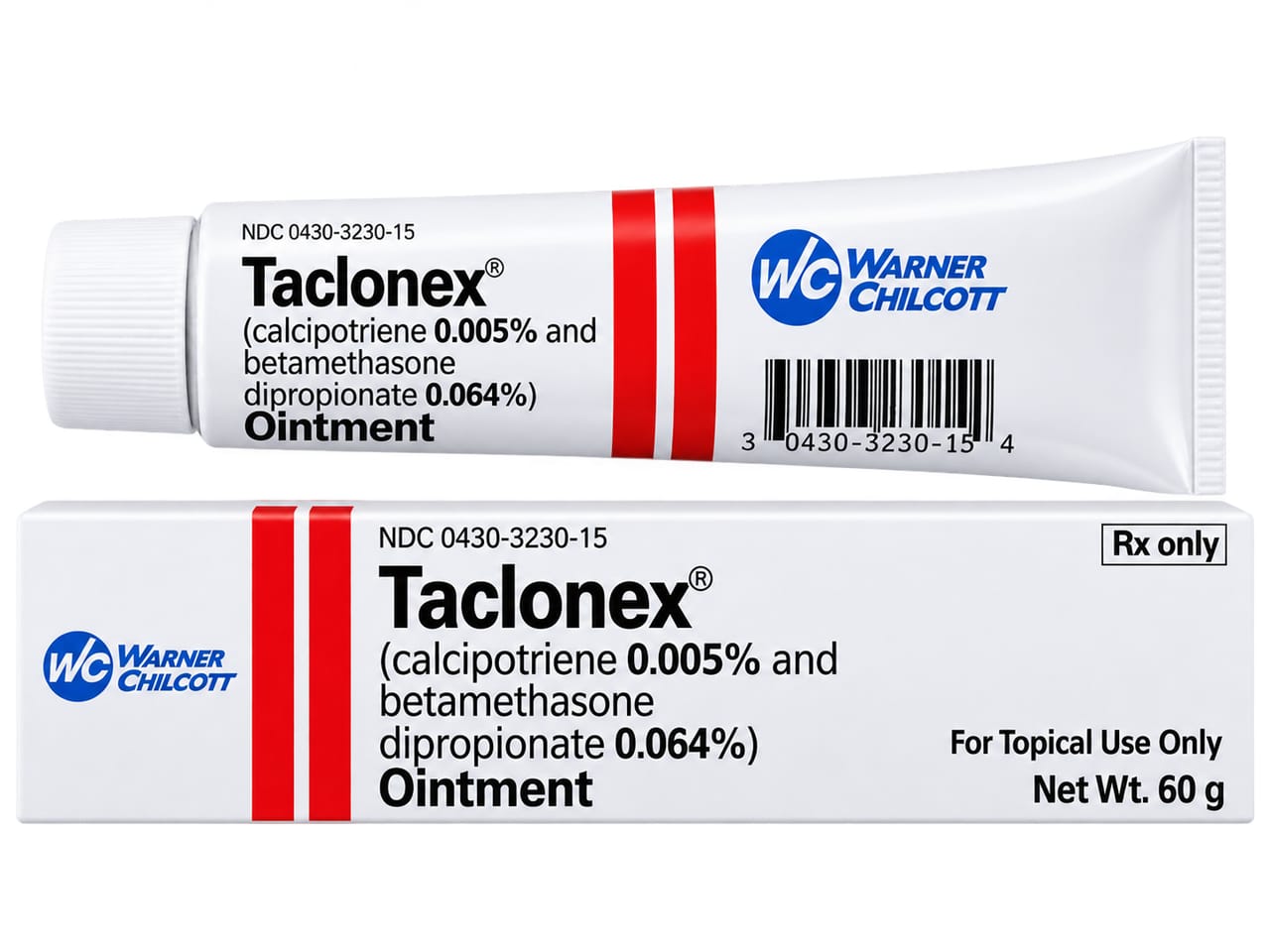
Taclonex Ointment combines betamethasone, a strong corticosteroid, with calcipotriene, a form of vitamin D. It is a prescription medicine applied to the skin and is used only by adults to treat plaque psoriasis (psoriasis vulgaris). It works by reducing inflammation and slowing excessive skin-cell growth, helping to relieve thickened, scaly, itchy, and red patches of skin.
What is Taclonex Ointment
Taclonex Ointment is a prescription medicine applied to the skin that combines betamethasone, a strong corticosteroid, and calcipotriene, a form of vitamin D. It belongs to the topical antipsoriatics drug class and is used only by adults to treat psoriasis vulgaris on the skin.
Taclonex Ointment uses
- Treats plaque psoriasis (psoriasis vulgaris)
- Helps reduce excessive skin-cell growth
- Reduces thickened and scaly psoriasis plaques
- Helps relieve inflammation and redness associated with psoriasis
- Helps reduce itching and discomfort
Benefits of Taclonex Ointment
- Combines two active medications with complementary actions
- Helps reduce psoriasis-related inflammation
- Slows excessive skin-cell production
- May improve plaque thickness and scaling
- Helps relieve itching and redness
How Taclonex Ointment works
Betamethasone is a steroid that stops the release of substances in the body that cause inflammation, which reduces swelling, redness, and itching. Calcipotriene is a form of vitamin D that slows down how fast skin cells reproduce, which prevents the buildup of thick, scaly skin patches.
Taclonex Ointment dosage
Use exactly as prescribed; do not use in larger amounts or for longer than recommended by your doctor. This medicine is for use on the skin only; do not take it by mouth. Wash your hands before and after use, unless you are treating your hands. Apply a thin layer to the affected skin and rub it in gently. Do not apply over a large area of skin unless your doctor has told you to. Do not cover the treated area with a bandage or other covering unless your doctor tells you to, since covering it can increase how much medicine your body absorbs. Do not apply to the face, groin, underarms, or broken or raw skin, and avoid getting the medicine in your eyes.
If you miss a dose, apply it as soon as you remember, but skip it if it is almost time for your next dose; do not apply two doses at once. Do not stop using this medicine suddenly; follow your doctor's instructions about reducing your dose gradually. Stop using once your skin symptoms are controlled, as advised by your doctor. Call your doctor if your symptoms do not improve or if they get worse. Avoid sunlight or tanning beds, and wear protective clothing and sunscreen when outdoors, since this medicine can make you sunburn more easily.
| Age group | Dose |
|---|---|
| Under 12 years | Safety and effectiveness not established; no approved dosage |
| 12–17 years | Apply a thin layer once daily; maximum 60 g per week |
| 18–74 years | Apply a thin layer once daily; maximum 100 g per week |
| 75 years and older | Apply a thin layer once daily; maximum 100 g per week, with careful monitoring of skin tolerance |
Available forms and strengths
- Ointment
- Topical suspension (liquid)
Side effects of Taclonex Ointment
Common
- Mild skin irritation, burning, or stinging at the application site
- Itching or redness
- Dryness, rash, or peeling
- Worsening of psoriasis or skin color changes
- Headache or sore throat
- Redness or crusting around hair follicles
Serious
- Skin thinning (skin atrophy), stretch marks, or easy bruising from long-term use or large amounts
- Adrenal gland suppression or Cushing's syndrome from absorbing strong steroids through the skin
- High blood calcium or high calcium in the urine from too much calcipotriene absorption
- Blurred vision, tunnel vision, eye pain, or seeing halos around lights
- High blood sugar signs: increased thirst, increased urination, dry mouth, fruity breath odor
- Signs of a serious allergic reaction: hives, difficulty breathing, swelling of the face, lips, tongue, or throat
Warnings and precautions
- Long-term use or using large amounts can cause thinning skin, stretch marks, or easy bruising
- Absorbing strong steroids through the skin can suppress the adrenal gland or trigger Cushing's syndrome
- Too much absorption of the vitamin D component can cause high blood calcium or high calcium in the urine
- Do not use on the face, groin, underarms, or on broken or raw skin, and do not go over the maximum weekly amount advised for adults
- This medicine should not be used by anyone younger than 18 years old for the ointment form
- Children can absorb larger amounts of this medicine through the skin and may be more likely to have side effects
- Do not use other skin medications containing betamethasone or calcipotriene while using this medicine, and do not treat any skin condition that has not been checked by your doctor
- Using a highly potent steroid medicine during pregnancy may increase the risk of low birthweight in the newborn baby.
- Tell your doctor if you are pregnant or plan to become pregnant, and use the smallest amount for the shortest time needed.
- It may not be safe to breastfeed while using this medicine. Ask your doctor about the risks, and if you apply it to your chest, avoid areas that could touch the baby's mouth.
- Safety has not been adequately evaluated in patients with severe renal impairment. Such patients require individualized assessment before treatment.
- Tell your doctor if you have liver disease before using this medicine.
- No major direct interaction is established between topical Taclonex and alcohol.
- Taclonex Ointment is not generally associated with drowsiness or impaired alertness and is unlikely to affect driving ability.
Storage
- Store at room temperature away from moisture and heat
- Keep the tube tightly closed when not in use
When to see a doctor
- Get emergency medical help right away if you think you have used too much medicine, or if you notice signs of an allergic reaction such as hives, trouble breathing, or swelling of your face, lips, tongue, or throat
- Call your doctor right away if your skin condition gets worse, or if treated skin becomes red, warm, swollen, oozing, or severely irritated
- Call your doctor right away if you have vision changes such as blurred vision, tunnel vision, eye pain, or seeing halos around lights
- Call your doctor right away if you notice signs of high calcium levels, such as confusion, tiredness, nausea, vomiting, loss of appetite, constipation, or increased thirst or urination
- Call your doctor right away if you notice signs of high blood sugar, such as increased thirst, increased urination, dry mouth, or fruity breath odor
- If someone has swallowed the medicine, seek emergency medical help or contact your local poison control center right away
Alternatives
- Taclonex
- Enstilar
- Generic
- Dovonex
Watch the video
FAQs
What is Taclonex Ointment used for?
It is a prescription medicine used only by adults to treat plaque psoriasis (psoriasis vulgaris) by reducing inflammation and slowing excessive skin-cell growth.
How does Taclonex Ointment work?
Betamethasone, a corticosteroid, stops the release of substances that cause inflammation, reducing swelling, redness, and itching, while calcipotriene, a form of vitamin D, slows down skin-cell reproduction to prevent buildup of thick, scaly patches.
How should Taclonex Ointment be applied?
Apply a thin layer to the affected skin once daily and rub it in gently, avoiding the face, groin, underarms, and broken or raw skin, and do not cover the area unless your doctor tells you to.
What is the maximum dose of Taclonex Ointment for adults?
Adults aged 18 to 74 can apply a thin layer once daily up to a maximum of 100 g per week, and those 75 and older follow the same maximum with careful monitoring of skin tolerance.
What are the serious side effects of Taclonex Ointment?
Serious side effects include skin thinning, stretch marks, easy bruising, adrenal gland suppression, Cushing's syndrome, high blood calcium, vision changes, high blood sugar signs, and signs of a serious allergic reaction.
General information, not medical advice
Your prescriber and the leaflet in your pack know your situation. This page does not.
- Follow your prescriber and the leaflet
- Don't start, stop, or change a dose on your own
- Doses and warnings differ by country and product
Sources
Video
Related medicines
Wynzora Cream: Uses, Dosage, Side Effects, Precautions and Alternates
Topical antipsoriatics
Wynzora Cream is a once-daily topical treatment combining calcipotriene and betamethasone for plaque psoriasis in adults. Learn uses, dosage, and side effects.
Dovonex Cream: Uses, Dosage, Side Effects, Precautions and Alternates
Topical antipsoriatics
Dovonex Cream (calcipotriene) treats plaque psoriasis by slowing skin-cell growth. Learn uses, dosage, side effects, warnings, and when to see a doctor.