
Safety
General information, not medical advice
Your prescriber and the leaflet in your pack know your situation. This page does not.
- Follow your prescriber and the leaflet
- Don't start, stop, or change a dose on your own
- Doses and warnings differ by country and product
Trimipramine Capsule: Uses, Dosage, Side Effects, Precautions and Alternates
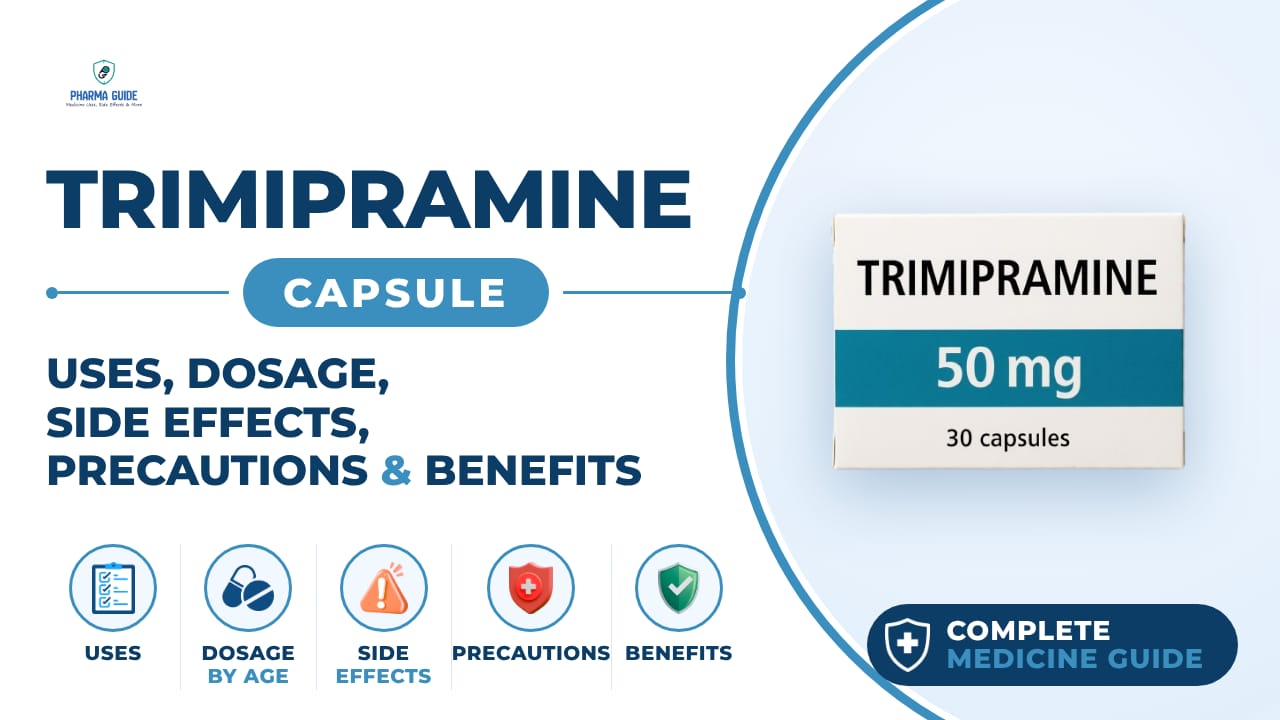
| Generic name | trimipramine, trimipramine maleate |
|---|---|
| Drug class | tricyclic antidepressant (TCA) |
| Forms | Oral capsule (25 mg, 50 mg, 100 mg) |
Quick overview
Trimipramine Capsule (trimipramine, trimipramine maleate) is a prescription tricyclic antidepressant (TCA) used to treat depression in adults, including major depressive disorder. It is thought to work by changing the levels of certain natural brain chemicals, such as serotonin and norepinephrine, to help improve mood. It is available as an oral capsule and carries a boxed warning about increased risk of suicidal thoughts and actions in people 24 and younger.
What is Trimipramine Capsule
Trimipramine is a prescription medicine used to treat depression. It belongs to a group of medicines called tricyclic antidepressants (TCAs).
Trimipramine Capsule uses
- Treats depression in adults
- Treats major depressive disorder
- Helps improve mood
- May reduce anxiety associated with depression
- May improve sleep disturbance related to depression
- Helps reduce other depressive symptoms
Benefits of Trimipramine Capsule
- Can help relieve symptoms of depression such as sadness, loss of interest, and changes in sleep or appetite
- May help improve mood over time with consistent use
- Can improve depressive symptoms
- May improve sleep
- May improve energy and daily functioning
- Provides another option when other antidepressants are unsuitable
How Trimipramine Capsule works
Trimipramine is thought to work by changing the levels of certain natural chemicals in the brain, such as serotonin and norepinephrine, which helps improve mood and relieve depression symptoms.
Trimipramine Capsule dosage
Trimipramine is taken by mouth, usually one to three times a day. Take it at around the same time each day to keep a steady level of the medicine in your body. It can be taken with or without food. Your doctor may start you on a low dose and slowly increase it over time, and it may take several weeks before you notice the full benefit.
Keep taking it even if you feel well, unless your doctor tells you to stop. Do not stop taking this medicine suddenly without talking to your doctor. If you miss a dose, take it as soon as you remember, but if it's almost time for your next dose, skip the missed one — do not double up.
| Age group | Dose |
|---|---|
| Under 18 years | Not recommended |
| 18–64 years | 75 mg, once/day |
| 65+ years | 25 mg, once/day |
Available forms and strengths
Oral capsule (25 mg, 50 mg, 100 mg)
Side effects of Trimipramine Capsule
Common
- Blurred vision
- Changes in taste
- Confusion
- Difficulty sleeping or nightmares
- Constipation, diarrhea, nausea, or vomiting
- Dizziness
- Drowsiness
- Dry mouth
- Feeling anxious, restless, or agitated
- Loss of coordination
- Numbness or tingling in arms or legs
- Skin rash or itching
- Sweating
- Ringing in the ears
- Weight gain or loss
- Inability to empty your bladder
- Headache
- Weakness or tiredness
- Changes in appetite or weight
- Frequent urination
- Changes in sex drive or ability
Serious
- Serotonin syndrome
- Irregular heart rhythm or other heart rhythm changes
- High or low blood sugar
- Hypomania or mania
- Seizures
- Involuntary movements (extrapyramidal symptoms)
- Urinary retention
- Low white blood cell or platelet levels
- Breast enlargement
- Liver problems
- Severe allergic reaction, including swelling of face, lips, mouth, tongue, or throat, or trouble breathing
- Angle-closure glaucoma, with eye pain, vision changes, or seeing halos around lights
- Suicidal thoughts or actions
- Jaw, neck, and back muscle spasms, slow or difficult speech, shuffling walk, or uncontrollable shaking
- Fever and sore throat
- Yellowing of skin or eyes
- Hallucinating (seeing or hearing things that are not there)
- Chest pain or pounding/irregular heartbeat
Warnings and precautions
- Trimipramine carries a boxed warning, the FDA's most serious warning, about increased risk of suicidal thoughts and actions in people 24 and younger, especially early in treatment or after dose changes.
- Trimipramine should not be taken if you have recently had a heart attack.
- Trimipramine can cause dangerous heart rhythm changes, especially in older adults or people with certain risk factors.
- Trimipramine can make skin more sensitive to sunlight, raising the risk of severe sunburn.
- Trimipramine may cause a sudden, severe increase in eye pressure (angle-closure glaucoma) that can lead to vision loss.
- Do not stop taking trimipramine suddenly without talking to your doctor, as this can cause withdrawal symptoms.
- Older adults (65 and older) may be at higher risk for some side effects and this medicine is usually not recommended for them because it may not be as safe as other options.
- Trimipramine is not approved for use in children.
- It is not known if trimipramine is safe during pregnancy or if it could harm an unborn baby. Tell your doctor if you are pregnant or planning to become pregnant.
- It is not known if trimipramine passes into breast milk, so tell your doctor if you are breastfeeding or plan to.
- Tell your doctor if you have kidney disease before taking trimipramine.
- Tell your doctor if you have liver disease before taking trimipramine.
- Avoid alcohol while taking trimipramine, since it can increase drowsiness, confusion, and dizziness.
- Trimipramine can affect alertness and coordination. Do not drive or operate machinery until you know how it affects you.
Storage
- Keep this medication in the container it came in, tightly closed, and out of reach of children.
- Store it at room temperature and away from excess heat and moisture (not in the bathroom).
- Dispose of unneeded medications in a way so that pets, children, and other people cannot take them. Do not flush this medication down the toilet. Use a medicine take-back program.
When to see a doctor
- Get emergency help right away if you have symptoms of a severe allergic reaction, such as swelling of the face, lips, mouth, tongue, or throat, trouble breathing, or difficulty swallowing.
- Call your doctor right away if you or a family member notices new or worsening depression, thoughts of harming yourself, panic attacks, severe restlessness, or unusual changes in behavior or mood.
- Seek emergency care if you have symptoms of serotonin syndrome, such as high fever, confusion, agitation, fast heartbeat, muscle twitching or stiffness, or seizures.
- Call your doctor or get emergency care if you have eye pain, vision changes, seeing halos around lights, nausea, or swelling or redness in or around the eye, since these may be signs of a serious eye problem.
- Get medical help right away if you faint or notice a fast, skipping, or irregular heartbeat.
- Call your doctor immediately or get emergency care if you have signs of a blood disorder, such as fever, easy bruising or bleeding, frequent infections, or sore throat.
- Call your doctor or get emergency treatment if you experience jaw, neck, or back muscle spasms, uncontrollable shaking, slow or slurred speech, difficulty breathing or swallowing, rash, yellowing of skin or eyes, seizures, hallucinations, chest pain, or an irregular heartbeat.
- If you think you've taken too much trimipramine, contact your doctor or a poison control center right away; call emergency services if there are severe symptoms like collapse, seizure, trouble breathing, or unresponsiveness.
Alternatives
- Amitriptyline
- Nortriptyline
- Imipramine
Watch the video
FAQs
What is Trimipramine Capsule used for?
Trimipramine is a prescription tricyclic antidepressant used to treat depression in adults, including major depressive disorder. It may also help reduce anxiety and improve sleep disturbance associated with depression.
How does Trimipramine Capsule work?
Trimipramine is thought to work by changing the levels of certain natural brain chemicals, such as serotonin and norepinephrine, which helps improve mood and relieve depression symptoms.
What is the usual dosage for Trimipramine Capsule?
Trimipramine is taken by mouth, usually one to three times a day, with or without food. Adults 18–64 typically take 75 mg once daily, while adults 65 and older typically take 25 mg once daily. It is not recommended for those under 18.
What are the serious side effects of Trimipramine Capsule?
Serious side effects include serotonin syndrome, irregular heart rhythm, seizures, urinary retention, liver problems, severe allergic reactions, angle-closure glaucoma, hallucinations, and suicidal thoughts or actions.
Does Trimipramine Capsule have a boxed warning?
Yes, it carries a boxed warning, the FDA's most serious warning, about increased risk of suicidal thoughts and actions in people 24 and younger, especially early in treatment or after dose changes.
General information, not medical advice
Your prescriber and the leaflet in your pack know your situation. This page does not.
- Follow your prescriber and the leaflet
- Don't start, stop, or change a dose on your own
- Doses and warnings differ by country and product
Sources
Video
Related medicines
Vivactil Tablet: Uses, Dosage, Side Effects, Precautions and Alternates
Tricyclic antidepressant (TCA)
Vivactil Tablet (protriptyline) is a tricyclic antidepressant for depression, especially in withdrawn or low-energy patients. Learn dosage, uses, and side
Pamelor Capsule: Uses, Dosage, Side Effects, Precautions and Alternates
Tricyclic antidepressant (TCA)
Pamelor Capsule (nortriptyline) treats depression in adults by raising mood-related brain chemicals. Learn uses, dosage, side effects, and precautions.