
Safety
General information, not medical advice
Your prescriber and the leaflet in your pack know your situation. This page does not.
- Follow your prescriber and the leaflet
- Don't start, stop, or change a dose on your own
- Doses and warnings differ by country and product
Valtoco Nasal Spray: Uses, Dosage, Side Effects, Precautions and Alternates
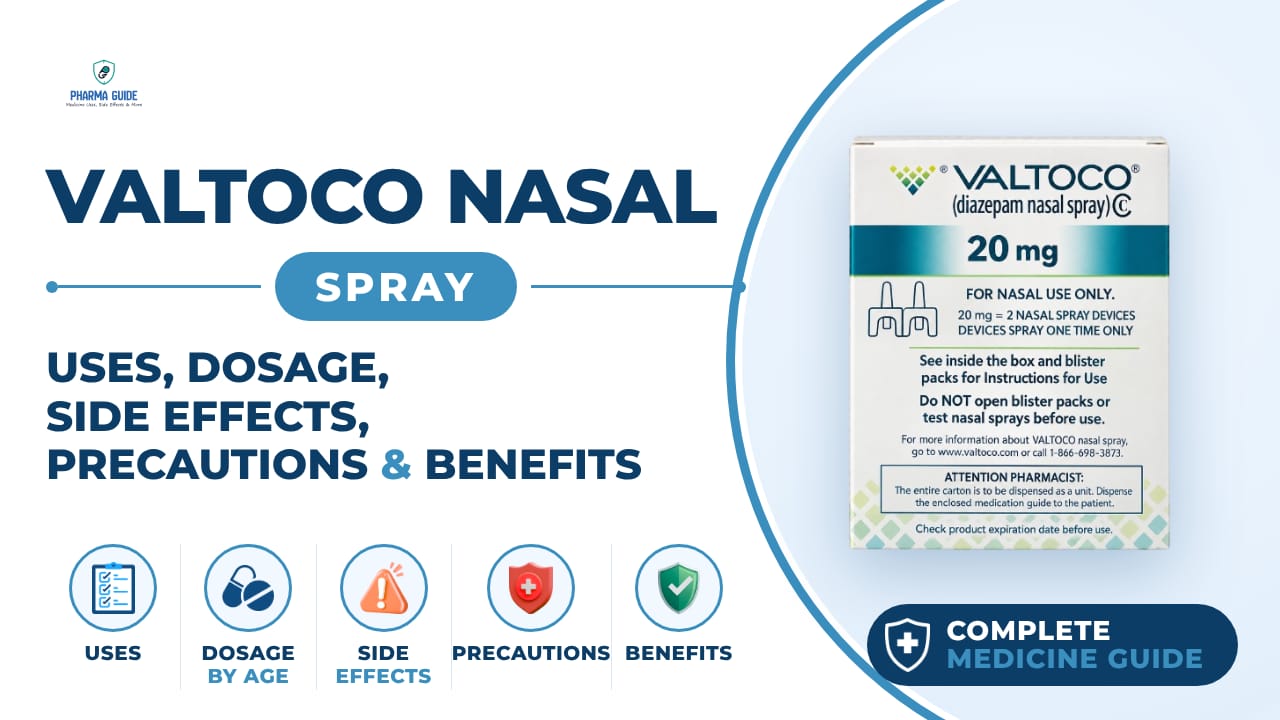
| Generic name | diazepam nasal spray |
|---|---|
| Drug class | Benzodiazepine anticonvulsant |
| Forms | Nasal Spray |
Quick overview
Valtoco Nasal Spray contains diazepam, a benzodiazepine anticonvulsant medicine. It is a prescription nasal spray used for the short-term treatment of seizure clusters (acute repetitive seizures) that differ from a person's usual seizure pattern, in people 2 years of age and older. It is meant for occasional, intermittent use and works by boosting the calming effect of a brain chemical called GABA.
What is Valtoco Nasal Spray
Valtoco is a prescription nasal spray containing diazepam, a benzodiazepine medicine. It is used for the short-term treatment of seizure clusters (also called acute repetitive seizures) that are different from a person's usual seizure pattern, in people 2 years of age and older.
Valtoco Nasal Spray uses
- Acute treatment of intermittent, stereotypic episodes of frequent seizure activity (seizure clusters, acute repetitive seizures) that are distinct from a patient's usual seizure pattern, in people with epilepsy 2 years of age and older.
Benefits of Valtoco Nasal Spray
- Helps control seizure clusters.
- Reduces repeated seizures.
- Provides emergency seizure treatment.
- Delivers medicine through the nose.
- Helps manage sudden seizure episodes.
How Valtoco Nasal Spray works
Valtoco contains diazepam, which is thought to boost the calming effect of a brain chemical called GABA. It attaches to specific sites on GABA receptors in the brain and nervous system, which strengthens calming signals and helps reduce seizure activity.
Valtoco Nasal Spray dosage
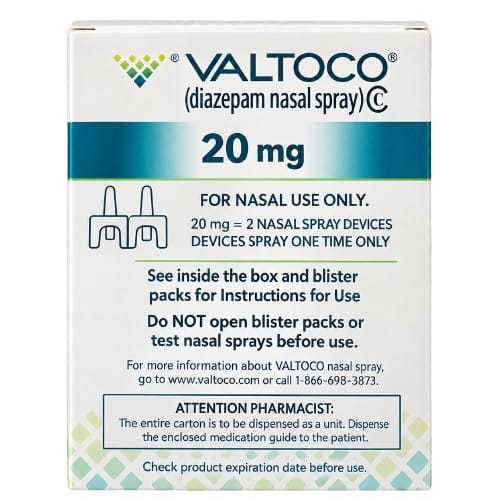
This medicine is given only as a nasal spray; it is not for oral, rectal, or injected use. Do not test or prime the device before use — it releases the full dose the first time it is pressed. Each device sprays only one time and cannot be reused. Use all of the medicine in one pack to get a complete dose. If the dose requires two devices, give one spray in each nostril. The device can be used with the person's head in any position and does not require them to breathe in deeply.
Stay with the person after giving the dose and watch them closely, noting the time the dose was given. A second dose may be given at least 4 hours after the first dose, using a new pack, if needed. Do not give more than 2 doses to treat one seizure cluster episode. Do not give a second dose if there is concern about the person's breathing, if they need help breathing, or if they have extreme drowsiness.
Do not use this medicine to treat more than one seizure cluster episode every 5 days, or more than 5 episodes in one month. This medicine is meant for occasional, intermittent use, not daily use.
| Age group | Dose |
|---|---|
| Under 18 years | Not recommended |
| 18–64 years | 5–20 mg/day |
| 65+ years | 5–20 mg/day |
Available forms and strengths
- Nasal Spray
Side effects of Valtoco Nasal Spray
Common
- Sleepiness or drowsiness
- Headache
- Diarrhea
- Lack of coordination
- Changes in sense of taste
- Dizziness
- Nasal discomfort or nosebleeds
Serious
- Slowed or shallow breathing, or breathing that stops
- Extreme sleepiness or difficulty waking up
- Slurred speech
- Suicidal thoughts or actions, new or worsened depression or anxiety, agitation, or unusual mood changes
- Signs of misuse, abuse, or addiction
- Signs of physical dependence or withdrawal if stopped suddenly or used too often
- Severe allergic reaction, including swelling of the face, lips, mouth, tongue, or throat, or trouble breathing
- Increased eye pressure in people with glaucoma
Warnings and precautions
Using this medicine together with opioid medicines can cause severe sedation, slowed or stopped breathing, coma, and death. Tell your doctor about any opioid use before starting this medicine.
This medicine carries a risk of abuse, misuse, and addiction, which can lead to overdose or death, even when taken as prescribed.
Using this medicine more often than recommended can lead to physical dependence. Stopping it suddenly or lowering the dose too quickly can cause serious, life-threatening withdrawal reactions, so any changes should be done gradually and under medical supervision.
This medicine should not be used by people who have had an allergic reaction to diazepam, or who have an eye condition called acute narrow-angle glaucoma.
This medicine can cause an increase in eye pressure in people with glaucoma, and should only be used in people with open-angle glaucoma if they are already receiving appropriate treatment for it.
This medicine is not approved for use in babies or children under 2 years old, and using it in newborns can cause a serious and sometimes fatal reaction called gasping syndrome.
Like other seizure medicines, this medicine may increase the risk of suicidal thoughts or actions in a small number of people.
Using Valtoco late in pregnancy may cause the baby to have breathing problems, sluggishness, low muscle tone, or withdrawal symptoms such as jitteriness, irritability, restlessness, shaking, excessive crying, or feeding problems after birth. Tell your doctor right away if you become pregnant while using this medicine.
This medicine passes into breast milk and may cause the baby to become sleepy, feed poorly, or gain less weight than expected. Talk to your doctor about the best way to feed your baby if you are using this medicine.
Tell your doctor if you have kidney problems before using this medicine.
Tell your doctor if you have liver problems before using this medicine, as this can change how the medicine is processed by your body.
Avoid drinking alcohol while using this medicine, as it can lead to dangerous side effects such as severe drowsiness and breathing problems.
Do not drive, operate heavy machinery, or do other activities that require alertness until you know how this medicine affects you, since it can cause drowsiness, dizziness, and slowed thinking or coordination.
Storage
- Store at room temperature between 68°F to 77°F (20°C to 25°C).
- Do not freeze.
- Keep it in its blister pack until ready to use.
- Protect from light.
- Keep out of the reach of children.
- Do not open individual blister packs or test the nasal spray devices before use.
- Do not use if the nasal spray unit appears damaged.
- Throw away (discard) the used device after giving a dose.
When to see a doctor
Get emergency medical help right away if breathing becomes slow or shallow, breathing stops, or the person becomes extremely sleepy or hard to wake, especially if combined with opioids, alcohol, or other sedating drugs.
Call a doctor or go to the nearest hospital emergency room right away for signs of serious side effects from misuse, including confusion, paranoia, suicidal thoughts, seizures, or trouble breathing.
Call a doctor or go to the emergency room right away if stopping the medicine causes unusual movements, seizures, severe mental changes, hallucinations, extreme increases in activity, or suicidal thoughts or actions.
Call a doctor right away for any new or worsening suicidal thoughts, agitation, aggression, panic attacks, insomnia, mania, anxiety, irritability, or other unusual mood or behavior changes.
After giving a dose for a seizure cluster, call for emergency help if the seizure behaves differently than the person's usual seizures, or if you are alarmed by how often, how severe, or how long the seizures last, or by the person's color or breathing.
Seek emergency medical attention right away in case of an overdose, which may include drowsiness, confusion, muscle weakness, or loss of consciousness.
Call a doctor right away if mild allergic symptoms occur, such as skin rash, itching, flushing, or swelling of the eyelids, lips, hands, or feet; seek emergency care immediately if swelling of the mouth, tongue, or throat makes it hard to breathe.
Alternatives
- Clonazepam
- Midazolam
- Nayzilam
Watch the video
FAQs
What is Valtoco Nasal Spray used for?
Valtoco is used for the short-term treatment of seizure clusters (acute repetitive seizures) that differ from a person's usual seizure pattern, in people 2 years of age and older.
How does Valtoco Nasal Spray work?
Valtoco contains diazepam, which boosts the calming effect of a brain chemical called GABA by attaching to specific sites on GABA receptors, strengthening calming signals and helping reduce seizure activity.
How many doses of Valtoco can be given for one seizure cluster?
A second dose may be given at least 4 hours after the first dose if needed, but no more than 2 doses should be given to treat one seizure cluster episode.
How often can Valtoco Nasal Spray be used?
This medicine should not be used to treat more than one seizure cluster episode every 5 days, or more than 5 episodes in one month, as it is meant for occasional, intermittent use, not daily use.
What are the serious side effects of Valtoco Nasal Spray?
Serious side effects include slowed or shallow breathing, extreme sleepiness or difficulty waking up, slurred speech, suicidal thoughts, signs of misuse or dependence, severe allergic reactions, and increased eye pressure in people with glaucoma.
General information, not medical advice
Your prescriber and the leaflet in your pack know your situation. This page does not.
- Follow your prescriber and the leaflet
- Don't start, stop, or change a dose on your own
- Doses and warnings differ by country and product
Sources
Video
Related medicines
Diazepam Gel: Uses, Dosage, Side Effects, Precautions and Alternates
Benzodiazepine anticonvulsant
Diazepam Gel is a rectal benzodiazepine used to stop acute repetitive seizures in epilepsy patients age 2+. Learn uses, dosage, side effects, and warnings.

Injectafer Injection: Uses, Dosage, Side Effects, Precautions and Alternates
Iron products
Injectafer (ferric carboxymaltose) treats iron deficiency anemia and heart failure-related iron deficiency via IV. Learn uses, dosage, side effects, and