
Safety
General information, not medical advice
Your prescriber and the leaflet in your pack know your situation. This page does not.
- Follow your prescriber and the leaflet
- Don't start, stop, or change a dose on your own
- Doses and warnings differ by country and product
Abemaciclib Tablet: Uses, Dosage, Side Effects, Precautions and Alternates
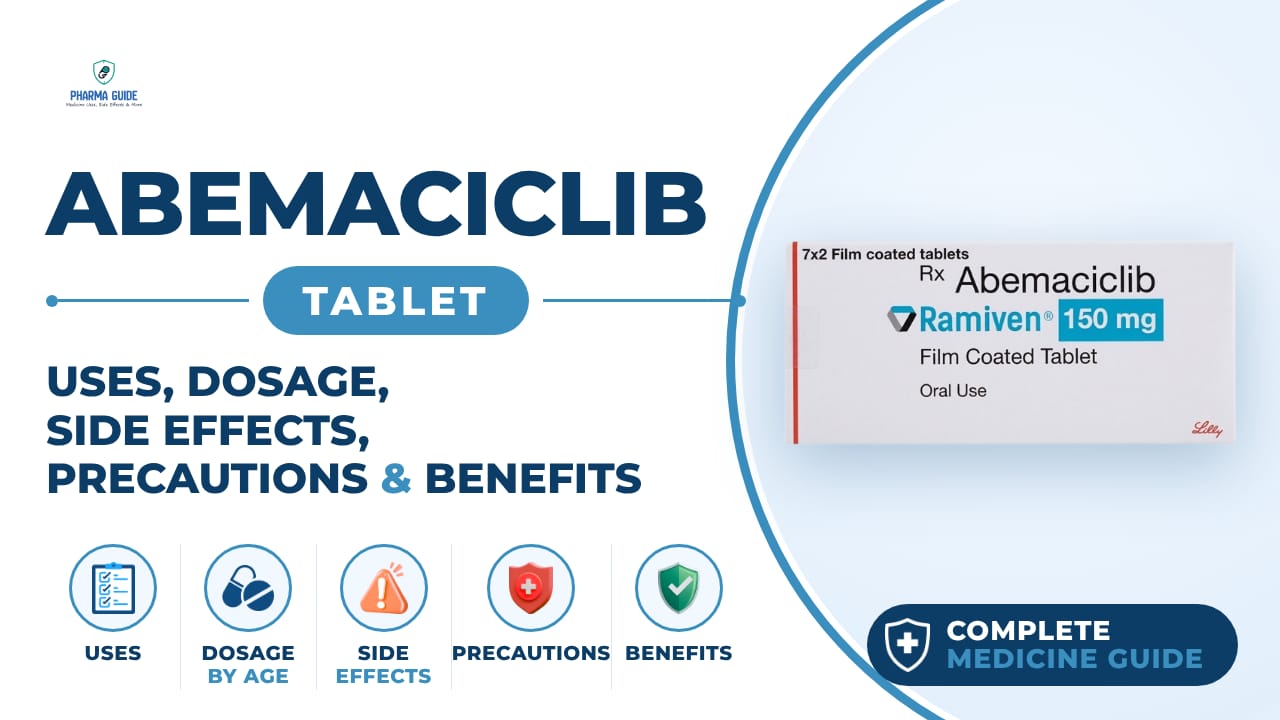
| Generic name | abemaciclib |
|---|---|
| Drug class | CDK4/6 (cyclin dependent kinase) inhibitor |
| Forms | Tablet |

Quick overview
Abemaciclib Tablet, also known by the brand name Verzenio, is a targeted cancer therapy belonging to the CDK4/6 inhibitor class. It is used to treat certain types of hormone receptor-positive, HER2-negative breast cancer, often in combination with hormone therapy. It works by blocking proteins that cancer cells need to grow and divide, helping to slow or stop the cancer's spread.
What is Abemaciclib Tablet
Abemaciclib is a targeted cancer therapy tablet, also known by the brand name Verzenio. It is used to treat certain types of hormone receptor-positive, HER2-negative breast cancer.
Abemaciclib Tablet uses
- Treatment of hormone receptor (HR)-positive, HER2-negative, node-positive early breast cancer at high risk of recurrence, given after surgery along with hormone therapy
- Treatment of HR-positive, HER2-negative advanced or metastatic breast cancer, in combination with an aromatase inhibitor as initial hormone-based therapy
- Treatment of HR-positive, HER2-negative advanced or metastatic breast cancer that has progressed after hormone therapy, in combination with fulvestrant
- Treatment of ER-positive, HER2-negative, ESR1-mutated advanced or metastatic breast cancer that has progressed after hormone therapy, in combination with imlunestrant
- Treatment alone (monotherapy) for HR-positive, HER2-negative advanced or metastatic breast cancer that has progressed after hormone therapy and chemotherapy
Benefits of Abemaciclib Tablet
- Blocks proteins that cause cancer cells to grow and multiply, helping to slow or stop the spread of cancer
- Lowers the risk of early breast cancer coming back after surgery when used with hormone therapy
- Can slow the progression of advanced or metastatic breast cancer and help people live longer
How Abemaciclib Tablet works
Abemaciclib blocks proteins called CDK4 and CDK6 that cancer cells need to grow and divide. By blocking these proteins, it stops the cancer cells from multiplying, which can slow or stop the cancer from growing and spreading.
Abemaciclib Tablet dosage
Take your tablets about the same time each day, about 12 hours apart. Swallow the tablets whole with water; do not crush, chew, dissolve, or split them. Do not take a tablet if it is broken, cracked, or otherwise not intact.
You can take it with or without food; if it upsets your stomach, take it with food. If you miss a dose, skip it and take your next dose at the usual time; do not take an extra dose. If you vomit after taking a dose, do not take another dose; take your next dose at the usual time.
Abemaciclib is usually given together with a hormone therapy drug such as an aromatase inhibitor, tamoxifen, or fulvestrant. For early breast cancer, treatment is usually continued for about 2 years; for advanced or metastatic breast cancer, treatment continues for as long as it is helping and side effects are manageable. Abemaciclib is not approved for use in children.
| Age group | Dose |
|---|---|
| Under 18 years | Under 18 years |
| 18–64 years | 150 mg, twice/day |
| 65+ years | 150 mg, twice/day |
Available forms and strengths
- Tablet
Side effects of Abemaciclib Tablet
Common
- Diarrhea
- Nausea and vomiting
- Loss of appetite
- Change in taste
- Low blood cell counts (affecting red cells, white cells, and platelets)
- Extreme tiredness (fatigue)
- Liver enzyme changes
- Skin changes, such as rash or dryness
- Hair thinning or hair loss
- Sore mouth
- Dizziness
- Headaches
- Stomach area (abdominal) pain
Serious
- Severe diarrhea leading to dehydration
- Low white blood cell counts (neutropenia), which can lead to serious infection
- Interstitial lung disease or pneumonitis (lung inflammation) causing cough or shortness of breath
- Liver problems, including yellowing of skin or eyes, dark urine, or severe fatigue
- Blood clots (such as deep vein thrombosis or pulmonary embolism)
- Allergic reactions, including swelling of the face, lips, tongue, or throat, and difficulty breathing
- Low red blood cell counts (anemia) causing breathlessness, dizziness, or tiredness
- Unusual bruising or bleeding due to low platelet counts
- Increased risk of heart attack or stroke when combined with hormone treatment for metastatic breast cancer
Warnings and precautions
- Abemaciclib can harm an unborn baby, so you should not become pregnant while taking it.
- A pregnancy test is needed before starting treatment, and effective contraception should be used during treatment and for at least 3 weeks after the last dose.
- You should not breastfeed during treatment with abemaciclib and for at least 3 weeks after your last dose, because the drug could pass into breast milk.
- No dose change is needed for mild or moderate kidney problems.
- It isn't known how the drug behaves in people with severe kidney impairment or those on dialysis.
- Abemaciclib can raise blood creatinine levels without actually affecting how well the kidneys work, so doctors may use other tests to check kidney function.
- No dose change is needed for mild or moderate liver problems, but people with severe liver impairment need a lower dosing frequency.
- Abemaciclib can also cause liver injury, so liver function will be checked with blood tests before and during treatment.
- Alcohol may worsen dehydration or liver-related adverse effects, so the oncology team should advise on use.
- Fatigue or other treatment effects may affect the ability to drive safely.
- Avoid grapefruit and grapefruit juice while taking abemaciclib, as they can raise the amount of the drug in your blood.
- Avoid taking supplements containing St John's Wort while on this medicine.
- Tell your treatment team about all medicines you take, especially anything containing ketoconazole, as well as certain antibiotics, antifungals, antivirals, and anti-epileptic drugs, since these can interact with abemaciclib.
- Abemaciclib contains lactose, so tell your treatment team if you are lactose intolerant.
- Do not have any live vaccines while having treatment with abemaciclib.
- Abemaciclib may affect fertility in men; talk to your treatment team about sperm preservation options before starting treatment if this concerns you.
Storage
- Store at room temperature between 20 and 25 degrees C (68 and 77 degrees F)
- Get rid of any unused medication after the expiration date
- Take the medication to a medication take-back program; check with your pharmacy or law enforcement to find a location
- If you cannot return the medication, ask your pharmacist or care team how to get rid of this medication safely
- Keep out of the reach of children and pets
When to see a doctor
- Contact your treatment team right away if you have a high or low temperature, suddenly feel unwell, or have signs of infection such as a sore throat, cough, needing to pee often, or feeling cold or shivery.
- Get medical help immediately if you notice signs of a blood clot, such as pain, redness, heat or swelling in an arm or leg, sudden shortness of breath, chest pain or tightness, or an unexplained cough or coughing up blood.
- Contact your treatment team straight away if you have shortness of breath, a cough (with or without fever), or any new or worsening breathing problems such as chest tightness or wheezing, as these could be signs of lung inflammation.
- Seek immediate medical help if you notice signs of an allergic reaction, including breathlessness, wheezing, a bad cough or sudden difficulty breathing, chest tightness or pain, swelling of the lips, tongue or throat, or itchy red or discolored bumps on the skin.
- Contact your treatment team if diarrhea continues despite anti-diarrhea medicine, or if you have diarrhea 3 or more times in 24 hours compared with what's usual for you.
- Contact your treatment team if you vomit 3 or more times in 24 hours or are finding it difficult to eat and drink.
- Tell your healthcare provider right away if you develop signs of liver problems, such as feeling very tired, pain in the upper right side of your stomach area, loss of appetite, or yellowing of the skin or eyes.
Alternatives
- Palbociclib
- Ribociclib
- Tamoxifen
Watch the video
FAQs
What is Abemaciclib Tablet used for?
It treats HR-positive, HER2-negative breast cancer, including early breast cancer after surgery with hormone therapy, and advanced or metastatic breast cancer in combination with an aromatase inhibitor, fulvestrant, or imlunestrant, or alone after prior hormone therapy and chemotherapy.
How is Abemaciclib Tablet taken?
It is taken about 12 hours apart at the same times each day, swallowed whole with water without crushing, chewing, or splitting. It can be taken with or without food, and with food if it upsets your stomach. If a dose is missed, skip it and resume at the next scheduled time.
What are the common side effects of Abemaciclib Tablet?
Common side effects include diarrhea, nausea and vomiting, loss of appetite, taste changes, low blood cell counts, fatigue, liver enzyme changes, skin changes, hair thinning, sore mouth, dizziness, headaches, and abdominal pain.
What precautions should be followed while taking Abemaciclib Tablet?
Avoid pregnancy and breastfeeding during treatment and for at least 3 weeks after the last dose, avoid grapefruit and St John's Wort, avoid live vaccines, inform your care team about lactose intolerance, and discuss all other medicines due to possible interactions.
When should I contact my doctor while on Abemaciclib Tablet?
Seek help for signs of infection, blood clots, lung inflammation symptoms like cough or shortness of breath, allergic reactions, persistent diarrhea or vomiting, or signs of liver problems such as yellowing skin or severe fatigue.
General information, not medical advice
Your prescriber and the leaflet in your pack know your situation. This page does not.
- Follow your prescriber and the leaflet
- Don't start, stop, or change a dose on your own
- Doses and warnings differ by country and product
Sources
Video
Related medicines

Injectafer Injection: Uses, Dosage, Side Effects, Precautions and Alternates
Iron products
Injectafer (ferric carboxymaltose) treats iron deficiency anemia and heart failure-related iron deficiency via IV. Learn uses, dosage, side effects, and

Gliclazide Tablet: Uses, Dosage, Side Effects, Precautions and Alternates
Sulfonylurea (hypoglycemic/antidiabetic agent)
Gliclazide Tablet is a sulfonylurea for type 2 diabetes that boosts insulin release. Learn about dosage, side effects, warnings, and precautions.