
Safety
General information, not medical advice
Your prescriber and the leaflet in your pack know your situation. This page does not.
- Follow your prescriber and the leaflet
- Don't start, stop, or change a dose on your own
- Doses and warnings differ by country and product
Adagrasib Tablet: Uses, Dosage, Side Effects, Precautions and Alternates
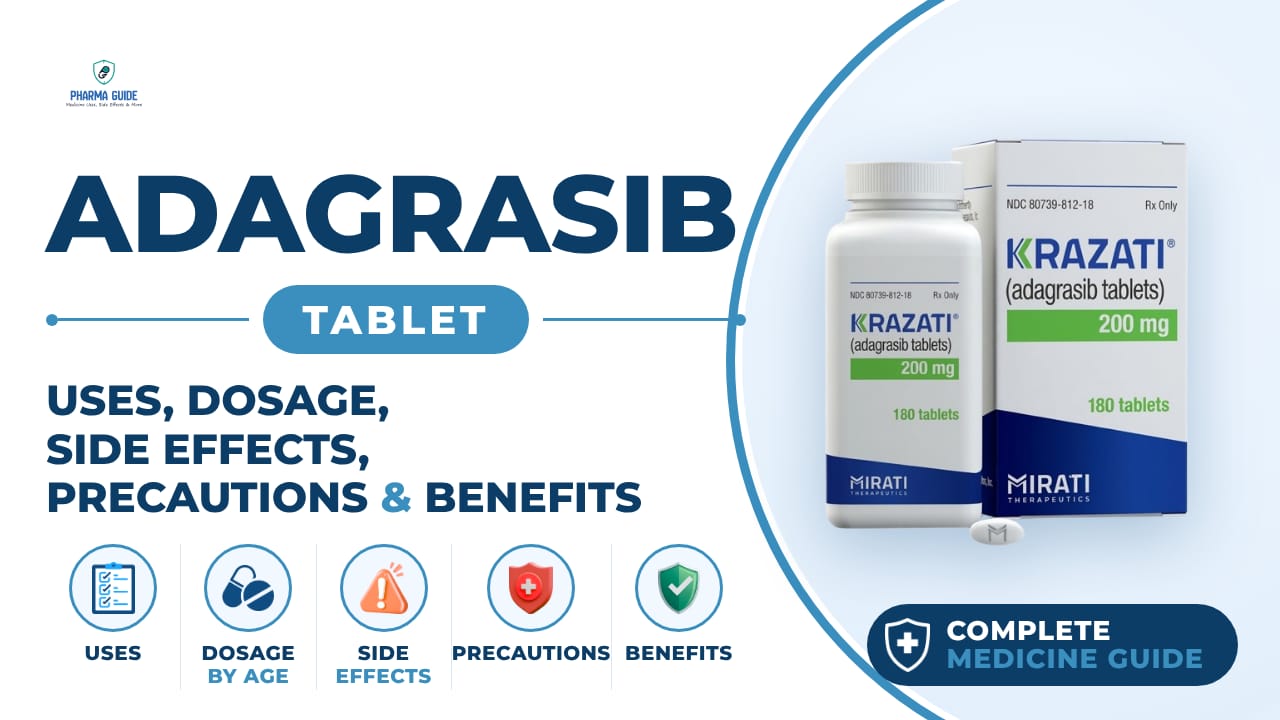
| Generic name | adagrasib |
|---|---|
| Drug class | KRAS inhibitor (RAS GTPase family inhibitor) |
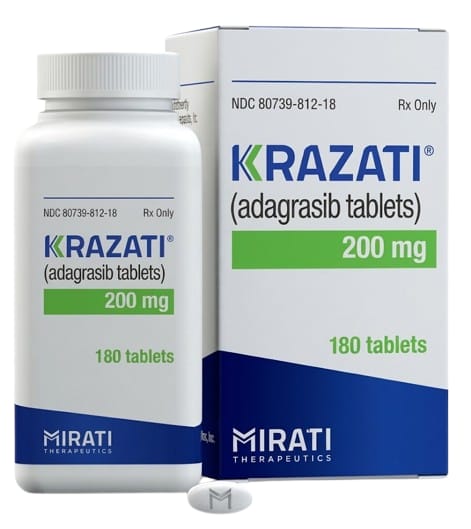
| Forms | Tablet (200 mg, film-coated) |
Quick overview
Adagrasib Tablet (generic name: adagrasib) is a prescription cancer medicine belonging to the KRAS inhibitor class. It is used in adults whose tumors have a specific abnormal gene change called KRAS G12C, including non-small cell lung cancer (NSCLC) that is locally advanced or metastatic. It is taken as a tablet twice daily, and dosing and use should always follow your doctor's instructions.
What is Adagrasib Tablet
Adagrasib is a prescription cancer medicine taken as a tablet. It is used in adults whose tumors have a specific abnormal gene change called KRAS G12C.
Adagrasib Tablet uses
- KRAS G12C-mutated non-small cell lung cancer (NSCLC).
- Locally advanced NSCLC with a confirmed KRAS G12C mutation.
- Metastatic NSCLC with a confirmed KRAS G12C mutation.
- NSCLC that has progressed after at least one prior systemic treatment.
- Selected cases where molecular testing confirms the targetable mutation.
Benefits of Adagrasib Tablet
- Targets cancer cells with the KRAS G12C mutation.
- Helps slow cancer-cell growth.
- May shrink tumors in eligible patients.
- May help control cancer progression.
- May help manage advanced cancer after previous treatment.
How Adagrasib Tablet works
Adagrasib works by attaching to and blocking the abnormal KRAS G12C protein that signals cancer cells to grow, locking it in an inactive state so it cannot send growth signals, which can slow or stop the cancer from growing.
Adagrasib Tablet dosage
Take your prescribed dose twice each day at about the same time each day. It can be taken with or without food. Swallow tablets whole; do not chew, crush, or split them. If you have trouble swallowing tablets, they may be dispersed in water as directed by your doctor rather than crushed or chewed. If you vomit after taking a dose, do not take an extra dose—just take your next dose at the regular scheduled time. If a dose is missed by more than 4 hours, skip that dose and take the next dose at its regular scheduled time; do not double up doses. Continue taking this medicine even if you feel well, and do not stop without talking to your doctor.
| Age group | Dose |
|---|---|
| Under 18 years | Not recommended |
| 18–64 years | 600 mg, twice/day |
| 65+ years | 600 mg, twice/day |
Available forms and strengths
- Tablet (200 mg, film-coated)
Side effects of Adagrasib Tablet
Common
- Nausea
- Diarrhea
- Vomiting
- Fatigue
- Musculoskeletal pain
- Liver enzyme changes (hepatotoxicity)
- Kidney problems (renal impairment)
- Swelling (edema)
- Shortness of breath
- Decreased appetite
- Decreased white blood cells
- Decreased hemoglobin (anemia)
- Low blood potassium
- Low blood sodium
- Increased lipase
- Dizziness
- Constipation
- Abdominal pain
- Rash
- Dry skin
- Numbness or tingling in hands or feet
Serious
- Severe gastrointestinal problems including bleeding, obstruction, colitis, or stenosis
- QT interval prolongation (abnormal heart electrical activity) that can lead to life-threatening irregular heartbeats
- Liver injury (hepatotoxicity) including signs like yellowing of skin/eyes, dark urine, light-colored stools, loss of appetite, tiredness, abdominal pain
- Interstitial lung disease/pneumonitis (lung inflammation) which can be fatal
- Severe skin reactions such as Stevens-Johnson syndrome, toxic epidermal necrolysis, and DRESS
- Allergic reaction signs such as hives, difficulty breathing, swelling of face, lips, tongue, or throat
- Fainting or seizures
- Fast, irregular, or pounding heartbeat
- Signs of gastrointestinal bleeding such as bloody or tarry stools, or vomit resembling coffee grounds
Warnings and precautions
- Adagrasib can cause severe gastrointestinal problems including bleeding, blockage, colitis, and narrowing of the intestine.
- Adagrasib can prolong the QTc interval of the heart, increasing risk of dangerous irregular heartbeats and sudden death; avoid other medicines that also prolong QT interval.
- Adagrasib can cause liver injury and hepatitis; liver function tests should be monitored before and during treatment.
- Adagrasib can cause lung inflammation (interstitial lung disease/pneumonitis), which can be fatal.
- Serious and potentially fatal skin reactions have been reported with this medicine, including Stevens-Johnson syndrome and toxic epidermal necrolysis.
- This medicine must not be combined with certain other drugs that are highly dependent on the liver enzyme CYP3A for clearance, because it could raise their levels to dangerous amounts.
- Adagrasib is not recommended during pregnancy, as there is no data on its safety in pregnant women and it is not known if it could harm an unborn baby. Women who can become pregnant should use effective contraception during treatment and for a period after the last dose.
- Women should not breastfeed during treatment with adagrasib and for one week after the final dose, since it is not known if the drug passes into breast milk.
- No dose adjustment is needed for patients with mild, moderate, or severe kidney impairment, though kidney function may still be affected by the medicine itself.
- No dose adjustment is required based on liver impairment alone, but the drug itself can cause liver injury, so liver function tests are needed before and during treatment.
- Adagrasib has only a minor effect on the ability to drive or use machines, but dizziness can occur, so caution is advised if affected.
Storage
- Store tablets at room temperature between 68°F to 77°F (20°C to 25°C)
- Keep the tablets in their original container along with the packet or canister of moisture-absorbing preservative (desiccant); do not remove or eat the desiccant
- Keep the bottle tightly closed and protect from moisture
- Keep out of the sight and reach of children
- Dispose of unneeded medication through a medicine take-back program rather than flushing it down the toilet
When to see a doctor
- Get emergency help right away if you have signs of a severe allergic reaction, such as hives, trouble breathing, or swelling of the face, lips, tongue, or throat.
- Call your doctor immediately if you notice signs of liver problems such as yellowing skin or eyes, dark urine, pale stools, loss of appetite, tiredness, or pain in the upper right abdomen.
- Seek medical attention for signs of stomach bleeding, such as bloody or tarry stools or vomit that looks like coffee grounds.
- Contact your doctor or get emergency care if you develop new or worsening shortness of breath, cough, or fever, which could signal lung inflammation.
- Seek medical attention immediately if you notice signs of a severe skin reaction, such as a widespread rash, blistering, skin peeling, or mouth/eye ulcers, sometimes with fever.
- Tell your doctor right away if you feel dizzy, lightheaded, or faint, or notice an irregular or fast heartbeat, as this could indicate a heart rhythm problem.
- If you take more adagrasib than prescribed, contact your doctor, pharmacist, or local poison control center right away, or seek emergency care.
Alternatives
- Atezolizumab
- Olomorasib
- Sotorasib
Watch the video
FAQs
What is Adagrasib Tablet used for?
Adagrasib is a prescription cancer medicine used in adults with locally advanced or metastatic non-small cell lung cancer (NSCLC) that has a confirmed KRAS G12C mutation, typically after at least one prior systemic treatment.
How is Adagrasib Tablet taken?
It is taken as a 600 mg tablet twice daily at about the same time each day, with or without food. Tablets should be swallowed whole and not chewed, crushed, or split.
What should I do if I miss a dose of Adagrasib?
If a dose is missed by more than 4 hours, skip that dose and take the next dose at its regular scheduled time. Do not double up doses, and do not take an extra dose if you vomit after taking one.
What are the serious side effects of Adagrasib Tablet?
Serious side effects include severe gastrointestinal problems like bleeding or obstruction, QT interval prolongation, liver injury, interstitial lung disease, and severe skin reactions such as Stevens-Johnson syndrome.
Can Adagrasib Tablet be used during pregnancy?
Adagrasib is not recommended during pregnancy since there is no safety data available, and women who can become pregnant should use effective contraception during treatment and for a period after the last dose.
General information, not medical advice
Your prescriber and the leaflet in your pack know your situation. This page does not.
- Follow your prescriber and the leaflet
- Don't start, stop, or change a dose on your own
- Doses and warnings differ by country and product
Sources
Video
Related medicines

Injectafer Injection: Uses, Dosage, Side Effects, Precautions and Alternates
Iron products
Injectafer (ferric carboxymaltose) treats iron deficiency anemia and heart failure-related iron deficiency via IV. Learn uses, dosage, side effects, and

Gliclazide Tablet: Uses, Dosage, Side Effects, Precautions and Alternates
Sulfonylurea (hypoglycemic/antidiabetic agent)
Gliclazide Tablet is a sulfonylurea for type 2 diabetes that boosts insulin release. Learn about dosage, side effects, warnings, and precautions.