
Safety
General information, not medical advice
Your prescriber and the leaflet in your pack know your situation. This page does not.
- Follow your prescriber and the leaflet
- Don't start, stop, or change a dose on your own
- Doses and warnings differ by country and product
Adbry Injection: Uses, Dosage, Side Effects, Precautions and Alternates
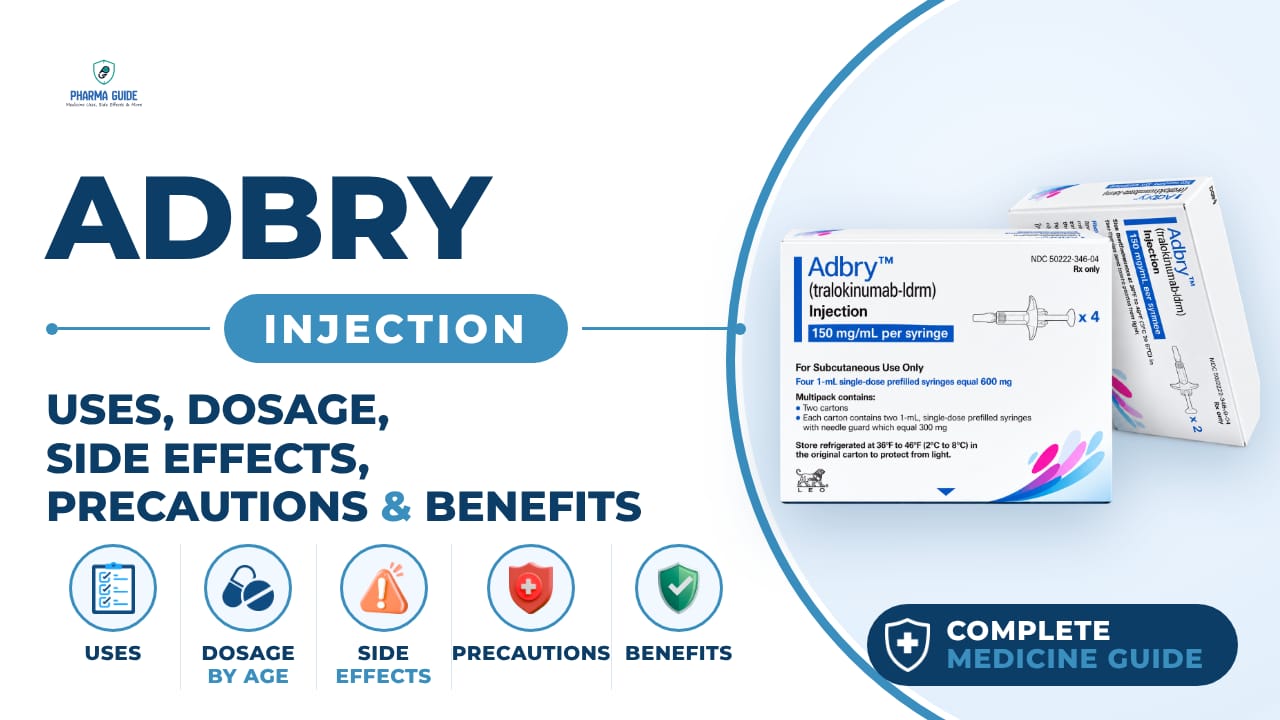
| Generic name | tralokinumab-ldrm |
|---|---|
| Drug class | Interleukin-13 antagonist (interleukin inhibitor) |
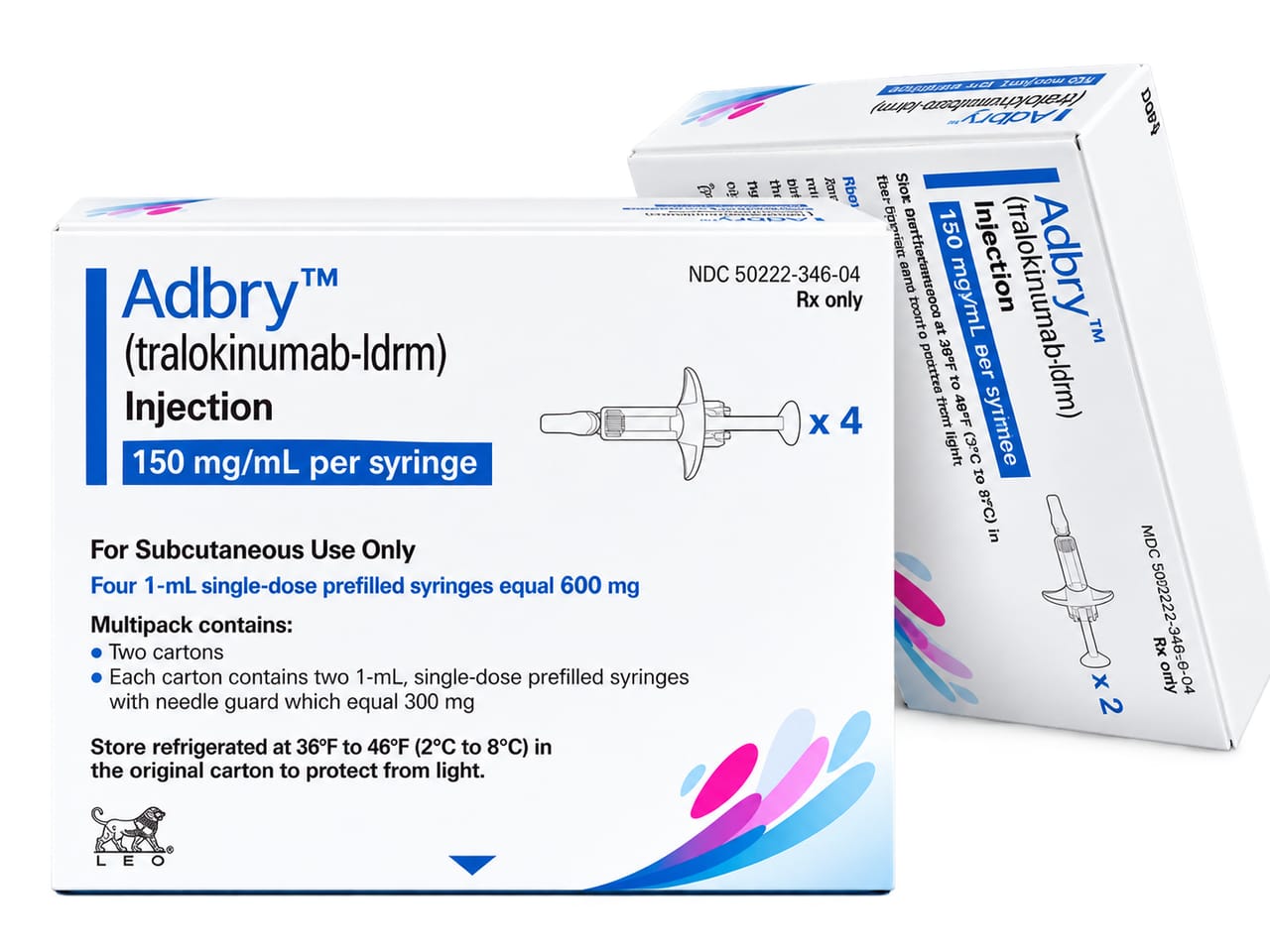
| Forms | Single-dose prefilled syringe (150 mg/mL), Single-dose autoinjector (300 mg/2 mL) |
Quick overview
Adbry Injection (tralokinumab-ldrm) is a prescription interleukin-13 antagonist used to treat moderate-to-severe atopic dermatitis (eczema) in adults and children 12 years of age and older. It is given as an injection under the skin and may be used alone or with topical corticosteroids. Adbry works by blocking interleukin-13, a protein involved in the inflammation that causes eczema symptoms.
What is Adbry Injection
Adbry is a prescription injectable medicine used to treat moderate-to-severe atopic dermatitis (eczema) in adults and children 12 and older. It is given as an injection under the skin. Its generic name is tralokinumab-ldrm, and it belongs to the interleukin-13 antagonist (interleukin inhibitor) drug class.
Adbry Injection uses
- Treats moderate-to-severe atopic dermatitis (eczema) in adults and children 12 years of age and older whose condition is not well controlled with topical prescription treatments, or when those treatments are not advisable
- Can be used with or without topical corticosteroids
Benefits of Adbry Injection
- About one in four to one in three patients using Adbry achieved clear or nearly clear skin, compared to roughly one in eight patients on placebo
- Around half of patients on Adbry saw their skin severity improve by 75% or more, while only about one in five to one in four placebo patients experienced this level of improvement
- Nearly half of Adbry patients reported significant relief from itching, compared to about one in five patients on placebo
How Adbry Injection works
Adbry works by attaching to a protein in the immune system called interleukin-13 (IL-13), which plays a key role in allergic and inflammatory reactions. By blocking IL-13 from attaching to its receptors on cells, Adbry helps prevent the inflammation that causes eczema symptoms like itching, redness, and skin thickening.
Adbry Injection dosage
Use Adbry exactly as prescribed by your healthcare provider. Adbry is given as an injection under the skin (subcutaneous injection). Follow the detailed Instructions for Use that comes with Adbry for how to prepare and inject it, and do not try to inject Adbry until you have been shown the right way by your healthcare provider.
In children 12 years of age and older, it is recommended that Adbry be given by or under the supervision of an adult. Let the syringe or autoinjector warm up to room temperature before injecting, without removing the needle cover or cap. Inject into the thigh or abdomen, except for the area around the navel; the upper arm can be used if a caregiver gives the injection. Do not inject into skin that is tender, damaged, bruised, or scarred, and rotate the injection site with each dose.
Your healthcare provider may prescribe other medicines to use with Adbry; use them exactly as directed. If you miss a dose, inject the missed dose as soon as possible, then continue with your next dose at your regular scheduled time; do not double up on doses.
| Age group | Dose |
|---|---|
| Under 12 years | Safety and effectiveness are not established; no standard dose |
| 12–17 years | Initial loading dose: 300 mg once, followed by 150 mg every 2 weeks |
| 18–39 years | Initial loading dose: 600 mg once, followed by 300 mg every 2 weeks |
| 65–74 years | Generally follows the adult regimen: 600 mg loading dose, then 300 mg every 2 weeks |
Available forms and strengths
- Single-dose prefilled syringe (150 mg/mL)
- Single-dose autoinjector (300 mg/2 mL)
Side effects of Adbry Injection
Common
- Upper respiratory tract infections
- Eye and eyelid inflammation, including redness, swelling, and itching
- Injection site reactions (pain, itching, swelling, or redness)
- High count of a certain white blood cell (eosinophilia)
Serious
- Allergic reactions, including anaphylaxis and angioedema
- Breathing problems or wheezing
- Swelling of the face, mouth, tongue, or throat
- Hives
- Itching or skin rash
- Fainting, dizziness, or feeling lightheaded (low blood pressure)
- Racing heart
- Fever or general ill feeling
- Swollen lymph nodes
- Trouble swallowing or throat tightness
- Nausea or vomiting
- Stomach cramps
- Joint pain
- Eye problems such as conjunctivitis (pink eye) or keratitis (corneal inflammation or ulcers)
- Eye redness, itchiness, pain, or swollen/itchy eyelids
- Feeling like something is in your eye, eye dryness, watering, or discharge
- Vision changes, such as blurry vision or sensitivity to light
Warnings and precautions
- Adbry can cause allergic reactions, including a severe reaction called anaphylaxis, and swelling called angioedema. Stop using Adbry and get emergency help right away if you notice breathing problems, swelling of the face, mouth, or tongue, hives, itching, skin rash, or fainting or dizziness.
- Adbry may cause eye problems such as conjunctivitis (pink eye) or keratitis (inflammation or ulcers of the cornea). Tell your healthcare provider about any new or worsening eye symptoms.
- Adbry may make it harder for your body to fight certain parasite (worm) infections. Tell your healthcare provider if you have a worm infection before starting treatment.
- Avoid live vaccines while using Adbry, since it may increase your risk of infection from them. Make sure all age-appropriate vaccines are up to date before starting treatment.
- Do not share your Adbry injector with other people, even if they have the same condition, as it may harm them.
- It is not known whether Adbry will harm an unborn baby. There is a pregnancy exposure registry that collects information about the health of mothers and babies exposed to Adbry during pregnancy. Tell your healthcare provider if you are or plan to become pregnant.
- It is not known whether Adbry passes into breast milk or if it can harm a breastfeeding baby. Tell your healthcare provider if you are breastfeeding or plan to breastfeed.
- No significant differences were seen in how the body processes Adbry in people with mild to moderate kidney problems. The effect of severe kidney impairment is unknown.
- No significant differences were seen in how the body processes Adbry in people with mild liver problems. The effect of moderate to severe liver impairment is unknown.
- It is unknown if drinking alcohol will affect Adbry.
- Adbry is not generally expected to impair driving.
Storage
- Store Adbry in a refrigerator between 36°F and 46°F (2°C and 8°C)
- Store Adbry in the original carton and protect it from light until you are ready to use it
- Adbry can be stored in the original carton at room temperature up to 86°F (30°C) for up to 14 days. If removed from the refrigerator, write down the date of removal on the back of the carton, and use Adbry within 14 days
- Throw away (dispose of) Adbry in a sharps disposal container if left out of the refrigerator for more than 14 days
- Do not freeze Adbry. Do not use if they have been frozen
- Do not shake Adbry
- Do not heat Adbry
- Do not put Adbry into direct sunlight
- Do not place Adbry back in the refrigerator after it has been left out at room temperature
- Dispose of used autoinjectors or syringes in an FDA-cleared sharps disposal container right away after use; do not throw them away in household trash
When to see a doctor
- Stop using Adbry and get emergency medical help right away if you have breathing problems, swelling of the face, mouth, or tongue, hives, itching, skin rash, or fainting, dizziness, or feeling lightheaded.
- Contact your healthcare provider right away if you have new or worsening eye symptoms, such as eye redness, pain, itchiness, swollen or itchy eyelids, feeling like something is in your eye, dryness, watering, discharge, or vision changes.
- If you inject too much Adbry, call your healthcare provider, contact a poison control center, or go to the nearest hospital emergency room right away.
Alternatives
- Dupixent
- Ebglyss
- Nemluvio
- Topical calcineurin inhibitors
Watch the video
FAQs
What is Adbry Injection used for?
Adbry treats moderate-to-severe atopic dermatitis (eczema) in adults and children 12 years and older whose condition isn't well controlled with topical prescription treatments, and can be used with or without topical corticosteroids.
How does Adbry Injection work?
Adbry attaches to interleukin-13 (IL-13), a protein involved in allergic and inflammatory reactions, blocking it from attaching to its receptors and helping prevent the inflammation that causes eczema symptoms like itching, redness, and skin thickening.
What is the dosage for Adbry Injection?
For ages 12-17, the initial loading dose is 300 mg once, followed by 150 mg every 2 weeks. For adults 18 and older, the initial loading dose is 600 mg once, followed by 300 mg every 2 weeks.
What are the common side effects of Adbry Injection?
Common side effects include upper respiratory tract infections, eye and eyelid inflammation (redness, swelling, itching), injection site reactions, and a high count of a white blood cell called eosinophilia.
How should Adbry Injection be stored?
Adbry should be stored in a refrigerator between 36°F and 46°F in its original carton, protected from light. It can be kept at room temperature up to 86°F for up to 14 days, but should not be frozen, shaken, heated, or placed back in the refrigerator once removed.
General information, not medical advice
Your prescriber and the leaflet in your pack know your situation. This page does not.
- Follow your prescriber and the leaflet
- Don't start, stop, or change a dose on your own
- Doses and warnings differ by country and product
Sources
Video
Related medicines

Injectafer Injection: Uses, Dosage, Side Effects, Precautions and Alternates
Iron products
Injectafer (ferric carboxymaltose) treats iron deficiency anemia and heart failure-related iron deficiency via IV. Learn uses, dosage, side effects, and

Gliclazide Tablet: Uses, Dosage, Side Effects, Precautions and Alternates
Sulfonylurea (hypoglycemic/antidiabetic agent)
Gliclazide Tablet is a sulfonylurea for type 2 diabetes that boosts insulin release. Learn about dosage, side effects, warnings, and precautions.