
Safety
General information, not medical advice
Your prescriber and the leaflet in your pack know your situation. This page does not.
- Follow your prescriber and the leaflet
- Don't start, stop, or change a dose on your own
- Doses and warnings differ by country and product
Addwize Tablet: Uses, Dosage, Side Effects, Precautions and Alternates
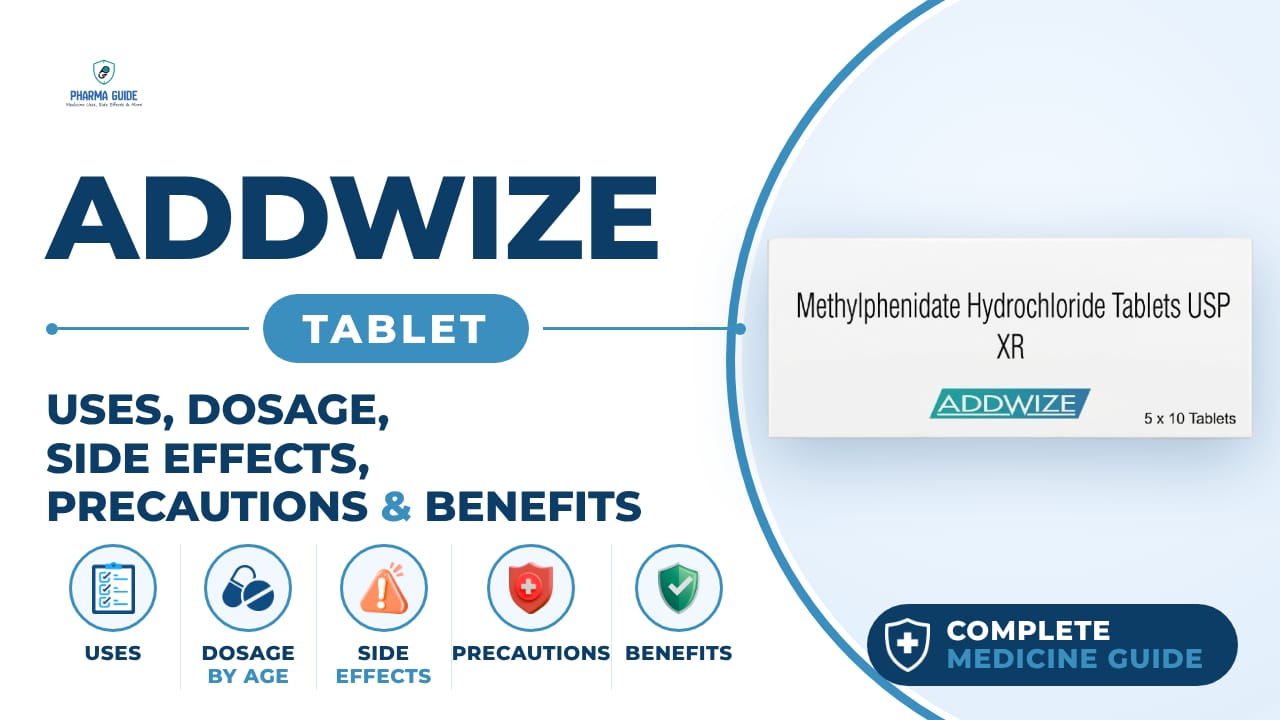
| Generic name | Methylphenidate |
|---|---|
| Drug class | Central nervous system (CNS) stimulant |
| Forms | Tablet |

Quick overview
Addwize Tablet contains methylphenidate, a central nervous system stimulant. It is mainly used to treat ADHD (attention deficit hyperactivity disorder) and narcolepsy, and may also be used for vertigo, Ménière's disease, tinnitus, and balance problems related to inner-ear or vestibular disorders. It works by raising levels of certain brain chemicals to improve attention, focus, impulse control, and wakefulness. It is a prescription medicine that should be taken exactly as directed by a doctor.
What is Addwize Tablet
Addwize is a prescription tablet that contains methylphenidate. It is mainly used to treat ADHD (attention deficit hyperactivity disorder) and narcolepsy.
Addwize Tablet uses
- Vertigo (dizziness)
- Ménière's disease
- Ringing in the ears (tinnitus)
- Balance problems related to inner-ear disorders
- Dizziness associated with vestibular disorders
Benefits of Addwize Tablet
- ADHD Symptom Control: Helps improve attention and reduce impulsive and hyperactive behavior.
- Attention Support: Can improve concentration and sustained attention.
- Wakefulness Support: Methylphenidate can increase alertness and wakefulness.
How Addwize Tablet works
Addwize is a CNS stimulant. It raises the levels of certain brain chemicals called norepinephrine and dopamine, which helps improve attention, focus, and impulse control, and helps people with narcolepsy stay awake.
Addwize Tablet dosage
Addwize can be taken with or without food. Swallow the tablet whole; do not break, crush, or chew it. Try to take it at the same time each day to keep a steady level in the body. Taking it early in the morning may help prevent trouble sleeping later at night. If you miss a dose, just continue with your regular schedule and do not take a double dose. Do not stop taking this medicine suddenly without talking to your doctor, as it may worsen your symptoms.
| Age group | Dose |
|---|---|
| Under 18 years | Not recommended |
| 18–64 years | 24 mg, twice/day |
| 65+ years | 24 mg, twice/day |
Available forms and strengths
- Tablet
Side effects of Addwize Tablet
Common
- Headache
- Insomnia (difficulty sleeping)
- Abdominal pain
- Irritability
- Dry mouth
- Dizziness
- Nausea or vomiting
- Restlessness
- Agitation
- Dyspepsia
- Infection
- Fever
- Loss of appetite
- Anxiety
- Nervousness
- Decreased appetite and weight loss
Serious
- Fast or irregular heartbeat and chest pain
- Allergic reactions (skin rash, swelling of the face or tongue)
- Uncontrolled muscle movements or tics
- Habit-forming potential with risk of dependence and abuse
- Sudden mood changes or suicidal thoughts
Warnings and precautions
- Avoid Addwize if you have hyperthyroidism, heart disease, or liver disease unless your doctor tells you otherwise. Other conditions such as schizophrenia, bipolar disorder, depression, or suicidal tendencies may also be affected.
- Addwize may have harmful effects on the heart. Stop taking it and tell your doctor if you notice any such effects.
- This medicine can be habit-forming, so take it only as prescribed by your doctor.
- This medicine has a high potential for dependence. Do not take more than the prescribed amount.
- Addwize may raise blood pressure and pulse, so monitor these regularly.
- It can reduce appetite, which may slow growth in children, so monitor your child's height and weight while on this medicine.
- Do not take Addwize with bupropion, as this combination can cause severe side effects.
- Addwize may be unsafe during pregnancy. Animal studies have shown harm to the developing baby, though there is limited human data. Talk to your doctor, who will weigh the benefits and risks before prescribing it.
- Addwize is probably unsafe during breastfeeding. Limited data suggests the drug may pass into breast milk and harm the baby. It should not be taken unless your doctor prescribes it.
- There is limited information on using Addwize in people with kidney disease. Talk to your doctor, and use caution if you have existing kidney disease.
- There is limited information on using Addwize in people with liver disease. Talk to your doctor before use.
- Avoid alcohol while taking Addwize, as the combination is considered unsafe.
- Addwize is not safe for driving. It can cause dizziness, trouble focusing, or blurred vision, which may affect your ability to drive or operate machinery.
Storage
- Store below 25°C in a dry place.
- Keep away from children.
- Protect from moisture.
When to see a doctor
- Tell your doctor if you develop unusual changes in mood or behavior, new or worsening depression, or any suicidal thoughts.
- Seek medical help right away for fast or irregular heartbeat and chest pain, allergic reactions like skin rash or swelling of the face or tongue, or uncontrolled muscle movements or tics.
- If side effects continue for a long time, consult your doctor right away.
Alternatives
- Atomoxetine
- Guanfacine
- Clonidine
Watch the video
FAQs
What is Addwize Tablet used for?
Addwize Tablet is mainly used to treat ADHD and narcolepsy. It may also be used for vertigo, Ménière's disease, tinnitus, and balance problems related to inner-ear or vestibular disorders.
How does Addwize Tablet work?
Addwize is a CNS stimulant that raises levels of brain chemicals called norepinephrine and dopamine, helping improve attention, focus, and impulse control, and helping people with narcolepsy stay awake.
What is the dosage of Addwize Tablet?
For adults aged 18–64 and those 65 and above, the typical dose is 24 mg twice a day. It is not recommended for those under 18 years. Swallow the tablet whole without breaking, crushing, or chewing it.
What are the common side effects of Addwize Tablet?
Common side effects include headache, insomnia, abdominal pain, irritability, dry mouth, dizziness, nausea or vomiting, restlessness, agitation, dyspepsia, fever, loss of appetite, anxiety, nervousness, and decreased appetite with weight loss.
Is Addwize Tablet safe during pregnancy or breastfeeding?
Addwize may be unsafe during pregnancy, as animal studies have shown harm to the developing baby, though human data is limited. It is probably unsafe during breastfeeding since it may pass into breast milk and harm the baby.
General information, not medical advice
Your prescriber and the leaflet in your pack know your situation. This page does not.
- Follow your prescriber and the leaflet
- Don't start, stop, or change a dose on your own
- Doses and warnings differ by country and product
Sources
- US Food and Drug Administration (FDA) - Package leaflet information for the user; Concerta® (methylphenidate HCl)
- KD Tripathi, Seventh Edition, Jaypee Brothers Medical Publishers; 2013: Page No 487
- April Hazard Vallerand, Cynthia A. Sanoski, Sixteenth Edition, F. A. Davis Company; 2019: Page No 840-843
Video
Related medicines
Desoxyn Tablet: Uses, Dosage, Side Effects, Precautions and Alternates
Central nervous system (CNS) stimulant
Desoxyn Tablet contains methamphetamine HCl, a Schedule II stimulant for ADHD in children 6+. Learn uses, dosage, side effects, and warnings.

Injectafer Injection: Uses, Dosage, Side Effects, Precautions and Alternates
Iron products
Injectafer (ferric carboxymaltose) treats iron deficiency anemia and heart failure-related iron deficiency via IV. Learn uses, dosage, side effects, and