
Safety
General information, not medical advice
Your prescriber and the leaflet in your pack know your situation. This page does not.
- Follow your prescriber and the leaflet
- Don't start, stop, or change a dose on your own
- Doses and warnings differ by country and product
Adenocard Injection: Uses, Dosage, Side Effects, Precautions and Alternates
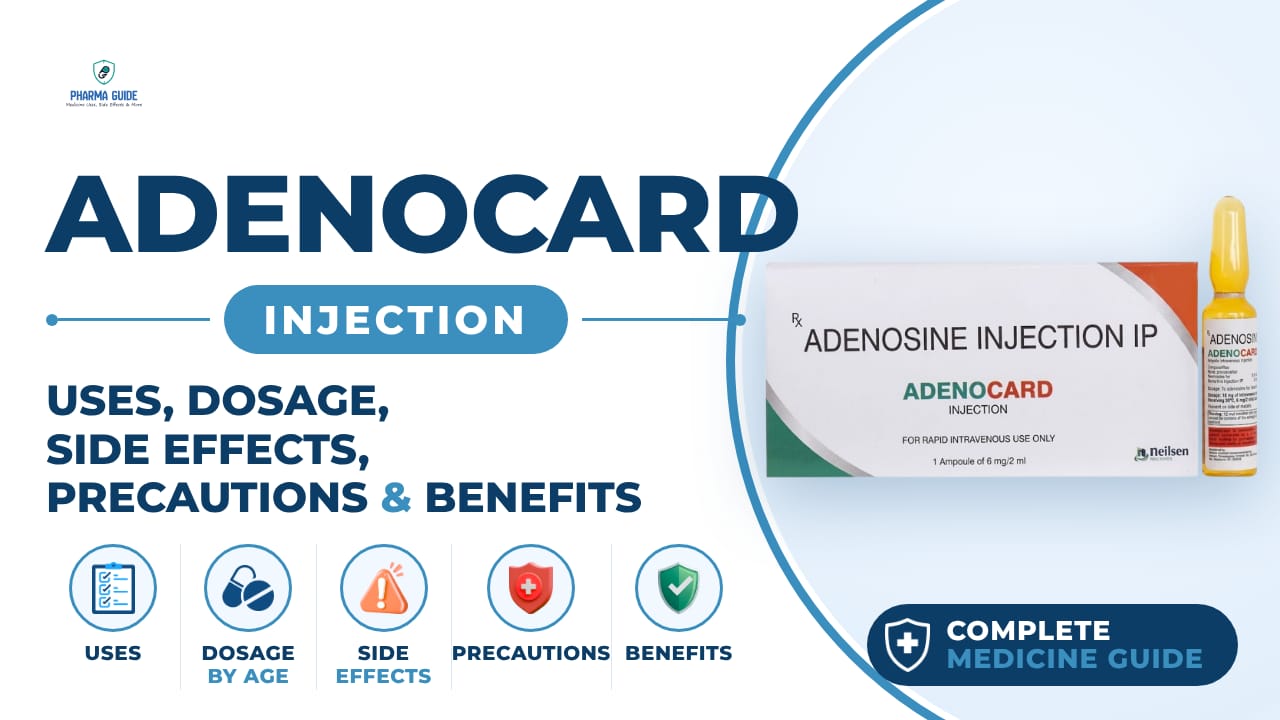
| Generic name | adenosine |
|---|---|
| Drug class | Antidysrhythmics (Group V antiarrhythmics) / cardiac stressing agents |
| Forms | Injection (solution for intravenous use), Prefilled syringe, Vial |
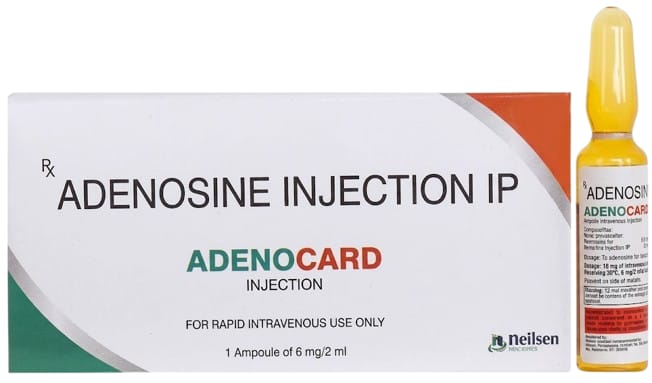
Quick overview
Adenocard Injection contains adenosine and belongs to the antidysrhythmic drug class. It is given as an injection by a healthcare provider to help convert certain fast, abnormal heart rhythms back to normal and to assist in diagnosing some types of rapid heartbeat. It works very quickly and its effects wear off fast, so side effects are usually short-lived. It is only given in settings with proper heart monitoring and resuscitation equipment available.
What is Adenocard Injection
Adenocard is a medicine that contains adenosine, a substance that occurs naturally in all the cells of your body. It is given as an injection to help control certain fast, abnormal heart rhythms.
Adenocard Injection uses
- Converting paroxysmal supraventricular tachycardia (PSVT), including PSVT linked to Wolff-Parkinson-White Syndrome, back to a normal heart rhythm
- Helping diagnose broad or narrow complex supraventricular tachycardia
- Used during a heart stress test
Benefits of Adenocard Injection
- Can quickly help restore a normal heart rhythm during an episode of PSVT
- Works very fast and its effects wear off quickly, so side effects are usually short-lived
How Adenocard Injection works
Adenocard works by slowing down the electrical signals that control your heart rhythm, especially through the AV node. This can interrupt the abnormal electrical circuit causing a fast heartbeat and let the heart return to its normal rhythm. It also relaxes blood vessels, allowing more blood to flow through them.
Adenocard Injection dosage
Adenocard is given only by a healthcare provider as an injection directly into a vein. It must be given as a rapid injection, not a slow one, so it reaches the general blood circulation effectively. If given through an IV line, it should be given as close to the patient as possible and followed quickly by a saline flush. Only one dose may be needed, but repeat doses can be given if the first does not work. Your breathing, blood pressure, oxygen levels, and heart rhythm will be closely monitored during treatment.
Before a heart stress test, you should avoid coffee, tea, cola, chocolate, energy drinks, or other sources of caffeine because they can interfere with test results. This medicine should only be given in a setting with proper heart monitoring and resuscitation equipment available.
| Age group | Dose |
|---|---|
| Under 18 years | Not recommended |
| 18–64 years | 6 mg, once day |
| 65+ years | 6 mg, once day |
Available forms and strengths
- Injection (solution for intravenous use)
- Prefilled syringe
- Vial
Side effects of Adenocard Injection
Common
- Facial flushing (sudden warmth, redness, or tingly feeling)
- Shortness of breath
- Chest pressure or chest pain
- Nausea
- Headache
- Dizziness or lightheadedness
- Sweating
- Palpitations
- Discomfort in the neck or jaw
- Metallic taste
- Tingling or numbness in arms
- Blurred vision
Serious
- Severe shortness of breath
- Chest pain or tightness, or pain spreading to the jaw or shoulder
- Fluttering in the chest
- A light-headed feeling like you might pass out
- Seizures
- Severe headache, blurred vision, or pounding in the neck or ears
- Sudden numbness or weakness, or problems with vision or speech
- Signs of an allergic reaction: hives, difficulty breathing, swelling of the face, lips, tongue, or throat
Warnings and precautions
- Adenocard should not be used in people with certain serious heart conditions, including second- or third-degree AV block, sick sinus syndrome, or symptomatic slow heart rate, unless they have a working artificial pacemaker. It should also not be used in anyone with a known allergy to adenosine.
- Adenocard can cause short periods of heart block. If you develop a high level of heart block after one dose, you should not be given more doses.
- There have been reports of prolonged pauses in the heartbeat (asystole), some of them fatal, and rare reports of ventricular fibrillation after Adenocard, most often in people also taking digoxin, or digoxin combined with verapamil. Adenocard should be used carefully in people taking these medicines.
- Adenocard can cause a variety of new, usually brief, heart rhythm changes right around the time your heart converts back to a normal rhythm.
- Adenocard can tighten the airways and should be avoided in people with asthma or active wheezing, and used carefully in people with other lung diseases like emphysema or bronchitis.
- Adenocard should be stopped if a patient develops severe breathing difficulties.
- This medicine should only be given where appropriate heart monitoring is available.
- It is not known whether Adenocard could harm an unborn baby. Tell your doctor if you are pregnant, as this medicine should only be used in pregnancy if it is clearly needed.
- Tell your doctor if you are breastfeeding. You may need to stop nursing for a short time after receiving Adenocard.
- Adenocard does not need the kidneys to work or be broken down, so kidney problems are not expected to change how well it works or how well it is tolerated.
- Adenocard does not need the liver to work or be broken down, so liver problems are not expected to change how well it works or how well it is tolerated.
Storage
- Store at controlled room temperature between 15°C and 30°C (59°F to 86°F)
- Do not refrigerate, as this may cause crystals to form
- If crystals form, warm the solution to room temperature to dissolve them
- The solution must be clear before it is used
- Contains no preservatives; discard any unused portion
- Keep this and all other medicines out of the reach of children
When to see a doctor
Get emergency medical help right away if you have signs of an allergic reaction, such as hives, trouble breathing, or swelling of the face, lips, tongue, or throat.
Tell your caregivers immediately if you have severe shortness of breath, chest pain or tightness, pain spreading to your jaw or shoulder, fluttering in your chest, a feeling like you might pass out, a seizure, a severe headache with blurred vision or pounding in the neck or ears, or sudden numbness, weakness, or problems with vision or speech.
Alternatives
- Metoprolol
- Verapamil
- Adenosine
Watch the video
FAQs
What is Adenocard Injection used for?
Adenocard is used to convert paroxysmal supraventricular tachycardia (PSVT), including PSVT linked to Wolff-Parkinson-White Syndrome, back to a normal heart rhythm, to help diagnose broad or narrow complex supraventricular tachycardia, and during heart stress tests.
How does Adenocard Injection work?
Adenocard works by slowing down the electrical signals that control heart rhythm, especially through the AV node, which can interrupt the abnormal electrical circuit causing a fast heartbeat and let the heart return to normal rhythm. It also relaxes blood vessels, allowing more blood flow.
How is Adenocard Injection given?
Adenocard is given only by a healthcare provider as a rapid injection directly into a vein, not a slow one, so it reaches the general blood circulation effectively. If given through an IV line, it should be given close to the patient and followed quickly by a saline flush.
What are the common side effects of Adenocard Injection?
Common side effects include facial flushing, shortness of breath, chest pressure or pain, nausea, headache, dizziness, sweating, palpitations, neck or jaw discomfort, metallic taste, tingling or numbness in arms, and blurred vision.
Who should not receive Adenocard Injection?
Adenocard should not be used in people with certain serious heart conditions, including second- or third-degree AV block, sick sinus syndrome, or symptomatic slow heart rate, unless they have a working artificial pacemaker, or in anyone with a known allergy to adenosine.
General information, not medical advice
Your prescriber and the leaflet in your pack know your situation. This page does not.
- Follow your prescriber and the leaflet
- Don't start, stop, or change a dose on your own
- Doses and warnings differ by country and product
Sources
Video
Related medicines

Injectafer Injection: Uses, Dosage, Side Effects, Precautions and Alternates
Iron products
Injectafer (ferric carboxymaltose) treats iron deficiency anemia and heart failure-related iron deficiency via IV. Learn uses, dosage, side effects, and

Gliclazide Tablet: Uses, Dosage, Side Effects, Precautions and Alternates
Sulfonylurea (hypoglycemic/antidiabetic agent)
Gliclazide Tablet is a sulfonylurea for type 2 diabetes that boosts insulin release. Learn about dosage, side effects, warnings, and precautions.