
Safety
General information, not medical advice
Your prescriber and the leaflet in your pack know your situation. This page does not.
- Follow your prescriber and the leaflet
- Don't start, stop, or change a dose on your own
- Doses and warnings differ by country and product
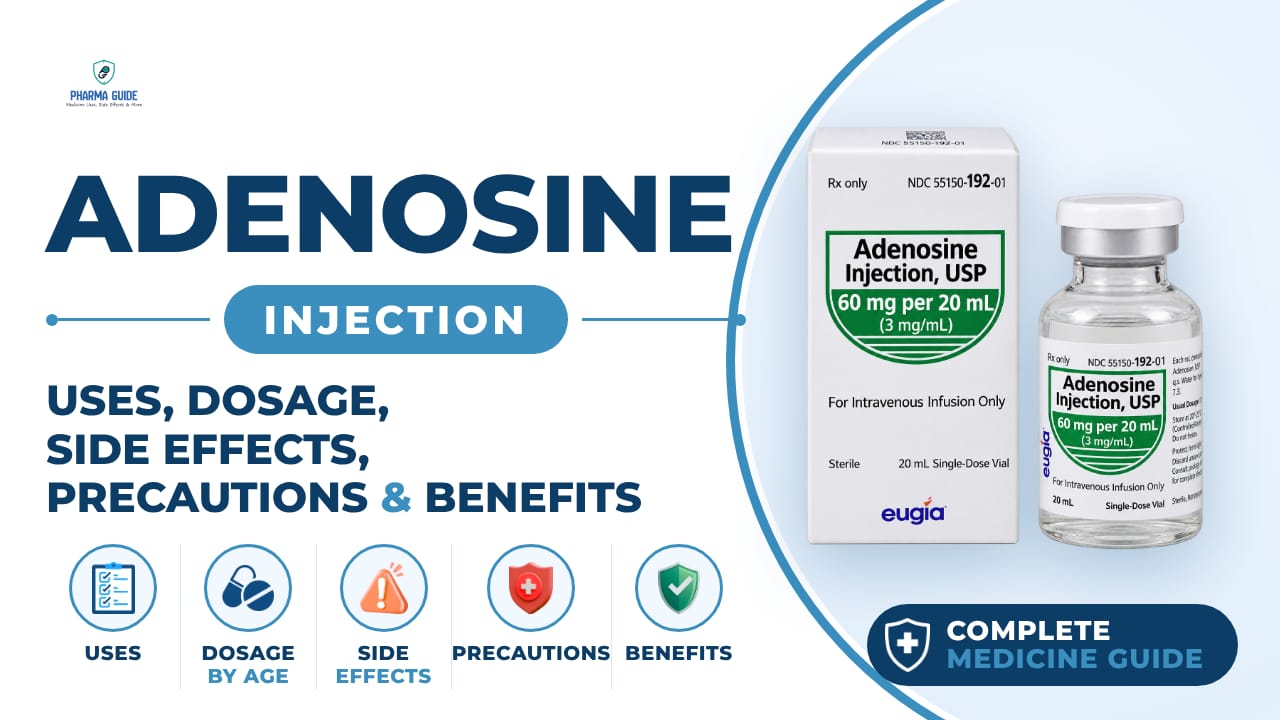
Adenosine Injection: Uses, Dosage, Side Effects, Precautions and Alternates
| Generic name | adenosine |
|---|---|
| Drug class | Antiarrhythmic |
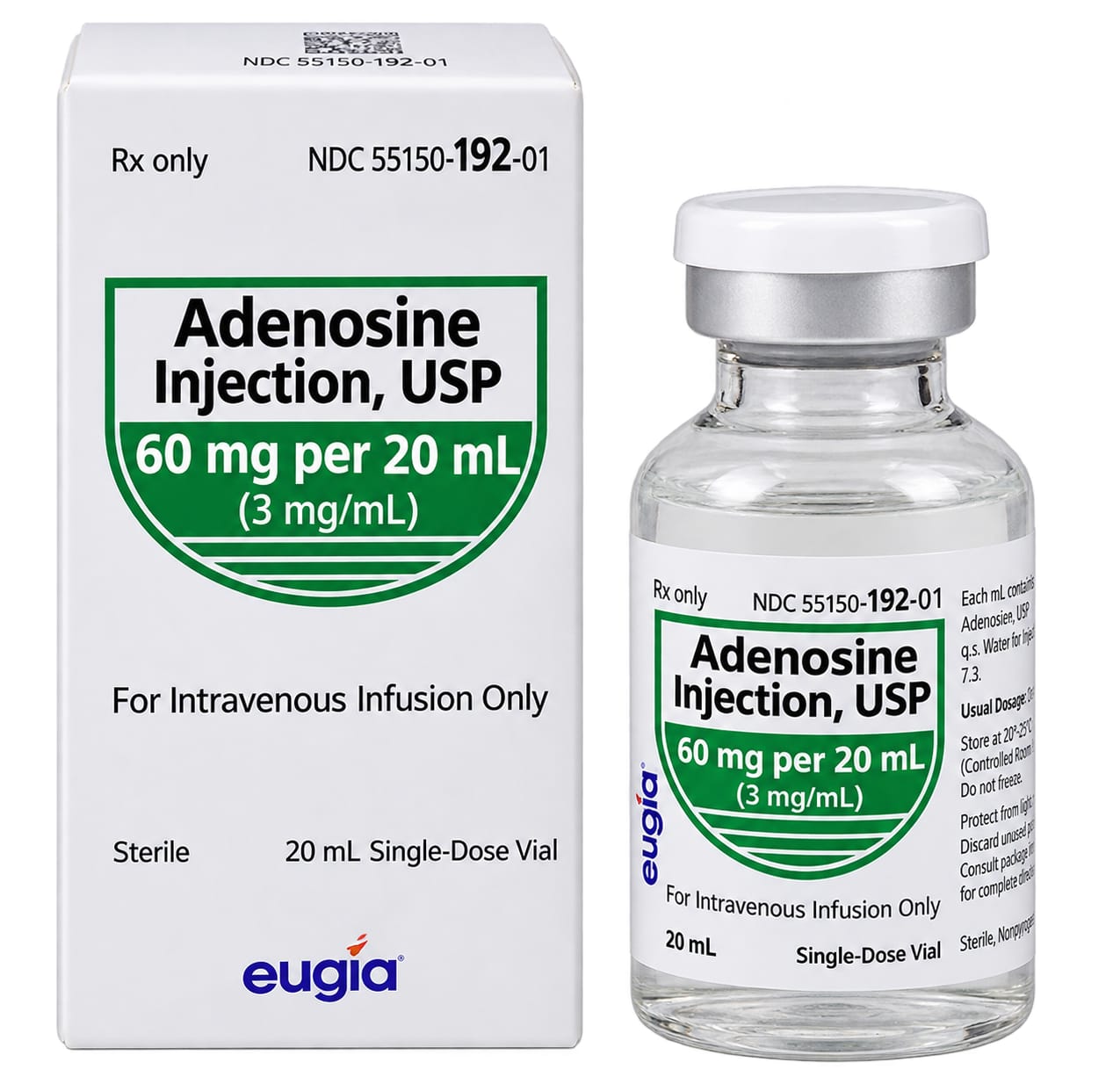
| Forms | Injectable solution (for injection into a vein) |
Quick overview
Adenosine Injection is a medicine containing adenosine, given through a vein in a hospital setting. It is used to treat fast heart rhythms, including paroxysmal supraventricular tachycardia, and to help doctors diagnose heart rhythm problems or assess heart function during stress testing. It works by briefly slowing electrical signals in the heart to interrupt an abnormal rhythm and allow the heart to return to normal.
What is Adenosine Injection
Adenosine Injection is a medicine given through a vein in a hospital setting. It contains adenosine, a substance that occurs naturally in all cells of the body. It is used to treat fast heart rhythms and to help doctors test heart function.
Adenosine Injection uses
- Treating paroxysmal supraventricular tachycardia (PSVT), a fast heart rhythm, including PSVT linked to Wolff-Parkinson-White syndrome
- Helping diagnose broad or narrow complex supraventricular tachycardia
- Used during a heart stress test for patients who cannot exercise enough
Benefits of Adenosine Injection
- Can bring a fast heart rhythm back to a normal rhythm
- Helps doctors see how the heart's electrical system is working during diagnostic tests
How Adenosine Injection works
Adenosine slows the electrical signals in the part of the heart called the AV node, which briefly interrupts the abnormal circuit causing the fast heartbeat. This allows the heart to go back to its normal rhythm.
Adenosine Injection dosage
Adenosine Injection is given only by a healthcare professional directly into a vein, as a fast push, not a slow drip. It must be given while your heart is being monitored. It is given either straight into a vein or, if using an IV line, as close to the body as possible, followed right away by a fluid flush so it reaches general circulation. If the first dose does not work, your doctor may give one or two more injections. Dosing for children depends on body weight.
Avoid caffeine or caffeine-containing drinks and food for a day before the medicine is given, since caffeine can make it less effective.
| Age group | Dose |
|---|---|
| Under 18 years | Not established |
| 18–60 years | 6 mg, once/day |
| 60+ years | 6 mg, once/day |
Available forms and strengths
- Injectable solution (for injection into a vein)
Side effects of Adenosine Injection
Common
- Facial flushing
- Shortness of breath
- Chest pressure or chest pain
- Nausea
- Headache
- Sweating
- Palpitations
- Low blood pressure
- Lightheadedness or dizziness
- Tingling or numbness in arms
- Blurred vision
- Burning sensation
- Neck or back pain
- Metallic taste
- Tightness in throat
- Pressure in the groin
Serious
- Prolonged or dangerous pauses in the heartbeat (asystole)
- Ventricular fibrillation, a dangerous irregular heart rhythm
- Serious breathing difficulty or narrowing of the airways (bronchospasm)
Warnings and precautions
- This medicine can cause a short-term heart block (an interruption in the heart's electrical signal). If you develop a high-level block after one dose, you will not be given more doses.
- Rarely, this medicine has led to a dangerous irregular heartbeat called ventricular fibrillation, including cases that were fatal, especially in people also taking digoxin or digoxin with verapamil.
- Temporary or prolonged pauses in the heartbeat have happened after this medicine was given, and in some cases this has been fatal.
- This medicine should be avoided in people with asthma or COPD because it can cause narrowing of the airways and worsen breathing problems.
- New, usually short-lived, abnormal heart rhythms can appear on heart monitoring at the moment the heart converts back to a normal rhythm.
- This medicine should only be used during pregnancy if it is truly needed, since there is not enough research on its safety in pregnant women.
- There is not enough information about using this medicine while breastfeeding, so it should only be used if truly needed, and your doctor may advise pausing breastfeeding for a time.
- This medicine's effects are not expected to be changed by kidney problems, since the kidneys are not needed to break it down or remove it from the body.
- This medicine's effects are not expected to be changed by liver problems, since the liver is not needed to break it down or remove it from the body.
- It is not known how this medicine interacts with alcohol, so check with your doctor before drinking alcohol.
Storage
- Store at controlled room temperature between 15°C and 30°C
- Do not refrigerate, as this can cause crystals to form
- If crystals form, warm the solution to room temperature until they dissolve
- The solution must be clear before it is used
- Check the solution by eye for particles or discoloration before use
When to see a doctor
- Get medical help right away if you have difficulty breathing after receiving this medicine.
- Seek medical attention if you have a seizure after receiving this medicine.
- Tell your doctor right away if you notice an irregular, slow, or fast heartbeat.
- This medicine should be discontinued if you develop severe breathing problems.
Alternatives
- Adenocard
- Adenocor
- Adenoscan
Watch the video
FAQs
What is Adenosine Injection used for?
It is used to treat paroxysmal supraventricular tachycardia (PSVT), including PSVT linked to Wolff-Parkinson-White syndrome, to help diagnose supraventricular tachycardia, and to assist heart stress testing in patients who cannot exercise enough.
How is Adenosine Injection given?
It is given only by a healthcare professional directly into a vein as a fast push, not a slow drip, while the heart is being monitored, followed right away by a fluid flush.
Why should I avoid caffeine before Adenosine Injection?
Caffeine can make the medicine less effective, so it should be avoided for a day before the injection is given.
What are the common side effects of Adenosine Injection?
Common side effects include facial flushing, shortness of breath, chest pressure or pain, nausea, headache, sweating, palpitations, low blood pressure, dizziness, and tingling in the arms.
Who should avoid Adenosine Injection?
It should be avoided in people with asthma or COPD because it can cause narrowing of the airways and worsen breathing problems.
General information, not medical advice
Your prescriber and the leaflet in your pack know your situation. This page does not.
- Follow your prescriber and the leaflet
- Don't start, stop, or change a dose on your own
- Doses and warnings differ by country and product
Sources
- https://www.buzzrx.com/blog/thin-skin-medications-that-could-be-to-b
- https://pdf.hres.ca/dpd_pm/00025904.PDF
- https://www.practo.com/medicine-info/adenosine-2080-api
- https://my.clevelandclinic.org/health/diseases/22232-paroxysmal-supraventricular-tachycardia-psvt
- https://www.ahajournals.org/doi/10.1161/01.CIR.0000059743.36226.E8#:
- https://www.ncbi.nlm.nih.gov/books/NBK519049/
- https://dailymed.nlm.nih.gov/dailymed/drugInfo.cfm?setid=b827e3f8-dd63-4e54-90f4-0eded943de9f
- https://my.clevelandclinic.org/health/drugs/20887-adenosine-injection
- https://pubmed.ncbi.nlm.nih.gov/1605147/#:
Video
Related medicines

Injectafer Injection: Uses, Dosage, Side Effects, Precautions and Alternates
Iron products
Injectafer (ferric carboxymaltose) treats iron deficiency anemia and heart failure-related iron deficiency via IV. Learn uses, dosage, side effects, and

Gliclazide Tablet: Uses, Dosage, Side Effects, Precautions and Alternates
Sulfonylurea (hypoglycemic/antidiabetic agent)
Gliclazide Tablet is a sulfonylurea for type 2 diabetes that boosts insulin release. Learn about dosage, side effects, warnings, and precautions.