
Safety
General information, not medical advice
Your prescriber and the leaflet in your pack know your situation. This page does not.
- Follow your prescriber and the leaflet
- Don't start, stop, or change a dose on your own
- Doses and warnings differ by country and product
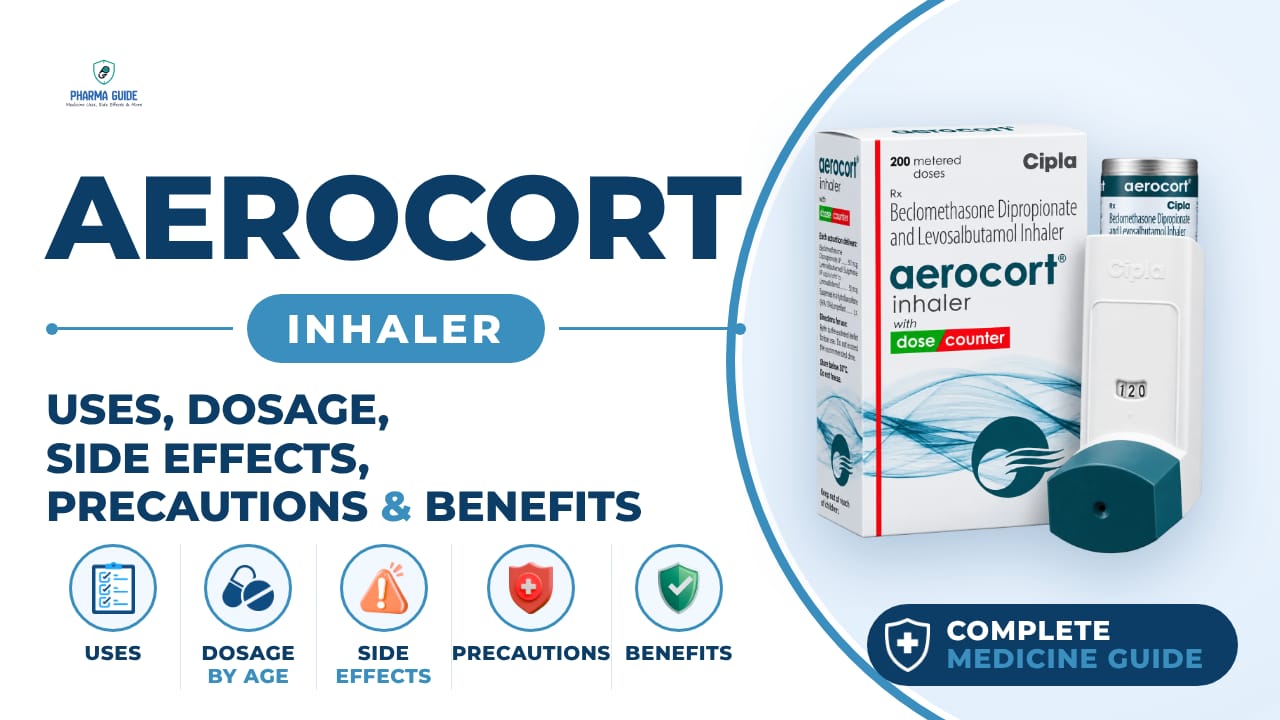
Aerocort Inhaler: Uses, Dosage, Side Effects, Precautions and Alternates
| Generic name | Levosalbutamol (50mcg) + Beclometasone (50mcg) |
|---|---|
| Drug class | Short-acting beta2-agonist (SABA) + Inhaled corticosteroid (ICS) |
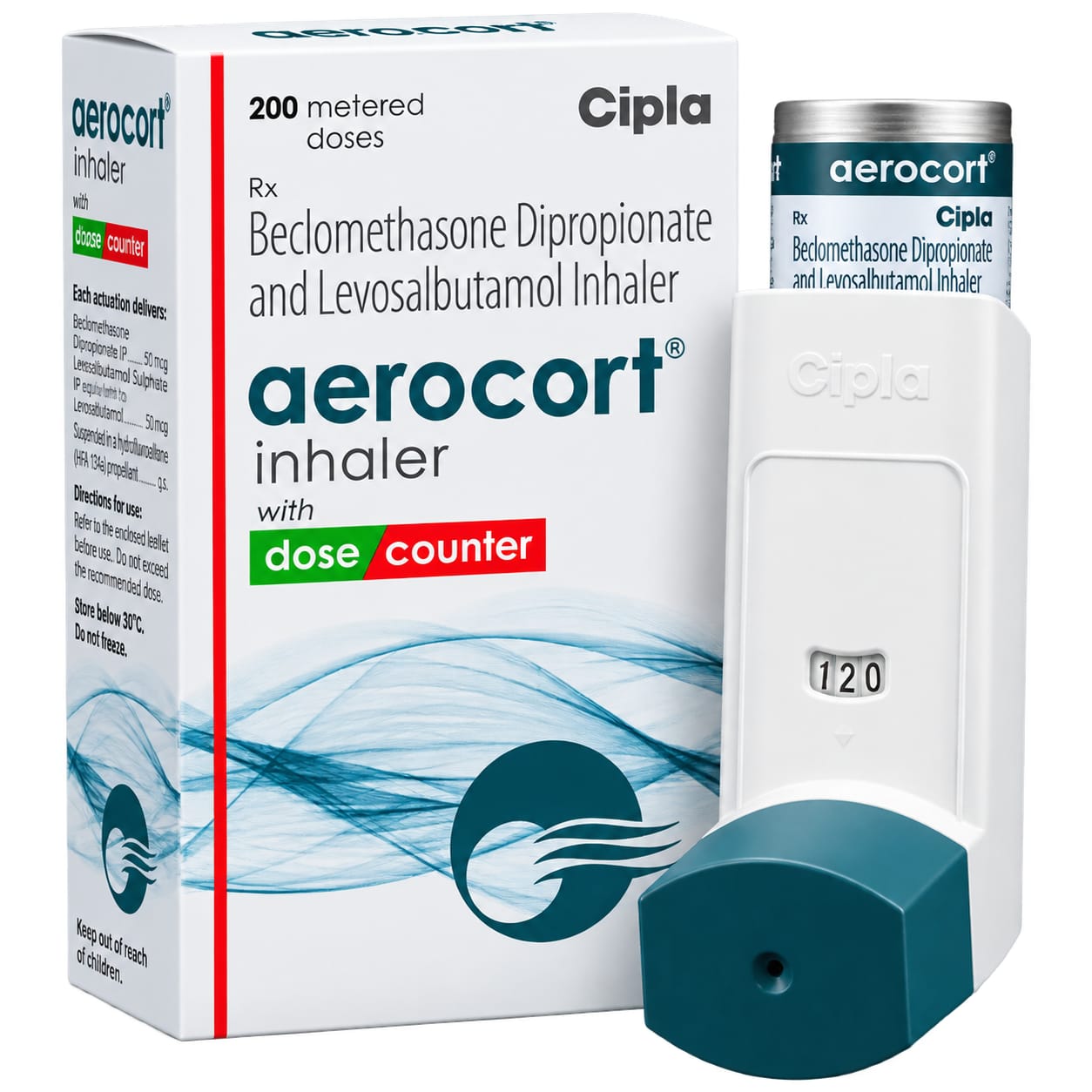
| Forms | Inhaler (metered dose inhaler) |
Quick overview
Aerocort Inhaler is a combination medicine containing levosalbutamol and beclometasone, used for the maintenance treatment of asthma. Levosalbutamol relaxes the muscles in the airways to open them up quickly, while beclometasone reduces airway inflammation to help prevent symptoms and asthma attacks. It is for inhalation use only and is not recommended for children below 12 years of age.
What is Aerocort Inhaler
Aerocort Inhaler is a combination medicine used to treat asthma. It contains levosalbutamol, which relaxes the muscles in the airways, and beclometasone, which reduces inflammation in the airways. Together they make breathing easier.
Aerocort Inhaler uses
- Maintenance treatment of asthma
- Relief of wheezing and shortness of breath in asthma with an inflammatory component
- Prevention of asthma symptoms in patients needing both bronchodilator and inhaled steroid
Benefits of Aerocort Inhaler
- Relieves wheezing and breathlessness
- Opens airways quickly
- Reduces airway inflammation
- Helps prevent asthma attacks when used regularly
- Improves overall asthma control
How Aerocort Inhaler works
Levosalbutamol is a fast-acting medicine that relaxes the muscles around the airways to open them up quickly. Beclometasone is a steroid medicine that reduces swelling and inflammation in the airways, which helps prevent symptoms and asthma attacks over time.
Aerocort Inhaler dosage
This inhaler is for inhalation use only; do not swallow it. Use it exactly as your doctor prescribed; it is usually taken regularly to control asthma, and may also be used as directed for symptom relief. Shake the inhaler well before use. Breathe out fully, seal your lips around the mouthpiece, and breathe in deeply while pressing down on the canister. Hold your breath for about 10 seconds, then breathe out slowly.
Rinse your mouth or gargle with water after each use to lower the risk of a fungal mouth infection. Use a spacer device if your doctor has advised one. Take it at the same time every day to keep a steady level of medicine in your body.
It does not work right away and should not be used to relieve sudden breathing problems; use your rescue inhaler for sudden attacks. Do not change the dose or stop using it early on your own, even if you feel well. Not recommended for use in children below 12 years of age.
| Age group | Dose |
|---|---|
| Under 4 Years | Use only if prescribed by a healthcare professional |
| 4–11 Years | 1 inhalation twice daily (as prescribed) |
| 12 Years and Above | 1–2 inhalations twice daily depending on condition |
| Adults (18–64 Years) | 1–2 inhalations twice daily as directed |
| Older Adults (65+ Years) | 1–2 inhalations twice daily; use according to medical advice |
Available forms and strengths
Aerocort Inhaler is available as a metered dose inhaler containing levosalbutamol 50mcg and beclometasone 50mcg.
Side effects of Aerocort Inhaler
Common
- Throat irritation
- Hoarseness of voice
- Cough
- Headache
- Tremor
- Palpitations
- Nervousness
- Dry mouth
- Nausea
- Oral thrush (fungal infection of the mouth)
- Dizziness
- Pharyngitis (sore throat)
- Vomiting
- Bronchitis
- Application site irritation
- Gastrointestinal motility disorder
- Running nose
Serious
- Rash
- Swelling of the face or lips
- Wheezing or difficulty breathing
- Signs of low blood potassium (weakness, irregular heartbeat)
- Signs of adrenal problems such as tiredness, nausea, vomiting, low energy, low blood pressure
- Vision changes, glaucoma, or cataracts with long-term use
- Reduced bone strength with long-term use
- Slowed growth in children with long-term high-dose use
Warnings and precautions
- This inhaler is not a substitute for emergency treatment during a severe asthma attack. Keep a fast-acting rescue inhaler on hand for sudden symptoms, and get urgent medical care if your breathing gets worse or your usual rescue medicine isn't helping. Do not use more than the prescribed dose. Rinse your mouth with water after each use to help prevent a fungal mouth infection.
- Use with caution if you have heart disease, high blood pressure, an overactive thyroid, diabetes, seizure disorders, or glaucoma. Using high doses of inhaled steroids for a long time may rarely cause adrenal gland problems, weaker bones, eye problems such as cataracts or glaucoma, and slowed growth in children; your doctor may check on these from time to time.
- Do not use this medicine if you are allergic to it or to any of its ingredients, including the propellant in the inhaler. The first dose should be taken under medical supervision, as it may cause sudden tightening of the airways in rare cases immediately after use. Do not stop using this medicine suddenly, even if you feel fine, because your breathing problems may come back. This medicine is not recommended for children under 12 years old.
- Use only with caution during pregnancy and after talking to your doctor. There isn't enough human data to confirm safety, and animal studies have shown some harmful effects on the developing baby, so your doctor will weigh the benefits and risks. Talk to your doctor before using this medicine while breastfeeding, as it is not known if it passes into breast milk.
- Tell your doctor if you have kidney problems before starting this medicine so they can decide if it's suitable and monitor you as needed. Use with caution if you have liver problems, as this medicine is processed by the liver and liver problems may cause it to build up in the body.
- Sources disagree on alcohol safety — some say there is no known interaction, while others advise avoiding alcohol because it may increase drowsiness or intensify side effects. Ask your doctor before drinking alcohol with this medicine.
- This medicine may cause dizziness or tiredness in some people. If this happens to you, do not drive or operate heavy machinery until you feel well.
Storage
- Store below 30°C.
- Keep away from direct sunlight and heat.
- Do not freeze.
- Keep the inhaler canister away from flame or heat; do not puncture it.
- Keep out of reach of children.
When to see a doctor
- Stop the medicine and get help right away if you notice a rash, swelling of the face or lips, wheezing, or difficulty breathing.
- If you think you have taken too much, do not wait for symptoms — go to the nearest emergency department and take the pack with you.
- Get emergency medical help if you notice signs of a serious allergic reaction such as skin rash, itching or swelling of the face, tongue or throat, or breathing difficulty.
- If you suddenly have trouble breathing right after using the inhaler, stop using it and call your healthcare provider right away.
Alternatives
- Foracort Inhaler
- Symbicort Inhaler
- Flutiform Inhaler
Watch the video
FAQs
What is Aerocort Inhaler used for?
It is used for the maintenance treatment of asthma, relieving wheezing and shortness of breath, and preventing asthma symptoms in patients who need both a bronchodilator and an inhaled steroid.
How does Aerocort Inhaler work?
It contains levosalbutamol, which quickly relaxes the muscles around the airways to open them up, and beclometasone, a steroid that reduces airway inflammation to help prevent symptoms and asthma attacks over time.
Can Aerocort Inhaler be used for a sudden asthma attack?
No, it does not work right away and should not be used to relieve sudden breathing problems. A fast-acting rescue inhaler should be kept on hand for sudden symptoms.
What is the dose of Aerocort Inhaler for adults?
Adults aged 18 to 64 years are usually prescribed 1–2 inhalations twice daily as directed by their doctor.
What are the common side effects of Aerocort Inhaler?
Common side effects include throat irritation, hoarseness of voice, cough, headache, tremor, palpitations, nervousness, dry mouth, nausea, oral thrush, dizziness, and sore throat.
General information, not medical advice
Your prescriber and the leaflet in your pack know your situation. This page does not.
- Follow your prescriber and the leaflet
- Don't start, stop, or change a dose on your own
- Doses and warnings differ by country and product
Sources
- Manufacturer labeling/pack insert
- Established medical literature (GINA asthma guidance)
- Drug reference databases
- Indian Pharmacopoeia
- Central Drugs Standard Control Organisation (CDSCO), Ministry of Health & Family Welfare, Government of India, approved drug and schedule listings.
- National List of Essential Medicines (NLEM) 2022, Government of India.
- Manufacturer's package insert / prescribing information for Aerocort Inhaler.
- World Health Organization, ATC/DDD classification and Model Formulary for the active ingredient.
- Beclomethasone oral inhalation: MedlinePlus drug information.
- Beclomethasone dipropionate: Uses, Interactions, Mechanism of Action | DrugBank Online.
- Levosalbutamol: Uses, interactions, mechanism of action | DrugBank Online.
- Brogden, R. N., Pinder, R. M., Sawyer, P. R., Speight, T. M., & Avery, G. S. (1975). Beclomethasone dipropionate inhaler. Drugs, 10(3), 166–210.
- Levosalbutamol. (2016). In Elsevier eBooks (p. 564).
Video
Related medicines

Injectafer Injection: Uses, Dosage, Side Effects, Precautions and Alternates
Iron products
Injectafer (ferric carboxymaltose) treats iron deficiency anemia and heart failure-related iron deficiency via IV. Learn uses, dosage, side effects, and

Gliclazide Tablet: Uses, Dosage, Side Effects, Precautions and Alternates
Sulfonylurea (hypoglycemic/antidiabetic agent)
Gliclazide Tablet is a sulfonylurea for type 2 diabetes that boosts insulin release. Learn about dosage, side effects, warnings, and precautions.