
Safety
General information, not medical advice
Your prescriber and the leaflet in your pack know your situation. This page does not.
- Follow your prescriber and the leaflet
- Don't start, stop, or change a dose on your own
- Doses and warnings differ by country and product
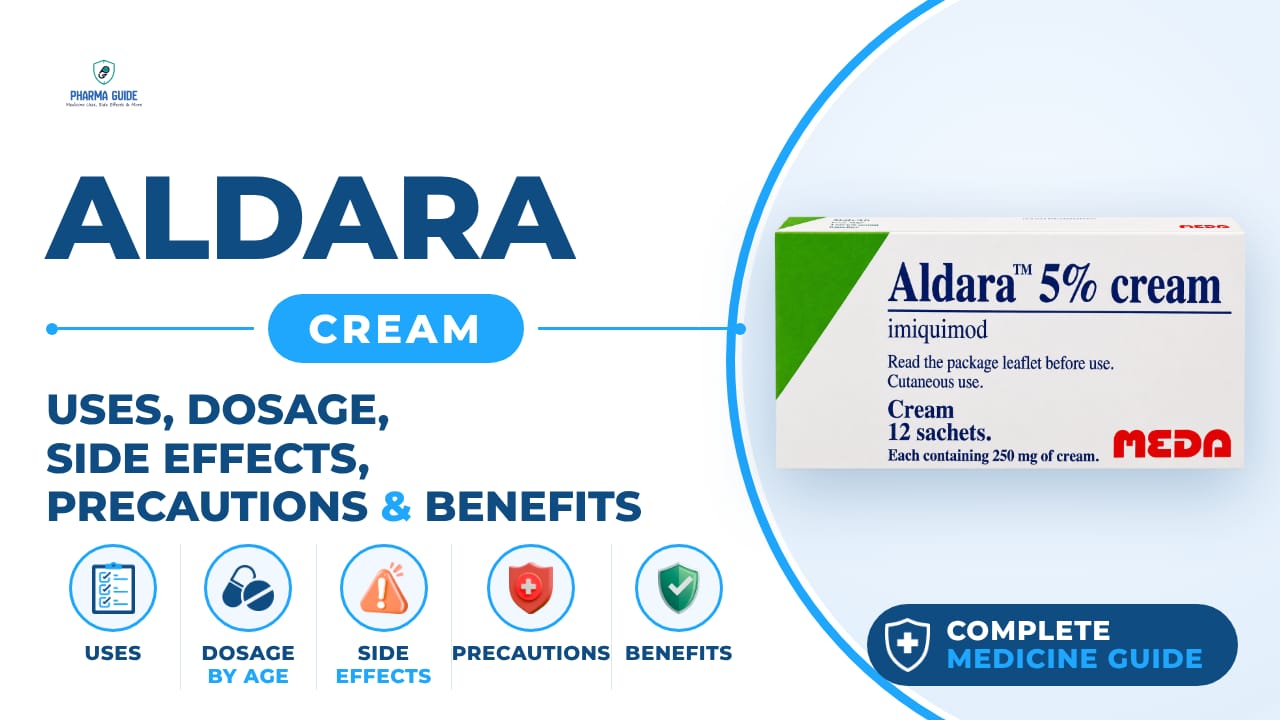
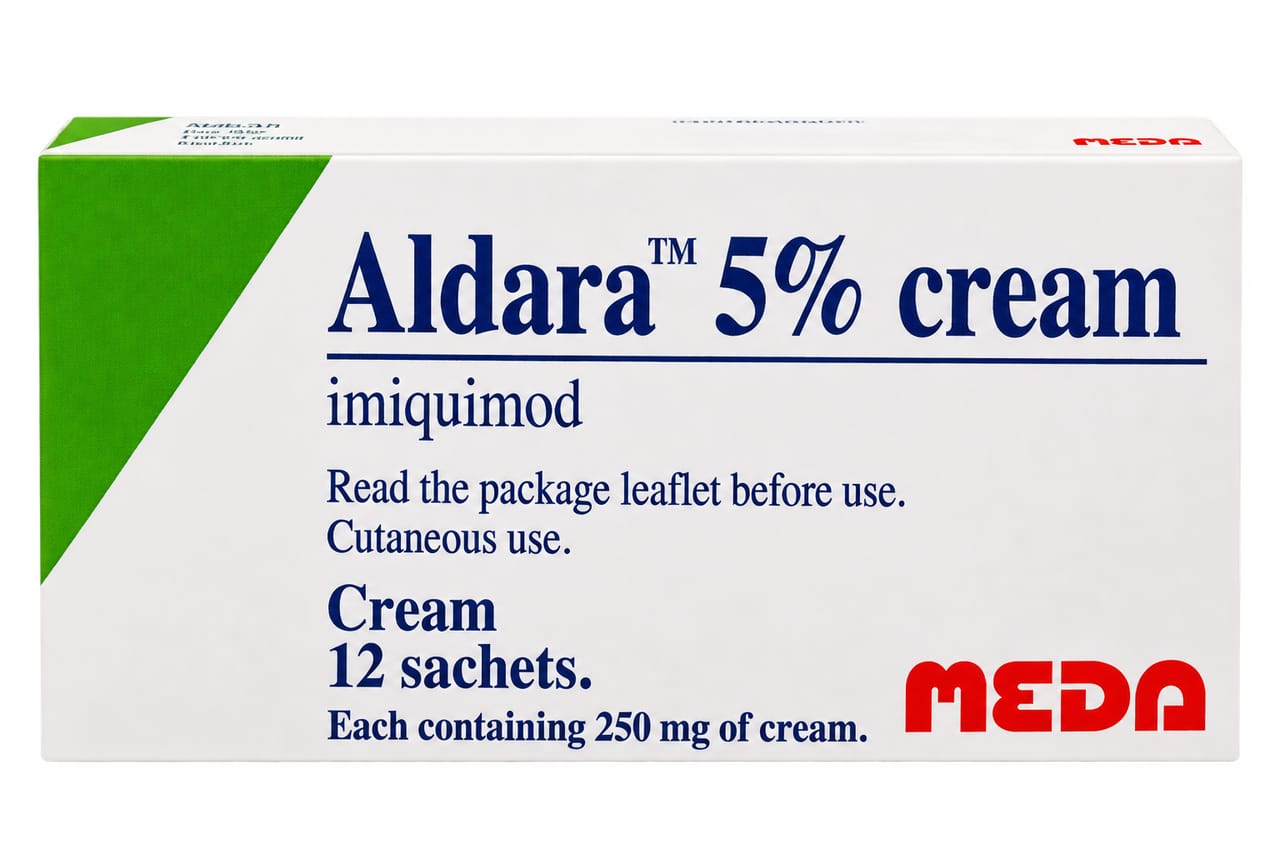
Aldara Cream: Uses, Dosage, Side Effects, Precautions and Alternates
| Generic name | imiquimod |
|---|---|
| Drug class | Topical anti-infectives, Topical antineoplastics (immune response modifier) |
| Forms | Cream in single-use sachets, Cream in a pump pack |
Quick overview
Aldara Cream contains the active ingredient imiquimod and belongs to the topical anti-infectives and topical antineoplastics (immune response modifier) drug class. It is a prescription cream applied to the skin to treat actinic keratoses, superficial basal cell carcinoma, and external genital and perianal warts caused by HPV. It works by activating the immune system to target abnormal or virus-infected skin cells. Aldara is used exactly as directed, with frequency depending on the condition being treated.
What is Aldara Cream
Aldara is a prescription cream containing the active ingredient imiquimod. It is applied to the skin to treat certain skin conditions caused by sun damage, a type of skin cancer, and genital warts caused by HPV.
Aldara Cream uses
- Topical treatment of actinic keratoses (also called solar keratoses) on the face and scalp
- Treatment of superficial basal cell carcinoma, a type of skin cancer, when surgery is not a good option
- Treatment of external genital and perianal warts (condyloma acuminata)
Benefits of Aldara Cream
- Can clear actinic keratosis lesions without surgery
- Can clear superficial basal cell carcinoma lesions in many patients when surgery is not appropriate
- Can clear external genital and perianal warts
- Works on hidden lesions beneath the skin surface, not just visible ones
How Aldara Cream works
Imiquimod is an immune response modifier. It activates immune cells in the body, which then recognize and destroy the abnormal or virus-infected skin cells. However, the exact way it works is not fully known.
Aldara Cream dosage
Wash your hands and the treatment area with mild soap and water and let it dry thoroughly before applying the cream. Apply a thin layer of cream to the affected area just before bedtime and rub in until the cream is no longer visible.
For actinic keratosis, apply the cream at bedtime a few times per week, as directed by your doctor. For superficial basal cell carcinoma, apply the cream at bedtime most days of the week, as directed by your doctor, covering the lesion and some surrounding skin. For genital or perianal warts, apply a thin layer of cream at bedtime a few times per week, as directed by your doctor.
Leave the cream on the skin for the time your doctor recommends, then wash it off in the morning with mild soap and water. Do not shower or bathe while the cream is left on the skin. Do not cover the treated area with bandages or other closed dressings unless your doctor tells you to; cotton gauze may be used if needed.
Avoid getting the cream in or near the eyes, lips, nostrils, ears, vagina, or anus; rinse with water right away if this happens.
If you forget to apply a dose, apply it as soon as you remember and continue on your regular schedule; do not double up to make up a missed dose.
Uncircumcised men treating warts under the foreskin should pull back the foreskin and clean the area daily.
Avoid sexual contact (genital, anal, or oral) while the cream is on the skin, and wash it off before any sexual activity.
This medicine is not recommended for use in children under 18 for actinic keratosis or basal cell carcinoma; for genital warts it is used in patients 12 years and older. It is not for use in or around the eyes, mouth, or vagina, and should only be used on the skin.
| Age group | Dose |
|---|---|
| Under 12 years | Not established / not recommended |
| 12–17 years | Apply a thin layer once daily at bedtime, 3 times per week |
| 18–64 years | Apply a thin layer as directed, usually 2–5 times per week depending on the prescribed treatment |
| 65+ years | Same as adults; dose adjustment is generally not required |
Available forms and strengths
- Cream in single-use sachets
- Cream in a pump pack
Side effects of Aldara Cream
Common
- Redness
- Skin peeling, flaking, or dryness
- Scabbing and crusting
- Swelling
- Small open sores or ulcers
- Itching
- Burning
- Pain or tenderness at the application site
- Skin hardening or thickening
- Changes in skin color
- Headache
- Tiredness
- Flu-like symptoms such as fever, chills, body aches
- Diarrhea
Serious
- Severe skin reactions such as intense redness, weeping, or erosion of the skin
- Severe swelling near the opening of the vagina, which can cause painful or difficult urination
- Signs of an allergic reaction such as hives, difficulty breathing, or swelling of the face, lips, tongue, or throat
- Permanent lightening or loss of skin color (hypopigmentation) in the treated area
- Flu-like systemic symptoms including fever, chills, body aches, and tiredness that may require stopping treatment
- Infection at the treatment site
Warnings and precautions
- Tell your doctor if you are pregnant, think you might be pregnant, or plan to become pregnant.
- It is not known if this medicine can harm an unborn baby, so check with your doctor before use, and call your doctor right away if you become pregnant while using it.
- Check with your doctor before using this medicine if you are breastfeeding. If you do use it while breastfeeding, avoid letting your baby's mouth or eyes touch the treated skin.
- For external use only. Do not swallow or apply inside the eyes, mouth, or vagina. Avoid contact with the eyes and mucous membranes. If contact occurs, rinse thoroughly with water. Do not apply to broken, infected, or severely irritated skin unless specifically directed by a doctor. Aldara can cause significant local skin reactions, including redness, swelling, itching, burning, erosion, or weeping.
- If a severe skin reaction develops, treatment may need to be temporarily stopped until the reaction improves. Avoid sexual, genital, anal, or oral contact while the cream is on the skin.
- Aldara may weaken condoms and vaginal diaphragms, so they should not be relied upon during treatment.
- Do not use other imiquimod products on the same treatment area, as this may increase skin reactions. Tell your doctor if you have chronic graft-versus-host disease or another inflammatory skin condition, as Aldara may worsen it.
- Keep out of reach of children. If pregnant or breastfeeding, consult a healthcare professional before use.
- Do not use more than the recommended amount of cream, and do not use it more often or for longer than prescribed, as this increases the risk of severe skin reactions.
- Do not apply the cream near the eyes, ears, lips, or nostrils, or inside the vagina or anus.
- Do not use sunlamps or tanning beds, and avoid sun exposure as much as possible during treatment, since the skin can become more sensitive to sunburn.
- Do not use this cream on skin with open sores, wounds, or sunburn.
- This cream may weaken latex condoms and diaphragms, so an alternate form of contraception is recommended during use.
- Avoid sexual contact while the cream is on the skin when treating genital or anal warts.
- This medicine does not cure genital warts and does not prevent spreading the infection to others; new warts may appear during treatment.
- Tell your doctor if you have a weakened immune system, an autoimmune disorder, graft-versus-host disease, or have had a bone marrow or cord blood transplant, before using this medicine.
Storage
- Store in a cool, dry place where the temperature stays below 25°C
- Do not freeze
- Keep out of reach of children
- When using the Aldara pump, discard any remaining medicine 4 weeks after opening
- Discard partially used sachets even if some cream is left in them
- If you no longer need the medicine or it is out of date, take it to a pharmacy for safe disposal
- Do not use after the expiry date
- Do not store in the bathroom, near a sink, in the car, or on window sills
When to see a doctor
- Stop using the cream and call your doctor right away if you have a skin reaction that affects your daily activities or does not go away.
- Get emergency help right away if you have signs of an allergic reaction, such as hives, trouble breathing, or swelling of the face, lips, tongue, or throat.
- Stop using the cream and contact your doctor immediately if you notice severe swelling near the vaginal opening, or problems passing urine.
- If you think you have swallowed the cream, contact your doctor or go to the nearest hospital emergency department right away, even if you feel fine.
- If you notice a change in skin color where the cream was applied, tell your doctor, as this may not go away.
- Uncircumcised men should stop treatment and call their doctor if they notice swelling, skin breakdown, or difficulty pulling back the foreskin.
Alternatives
- 5-Fluorouracil (5-FU) cream
- Sinecatechins
- Cryotherapy
Watch the video
FAQs
What is Aldara Cream used for?
Aldara Cream is used to treat actinic keratoses on the face and scalp, superficial basal cell carcinoma when surgery isn't a good option, and external genital and perianal warts caused by HPV.
How does Aldara Cream work?
Aldara contains imiquimod, an immune response modifier that activates immune cells in the body, which then recognize and destroy abnormal or virus-infected skin cells. The exact mechanism is not fully known.
How should Aldara Cream be applied?
Wash hands and the treatment area, let it dry, then apply a thin layer at bedtime and rub in until no longer visible. Leave on for the recommended time, then wash off in the morning with mild soap and water. Frequency depends on the condition being treated.
Can Aldara Cream weaken condoms?
Yes, Aldara may weaken condoms and vaginal diaphragms, so they should not be relied upon during treatment; an alternate form of contraception is recommended.
What are the common side effects of Aldara Cream?
Common side effects include redness, skin peeling or dryness, scabbing, swelling, small sores, itching, burning, pain at the application site, skin thickening, color changes, headache, tiredness, flu-like symptoms, and diarrhea.
General information, not medical advice
Your prescriber and the leaflet in your pack know your situation. This page does not.
- Follow your prescriber and the leaflet
- Don't start, stop, or change a dose on your own
- Doses and warnings differ by country and product
Sources
Video
Related medicines

Injectafer Injection: Uses, Dosage, Side Effects, Precautions and Alternates
Iron products
Injectafer (ferric carboxymaltose) treats iron deficiency anemia and heart failure-related iron deficiency via IV. Learn uses, dosage, side effects, and

Gliclazide Tablet: Uses, Dosage, Side Effects, Precautions and Alternates
Sulfonylurea (hypoglycemic/antidiabetic agent)
Gliclazide Tablet is a sulfonylurea for type 2 diabetes that boosts insulin release. Learn about dosage, side effects, warnings, and precautions.