
Safety
General information, not medical advice
Your prescriber and the leaflet in your pack know your situation. This page does not.
- Follow your prescriber and the leaflet
- Don't start, stop, or change a dose on your own
- Doses and warnings differ by country and product
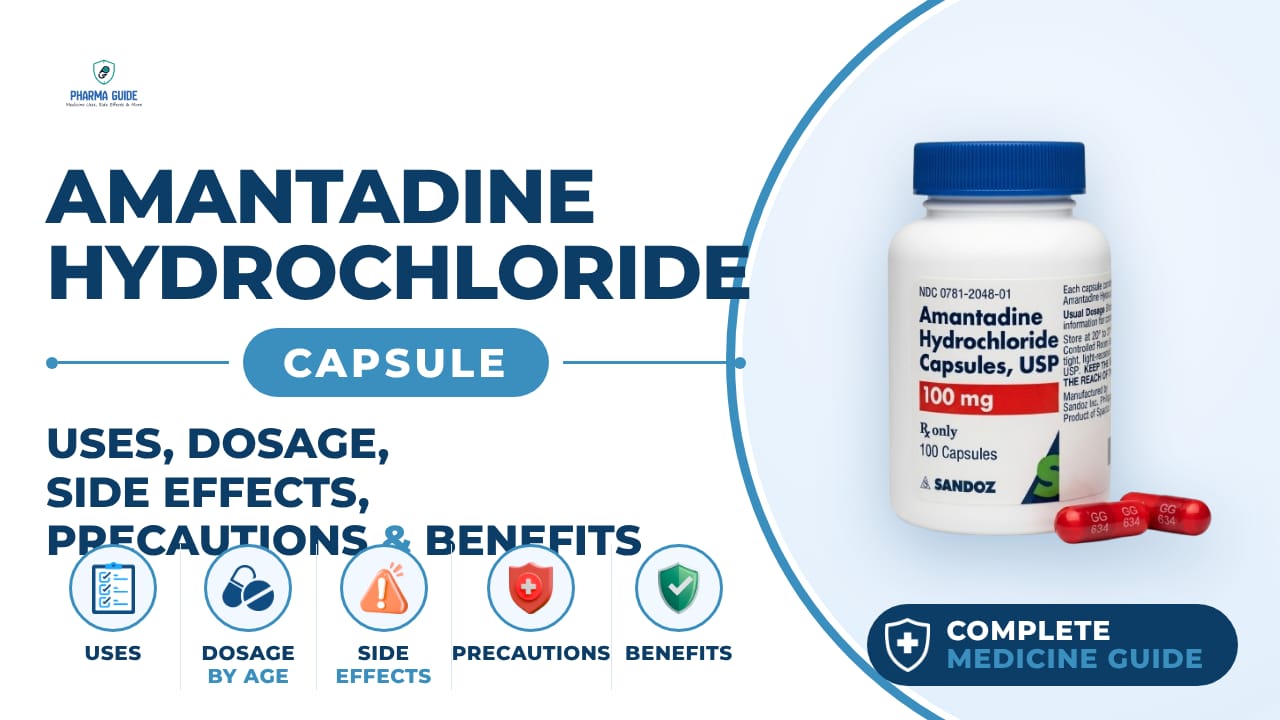
Amantadine Hydrochloride Capsule: Uses, Dosage, Side Effects, Precautions and Alternates
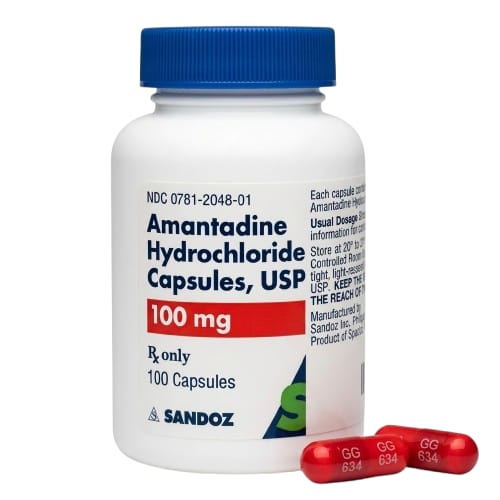
| Generic name | Amantadine hydrochloride |
|---|---|
| Drug class | Adamantane antiviral / Dopaminergic antiparkinsonism agent |
| Forms | Capsule, Tablet, Syrup/oral solution |
Quick overview
Amantadine Hydrochloride Capsule contains amantadine hydrochloride, a medicine belonging to the adamantane antiviral and dopaminergic antiparkinsonism drug classes. It is used to manage Parkinson's disease symptoms, parkinsonism, drug-induced extrapyramidal reactions, and certain cases of influenza A. It comes as capsules, tablets, or syrup, and must be taken exactly as prescribed due to the risk of serious side effects.
What is Amantadine Hydrochloride Capsule
Amantadine hydrochloride is a medicine that works as both an antiviral and an anti-Parkinson drug. It comes as capsules, tablets, or syrup.
Amantadine Hydrochloride Capsule uses
- Parkinson's disease symptoms
- Parkinsonism
- Drug-induced extrapyramidal reactions
- Certain medication-related movement disorders
- Influenza A treatment or prevention where specifically indicated; resistance limits its usefulness
Benefits of Amantadine Hydrochloride Capsule
- Can reduce signs and symptoms of influenza A infection, especially when started early
- Can help improve movement symptoms of Parkinson's disease such as stiffness and tremors
- Can be used alongside other Parkinson's medicines like levodopa to smooth out symptom control
- Has a lower rate of anticholinergic-type side effects than anticholinergic antiparkinson drugs when used for drug-induced extrapyramidal reactions
How Amantadine Hydrochloride Capsule works
It isn't fully understood how this medicine works. For Parkinson's disease, it's thought to affect the brain and nervous system in ways that help with symptoms. For the flu virus, it's thought to work by blocking the virus's ability to infect the body, mainly by stopping the virus from releasing its genetic material into cells.
Amantadine Hydrochloride Capsule dosage
Take this medicine exactly as your doctor has told you; do not increase, decrease, or stop it without talking to your doctor first. Swallow the capsule whole with a drink of water; do not crush, chew, or break it. If you cannot swallow a capsule whole, you may open it and sprinkle the medicine into a spoonful of applesauce and swallow right away without chewing; do not save the mixture for later. You may take it with or without food.
If taking for influenza, start the medicine as soon as possible, preferably within 24 to 48 hours after symptoms begin, and keep taking it for the full prescribed length of time. If central nervous system side effects occur with once-daily dosing, your doctor may split the dose into two smaller doses per day.
If you take this medicine for Parkinson's symptoms, do not stop using it suddenly, as this may make your condition worse or cause withdrawal symptoms; ask your doctor how to stop safely.
If you miss a dose, take it as soon as you remember, unless it is almost time for your next dose — in that case, skip the missed dose and continue your regular schedule; do not take two doses at once. Call your doctor if you miss several doses in a row.
| Age group | Dose |
|---|---|
| Under 18 years | Not recommended |
| 18–64 years | 100 mg, twice/day |
| 65+ years | 100 mg, twice/day |
Available forms and strengths
- Capsule
- Tablet
- Syrup/oral solution
Side effects of Amantadine Hydrochloride Capsule
Common
- Nausea
- Dizziness or lightheadedness
- Trouble sleeping (insomnia)
- Dry mouth
- Constipation
- Swelling in legs, feet, or hands
- Headache
- Loss of appetite
- Anxiety or feeling nervous
- Feeling tired
- Difficulty concentrating
- Sweating
- Difficulty emptying your bladder
Serious
- Suicidal thoughts or actions
- Neuroleptic malignant syndrome: high fever, muscle stiffness, confusion, irregular heartbeat, sweating, changes in blood pressure
- Congestive heart failure: shortness of breath, swelling in hands/feet/legs, fatigue, cough, rapid or irregular heartbeat
- Severe allergic reaction: hives, difficulty breathing, swelling of face, lips, tongue, or throat
- Hallucinations (seeing or hearing things that are not there)
- Seizures (convulsions)
- Fainting or severe dizziness (orthostatic hypotension)
- Vision changes, including blurred vision, vision loss, or eye pain
- Falling asleep suddenly during daily activities
- Behavior and mood changes: agitation, aggression, compulsive gambling, compulsive shopping, increased sexual urges, binge eating
- Slurred speech
- Irregular, fast, or slow heartbeat (arrhythmia)
- Signs of overdose: confusion, agitation, hallucinations, severe headache, muscle stiffness, trouble breathing, fast heartbeat, seizure
Warnings and precautions
- This medicine may harm an unborn baby and should only be used in pregnancy if the potential benefit outweighs the possible risk. Tell your doctor if you are pregnant or planning to become pregnant.
- This medicine passes into breast milk and is not recommended for use while breastfeeding.
- Because this medicine is mainly removed from the body by the kidneys, it can build up if kidney function is reduced, raising the risk of serious side effects or even fatal overdose. Your doctor will need to lower your dose if you have kidney problems.
- Caution should be used when giving this medicine to patients with liver disease. Rare cases of reversible liver enzyme elevations have occurred, though a direct link to the drug hasn't been proven.
- Avoid drinking too much alcohol while taking this medicine, since it can increase side effects like dizziness, confusion, lightheadedness, and a drop in blood pressure when standing up.
- If you notice central nervous system effects or blurred vision, avoid driving or working in situations where you need to be alert or have good coordination.
- Deaths have been reported from overdose with this medicine, with the lowest reported fatal dose being 1 gram. Overdose can cause serious heart, lung, kidney, or nervous system problems.
- Some patients, including those with no history of mental illness, have attempted suicide while taking this medicine, sometimes after only short courses for the flu.
- People with a history of seizures should be watched closely, as this medicine may increase seizure activity.
- This medicine should not be stopped suddenly in Parkinson's disease patients, as this can cause a sudden, serious worsening of symptoms (parkinsonian crisis) or trigger delirium, agitation, hallucinations, and other reactions.
- A rare but life-threatening condition called Neuroleptic Malignant Syndrome (NMS) has been reported when the dose is lowered or the medicine is stopped, especially in patients also taking antipsychotic medicines.
- Some patients have developed intense urges, such as gambling, overspending, or increased sexual urges, that they may be unable to control while taking this medicine.
- People with Parkinson's disease have a higher risk of developing melanoma (a type of skin cancer), so regular skin checks are recommended while on this medicine.
- This medicine should not be given to patients with untreated angle-closure glaucoma because it can cause pupil dilation.
- Do not receive a live nasal flu vaccine while taking this medicine or within a short time after stopping it, since the vaccine may not work as well.
Storage
- Store at room temperature (15 to 30°C)
- Protect from humidity
- Keep out of reach and sight of children
- Medicines should not be disposed of via wastewater or household waste; bring unused and expired prescription drugs to your local pharmacist for proper disposal
When to see a doctor
- Get emergency help right away if you have signs of a severe allergic reaction: hives, difficulty breathing, or swelling of your face, lips, tongue, or throat.
- Call your doctor right away if you feel extremely drowsy or fall asleep suddenly, feel like you might pass out, have shortness of breath or swelling in your hands or feet, have painful or difficult urination, have mood or behavior changes, hallucinations, or thoughts of hurting yourself, have a seizure, or notice severe muscle stiffness with high fever, sweating, confusion, and fast or uneven heartbeat.
- Seek medical attention immediately if you suspect you have taken too much of this medicine, even if you don't have symptoms yet, because overdose can be fatal.
- Tell your doctor if you notice changes in your vision, such as blurry vision, vision loss, or eye pain.
- Call your doctor if your flu symptoms do not improve, or if you develop a fever with headache, cough, skin rash, or other new symptoms.
Alternatives
- Carbidopa
- Levodopa
- Rimantadine
Watch the video
FAQs
What is Amantadine Hydrochloride Capsule used for?
It is used to manage Parkinson's disease symptoms, parkinsonism, drug-induced extrapyramidal reactions, and certain cases of influenza A, though resistance limits its usefulness for flu.
How should I take Amantadine Hydrochloride Capsule?
Swallow the capsule whole with water; do not crush or chew it. If you cannot swallow it whole, you may open it and sprinkle the medicine into a spoonful of applesauce and swallow right away. It can be taken with or without food.
What is the dosage of Amantadine Hydrochloride Capsule for adults?
For adults aged 18-64 and those 65 and older, the typical dose is 100 mg twice a day. It is not recommended for use in children under 18 years.
Can I stop taking Amantadine Hydrochloride Capsule suddenly?
No, if you take it for Parkinson's symptoms, do not stop suddenly, as this may cause a serious worsening of symptoms (parkinsonian crisis) or trigger delirium, agitation, and hallucinations. Ask your doctor how to stop safely.
What are the serious side effects of Amantadine Hydrochloride Capsule?
Serious side effects include suicidal thoughts, neuroleptic malignant syndrome, congestive heart failure, severe allergic reactions, hallucinations, seizures, fainting, vision changes, sudden sleep episodes, and behavior changes like compulsive gambling or increased sexual urges.
General information, not medical advice
Your prescriber and the leaflet in your pack know your situation. This page does not.
- Follow your prescriber and the leaflet
- Don't start, stop, or change a dose on your own
- Doses and warnings differ by country and product
Sources
Video
Related medicines

Injectafer Injection: Uses, Dosage, Side Effects, Precautions and Alternates
Iron products
Injectafer (ferric carboxymaltose) treats iron deficiency anemia and heart failure-related iron deficiency via IV. Learn uses, dosage, side effects, and

Gliclazide Tablet: Uses, Dosage, Side Effects, Precautions and Alternates
Sulfonylurea (hypoglycemic/antidiabetic agent)
Gliclazide Tablet is a sulfonylurea for type 2 diabetes that boosts insulin release. Learn about dosage, side effects, warnings, and precautions.