
Safety
General information, not medical advice
Your prescriber and the leaflet in your pack know your situation. This page does not.
- Follow your prescriber and the leaflet
- Don't start, stop, or change a dose on your own
- Doses and warnings differ by country and product
Ameluz Gel: Uses, Dosage, Side Effects, Precautions and Alternates
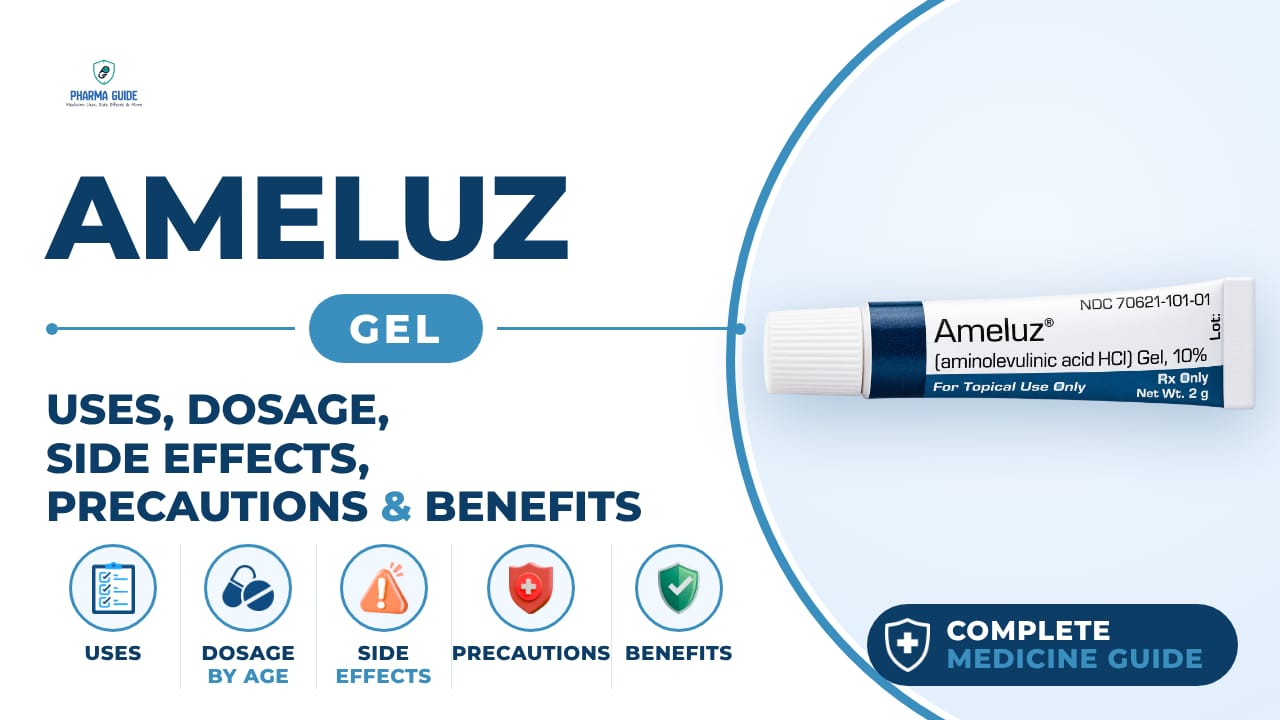
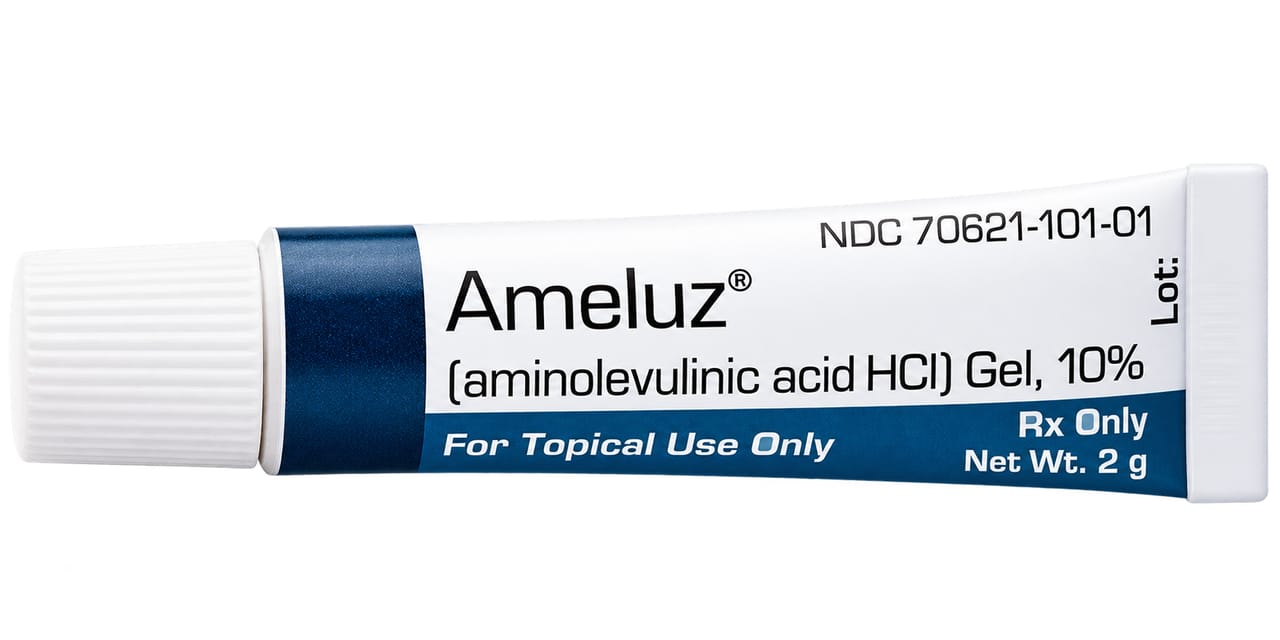
| Generic name | aminolevulinic acid HCl 10% |
|---|---|
| Drug class | Topical photochemotherapeutics |
| Forms | topical gel |
Quick overview
Ameluz Gel contains aminolevulinic acid HCl 10% and belongs to the topical photochemotherapeutics drug class. It is a prescription gel used together with red light photodynamic therapy (PDT) to treat actinic keratosis and superficial basal cell carcinoma in adults. The gel is applied only by a healthcare provider and then activated using a special red light lamp. Common side effects include application-site pain, redness, and irritation, while serious effects such as allergic reactions and eye problems can also occur.
What is Ameluz Gel
Ameluz gel is a prescription topical gel used together with red light photodynamic therapy (PDT) to treat certain skin conditions in adults. It contains aminolevulinic acid and is applied by a healthcare provider, then activated with a special red light lamp.
Ameluz Gel uses
- Mild-to-moderate actinic keratosis (precancerous scaly spots on sun-damaged skin) on the face and scalp, treated as single spots or a whole affected area
- Superficial basal cell carcinoma (sBCC), a slow-growing skin cancer that stays in the top layer of skin
Benefits of Ameluz Gel
- In actinic keratosis trials, 84% to 91% of people had complete clearance of lesions 12 weeks after the last treatment, compared with 13% to 22% with the inactive gel
- In the basal cell carcinoma trial, 66% of people had the main lesion clear on both examination and biopsy 12 weeks after the last treatment cycle, compared with 5% with the inactive gel
How Ameluz Gel works
After the gel is applied to the skin, aminolevulinic acid is absorbed by skin cells and turned into a light-sensitive substance. When the treated area is exposed to red light from the special lamp, this substance is activated and, with the help of oxygen in the cells, forms reactive molecules that damage and destroy the targeted skin cells.
Ameluz Gel dosage
This medicine is applied only by a healthcare provider, for use on the skin only — not in the eyes, mouth, or vagina, and not on or around the eyelid. Your provider first cleans the treatment area with an alcohol pad, removes scaling and crusts, and gently roughens the lesion surface while avoiding bleeding.
A thin layer of gel is spread over the lesions and a border of surrounding healthy skin using gloved fingers or a spatula, keeping it away from the eyes, nostrils, mouth, and ears. The gel is allowed to dry, then the area is covered with a dressing that blocks light for about 3 hours before being wiped off.
Right after the dressing is removed, the area is treated with the red light lamp; everyone in the room must wear protective eyewear during this step. You may feel tingling, stinging, prickling, or burning during the light treatment, which is usually temporary; cooling with an air stream or fine water mist may help. Healthy skin around the lesions does not need to be covered during the light treatment.
If the light treatment cannot be given within 3 hours of applying the gel, the gel is rinsed off and the area must be protected from sunlight and strong light for 2 days afterward. You may need separate treatment sessions if you have lesions in more than one area.
For actinic keratosis, lesions that have not fully cleared are re-treated about 3 months after the first treatment. For superficial basal cell carcinoma, treatment is given in two sessions spaced 1 to 2 weeks apart, with follow-up checks and possible further treatment cycles later.
This medicine has not been established as safe and effective in children, since these conditions are not usually seen in children. In clinical trials, most people treated were older adults, and no major differences in safety or effectiveness were seen compared with younger adults, though some older people may be more sensitive.
| Age group | Dose |
|---|---|
| Under 18 years | Safety and effectiveness not established; no approved pediatric dosage |
| 18–64 years | 10% gel, approximately 1 mm thick, per PDT session; maximum 6 g over 60 cm² |
| 65–74 years | 10% gel, approximately 1 mm thick, per PDT session; maximum 6 g over 60 cm², with clinical monitoring |
| 75 years and older | 10% gel, approximately 1 mm thick, per PDT session; maximum 6 g over 60 cm², with careful skin monitoring |
Available forms and strengths
- Topical gel, aminolevulinic acid HCl 10%
Side effects of Ameluz Gel
Common
- Pain or burning where the gel was applied
- Skin reddening (erythema)
- Irritation
- Swelling (edema)
- Itching (pruritus)
- Scaling or peeling (exfoliation)
- Scabbing
- Skin hardening (induration)
- Blisters (vesicles)
- Tingling or numbness (paresthesia)
- Skin discoloration
- Chills
- Headache
- Mild skin irritation, redness, or dryness
- Sensitivity to light
Serious
- Severe allergic reaction, including trouble breathing, swelling of the face, lips, tongue, or throat, hives, fast heartbeat, sweating, and loss of consciousness
- Temporary loss of memory, confusion, or disorientation
- Eye problems such as eyelid swelling, dry eyes, double vision, red eyes, or sensitivity to light
- Severe skin pain or burning
- Skin irritation that does not settle
- Allergic dermatitis and hypersensitivity reactions reported after the drug came on the market
Warnings and precautions
- This medicine can cause allergic reactions, including severe reactions like anaphylaxis, sometimes even before the light treatment is given. If signs of an allergy occur, the gel is washed off and treatment is given right away.
- Temporary memory loss has been reported with this treatment. Contact your healthcare provider if you notice memory loss, confusion, or disorientation after treatment.
- The light treatment lamp can cause eye irritation, glare, blurred vision, or eye injury. Everyone present must wear protective eyewear and avoid looking directly at the light.
- Eyelid swelling and dry eyes can occur after treatment. Avoid getting this medicine in your eyes, and rinse with water if it happens by accident.
- This medicine makes skin much more sensitive to light. Avoid sunlight and strong or prolonged light such as tanning beds and sun lamps on treated skin for about 48 hours after treatment, whether or not the light treatment was actually given.
- This medicine has not been tested in people with bleeding disorders. Care is taken to avoid bleeding when preparing the skin, and any bleeding must be stopped before the gel is applied.
- This medicine can irritate mucous membranes and is for skin use only. Avoid contact with mucous membranes and rinse with water if it happens accidentally.
- This medicine should not be used by people who are allergic to porphyrins or any ingredient in the gel, including soybean phosphatidylcholine, or who have porphyria or photodermatoses, since these conditions can cause dangerous reactions to light.
- Using other medicines that increase sensitivity to light, such as certain antibiotics, an antifungal, water pills, St. John's wort, phenothiazines, or diabetes medicines, may raise the risk of a reaction to the light treatment.
- There is no data showing this medicine causes major birth defects or pregnancy problems, and very little of the drug is absorbed into the body, so it is not expected to reach an unborn baby. Still, tell your doctor if you are pregnant or planning to become pregnant.
- It isn't known if this medicine passes into breast milk, but because very little is absorbed into the body, it is not expected to reach a breastfed baby. Ask your doctor if it's safe to breastfeed while using this medicine.
- No established renal-specific dosage adjustment is available. Patients with significant kidney disease should receive individualized clinical assessment.
- No routine hepatic dosage adjustment is established. Patients with significant liver impairment require appropriate medical evaluation.
- No major direct interaction has been established between topical Ameluz and alcohol.
- Temporary visual disturbances or discomfort may occur following photodynamic treatment. Avoid driving if vision or alertness is affected.
Storage
- Store Ameluz in a refrigerator at 2°C to 8°C (36°F to 46°F). Excursions are permitted to 15°C to 30°C (59°F to 86°F).
- After opening, Ameluz can be stored for up to 12 weeks in a refrigerator at 2°C to 8°C (36°F to 46°F) if the tube is tightly closed.
When to see a doctor
- Get emergency medical help if you have signs of a severe allergic reaction, such as hives, trouble breathing, swelling of the face, lips, tongue, or throat, a fast heartbeat, sweating, or loss of consciousness.
- Call your doctor right away if you have eye problems such as eyelid swelling, dry eyes, double vision, red eyes, or sensitivity to light; severe skin pain or burning; skin irritation that doesn't settle; or memory problems, confusion, or disorientation.
Alternatives
- Cryotherapy
- Imiquimod Cream
- Klisyri
Watch the video
FAQs
What is Ameluz Gel used for?
Ameluz Gel is used with red light photodynamic therapy (PDT) to treat mild-to-moderate actinic keratosis on the face and scalp and superficial basal cell carcinoma in adults.
How does Ameluz Gel work?
After application, aminolevulinic acid is absorbed by skin cells and converted into a light-sensitive substance. When exposed to red light, it forms reactive molecules that damage and destroy the targeted skin cells.
What are the common side effects of Ameluz Gel?
Common side effects include pain or burning at the application site, redness, irritation, swelling, itching, scaling, scabbing, blisters, tingling, skin discoloration, chills, headache, and light sensitivity.
How is Ameluz Gel applied and activated?
A healthcare provider cleans and prepares the skin, applies a thin layer of gel, covers it with a light-blocking dressing for about 3 hours, then removes the dressing and treats the area with a red light lamp, with everyone in the room wearing protective eyewear.
Can Ameluz Gel cause serious side effects?
Yes, serious effects can include severe allergic reactions, temporary memory loss or confusion, eye problems like eyelid swelling or double vision, and severe skin pain or irritation that does not settle.
General information, not medical advice
Your prescriber and the leaflet in your pack know your situation. This page does not.
- Follow your prescriber and the leaflet
- Don't start, stop, or change a dose on your own
- Doses and warnings differ by country and product
Sources
Video
Related medicines

Injectafer Injection: Uses, Dosage, Side Effects, Precautions and Alternates
Iron products
Injectafer (ferric carboxymaltose) treats iron deficiency anemia and heart failure-related iron deficiency via IV. Learn uses, dosage, side effects, and

Gliclazide Tablet: Uses, Dosage, Side Effects, Precautions and Alternates
Sulfonylurea (hypoglycemic/antidiabetic agent)
Gliclazide Tablet is a sulfonylurea for type 2 diabetes that boosts insulin release. Learn about dosage, side effects, warnings, and precautions.