
Safety
General information, not medical advice
Your prescriber and the leaflet in your pack know your situation. This page does not.
- Follow your prescriber and the leaflet
- Don't start, stop, or change a dose on your own
- Doses and warnings differ by country and product
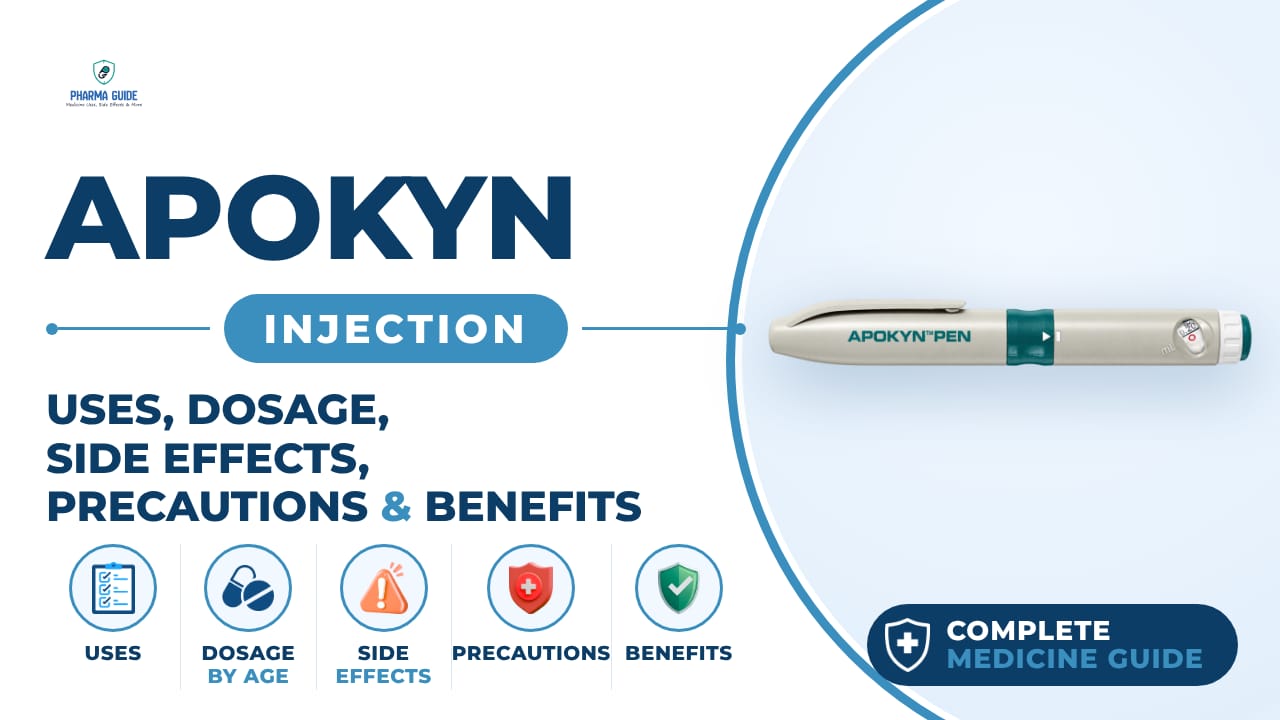
Apokyn Injection: Uses, Dosage, Side Effects, Precautions and Alternates
| Generic name | apomorphine hydrochloride |
|---|---|
| Drug class | Dopaminergic antiparkinsonism agents |
| Forms | injection (subcutaneous) |
Quick overview
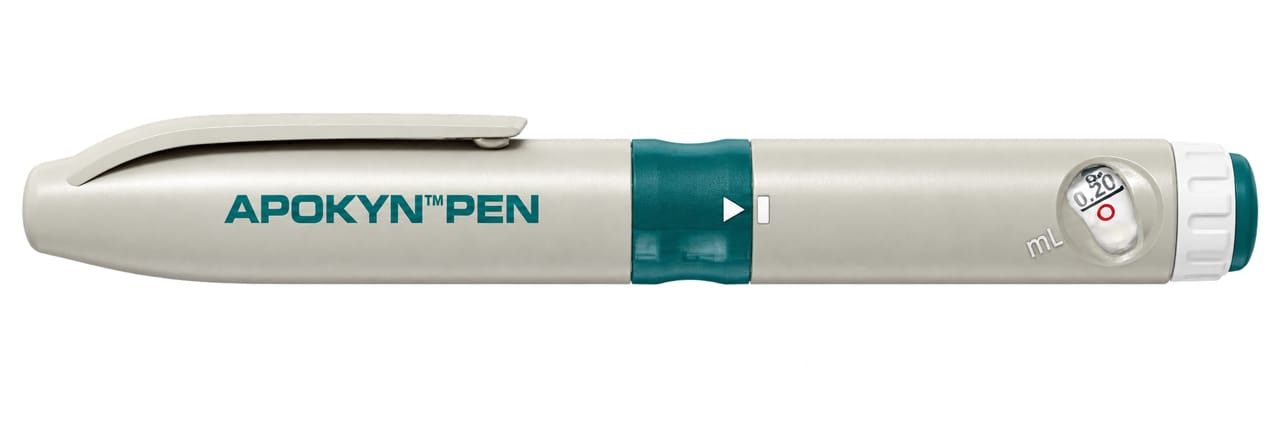
Apokyn Injection (apomorphine hydrochloride) is a dopaminergic antiparkinsonism agent given as an injection under the skin. It is used to treat sudden "off" episodes of poor movement in people with advanced Parkinson's disease, working quickly alongside a person's regular oral Parkinson's medications. It is not a replacement for daily oral treatment but a rescue medication for when those medications wear off or stop working.
What is Apokyn Injection
Apokyn is a prescription injection used to treat sudden episodes of poor movement, called "off" episodes, in people with advanced Parkinson's disease. It is given as a shot under the skin and works quickly to help restore movement.
Apokyn Injection uses
- Treats acute, intermittent "off" episodes (times of muscle stiffness, slowness, or trouble moving) in people with advanced Parkinson's disease
- Used as a rescue medication when routine oral Parkinson's medications wear off or fail to work
- Used alongside other Parkinson's disease medications, not as a replacement for daily oral treatments
Benefits of Apokyn Injection
- Typically starts working within 10 to 20 minutes
- Can help people walk, talk, and move around more easily during off episodes
- Can be used at any time of day, without needing to plan around meals
- Can improve bowel-control symptoms
- May reduce urgency and frequency of diarrhea
- Provides an oral treatment option when conventional IBS-D therapy has not worked adequately
How Apokyn Injection works
Apokyn acts like dopamine, a brain chemical that helps control movement and coordination. It stimulates dopamine receptors in the brain to quickly restore motor function, even when oral Parkinson's medication isn't working.
Apokyn Injection dosage
Apokyn is given as an injection under the skin; you will be taught how to prepare and give the injection. Take it exactly as directed on your prescription label and do not use it more often than directed. Keep using this medication unless your care team tells you to stop; stopping it suddenly can cause serious side effects or make your condition worse. Your doctor may have you take an anti-nausea medicine before starting treatment, since nausea and vomiting are common, especially at first.
Inject into the stomach area (staying away from the navel), upper arm, or upper thigh, and rotate the injection site each time. Allow at least 2 hours between doses. This medicine is not for regular scheduled use, so there is no routine missed-dose schedule; if a dose is missed, use it as soon as you can but skip it if it's almost time for the next dose, and do not double up. Never inject this medicine into a vein. Put used needles and syringes into a special sharps container, not in the regular trash.
| Age group | Dose |
|---|---|
| Under 18 years | Safety and effectiveness are not established; no standard pediatric dose |
| 18–39 years | Initial dose: 0.5 mg twice daily |
| 40–64 years | Initial dose: 0.5 mg twice daily |
Available forms and strengths
- Injection (subcutaneous)
Side effects of Apokyn Injection
Common
- Yawning
- Drowsiness or sleepiness, even during daily activities
- Nausea and vomiting
- Dizziness
- Involuntary movements (dyskinesia)
- Injection site reactions such as bruising, swelling, redness, or itching
- Runny or stuffy nose
- Swelling of the hands, arms, legs, or feet
- Confusion
Serious
- Fainting or low blood pressure, especially when standing up quickly
- Falls
- Hallucinations or psychotic-like behavior, including confusion and paranoid thinking
- Impulse control problems such as gambling urges, increased sexual urges, or compulsive spending
- Chest pain, angina, heart attack, or other heart problems
- Irregular or fast heartbeat, or QT prolongation
- Severe or ongoing nausea and vomiting
- Low red blood cell count (hemolytic anemia)
- Prolonged, painful erection lasting more than 4 hours (priapism)
- Allergic reaction: hives, itching, rash, swelling of face/lips/tongue, trouble breathing or swallowing
- New or worsening uncontrolled movements of the face, mouth, or upper body
- High fever, muscle stiffness, and confusion if the medicine is stopped suddenly
Warnings and precautions
- This medicine must only be injected under the skin. Injecting it into a vein can cause dangerous blood clots and lung clots (pulmonary embolism).
- Never take this medicine with certain anti-nausea drugs called 5-HT3 antagonists (such as ondansetron, granisetron, dolasetron, palonosetron, or alosetron), because the combination can cause a dangerous drop in blood pressure and loss of consciousness.
- Some people fall asleep suddenly during daily activities like eating, talking, or driving, sometimes without feeling drowsy beforehand.
- This medicine can cause hallucinations or psychotic-like behavior, including seeing or hearing things that are not real, confusion, suspicion, aggression, or disorganized thinking.
- Some people develop strong, uncontrollable urges such as gambling, increased sexual urges, or compulsive spending while taking this medicine.
- This medicine contains a sulfite (sodium metabisulfite) that can cause severe, life-threatening allergic reactions, especially in people with asthma.
- Do not stop taking this medicine suddenly without talking to your doctor, as rapid withdrawal has been linked to a serious condition with high fever, muscle stiffness, and confusion.
- If you need to take nitroglycerin under your tongue while using this medicine, lie down first, since it can cause a sudden and severe drop in blood pressure.
- Tell your doctor if you are pregnant or planning to become pregnant, since it is not known if Apokyn could harm an unborn baby. Tell your doctor if you are breastfeeding or planning to breastfeed, since it is not known if Apokyn passes into breast milk. Tell your doctor if you have kidney problems or liver problems before starting this medicine.
- Do not drink alcohol while using this medicine, since it can increase your chance of developing serious side effects such as low blood pressure and severe drowsiness. Do not drive, operate machinery, or do other dangerous activities until you know how this medicine affects you, since it can cause sudden sleepiness or dizziness without warning.
Storage
- Store at room temperature between 20 and 25 degrees C (68 and 77 degrees F)
- Get rid of any unused medication after the expiration date
- Keep out of the reach of children and pets
- Take the medication to a medication take-back program; check with your pharmacy or law enforcement to find a location
- If you cannot return the medication, ask your pharmacist or care team how to get rid of it safely
When to see a doctor
- Get emergency help right away for signs of a severe allergic reaction: hives, itching, swelling of the face, lips, tongue, or throat, or trouble breathing.
- Call your doctor right away if you feel like you might pass out, become extremely drowsy, or suddenly fall asleep even after feeling alert.
- Seek help right away if you have chest pain, fast or pounding heartbeat, shortness of breath, or sudden dizziness, since these could be signs of a heart problem.
- Call for emergency care immediately if you have an erection that lasts more than 4 hours.
- Contact your doctor if you notice confusion, hallucinations, or unusual changes in thoughts or behavior.
- Seek medical help if you develop signs of low red blood cell count, such as unusual weakness, dizziness, yellowing of the skin or eyes, or dark urine.
- Get help right away if you have very stiff muscles, high fever, sweating, confusion, and fast or uneven heartbeat, which could signal a severe nervous system reaction.
Alternatives
- Bile-acid sequestrants in selected patients
- Eluxadoline
- Loperamide
- Rifaximin
Watch the video
FAQs
What is Apokyn Injection used for?
Apokyn treats sudden, acute off episodes of poor movement, stiffness, or slowness in people with advanced Parkinson's disease. It is used as a rescue medication alongside regular oral Parkinson's medications, not as a replacement for them.
How quickly does Apokyn Injection work?
Apokyn typically starts working within 10 to 20 minutes, helping people walk, talk, and move more easily during off episodes.
How is Apokyn Injection given?
Apokyn is injected under the skin into the stomach area, upper arm, or upper thigh, rotating the injection site each time. It should never be injected into a vein, and at least 2 hours should pass between doses.
What medications should not be combined with Apokyn?
Apokyn should never be taken with 5-HT3 antagonist anti-nausea drugs such as ondansetron, granisetron, dolasetron, palonosetron, or alosetron, because the combination can cause a dangerous drop in blood pressure and loss of consciousness.
What are the serious side effects of Apokyn Injection?
Serious effects include fainting or low blood pressure, falls, hallucinations, impulse control problems, heart problems, irregular heartbeat, severe nausea and vomiting, low red blood cell count, priapism, allergic reactions, and uncontrolled movements.
General information, not medical advice
Your prescriber and the leaflet in your pack know your situation. This page does not.
- Follow your prescriber and the leaflet
- Don't start, stop, or change a dose on your own
- Doses and warnings differ by country and product
Sources
Video
Related medicines
Rytary Capsule: Uses, Dosage, Side Effects, Precautions and Alternates
Dopaminergic antiparkinsonism agents
Rytary Capsule is an extended-release carbidopa-levodopa medicine for Parkinson's disease and parkinsonism. Learn about dosage, side effects, and warnings.

Safinamide Tablet: Uses, Dosage, Side Effects, Precautions and Alternates
Dopaminergic antiparkinsonism agents
Safinamide Tablet is a MAO-B inhibitor used with levodopa and carbidopa for Parkinson's disease. Learn about dosage, side effects, and precautions.