
Safety
General information, not medical advice
Your prescriber and the leaflet in your pack know your situation. This page does not.
- Follow your prescriber and the leaflet
- Don't start, stop, or change a dose on your own
- Doses and warnings differ by country and product
Rytary Capsule: Uses, Dosage, Side Effects, Precautions and Alternates

| Generic name | carbidopa and levodopa |
|---|---|
| Drug class | Dopaminergic antiparkinsonism agents |
| Forms | extended-release oral capsules |
Quick overview
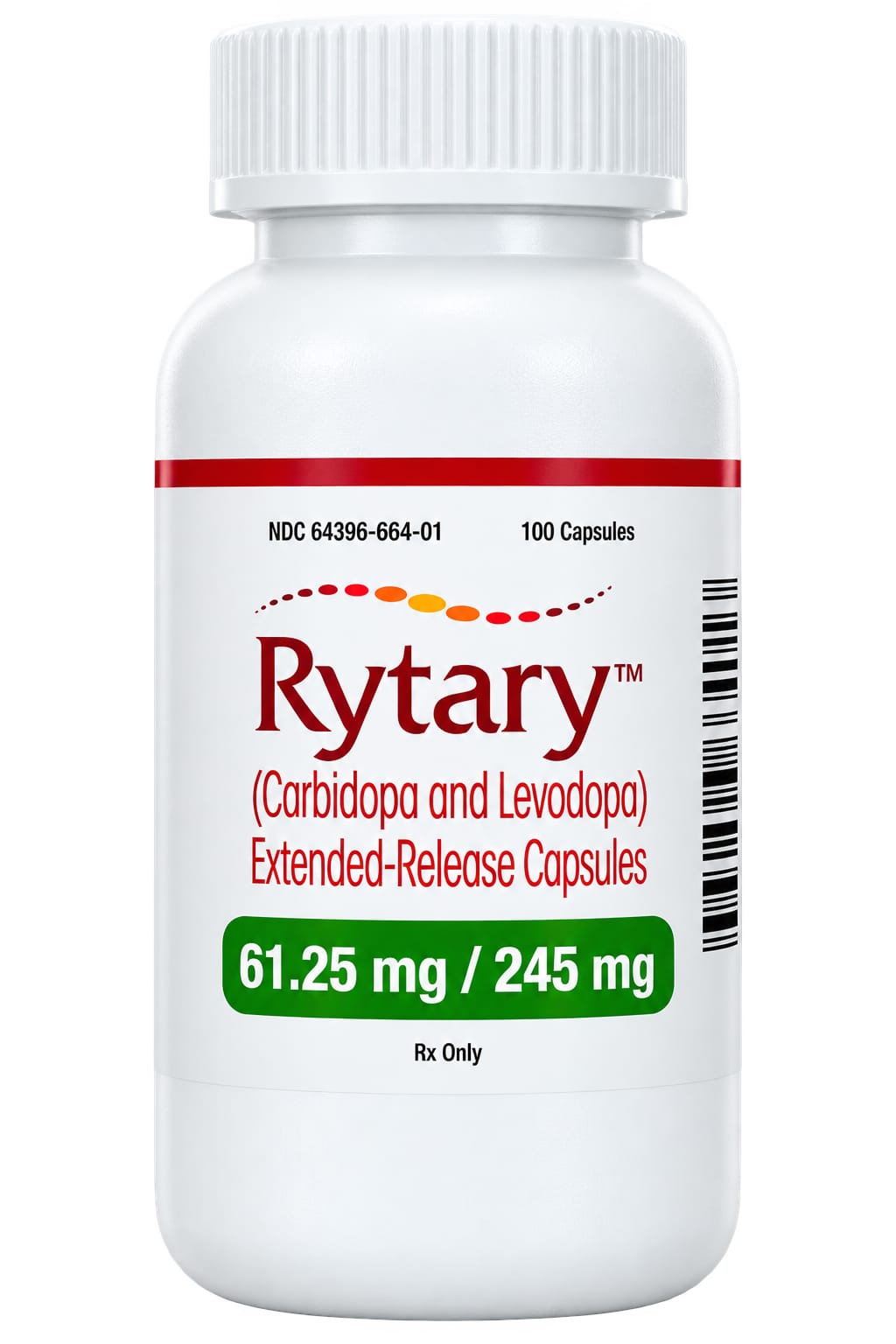
Rytary Capsule is an extended-release prescription medicine containing carbidopa and levodopa, used to treat Parkinson's disease and certain types of parkinsonism. It helps manage symptoms such as muscle stiffness, tremors, spasms, and poor muscle control by delivering medicine that converts into dopamine in the brain. Rytary is taken by mouth, usually several times a day, and comes with important warnings about sudden sleepiness, abrupt discontinuation, and mental health changes.
What is Rytary Capsule
Rytary is an extended-release prescription capsule that contains carbidopa and levodopa. It is used to treat Parkinson's disease and certain types of parkinsonism. It belongs to a class of medicines called dopaminergic antiparkinsonism agents.
Rytary Capsule uses
- Treats symptoms of Parkinson's disease, such as muscle stiffness, tremors, spasms, and poor muscle control
- Treats parkinsonism that follows carbon monoxide poisoning or manganese poisoning
- Treats post-encephalitic parkinsonism
Benefits of Rytary Capsule
- Reduces daily "off" time when symptoms return
- Increases smooth "on" time compared with immediate-release versions
- Helps control muscle stiffness, tremors, spasms, and poor muscle control
- Provides extended-release delivery of carbidopa and levodopa
- Helps improve mobility and muscle coordination
- May reduce periods of reduced medication effectiveness
How Rytary Capsule works
Levodopa changes into dopamine in the brain to help control movement. Carbidopa stops levodopa from breaking down in the bloodstream before it reaches the brain, so more of it gets there.
Rytary Capsule dosage
Take this medicine exactly as your doctor prescribes and follow the directions on your prescription label. Take doses at regular, evenly spaced times to keep a steady amount of medicine in your body. It is usually taken three times a day, and up to five times a day if needed.
Swallow the capsule whole; do not chew, divide, or crush it. If you have trouble swallowing, you can twist the capsule apart and sprinkle the contents onto one to two tablespoons of applesauce, then take it right away; do not save the mixture for later. It can be taken with or without food, though a high-fat, high-calorie meal can delay the medicine from working by two to three hours, so you may want to take your first dose of the day one to two hours before eating.
Do not take other carbidopa and levodopa products with Rytary unless your doctor tells you to. It may take several weeks before your symptoms improve; keep taking it as directed and tell your doctor if it doesn't seem to be working or wears off quickly between doses. Do not stop taking this medicine suddenly; ask your doctor how to stop safely. This medicine is not approved for use in children.
| Age group | Dose |
|---|---|
| 18–39 years | Starting dose: 23.75 mg/95 mg three times daily |
| 40–64 years | Starting dose: 23.75 mg/95 mg three times daily |
| 65–74 years | Starting dose: 23.75 mg/95 mg three times daily |
| 75 years and older | Starting dose: 23.75 mg/95 mg three times daily |
Available forms and strengths
Rytary is available as extended-release oral capsules.
Side effects of Rytary Capsule
Common
- Nausea and vomiting
- Constipation
- Dizziness and lightheadedness
- Headache
- Sleep problems and strange or vivid dreams
- Dry mouth
- Dyskinesia (jerky or twisting uncontrolled movements)
- Anxiety
- Low blood pressure on standing, which can cause lightheadedness, nausea, sweating, or fainting
Serious
- Signs of an allergic reaction: hives, difficulty breathing, swelling of face, lips, tongue, or throat
- Uncontrolled muscle movements in the face such as chewing, lip smacking, frowning, tongue movement, blinking, or eye movement
- New or worsening uncontrolled movements (dyskinesia) or worsening tremors
- Severe or ongoing vomiting or diarrhea
- Confusion, hallucinations, paranoia, agitation, or unusual changes in mood or behavior
- Depression or suicidal thoughts
- Severe nervous system reaction: very stiff muscles, high fever, sweating, confusion, fast or uneven heartbeats, tremors, feeling like you might pass out
- Chest pain or other signs of a heart problem
- Cracking, crusting, or scaling in the corners of the mouth
- Inflammation of the tongue
- Skin rash, or a new or changing mole
- Anemia
- Nerve pain (neuropathy)
- Falling asleep suddenly during daily activities such as driving
- Stomach bleeding: bloody or black, tar-like stools, vomiting blood or material that looks like coffee grounds
- Sudden eye pain or changes in vision, such as blurry vision, seeing halos around lights, or vision loss
- Urges to gamble, binge eat, spend money, or engage in unusual sexual activity
Warnings and precautions
- Some people have fallen asleep suddenly during normal daytime activities, including while driving, sometimes without warning. This can happen even more than a year after starting treatment.
- Do not stop taking this medicine suddenly. Stopping abruptly or lowering the dose too quickly can cause a serious reaction with fever, severe muscle stiffness, confusion, and unstable blood pressure or heart rate.
- This medicine can cause hallucinations and psychosis, usually soon after starting treatment, and should not be used by people with a major psychotic disorder.
- Do not take this medicine if you are taking, or have taken in the past two weeks, a nonselective MAO inhibitor such as phenelzine or tranylcypromine, since this combination can cause dangerously high blood pressure.
- This medicine may lower vitamin B6 levels in the body, which can lead to seizures that don't respond well to usual seizure medicines but improve with vitamin B6.
- Heart problems from reduced blood flow have occurred in people taking this medicine, mostly those who already had heart disease or risk factors for it.
- People taking this medicine may develop intense, uncontrollable urges such as compulsive gambling, spending, eating, or increased sexual urges. They may not notice these changes themselves.
- Tell your doctor if you are pregnant or planning to become pregnant. There isn't enough information on the risk to a pregnancy from Rytary, but in animal studies, the ingredients caused birth defects at doses similar to those used in people.
- Tell your doctor if you are breastfeeding. Levodopa passes into breast milk and can also reduce milk production. Effects on a breastfed baby are not known.
- Tell your doctor if you have kidney disease before taking this medicine.
- Tell your doctor if you have liver disease before taking this medicine.
- Avoid drinking alcohol while taking this medicine, as it can increase drowsiness and is not recommended with certain forms of this medicine.
- Avoid driving or hazardous activities until you know how this medicine affects you, since it can impair your reactions and cause sudden sleep onset.
Storage
- Store at room temperature between 20 and 25 degrees C (68 and 77 degrees F)
- Protect from light and moisture
- Keep the container tightly closed
- Get rid of any unused medication after the expiration date
- Take the medication to a medication take-back program when no longer needed; check with your pharmacy or law enforcement to find a location
- If you cannot return the medication, check the label or package insert to see if it should be thrown in the garbage or flushed; if unsure, ask your care team; if safe to trash, mix the medication with something like cat litter, dirt, or coffee grounds, seal it in a bag, and put it in the trash
When to see a doctor
- Get emergency medical help right away for signs of an allergic reaction: hives, difficulty breathing, or swelling of the face, lips, tongue, or throat.
- Call your doctor right away if you have a severe nervous system reaction with very stiff muscles, high fever, sweating, confusion, fast or uneven heartbeats, tremors, or feeling like you might pass out.
- Call your doctor right away if you have confusion, hallucinations, paranoia, agitation, unusual mood or behavior changes, depression, or suicidal thoughts.
- Call your doctor right away if you have chest pain or other signs of a heart problem.
- Call your doctor right away if you have new or worsening uncontrolled movements, worsening tremors, or uncontrolled movements of the face such as chewing, lip smacking, or blinking.
- Call your doctor right away if you have severe or ongoing vomiting or diarrhea.
- If you think you have taken too much of this medicine, seek emergency medical attention or contact a poison control center right away.
- Contact your care team right away if you fall asleep suddenly without warning during activities like driving, talking, or eating.
Alternatives
- Safinamide
- Rotigotine
- Ropinirole
- Pramipexole
Watch the video
FAQs
What is Rytary Capsule used for?
Rytary treats symptoms of Parkinson's disease like muscle stiffness, tremors, spasms, and poor muscle control. It also treats parkinsonism following carbon monoxide or manganese poisoning, and post-encephalitic parkinsonism.
How should I take Rytary Capsule?
Swallow the capsule whole without chewing, dividing, or crushing it. If you have trouble swallowing, twist it apart and sprinkle contents onto one to two tablespoons of applesauce, then take right away. It is usually taken three times a day, up to five times a day if needed, at regular, evenly spaced times.
Can Rytary be taken with food?
Yes, it can be taken with or without food, though a high-fat, high-calorie meal can delay the medicine from working by two to three hours. You may want to take your first dose of the day one to two hours before eating.
What are the serious side effects of Rytary Capsule?
Serious side effects include sudden sleep onset, hallucinations, confusion, depression or suicidal thoughts, severe nervous system reactions with stiff muscles and high fever, chest pain, stomach bleeding, vision changes, and intense urges like compulsive gambling or spending.
Can I stop taking Rytary suddenly?
No, you should not stop taking Rytary suddenly. Stopping abruptly or lowering the dose too quickly can cause a serious reaction with fever, severe muscle stiffness, confusion, and unstable blood pressure or heart rate. Ask your doctor how to stop safely.
General information, not medical advice
Your prescriber and the leaflet in your pack know your situation. This page does not.
- Follow your prescriber and the leaflet
- Don't start, stop, or change a dose on your own
- Doses and warnings differ by country and product
Sources
Video
Related medicines

Safinamide Tablet: Uses, Dosage, Side Effects, Precautions and Alternates
Dopaminergic antiparkinsonism agents
Safinamide Tablet is a MAO-B inhibitor used with levodopa and carbidopa for Parkinson's disease. Learn about dosage, side effects, and precautions.

Apokyn Injection: Uses, Dosage, Side Effects, Precautions and Alternates
Dopaminergic antiparkinsonism agents
Apokyn Injection is a fast-acting subcutaneous rescue treatment for sudden off episodes in advanced Parkinson's disease, used alongside regular oral