
Safety
General information, not medical advice
Your prescriber and the leaflet in your pack know your situation. This page does not.
- Follow your prescriber and the leaflet
- Don't start, stop, or change a dose on your own
- Doses and warnings differ by country and product
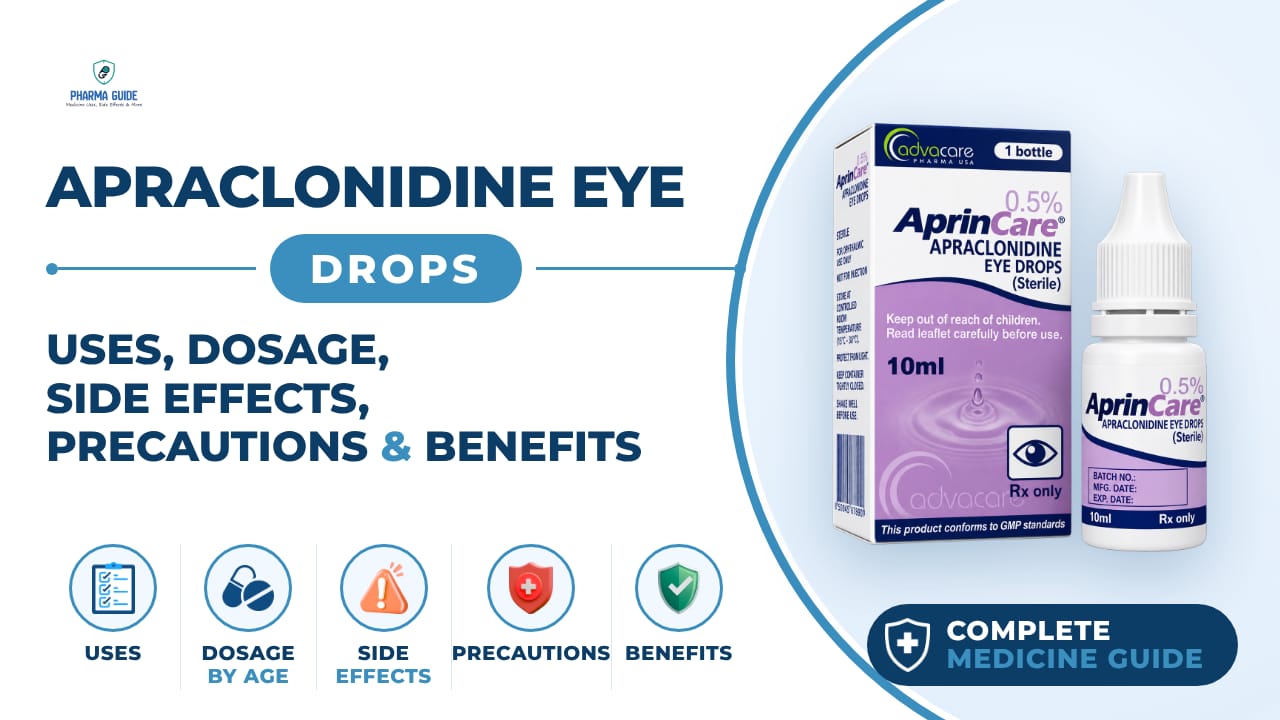
Apraclonidine Eye Drops: Uses, Dosage, Side Effects, Precautions and Alternates
| Generic name | apraclonidine (apraclonidine hydrochloride) |
|---|---|
| Drug class | Alpha-2 adrenergic agonist (ophthalmic alpha agonist) |
| Forms | 0.125% ophthalmic solution (eye drops), 0.5% ophthalmic solution (eye drops), 1% ophthalmic solution (eye drops) |
Quick overview
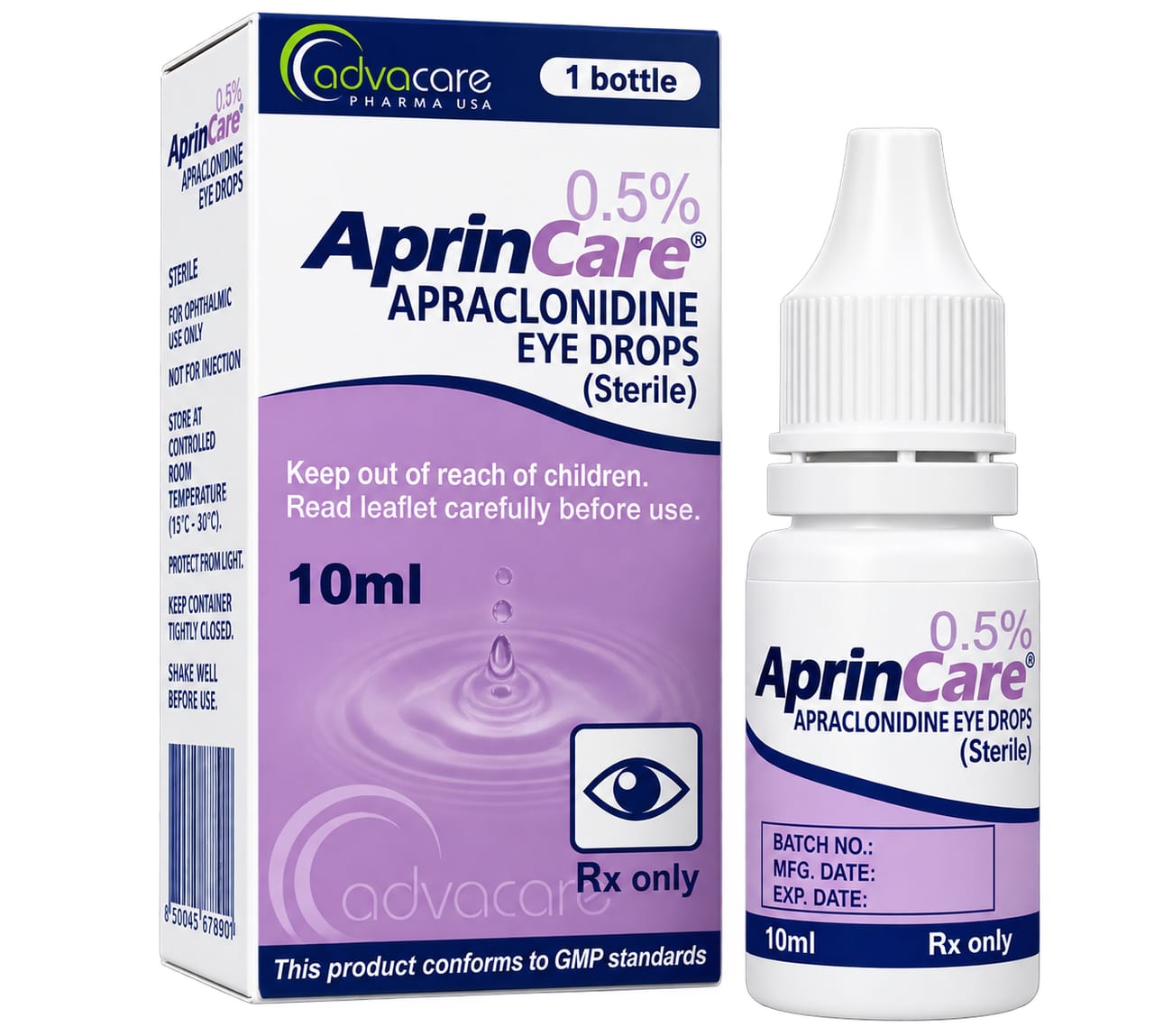
Apraclonidine Eye Drops (apraclonidine hydrochloride) are an alpha-2 adrenergic agonist available in different strengths. The 0.5% solution is used to lower eye pressure in glaucoma patients already on maximum medical therapy, while the 1% solution is used around certain eye surgeries to prevent or control pressure spikes. It works by reducing the amount of fluid the eye produces, which lowers pressure inside the eye.
What is Apraclonidine Eye Drops
Apraclonidine is an eye drop medicine that comes in different strengths. The 0.5% solution is used to lower pressure inside the eye in people with glaucoma, and the 1% solution is used around the time of certain eye surgeries to prevent or control pressure spikes.
Apraclonidine Eye Drops uses
- Short-term add-on treatment to lower eye pressure in glaucoma patients already on maximum medical therapy who still need more pressure reduction
- Preventing or reducing increased eye pressure during and after certain laser eye surgeries (1% solution)
- Lowers intraocular pressure
- Used as short-term additional treatment for glaucoma
- Helps control pressure when other glaucoma medicines are insufficient
Benefits of Apraclonidine Eye Drops
- Can further lower eye pressure when other glaucoma medications aren't working well enough
- Starts working within about one hour
- Can delay the need for glaucoma surgery for some patients on maximum therapy
- Reduces elevated eye pressure
- Has a relatively rapid onset of action
How Apraclonidine Eye Drops works
Apraclonidine stimulates alpha-2 receptors in the eye, which reduces the amount of fluid the eye produces. With less fluid being made, the pressure inside the eye goes down.
Apraclonidine Eye Drops dosage
This medicine is only for use in the eye — do not swallow the drops. If using the eye drops regularly, use them at around the same times every day. If you are using other eye medications, wait at least 5 minutes between using apraclonidine and the other medication. If using more than one drop in the same eye, wait at least 5 minutes before the next drop.
Wash your hands before and after giving yourself the drops, and avoid touching the dropper tip to the eye or any surface. After instilling a drop, close the eye for a couple of minutes and press a finger gently on the inner corner of the eye near the nose. Remove soft contact lenses before using the drops; they can be put back in about 15 minutes after instilling the dose.
Continue using the drops even if you feel well, and do not stop without talking to your doctor, since this treatment does not cure glaucoma. If you forget a dose, use it as soon as you remember, but if it is almost time for the next dose, skip the missed one — do not double up. The eye-pressure-lowering effect of the 0.5% drops may wear off over time, often in less than a month, so your doctor will check your eye pressure regularly.
| Age group | Dose |
|---|---|
| Under 18 years | Safety and effectiveness are not established; no standard pediatric dose |
| 18–39 years | For 0.5% solution: usually 1–2 drops in the affected eye(s) 3 times daily |
| 40–64 years | For 0.5% solution: usually 1–2 drops 3 times daily |
Available forms and strengths
- 0.125% ophthalmic solution (eye drops)
- 0.5% ophthalmic solution (eye drops)
- 1% ophthalmic solution (eye drops)
Side effects of Apraclonidine Eye Drops
Common
- Red, itchy, watery, or uncomfortable eyes
- Feeling like something is in the eye
- Dry eyes
- Dry mouth
- Blurred vision
- Eyelid swelling, crusting, or redness
- Drowsiness or dizziness
- Headache
- Stuffy or runny nose
- Changed sense of taste or smell
- Constipation
- Nausea
Serious
- Irregular, slow, or pounding heartbeat
- Fainting
- Swelling of the face, eyes, arms, hands, feet, ankles, or lower legs
- Shortness of breath
- Depression
- Signs of a severe allergic reaction such as breathing problems, wheezing, swelling of the face, lips, mouth, tongue, or throat, or hives
Warnings and precautions
- This medicine is for use in the eye only. Do not inject it or swallow it.
- Do not use this medicine if you are taking, or have recently stopped taking, a monoamine oxidase inhibitor (MAOI), as this combination is not safe.
- Use with caution if you have heart problems, a history of stroke, Raynaud's disease, blocked blood vessels in the arms or legs, or a history of fainting spells.
- This medicine's effect on eye pressure may lessen over time in some people, so regular follow-up with your doctor is important.
- Remove soft contact lenses before using the drops, since the preservative can be absorbed by the lenses; they can be reinserted about 15 minutes later.
- Pregnancy: It isn't known whether apraclonidine is safe during pregnancy. Tell your doctor if you are or plan to become pregnant so they can weigh the benefits and risks.
- Breastfeeding: It isn't known whether this medicine passes into breast milk, so caution is advised if you are breastfeeding while using it.
- Kidney: People with kidney problems should be closely monitored, since the medicine can build up more in the body and the similar drug clonidine stays in the body longer with severe kidney impairment.
- Liver: People with liver problems should have their heart rate and blood pressure monitored closely while using this medicine.
- Alcohol: It isn't clear if alcohol directly interacts with apraclonidine, but drinking alcohol may increase the risk of dizziness or sleepiness from this medicine.
- Driving: This medicine can cause drowsiness and dizziness, so don't drive or do tasks that require alertness until you know how it affects you.
Storage
- Store between 36°F and 77°F (2°C and 25°C)
- Protect from freezing and light
- Keep the container tightly closed and out of reach of children
- Store at room temperature and away from light, excess heat, and moisture (not in the bathroom)
- Dispose of unneeded medication through a medicine take-back program rather than flushing it down the toilet
When to see a doctor
- Stop using the drops and get medical help right away if you notice redness, itching, discomfort, tearing, or swelling of the eye or eyelid, as this can be an allergic reaction.
- Call your doctor immediately if you faint, or notice swelling of the face, eyes, arms, hands, feet, ankles, or lower legs, or have shortness of breath.
- If someone swallows this medicine, contact your local poison control center right away. If the person has collapsed or is not breathing, call emergency services immediately.
- Watch for signs of overdose such as a slowed pulse, extreme sleepiness, or chills, and seek medical help if these occur.
Alternatives
- Brimonidine eye drops
- Timolol eye drops
- Dorzolamide eye drops
- Latanoprost eye drops
Watch the video
FAQs
What is Apraclonidine Eye Drops used for?
The 0.5% solution is used as short-term add-on treatment to lower eye pressure in glaucoma patients already on maximum medical therapy, while the 1% solution is used around certain eye surgeries to prevent or control pressure spikes.
How does Apraclonidine Eye Drops work?
It stimulates alpha-2 receptors in the eye, which reduces the amount of fluid the eye produces, lowering the pressure inside the eye.
How quickly does Apraclonidine Eye Drops start working?
It has a relatively rapid onset of action and starts working within about one hour.
Can I wear contact lenses while using Apraclonidine Eye Drops?
Soft contact lenses should be removed before using the drops because the preservative can be absorbed by the lenses; they can be reinserted about 15 minutes after instilling the dose.
What should I do if I miss a dose of Apraclonidine Eye Drops?
Use the missed dose as soon as you remember, but if it is almost time for the next dose, skip the missed one and do not double up.
General information, not medical advice
Your prescriber and the leaflet in your pack know your situation. This page does not.
- Follow your prescriber and the leaflet
- Don't start, stop, or change a dose on your own
- Doses and warnings differ by country and product
Sources
Video
Related medicines

Injectafer Injection: Uses, Dosage, Side Effects, Precautions and Alternates
Iron products
Injectafer (ferric carboxymaltose) treats iron deficiency anemia and heart failure-related iron deficiency via IV. Learn uses, dosage, side effects, and

Gliclazide Tablet: Uses, Dosage, Side Effects, Precautions and Alternates
Sulfonylurea (hypoglycemic/antidiabetic agent)
Gliclazide Tablet is a sulfonylurea for type 2 diabetes that boosts insulin release. Learn about dosage, side effects, warnings, and precautions.