
Safety
General information, not medical advice
Your prescriber and the leaflet in your pack know your situation. This page does not.
- Follow your prescriber and the leaflet
- Don't start, stop, or change a dose on your own
- Doses and warnings differ by country and product
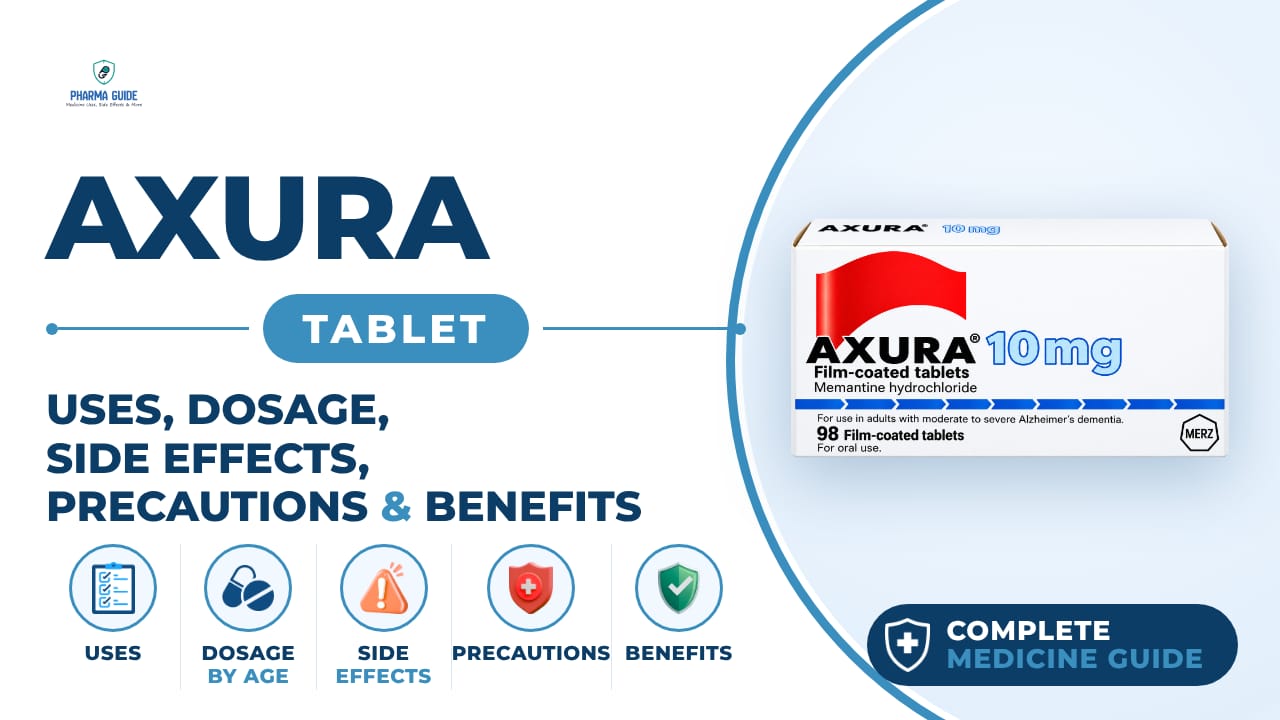
Axura Tablet: Uses, Dosage, Side Effects, Precautions and Alternates
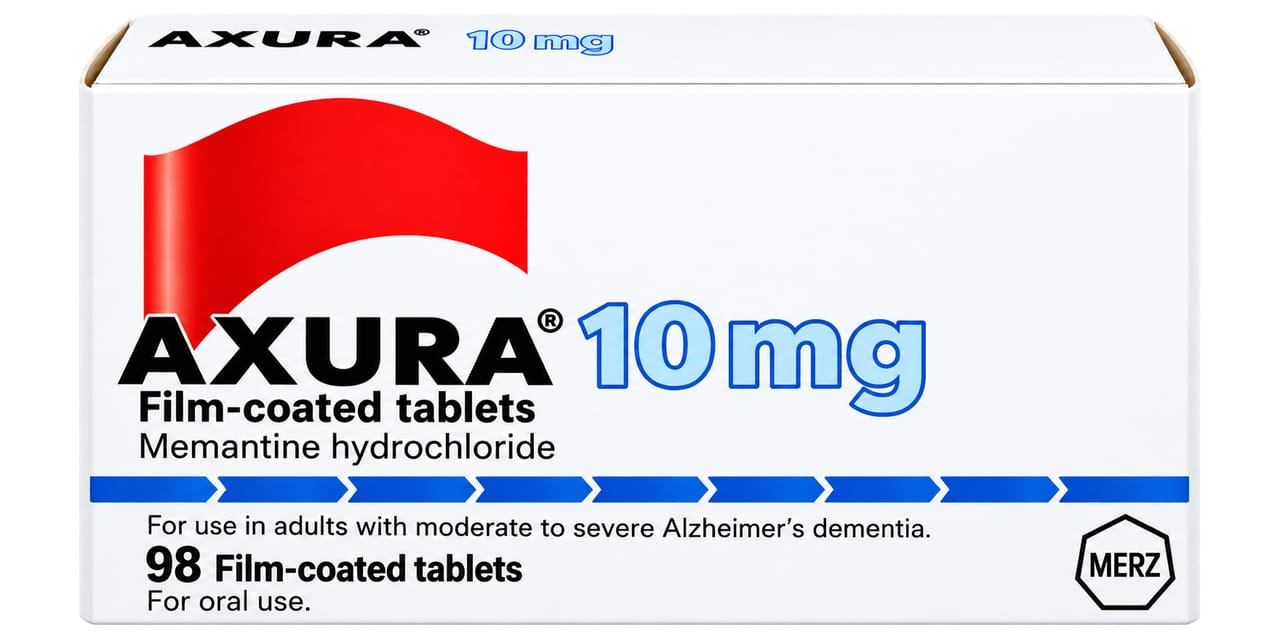
| Generic name | Memantine hydrochloride |
|---|---|
| Drug class | Anti-dementia medicine (NMDA-receptor antagonist) |
| Forms | Film-coated tablets (5 mg, 10 mg, 15 mg, 20 mg), Oral solution (5 mg per pump actuation), Oral drops, solution (10 mg/g) |
Quick overview
Axura Tablet contains memantine hydrochloride, an anti-dementia medicine that acts as an NMDA-receptor antagonist. It is used to treat moderate to severe Alzheimer's disease, helping to manage memory and cognitive symptoms and supporting everyday functioning. Axura is taken once daily, usually starting at a low dose that is gradually increased, and is available in several forms and strengths.
What is Axura Tablet
Axura contains the active substance memantine hydrochloride and belongs to a group of medicines known as anti-dementia medicines. It works on NMDA-receptors in the brain to help improve the transmission of nerve signals involved in memory and learning.
Axura Tablet uses
- Treatment of patients with moderate to severe Alzheimer's disease
- Treats moderate to severe Alzheimer's disease
- Helps manage memory and cognitive symptoms
- May support everyday functioning
- May help reduce some behavioral symptoms associated with dementia
Benefits of Axura Tablet
- Showed beneficial effects compared to placebo on clinical measures of cognitive, global, and functional ability in moderate to severe Alzheimer's disease studies
- Provides once-daily maintenance dosing
- May improve or stabilize cognitive symptoms in some patients
- Can support daily functioning in moderate-to-severe Alzheimer's disease
- Works by blocking excessive activity at NMDA glutamate receptors
How Axura Tablet works
Memory loss in Alzheimer's disease is caused by disrupted signaling in the brain. Axura blocks NMDA receptors that are overactivated by excess glutamate, helping to improve the transmission of nerve signals important for learning and memory.
Axura Tablet dosage
Take Axura once a day at the same time every day. It can be taken with or without food, and tablets should be swallowed with some water. Treatment is usually started at a low dose and gradually increased over several weeks to reduce the risk of side effects. If you forget a dose, wait and take the next dose at the usual time; do not take a double dose. Continue taking the medicine for as long as it continues to help you, with regular assessment by your doctor. Therapy should only be started if a caregiver is available to regularly monitor that the patient is taking the medicine.
| Age group | Dose |
|---|---|
| Under 18 years | Safety and effectiveness are not established; no standard pediatric dose |
| 18–39 years | Start 5 mg once daily; increase weekly to the maintenance dose |
| 40–64 years | Start 5 mg once daily; gradually increase to 20 mg once daily |
| 65–74 years | Same standard adult titration; recommended maintenance dose 20 mg once daily |
Available forms and strengths
- Film-coated tablets (5 mg, 10 mg, 15 mg, 20 mg)
- Oral solution (5 mg per pump actuation)
- Oral drops, solution (10 mg/g)
Side effects of Axura Tablet
Common
- Headache
- Sleepiness (somnolence)
- Constipation
- Dizziness
- Balance disorders
- Shortness of breath (dyspnoea)
- High blood pressure (hypertension)
- Drug hypersensitivity
- Elevated liver function tests
Serious
- Seizures (very rare)
- Heart failure (uncommon)
- Venous blood clotting (thrombosis/thromboembolism) (uncommon)
- Confusion (uncommon)
- Hallucinations, mainly in patients with severe Alzheimer's disease (uncommon)
- Psychotic reactions (not known frequency)
- Inflammation of the pancreas (pancreatitis) (not known frequency)
- Inflammation of the liver (hepatitis) (not known frequency)
- Depression, suicidal ideation, and suicide have been reported in patients treated with Axura
Warnings and precautions
- Memantine is not recommended for use during pregnancy unless clearly necessary, as there is not enough human safety data.
- Women taking Axura should not breastfeed.
- If you have kidney problems, your doctor will need to adjust your dose and monitor your kidney function regularly.
- No dose adjustment is needed for mild to moderate liver problems, but Axura is not recommended for people with severe liver impairment because there is no safety data available.
- Alcohol can worsen dizziness, confusion, and cognitive impairment.
- Alzheimer's disease itself can affect the ability to drive safely, and Axura may also change reactions, so patients should be cautious about driving or operating machinery.
- Caution is needed in people with epilepsy or a history of seizures, since this medicine can affect brain activity.
- Taking Axura together with other NMDA-receptor blocking medicines such as amantadine, ketamine, or dextromethorphan should be avoided because it can increase the risk and severity of side effects.
- People with a recent heart attack, uncontrolled high blood pressure, or heart failure were not well studied with this medicine, so these patients should be closely monitored by their doctor.
- Large changes in diet (such as switching to a strict vegetarian diet) or certain kidney/urinary conditions can change how the body removes this medicine, requiring dose adjustment.
- Alzheimer's disease itself has been linked to depression, suicidal thoughts, and suicide, and these events have been reported in people taking this medicine.
Storage
- Keep out of the sight and reach of children
- This medicinal product does not require any special storage conditions (for film-coated tablets)
- Do not use after the expiry date stated on the carton and blister after EXP; the expiry date refers to the last day of that month
- Do not throw away any medicines via wastewater or household waste; ask your pharmacist how to dispose of medicines you no longer use
When to see a doctor
- If you take a large overdose, contact your doctor or get medical advice right away as you may need medical attention.
- Tell your doctor or pharmacist if you experience any side effects, including ones not listed in the leaflet.
Alternatives
- Donepezil
- Rivastigmine
- Galantamine
- Ebixa / memantine
Watch the video
FAQs
What is Axura Tablet used for?
Axura Tablet is used to treat moderate to severe Alzheimer's disease. It helps manage memory and cognitive symptoms, supports everyday functioning, and may help reduce some behavioral symptoms associated with dementia.
How does Axura Tablet work?
Axura contains memantine hydrochloride, which blocks NMDA receptors in the brain that are overactivated by excess glutamate. This helps improve the transmission of nerve signals important for learning and memory.
How should Axura Tablet be taken?
Axura is taken once a day at the same time every day, with or without food, swallowed with water. Treatment usually starts at a low dose that is gradually increased over several weeks to reduce the risk of side effects. If a dose is missed, take the next dose at the usual time without doubling up.
What are the common side effects of Axura Tablet?
Common side effects include headache, sleepiness, constipation, dizziness, balance disorders, shortness of breath, high blood pressure, drug hypersensitivity, and elevated liver function tests.
What forms and strengths of Axura Tablet are available?
Axura is available as film-coated tablets (5 mg, 10 mg, 15 mg, 20 mg), an oral solution (5 mg per pump actuation), and oral drops, solution (10 mg/g).
General information, not medical advice
Your prescriber and the leaflet in your pack know your situation. This page does not.
- Follow your prescriber and the leaflet
- Don't start, stop, or change a dose on your own
- Doses and warnings differ by country and product
Sources
Video
Related medicines

Injectafer Injection: Uses, Dosage, Side Effects, Precautions and Alternates
Iron products
Injectafer (ferric carboxymaltose) treats iron deficiency anemia and heart failure-related iron deficiency via IV. Learn uses, dosage, side effects, and

Gliclazide Tablet: Uses, Dosage, Side Effects, Precautions and Alternates
Sulfonylurea (hypoglycemic/antidiabetic agent)
Gliclazide Tablet is a sulfonylurea for type 2 diabetes that boosts insulin release. Learn about dosage, side effects, warnings, and precautions.