
Safety
General information, not medical advice
Your prescriber and the leaflet in your pack know your situation. This page does not.
- Follow your prescriber and the leaflet
- Don't start, stop, or change a dose on your own
- Doses and warnings differ by country and product
Azactam Injection: Uses, Dosage, Side Effects, Precautions and Alternates

| Generic name | aztreonam |
|---|---|
| Drug class | Monobactams |
| Forms | Powder for injection (vials) |
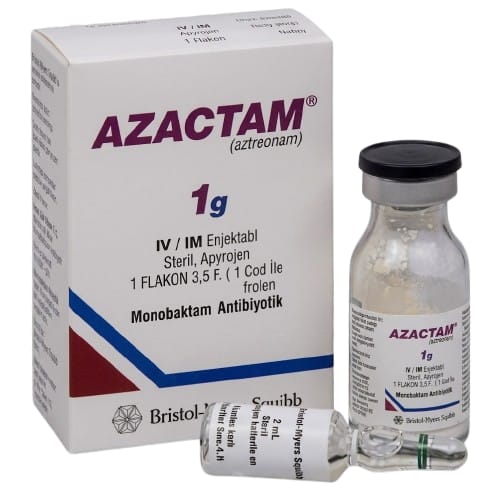
Quick overview
Azactam Injection is an antibiotic containing the active ingredient aztreonam, from the monobactam class of medicines. It is given by injection or infusion to treat infections caused by susceptible bacteria, including urinary tract, kidney, respiratory, bloodstream, skin, and intra-abdominal or gynecological infections. It works by stopping bacteria from building their cell walls, which kills the bacteria causing the infection.
What is Azactam Injection
Azactam is an antibiotic that fights bacteria. It contains the active ingredient aztreonam, a man-made bactericidal antibiotic given by injection.
Azactam Injection uses
- Complicated urinary tract infections.
- Kidney infections caused by susceptible bacteria.
- Certain lower respiratory tract infections.
- Bloodstream infections caused by susceptible bacteria.
- Certain skin and soft-tissue infections.
- Intra-abdominal and gynecological infections caused by susceptible bacteria.
Benefits of Azactam Injection
- Treats susceptible bacterial infections.
- Helps control bacterial growth.
- Supports recovery from serious infections.
- Targets many susceptible Gram-negative bacteria.
- Can be used when selected antibiotics are unsuitable.
How Azactam Injection works
Azactam works by stopping bacteria from building their cell walls, which kills the bacteria causing the infection.
Azactam Injection dosage
Azactam is given as an injection into a muscle or as an infusion into a vein; a healthcare provider may teach some patients to give the injection themselves. It may be given for several weeks depending on how severe the infection is, and should be used for the full length of time prescribed, even if symptoms improve quickly, to avoid the infection coming back or becoming resistant to treatment.
Prepare the injection only when ready to give it; do not use if the medicine has changed color or has particles in it. It must be mixed with a liquid (diluent) before use, and the mixed solution should be shaken right away and vigorously. It is given through a vein slowly over several minutes, or as an infusion over a set period of time. When given into a muscle, it is injected deep into a large muscle, such as the buttock or thigh. It is usually continued until the infection has cleared or the patient has had no symptoms for at least two days.
| Age group | Dose |
|---|---|
| Under 18 years | Not recommended |
| 18–64 years | 1 g, 3 times/day |
| 65+ years | 1 g, 3 times/day |
Available forms and strengths
- Powder for injection (vials)
Side effects of Azactam Injection
Common
- Nausea, vomiting, diarrhea
- Rash
- Vaginal itching or discharge
- Pain, bruising, swelling, or irritation where the medicine was injected
- Altered taste, mouth ulcer
- Flushing
- Abdominal cramps or bloating
Serious
- Signs of an allergic reaction: hives, difficult breathing, swelling of the face or throat
- Severe skin reaction: fever, sore throat, burning eyes, skin pain, red or purple skin rash with blistering and peeling
- Severe stomach pain, diarrhea that is watery or bloody
- Wheezing, chest pain
- Easy bruising or bleeding
- Seizures
- Liver problems: loss of appetite, stomach pain (upper right side), dark urine, clay-colored stools, jaundice (yellowing of skin or eyes)
- Changes in blood cell counts
Warnings and precautions
This medicine can cause allergic reactions, even in people who have never had a reaction to it before. If you notice swelling of the face, lips, tongue, or throat, or trouble breathing, get emergency help right away.
Antibiotics, including this one, can cause a serious bowel infection with diarrhea that may be severe, watery, or bloody, sometimes starting weeks after stopping treatment. Do not treat this diarrhea yourself; contact your doctor.
Rare, serious skin reactions involving severe blistering and peeling of the skin have occurred in some patients, especially those with certain risk factors like bone marrow transplant or other serious illness.
This medicine should only be used to treat infections that are proven or strongly believed to be caused by bacteria, not for viral infections like colds.
It is not known whether Azactam will harm an unborn baby. Aztreonam does cross into the baby's blood supply through the placenta. Tell your doctor if you are pregnant, as this medicine should only be used during pregnancy if clearly needed.
It may not be safe to breastfeed while using this medicine. A small amount of the drug passes into breast milk, so your doctor may suggest temporarily stopping breastfeeding and using formula instead.
Tell your doctor if you have kidney disease, since the drug stays in the body longer if the kidneys are not working well, and your dose may need to be adjusted.
Tell your doctor if you have liver disease; your doctor may want to monitor you more closely during treatment.
Tell your doctor if you drink alcohol while being treated with this medicine.
Be careful before you drive or use machines or tools until you know how this medicine affects you.
Storage
- Store unmixed Azactam at room temperature away from moisture and heat
- You may store mixed medicine for up to 48 hours at room temperature, or up to 7 days in a refrigerator
- Azactam that is supplied as a frozen solution in a plastic container should be stored in a freezer, ideally at 4 degrees below 0 Fahrenheit or colder
- Thaw the medicine either in a refrigerator or at room temperature; do not heat the medicine
- Azactam should be used within 2 weeks if thawed in a refrigerator, or used within 48 hours if thawed at room temperature
- Store original packages at room temperature; avoid excessive heat
- Do not use if vial seal is broken or missing
When to see a doctor
Get emergency help right away if you notice hives, difficulty breathing, or swelling of your face or throat.
Call your doctor right away if you have severe stomach pain, or diarrhea that is watery or bloody, wheezing or chest pain, easy bruising or bleeding, a seizure, or signs of liver problems such as loss of appetite, stomach pain, dark urine, pale stools, or yellowing of the skin or eyes.
Call your doctor straight away if you notice severe, prolonged, or bloody diarrhea, even if it happens several weeks after you stop taking this medicine, since it could be a sign of serious bowel inflammation.
Alternatives
- Meropenem
- Cefepime
- Ceftazidime
Watch the video
FAQs
What is Azactam Injection used for?
Azactam is used to treat complicated urinary tract infections, kidney infections, certain lower respiratory tract infections, bloodstream infections, skin and soft-tissue infections, and intra-abdominal or gynecological infections caused by susceptible bacteria.
How is Azactam Injection given?
Azactam is given as an injection into a muscle or as an infusion into a vein. It may be given for several weeks depending on severity, and should be used for the full prescribed length of time even if symptoms improve quickly.
What is the dosage of Azactam Injection for adults?
For adults aged 18-64 and those 65 and older, the typical dose is 1 g given 3 times a day. It is not recommended for use in those under 18 years.
What are the common side effects of Azactam Injection?
Common side effects include nausea, vomiting, diarrhea, rash, vaginal itching or discharge, pain or swelling at the injection site, altered taste, mouth ulcer, flushing, and abdominal cramps or bloating.
Is it safe to use Azactam Injection during pregnancy?
It is not known whether Azactam will harm an unborn baby, and aztreonam does cross into the baby's blood supply through the placenta. It should only be used during pregnancy if clearly needed, so tell your doctor if you are pregnant.
General information, not medical advice
Your prescriber and the leaflet in your pack know your situation. This page does not.
- Follow your prescriber and the leaflet
- Don't start, stop, or change a dose on your own
- Doses and warnings differ by country and product
Sources
Video
Related medicines
Cayston Inhaler: Uses, Dosage, Side Effects, Precautions and Alternates
Monobactams
Cayston Inhaler (aztreonam) treats Pseudomonas aeruginosa lung infections in cystic fibrosis patients. Learn how it works, dosage, side effects, and

Injectafer Injection: Uses, Dosage, Side Effects, Precautions and Alternates
Iron products
Injectafer (ferric carboxymaltose) treats iron deficiency anemia and heart failure-related iron deficiency via IV. Learn uses, dosage, side effects, and