
Safety
General information, not medical advice
Your prescriber and the leaflet in your pack know your situation. This page does not.
- Follow your prescriber and the leaflet
- Don't start, stop, or change a dose on your own
- Doses and warnings differ by country and product
Cayston Inhaler: Uses, Dosage, Side Effects, Precautions and Alternates
| Generic name | aztreonam (inhalation) |
|---|---|
| Drug class | Monobactams |
| Forms | Lyophilized powder for inhalation solution (single-use vial) with diluent ampule |
Quick overview
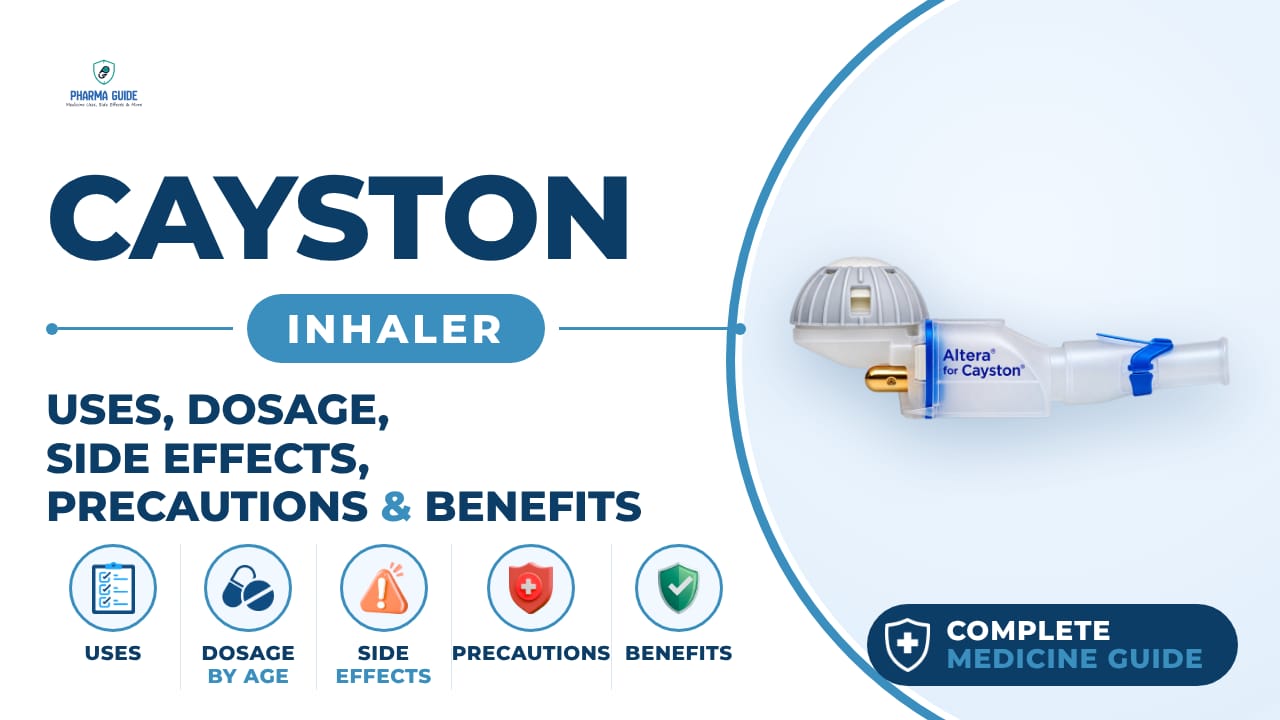
Cayston Inhaler is a prescription inhaled antibiotic that contains aztreonam, a monobactam antibiotic. It is used to help improve breathing symptoms in people with cystic fibrosis (CF) who have a lung infection caused by Pseudomonas aeruginosa bacteria. It is taken using the Altera Nebulizer System and works by attacking the bacteria's cell wall.
What is Cayston Inhaler
Cayston is a prescription inhaled antibiotic that contains aztreonam. It is used to improve breathing symptoms in people with cystic fibrosis (CF) who have a lung infection caused by the bacteria Pseudomonas aeruginosa.
Cayston Inhaler uses
- Improve respiratory symptoms in cystic fibrosis (CF) patients with Pseudomonas aeruginosa lung infection
Benefits of Cayston Inhaler
- Improves breathing symptoms in people with cystic fibrosis who have Pseudomonas aeruginosa lung infection
- Improved lung function (FEV1) was seen in clinical trials
How Cayston Inhaler works
Aztreonam attaches to proteins in the bacteria's cell wall, which stops the wall from forming properly and kills the bacteria.
Cayston Inhaler dosage
Take this medicine only by inhaling it through the Altera Nebulizer System. Do not use any other type of nebulizer or inhaler device.
Do not mix other medicines with Cayston in the nebulizer handset. Mix the medicine with the saline (diluent) only right before you are ready to use it; do not mix more than one dose at a time. Use the mixed medicine right away after mixing.
Space each dose at least 4 hours apart. Use an inhaled bronchodilator before each dose; take a short-acting bronchodilator between 15 minutes and 4 hours before your dose, or a long-acting bronchodilator between 30 minutes and 12 hours before your dose.
If you take several inhaled cystic fibrosis treatments, use them in this order: bronchodilator, then mucolytics (medicines to clear mucus), then Cayston. Each treatment takes about 2 to 3 minutes to complete.
Complete the full 28-day course even if you feel better, then take 28 days off before starting another course if prescribed.
If you miss a dose, you can still take all 3 doses for the day as long as they are at least 4 hours apart.
Do not use the saline or mixed medicine if it looks cloudy or has particles in it.
Not approved for children younger than 7 years old.
| Age group | Dose |
|---|---|
| Under 18 years | Safety and effectiveness are not established; no standard pediatric dose |
| 18–39 years | Usually starts at 0.5 mg twice daily; may be increased to 1 mg twice daily if needed and tolerated |
| 40–64 years | Usually 0.5 mg twice daily initially; may increase to 1 mg twice daily based on response |
| 65 years and older | No separate fixed dose; usually starts cautiously at 0.5 mg twice daily with closer monitoring |
Available forms and strengths
- Lyophilized powder for inhalation solution (single-use vial) with diluent ampule
Side effects of Cayston Inhaler
Common
- Cough
- Nasal congestion
- Wheezing
- Sore throat (pharyngolaryngeal pain)
- Fever (may be more common in children than adults)
- Chest discomfort
- Stomach area (abdominal) pain
- Vomiting
- Swelling or pain in joints
Serious
- Severe allergic reactions, including rash or swelling of the face and throat tightness
- Trouble breathing right after treatment (bronchospasm), with shortness of breath, wheezing, coughing, and chest tightness
Warnings and precautions
- Do not use Cayston if you are allergic to aztreonam or any of its ingredients.
- Serious allergic reactions have occurred with Cayston, including facial rash, facial swelling, and throat tightness. Stop the medicine and get medical help if this happens.
- Use caution if you have a history of allergy to other beta-lactam antibiotics such as penicillins, cephalosporins, or carbapenems, since cross-reactivity may occur.
- Bronchospasm (tightening of the airways) can happen with this nebulized medicine. Stop treatment if your chest feels tight during use.
- This medicine should only be used in CF patients who are known to have Pseudomonas aeruginosa infection, to help prevent bacteria from becoming drug-resistant.
- Complete the full 28-day course even if you feel better. Skipping doses or not finishing the course may make the infection harder to treat in the future.
- It is not known if Cayston can harm an unborn baby. Tell your doctor if you are pregnant or plan to become pregnant; the medicine should be used during pregnancy only if clearly needed.
- Aztreonam can pass into breast milk, but at very low levels. Talk with your doctor about the best way to feed your baby while taking this medicine.
- Cayston can be used in patients with mild, moderate, or severe kidney impairment without needing to change the dose.
- No routine liver-specific dose adjustment is established.
- No major direct alcohol interaction is established.
- Cayston generally does not directly impair driving.
Storage
- Store CAYSTON and saline in the refrigerator between 36 °F to 46 °F (2 °C to 8 °C) until needed.
- When you remove CAYSTON and saline from the refrigerator, they may be stored at room temperature (up to 77 °F) for up to 28 days. Do not use any CAYSTON that has been stored at room temperature for more than 28 days.
- Keep CAYSTON away from light.
- Do not use CAYSTON after the expiration date on the vial. Do not use the saline after the expiration date on the ampule.
- Keep CAYSTON and all medicines out of the reach of children.
- The empty vial, stopper and saline ampule should be disposed of in household garbage upon completion of dosing.
When to see a doctor
- Stop treatment and call your doctor right away if you have signs of an allergic reaction, such as rash or swelling of your face or throat tightness.
- Tell your healthcare provider right away if you have shortness of breath with wheezing, coughing, or chest tightness after a treatment.
- Get emergency medical help if you have signs of a severe allergic reaction such as hives, difficulty breathing, or swelling of your face, lips, tongue, or throat.
- Call your doctor if you have new or worsening breathing problems, or any side effect that bothers you or doesn't go away.
Alternatives
- Tobramycin inhalation solution
- Tobramycin inhalation powder
- Colistimethate inhalation where appropriate
- Other cystic-fibrosis specialist-selected inhaled antibiotics
Watch the video
FAQs
What is Cayston Inhaler used for?
Cayston Inhaler is used to improve breathing symptoms in people with cystic fibrosis (CF) who have a lung infection caused by Pseudomonas aeruginosa bacteria.
How do you take Cayston Inhaler?
Cayston is taken only by inhaling it through the Altera Nebulizer System, spacing each dose at least 4 hours apart, and using it in order after a bronchodilator and mucolytics if you take multiple inhaled CF treatments. Each treatment takes about 2 to 3 minutes.
How long is a course of Cayston treatment?
You should complete the full 28-day course even if you feel better, then take 28 days off before starting another course if prescribed.
What are the common side effects of Cayston Inhaler?
Common side effects include cough, nasal congestion, wheezing, sore throat, fever, chest discomfort, stomach pain, vomiting, and joint swelling or pain.
Can Cayston Inhaler be used in children?
Cayston is not approved for children younger than 7 years old, and safety and effectiveness have not been established for those under 18.
General information, not medical advice
Your prescriber and the leaflet in your pack know your situation. This page does not.
- Follow your prescriber and the leaflet
- Don't start, stop, or change a dose on your own
- Doses and warnings differ by country and product
Sources
Video
Related medicines

Azactam Injection: Uses, Dosage, Side Effects, Precautions and Alternates
Monobactams
Azactam Injection (aztreonam) treats bacterial infections like UTIs, kidney, respiratory, and bloodstream infections. Learn uses, dosage, side effects, and

Injectafer Injection: Uses, Dosage, Side Effects, Precautions and Alternates
Iron products
Injectafer (ferric carboxymaltose) treats iron deficiency anemia and heart failure-related iron deficiency via IV. Learn uses, dosage, side effects, and