
Safety
General information, not medical advice
Your prescriber and the leaflet in your pack know your situation. This page does not.
- Follow your prescriber and the leaflet
- Don't start, stop, or change a dose on your own
- Doses and warnings differ by country and product
Azithromycin Suspension: Uses, Dosage, Side Effects, Precautions and Alternates

| Generic name | Azithromycin |
|---|---|
| Drug class | Macrolide (azalide) antibacterial |
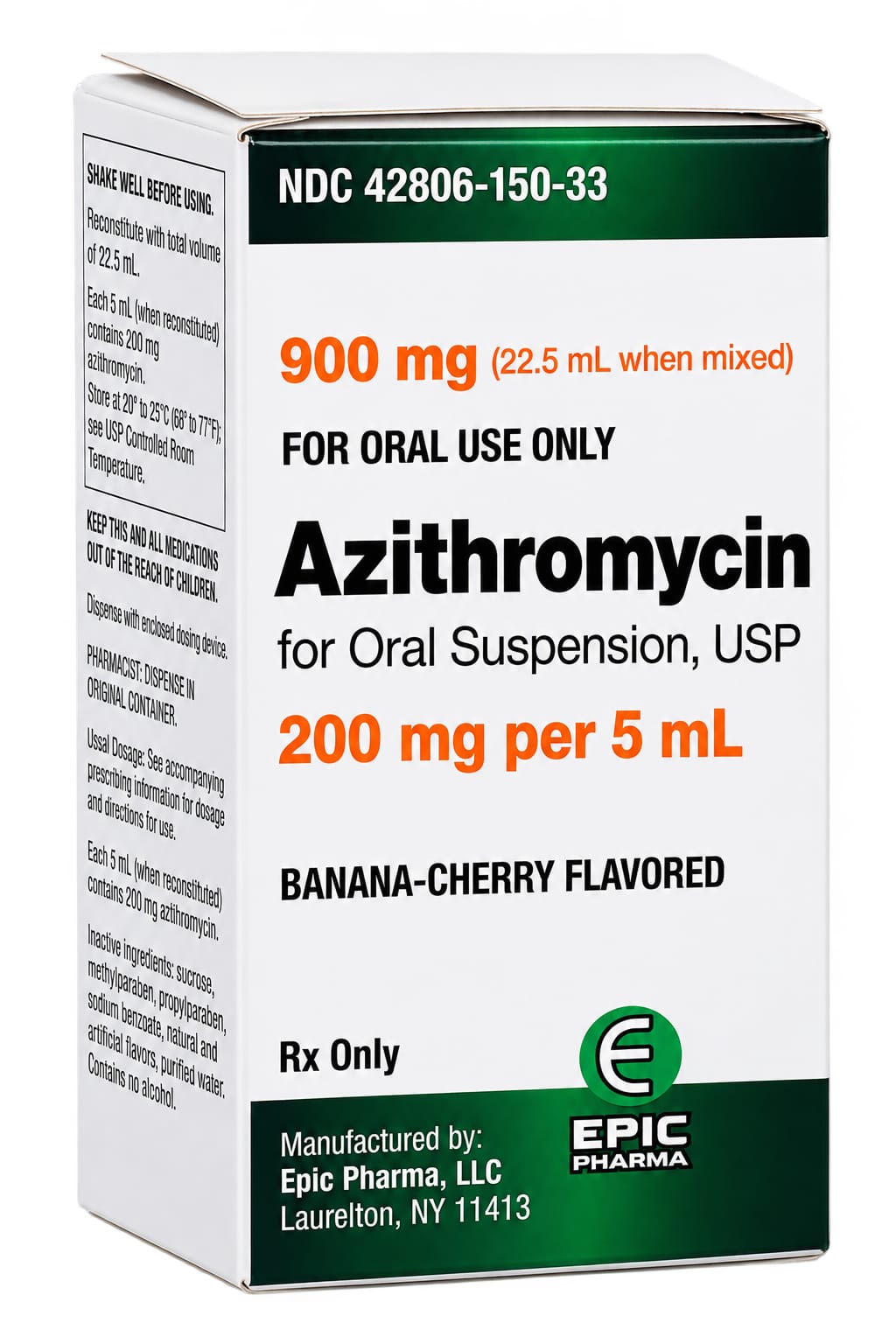
| Forms | Powder for oral suspension (200 mg/5 mL), Tablets (250 mg and 500 mg), Oral suspension (100 mg/5 mL) |
Quick overview
Azithromycin Suspension is an antibiotic medicine used to treat infections caused by certain bacteria, including sinus, ear, throat, lung, skin, and certain reproductive tract infections. It comes as a powder that is mixed with water to make a liquid suspension, often given as a short treatment course of three to five days, usually once a day. As with any antibiotic, it can cause side effects and requires certain precautions, so it should be used exactly as prescribed.
What is Azithromycin Suspension
Azithromycin oral suspension is an antibiotic medicine used to treat infections caused by certain bacteria. It comes as a powder that is mixed with water to make a liquid suspension. The generic name is azithromycin, and it belongs to the macrolide (azalide) antibacterial drug class.
Azithromycin Suspension uses
- Acute bacterial sinusitis
- Acute bacterial otitis media (ear infection)
- Pharyngitis and tonsillitis (throat and tonsil infections)
- Acute exacerbation of chronic bronchitis
- Mild to moderately severe community-acquired pneumonia
- Skin and soft tissue infections such as folliculitis, cellulitis, and erysipelas
- Uncomplicated Chlamydia trachomatis urethritis and cervicitis
Benefits of Azithromycin Suspension
- Can often be given as a short course (3 to 5 days) compared with some other antibiotics
- Usually taken once a day
- Available as a liquid for patients who cannot swallow tablets
- Usually requires relatively short treatment courses
How Azithromycin Suspension works
Azithromycin works by attaching to a part of the bacteria's machinery (the ribosome) that they need to make proteins. This stops the bacteria from growing and multiplying.
Azithromycin Suspension dosage
This medicine can be taken with or without food. Shake the bottle well before each dose. If you are using antacids, take azithromycin at least 1 hour before or 2 hours after the antacid, not at the same time. Use the measuring syringe or spoon provided to measure children's doses accurately.
Take the medicine exactly as directed and finish the full course even if you start to feel better, unless your doctor tells you to stop or you have a serious allergic reaction. Do not skip doses, as this can make the infection harder to treat and increase the risk of antibiotic resistance. If a child vomits or becomes irritable with feeding, especially a very young infant, contact a doctor.
| Age group | Dose |
|---|---|
| Under 6 months | No standard labeled dose established for these common indications |
| 2–5 years | 10 mg/kg once daily; for pharyngitis/tonsillitis: 12 mg/kg once daily |
| 6–11 years | 10 mg/kg once daily; for pharyngitis/tonsillitis: 12 mg/kg once daily |
| 18–64 years | Common adult regimen: 500 mg on Day 1, then 250 mg once daily on Days 2–5 |
Available forms and strengths
- Powder for oral suspension (200 mg/5 mL)
- Tablets (250 mg and 500 mg)
- Oral suspension (100 mg/5 mL)
Side effects of Azithromycin Suspension
Common
- Diarrhea or loose stools
- Nausea
- Abdominal pain
- Vomiting
- Headache
- Dizziness
- Rash
Serious
- Severe allergic reactions such as swelling of the face, lips, or throat, difficulty breathing, or severe skin reactions
- Liver problems, including yellowing of the skin or eyes, dark urine, or unusual tiredness
- Irregular or rapid heartbeat (QT prolongation, torsades de pointes)
- Severe watery or bloody diarrhea (possible colitis) that can occur even weeks after finishing treatment
- Worsening of muscle weakness in people with myasthenia gravis
- Hearing problems including hearing loss or ringing in the ears
Warnings and precautions
- There isn't enough information to know for certain whether azithromycin is safe in pregnancy. It should only be used in pregnancy if your doctor decides the benefits outweigh the risks.
- Azithromycin passes into breast milk in small amounts. Talk to your doctor about whether to continue breastfeeding or continue the medicine.
- No dose change is usually needed for mild to moderate kidney problems, but people with severe kidney impairment may have higher levels of the drug in their body.
- Because the liver is the main way this medicine leaves the body, people with liver disease should use it with caution. In some products it should not be used at all if you have liver disease.
- Alcohol does not directly inactivate azithromycin, but it may worsen nausea or other gastrointestinal effects.
- This medicine can cause dizziness, vision problems, or hearing loss in some people, which may affect your ability to drive or use machines.
- Serious, sometimes fatal, allergic reactions have happened with azithromycin and similar antibiotics, including severe swelling and anaphylaxis. Symptoms can come back even after initial treatment.
- Serious liver problems, including life-threatening liver failure, have been reported with this medicine.
- This medicine can affect heart rhythm (QT prolongation), which can lead to a dangerous irregular heartbeat, especially in people with certain heart conditions or taking other medicines that affect heart rhythm.
- Severe diarrhea caused by an overgrowth of bacteria called C. difficile can occur with this and almost all antibiotics, and can range from mild to life-threatening.
- A rare stomach problem called infantile hypertrophic pyloric stenosis has been reported in newborns treated with azithromycin. Parents should watch for vomiting or irritability with feeding.
- This medicine can worsen symptoms in people with the muscle-weakness condition myasthenia gravis.
- This medicine should not be combined with ergot-based medicines because of a theoretical risk of a serious reaction called ergotism.
- This medicine should only be used to treat infections proven or strongly suspected to be caused by bacteria, not viral infections like the common cold, to help prevent bacteria from becoming resistant to treatment.
Storage
- Store the powder in a dry place, below 30°C
- Protect from light
- After mixing with water, store the suspension between 5°C and 30°C and keep the bottle tightly closed
- Shake well before each use
- Discard any unused suspension after 10 days or once the full course is finished
- Keep out of reach of children
- Safely throw away any medicine that is out of date or no longer needed
When to see a doctor
- Get emergency medical help right away if you have trouble breathing or swallowing, swelling of the lips, tongue, or face, throat tightness, rapid heartbeat, faintness, or hives.
- Stop the medicine and call your doctor right away if you notice yellowing of the skin or eyes, dark urine, severe tiredness, loss of appetite, or stomach pain, as these can be signs of a serious liver problem.
- Tell your doctor right away if you notice a fast or irregular heartbeat, or if you feel faint or dizzy.
- Call your doctor right away if you have worsening muscle weakness or breathing problems.
- Tell your doctor right away if you have watery or bloody diarrhea, with or without stomach cramps or fever, even if it starts after you finish the medicine.
- Contact a doctor right away if a young infant taking this medicine vomits or becomes irritable with feeding.
- If you think you have taken too much of this medicine, get medical help right away.
Alternatives
- Amoxicillin
- Amoxicillin/clavulanate
- Clarithromycin
- Cefdinir
Watch the video
FAQs
What is Azithromycin Suspension used for?
It treats bacterial infections such as sinusitis, ear infections, pharyngitis/tonsillitis, chronic bronchitis flare-ups, community-acquired pneumonia, certain skin infections, and uncomplicated chlamydia urethritis or cervicitis.
How is Azithromycin Suspension dosed?
It can be taken with or without food; shake well before each dose. For children 2–11 years, the dose is typically 10 mg/kg once daily (12 mg/kg for pharyngitis/tonsillitis). Adults commonly take 500 mg on Day 1, then 250 mg once daily on Days 2–5. It is usually given as a 3 to 5 day course.
What are the common side effects of Azithromycin Suspension?
Common side effects include diarrhea or loose stools, nausea, abdominal pain, vomiting, headache, dizziness, and rash.
What serious side effects should I watch for with Azithromycin Suspension?
Seek medical help for signs of severe allergic reaction, liver problems like yellowing skin or dark urine, irregular or rapid heartbeat, severe watery or bloody diarrhea, worsening muscle weakness, or hearing problems.
How should Azithromycin Suspension be stored?
Store the powder in a dry place below 30°C and protect it from light. After mixing with water, keep the suspension between 5°C and 30°C in a tightly closed bottle, shake well before use, and discard any unused suspension after 10 days or once the course is finished.
General information, not medical advice
Your prescriber and the leaflet in your pack know your situation. This page does not.
- Follow your prescriber and the leaflet
- Don't start, stop, or change a dose on your own
- Doses and warnings differ by country and product
Sources
- https://www.efda.gov.et/wp-content/uploads/2023/07/Azithromycin-oral-suspension-200mg-per-5mL_CAZITHRO-ORAL-SUSPENSION_Cachet-Pharmaceuticals-Pvt.-Ltd..pdf
- https://austell.co.za/wp-content/uploads/2023/11/Approved-PI-Austell-Azithro-Suspension.pdf
- https://www.accessdata.fda.gov/drugsatfda_docs/label/2017/050710s44-050711s41-050784s28lbl.pdf
Video
Related medicines

Injectafer Injection: Uses, Dosage, Side Effects, Precautions and Alternates
Iron products
Injectafer (ferric carboxymaltose) treats iron deficiency anemia and heart failure-related iron deficiency via IV. Learn uses, dosage, side effects, and

Gliclazide Tablet: Uses, Dosage, Side Effects, Precautions and Alternates
Sulfonylurea (hypoglycemic/antidiabetic agent)
Gliclazide Tablet is a sulfonylurea for type 2 diabetes that boosts insulin release. Learn about dosage, side effects, warnings, and precautions.