
Safety
General information, not medical advice
Your prescriber and the leaflet in your pack know your situation. This page does not.
- Follow your prescriber and the leaflet
- Don't start, stop, or change a dose on your own
- Doses and warnings differ by country and product
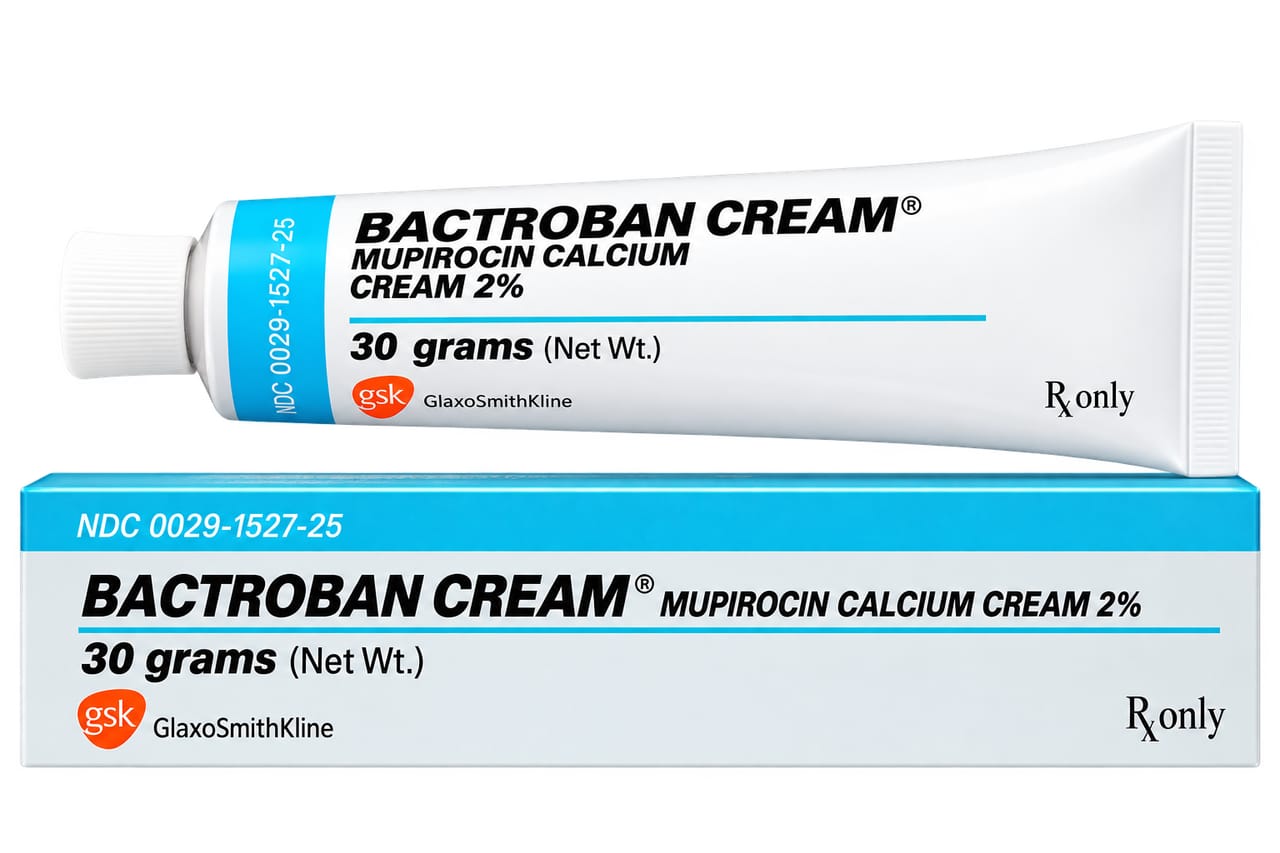
Bactroban Cream: Uses, Dosage, Side Effects, Precautions and Alternates

| Generic name | mupirocin calcium |
|---|---|
| Drug class | Topical antibiotic (RNA synthetase inhibitor antibacterial) |
| Forms | Cream (2.15% w/w mupirocin calcium, equal to 2% mupirocin free acid) in 15-gram and 30-gram tubes |
Quick overview
Bactroban Cream contains mupirocin calcium, a topical antibiotic that kills certain bacteria causing skin infections. It is applied directly to the skin to treat infected cuts, scrapes, stitched wounds, and mild impetigo caused by Staphylococcus aureus or Streptococcus pyogenes. The cream works locally with minimal absorption into the rest of the body. It should be used exactly as directed and for the full course prescribed.
What is Bactroban Cream
Bactroban Cream is a prescription antibiotic cream that you put on the skin. It contains mupirocin, which kills certain bacteria that cause skin infections. Mupirocin calcium belongs to a class of medicines known as topical antibiotics (RNA synthetase inhibitor antibacterials).
Bactroban Cream uses
- Treating infected cuts, scrapes, or stitched wounds (up to 10 cm long or 100 cm² in area) caused by Staphylococcus aureus or Streptococcus pyogenes bacteria
- Treating mild impetigo (school sores) and similar bacterial skin infections
- Treats bacterial skin infections
- Treats infected small cuts and wounds
- Treats infected scrapes and traumatic skin lesions
- Targets susceptible Staphylococcus aureus
Benefits of Bactroban Cream
- Targets and kills the specific bacteria causing the skin infection
- Can be applied directly to the affected area without needing to take a pill
- Provides localized antibacterial treatment
- Has minimal systemic absorption
- Helps clear susceptible bacterial skin infections
- Can be covered with a gauze dressing when appropriate
How Bactroban Cream works
Mupirocin works by blocking a process bacteria need to build proteins, which stops them from growing. It is strong enough to kill bacteria at the levels reached when applied to the skin.
Bactroban Cream dosage
For use on the skin only — do not swallow it. Wash your hands before and after applying the cream. Clean and dry the affected area first. Apply a small amount using a cotton swab or gauze pad. You may cover the treated area with a gauze dressing if you want to, unless your healthcare provider tells you to leave it uncovered. Do not apply it in or near your eyes, nose, mouth, or vagina. Do not use other creams, lotions, or ointments on the same area at the same time. Finish the full course of treatment even if your skin looks better sooner, so the infection is fully treated. If you miss an application, apply it as soon as you remember, but do not use extra to make up for a missed one. Contact your healthcare provider if your skin does not improve within 3 to 5 days.
| Age group | Dose |
|---|---|
| Under 3 months | Safety and effectiveness are not established |
| 3 months–5 years | Apply a small amount to the affected skin 3 times daily for 10 days |
| 6–64 years | Apply a small amount 3 times daily for 10 days |
Available forms and strengths
- Cream (2.15% w/w mupirocin calcium, equal to 2% mupirocin free acid) in 15-gram and 30-gram tubes
Side effects of Bactroban Cream
Common
- Headache
- Rash
- Nausea
- Burning at the application site
- Itching (pruritus)
Serious
- Severe allergic reactions such as hives, swelling of the face, lips, mouth, or tongue, a rash over the whole body, trouble breathing or wheezing, dizziness, or a fast or pounding heartbeat
- Clostridium difficile-associated diarrhea (CDAD), which can range from mild diarrhea to severe, life-threatening colitis
- Severe local irritation or sensitization of the skin
Warnings and precautions
- Do not use this cream if you are allergic to mupirocin or any of its ingredients.
- Avoid getting the cream in your eyes. If it does get in your eyes, rinse well with water.
- If the skin becomes very irritated or sensitive, stop using the cream and talk to your healthcare provider about other treatment.
- Using this cream for a long time can let other germs, including fungi, grow out of control.
- This cream is not meant to be used inside the nose, eyes, or other moist body surfaces (mucous membranes).
- Do not apply other creams, lotions, or ointments to the same area at the same time as this cream.
- Pregnancy: There isn't enough information in people to know if this cream is safe during pregnancy, though very little of the drug passes into the body through intact skin. Talk to your healthcare provider if you are pregnant or planning to become pregnant.
- Breastfeeding: It isn't known if this medicine passes into breast milk, but very little is absorbed into the body through the skin. If you use it on your breast or nipple, wash the area well before breastfeeding your baby.
- Kidney: Topical absorption is minimal, so routine renal dose adjustment is generally unnecessary.
- Liver: No routine hepatic dose adjustment is established.
- Alcohol: No significant direct interaction is expected with topical mupirocin.
- Driving: Bactroban does not normally affect driving.
Storage
- Store at or below 25°C (77°F)
- Do not freeze
- Keep out of the reach of children
When to see a doctor
- Get emergency help right away if you have signs of a severe allergic reaction, such as hives, swelling of the face, lips, mouth, or tongue, a rash all over the body, trouble breathing or wheezing, or a fast heartbeat with dizziness.
- Call your healthcare provider or go to the emergency room right away if you get diarrhea while using this medicine or after stopping it, since this could be a sign of a serious bowel problem.
- Contact your healthcare provider if your skin does not get better within 3 to 5 days of starting treatment.
- Stop using the cream and tell your healthcare provider if you develop irritation, severe itching, or a rash where you applied it.
Alternatives
- Fusidic acid cream
- Retapamulin ointment
- Ozenoxacin cream
Watch the video
FAQs
What is Bactroban Cream used for?
It treats infected cuts, scrapes, or stitched wounds (up to 10 cm long or 100 cm² in area) and mild impetigo caused by Staphylococcus aureus or Streptococcus pyogenes bacteria.
How is Bactroban Cream applied?
Clean and dry the affected area, then apply a small amount using a cotton swab or gauze pad 3 times daily for 10 days. You may cover it with a gauze dressing unless told otherwise, and should avoid the eyes, nose, mouth, or vagina.
What are the common side effects of Bactroban Cream?
Common side effects include headache, rash, nausea, burning at the application site, and itching.
When should I contact my doctor while using Bactroban Cream?
Contact your healthcare provider if your skin does not improve within 3 to 5 days, or if you develop irritation, severe itching, a rash, or diarrhea while using the cream.
Is Bactroban Cream safe during pregnancy?
There isn't enough information in people to confirm safety during pregnancy, though very little of the drug passes into the body through intact skin. Talk to your healthcare provider if pregnant or planning to become pregnant.
General information, not medical advice
Your prescriber and the leaflet in your pack know your situation. This page does not.
- Follow your prescriber and the leaflet
- Don't start, stop, or change a dose on your own
- Doses and warnings differ by country and product
Sources
Video
Related medicines
Mupirocin Ointment: Uses, Dosage, Side Effects, Precautions and Alternates
Topical antibiotic (RNA synthetase inhibitor antibacterial)
Mupirocin Ointment treats impetigo by killing bacteria. Learn about dosage, application tips, side effects, warnings, and when to see a doctor.

Injectafer Injection: Uses, Dosage, Side Effects, Precautions and Alternates
Iron products
Injectafer (ferric carboxymaltose) treats iron deficiency anemia and heart failure-related iron deficiency via IV. Learn uses, dosage, side effects, and