
Safety
General information, not medical advice
Your prescriber and the leaflet in your pack know your situation. This page does not.
- Follow your prescriber and the leaflet
- Don't start, stop, or change a dose on your own
- Doses and warnings differ by country and product
Benzydamine Spray: Uses, Dosage, Side Effects, Precautions and Alternates
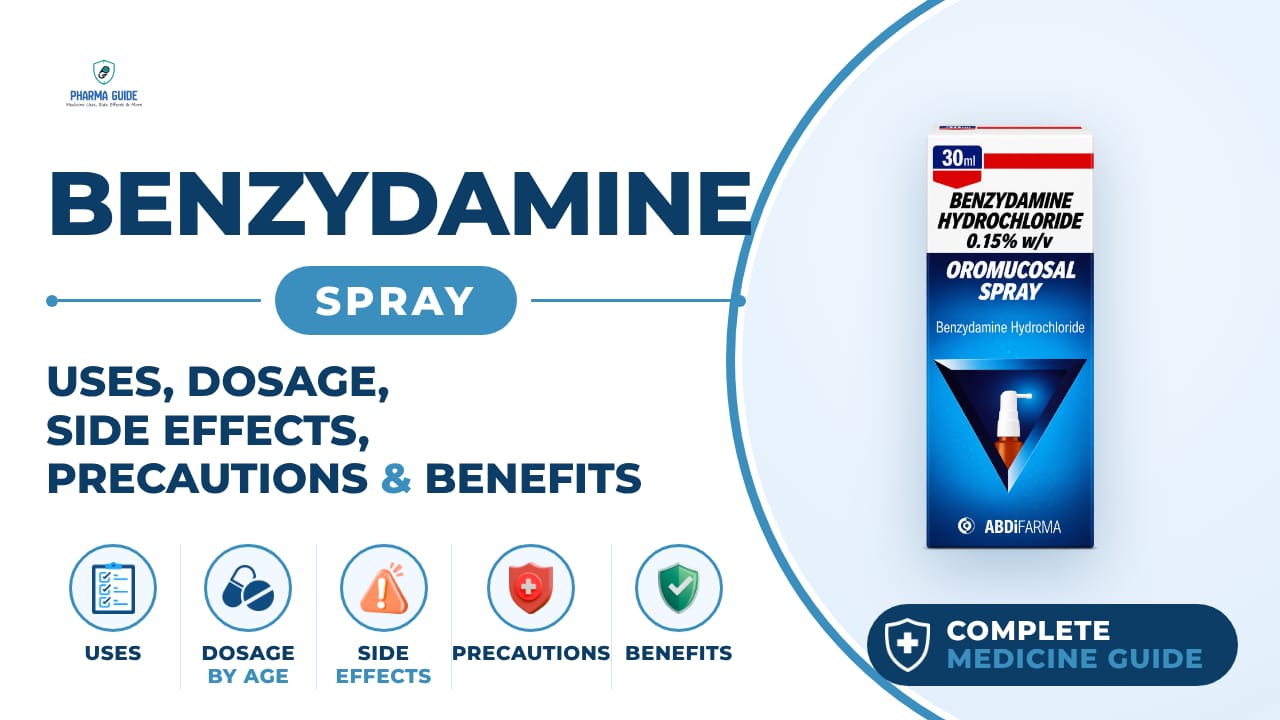
| Generic name | Benzydamine hydrochloride |
|---|---|
| Drug class | Non-steroidal anti-inflammatory drug (NSAID) - topical oromucosal analgesic |
| Forms | Oromucosal spray, solution |
Quick overview
Benzydamine Spray (benzydamine hydrochloride) is a non-steroidal anti-inflammatory drug used as a topical oromucosal analgesic. It is a clear, colorless, mint-scented solution sprayed into the mouth or throat to relieve pain and reduce inflammation in these areas. It is used for conditions such as sore throat, mouth ulcers, and discomfort after dental surgery or tonsil removal. It works locally and should be used as directed, with spacing between doses.
What is Benzydamine Spray
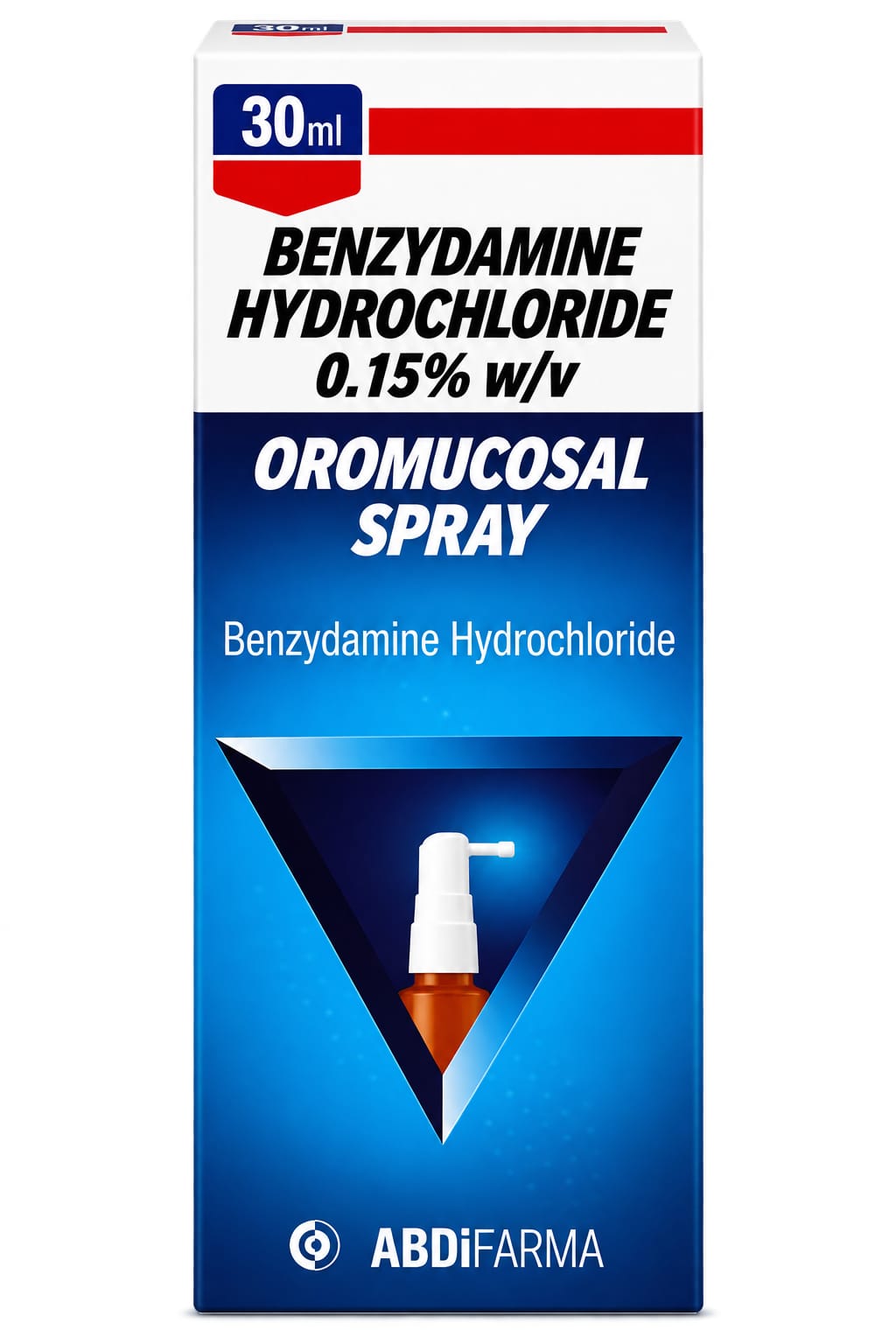
Benzydamine Hydrochloride Oromucosal Spray is a locally acting analgesic and anti-inflammatory medicine for the throat and mouth. It is a colorless, clear solution with a mint smell that is sprayed into the mouth or throat.
Benzydamine Spray uses
- Relieving pain in the throat and mouth
- Easing pain after tonsil removal (tonsillectomy)
- Easing pain from use of a naso-gastric tube
- Relieving pain after dental surgery
- Sore throats
- Mouth ulcers and cold sores
- Inflamed gums or sore tongue (gingivitis, glossitis)
- Teething discomfort
- Denture irritation
Benefits of Benzydamine Spray
- Provides local pain relief in the mouth and throat
- Reduces swelling and inflammation at the site it is applied
- Produces a numbing effect that eases irritation
How Benzydamine Spray works
Benzydamine works mainly by blocking the production of substances in the body that cause inflammation, rather than by the typical pathway used by most anti-inflammatory painkillers. It also has a local numbing (anesthetic) effect that helps ease pain.
Benzydamine Spray dosage
Spray into the mouth or throat; it is for oral use only. Do not swallow the medicine. Space doses about 1.5 to 3 hours apart. Avoid getting the spray in your eyes. If your symptoms get worse or do not improve, stop using the spray and see a doctor. Elderly people can use the same amount as adults because only a small amount of the drug is absorbed.
| Age group | Dose |
|---|---|
| Under 6 years | 1 spray per 4 kg body weight, up to a maximum of 4 sprays, every 1.5–3 hours |
| 6–11 years | 4 sprays every 1.5–3 hours |
| 12–74 years | 4–8 sprays every 1.5–3 hours |
Available forms and strengths
- Oromucosal spray, solution
Side effects of Benzydamine Spray
Common
- Numbness in the mouth
- Stinging feeling in the mouth
- Dry mouth
- Cough
- Headache
- Mild drowsiness or fatigue
- Upset stomach or nausea (rarely)
Serious
- Severe allergic (anaphylactic) reactions
- Swelling of the face, lips, tongue, or throat
- Difficulty breathing, wheezing, or a tight throat
- Spasm of the voice box or airways (laryngospasm or bronchospasm)
- Itching, hives, sensitivity to sunlight, and rash
- Swelling under the skin (angioedema)
Warnings and precautions
- Do not use this medicine if you are allergic to benzydamine hydrochloride or any of its other ingredients.
- This medicine is not recommended if you are sensitive to aspirin or other anti-inflammatory painkillers, as it could cause a reaction.
- People with asthma or a history of asthma should use this spray with caution, as it may trigger airway spasms.
- Avoid getting the spray in your eyes.
- Stop using the spray if your condition gets worse or does not improve.
- This medicine contains a preservative (methyl parahydroxybenzoate) that may cause allergic reactions, which can sometimes be delayed.
- Taking a large amount of this medicine by accident can cause nausea, vomiting, stomach pain, dizziness, hallucinations, agitation, anxiety, or irritability.
- This spray should not be used during pregnancy unless a doctor decides it is clearly necessary. Using it from the 20th week of pregnancy onward may affect the baby's kidney function and fluid levels around the baby, and it is not allowed at all during the last three months of pregnancy.
- This medicine should not be used while breastfeeding unless a doctor considers it necessary.
- Caution is needed in people with kidney problems.
- Each puff contains a very small amount of alcohol, similar to less than 1 ml of beer or wine, which is not expected to cause any noticeable effects.
- This medicine is not known to affect your ability to drive or use machines.
Storage
- Do not freeze
- This medicine does not require any special storage conditions
- After first opening the bottle, it can be used for 6 months
- Shelf life is 3 years before opening
- No special requirements are needed when throwing away this medicine
When to see a doctor
- Get emergency medical help right away if you have signs of a severe allergic reaction, such as swelling of the face, lips, tongue, or throat, trouble breathing, wheezing, or a tight throat.
- See a doctor if your symptoms do not get better or get worse after 7 days.
- If you accidentally swallow a large amount of this medicine, seek medical help or contact your local poison control center immediately.
- Stop treatment if mouth stinging persists instead of fading with continued use.
Alternatives
- Benzydamine lozenges
- Benzydamine mouthwash
- Paracetamol
Watch the video
FAQs
What is Benzydamine Spray used for?
It is used for relieving pain and inflammation in the mouth and throat, including sore throats, mouth ulcers, cold sores, gingivitis, glossitis, teething discomfort, denture irritation, and pain after tonsil removal or dental surgery.
How often can I use Benzydamine Spray?
Doses should be spaced about 1.5 to 3 hours apart. Dosage varies by age, with adults aged 12-74 years using 4-8 sprays every 1.5-3 hours.
What are the common side effects of Benzydamine Spray?
Common side effects include numbness or stinging in the mouth, dry mouth, cough, headache, mild drowsiness or fatigue, and rarely, upset stomach or nausea.
Can Benzydamine Spray be used during pregnancy?
It should not be used during pregnancy unless a doctor decides it is clearly necessary. It is not allowed during the last three months of pregnancy, and use from the 20th week onward may affect the baby's kidney function and fluid levels.
When should I see a doctor while using Benzydamine Spray?
See a doctor if symptoms do not improve or worsen after 7 days, or seek emergency help for signs of a severe allergic reaction like facial swelling, trouble breathing, or wheezing.
General information, not medical advice
Your prescriber and the leaflet in your pack know your situation. This page does not.
- Follow your prescriber and the leaflet
- Don't start, stop, or change a dose on your own
- Doses and warnings differ by country and product
Sources
Video
Related medicines

Injectafer Injection: Uses, Dosage, Side Effects, Precautions and Alternates
Iron products
Injectafer (ferric carboxymaltose) treats iron deficiency anemia and heart failure-related iron deficiency via IV. Learn uses, dosage, side effects, and

Gliclazide Tablet: Uses, Dosage, Side Effects, Precautions and Alternates
Sulfonylurea (hypoglycemic/antidiabetic agent)
Gliclazide Tablet is a sulfonylurea for type 2 diabetes that boosts insulin release. Learn about dosage, side effects, warnings, and precautions.