
Safety
General information, not medical advice
Your prescriber and the leaflet in your pack know your situation. This page does not.
- Follow your prescriber and the leaflet
- Don't start, stop, or change a dose on your own
- Doses and warnings differ by country and product
Betahistine Tablet: Uses, Dosage, Side Effects, Precautions and Alternates
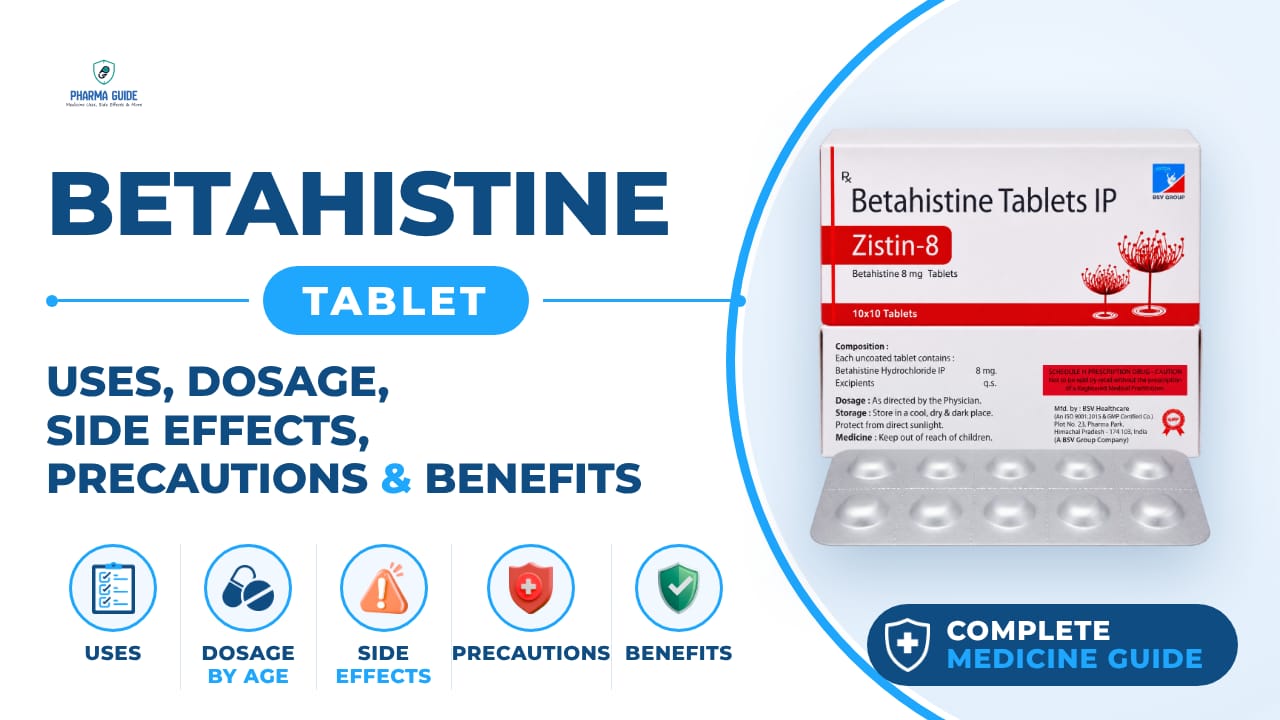
| Generic name | Betahistine dihydrochloride |
|---|---|
| Drug class | Antivertigo agent (histamine analogue) |
| Forms | Tablet |

Quick overview
Betahistine Tablet (betahistine dihydrochloride) is an antivertigo agent used to treat Meniere's syndrome and related inner ear symptoms such as tinnitus, hearing loss, vertigo, and nausea. It is thought to work by improving blood flow in the inner ear. It is available as tablets and should be used exactly as prescribed, with common side effects including stomach upsets and dizziness, and some serious effects requiring urgent medical attention.
What is Betahistine Tablet
Betahistine is a histamine-like medicine used to treat inner ear disorders. It is available as tablets containing betahistine dihydrochloride.
Betahistine Tablet uses
- Meniere's syndrome (an inner ear disorder)
- Ringing in the ears (tinnitus)
- Loss of clear hearing
- Balance problems (vertigo)
- Nausea, vomiting and headache linked to inner ear disorders
Benefits of Betahistine Tablet
- May reduce the number of vertigo (dizziness) episodes
- Can help lessen ringing in the ears, hearing loss, and nausea linked to Meniere's syndrome
How Betahistine Tablet works
Betahistine is thought to work by improving blood flow in the inner ear, which reduces the build-up of pressure there and helps normalize how the nerves in the ear respond to signals.
Betahistine Tablet dosage
Swallow the tablets with a glass of water. Take the tablet with or shortly after a meal, at about the same time each day, since taking it on an empty stomach may cause stomach upsets. Take your tablets regularly at the same time each day to get the best effect.
If you miss a dose, skip the missed dose and take your next dose at the usual time. Do not double up to make up for a missed dose. Do not stop taking the tablets or change the dose without checking with your doctor.
Not recommended for children or teenagers under 18 years of age. It may take a few days to a few weeks before you notice improvement.
| Age group | Dose |
|---|---|
| Under 18 Years | Not recommended unless prescribed by a specialist |
| Adults (18–64 Years) | 8–16 mg three times daily (usual maintenance up to 48 mg/day) |
| Older Adults (65+ years) | Same adult dose; adjustment based on medical condition |
Available forms and strengths
- Tablet
Side effects of Betahistine Tablet
Common
- Skin irritations or rash
- Stomach upsets, indigestion, bloating, swollen stomach
- Nausea, vomiting
- Diarrhoea
- Dizziness
- Fast heart-beat
- Headache
- Difficulty sleeping (insomnia)
- Tiredness
- Occasional drowsiness
Serious
- Serious allergic reaction (swelling of face, lips, tongue or throat; difficulty breathing; hives; skin turning blue, grey or pale)
- Severe skin reactions
- Convulsions (fits)
- Hallucinations
- Confusion
- Low blood pressure
- Slow heart-beat
- Bronchospasm in people with asthma
Warnings and precautions
- Do not use if you have ever had an allergic reaction to betahistine or any of its ingredients.
- Do not use if you have a rare adrenal gland tumour called phaeochromocytoma.
- Do not use if you have or have had a peptic (stomach) ulcer.
- Tell your doctor if you have asthma, as this medicine may worsen breathing problems.
- Do not give this medicine to anyone else, even if they have the same symptoms as you.
- Do not stop taking or lower the dose without checking with your doctor first.
- Not recommended for children and teenagers under 18 years old because there is no data on safety and effectiveness in this age group.
- Betahistine should not be used during pregnancy unless your doctor decides it is absolutely necessary. Talk to your doctor about the risks and benefits.
- Do not breastfeed while taking betahistine unless your doctor tells you to, as it is not known if it passes into breast milk.
- There is no information available on the use of betahistine in people with kidney problems.
- Liver problems may cause the medicine to build up in the body, which could increase side effects. Tell your doctor about any history of liver disease.
- It is not known how betahistine interacts with alcohol, so it's best to check with your doctor before drinking.
- Betahistine itself is not likely to affect your ability to drive, but the dizziness caused by the underlying inner ear condition can affect driving or using machinery, so be careful until you know how it affects you.
Storage
- Keep your tablets in the pack until it is time to take them.
- Keep your tablets in a cool, dry place where the temperature stays below 25°C (or below 30°C depending on product).
- Protect from moisture, heat, and sunlight; do not store in the bathroom, near a sink, in the car, or on window sills.
- Keep out of the reach and sight of children.
- Do not use after the expiry date.
- If you no longer need the medicine or it is out of date, take it to a pharmacy for safe disposal rather than throwing it in household waste or wastewater.
When to see a doctor
- Get urgent medical help if you think you have taken too much of this medicine, even if you feel fine, since overdose can cause nausea, vomiting, digestion problems, coordination problems, and fits at higher doses.
- Stop taking the medicine and get emergency medical help right away if you notice signs of a serious allergic reaction, such as swelling of the face, lips, tongue or throat, difficulty breathing, or a widespread itchy or blistering rash.
- Call your doctor straight away or go to the nearest hospital emergency department if you notice serious side effects like skin reactions, difficulty breathing, convulsions, hallucinations, confusion, allergic reaction, low blood pressure, or slow heart-beat.
Alternatives
- Cinnarizine
- Prochlorperazine
- Dimenhydrinate
Watch the video
FAQs
What is Betahistine Tablet used for?
It is used to treat Meniere's syndrome and related inner ear symptoms such as tinnitus, hearing loss, vertigo, nausea, vomiting, and headache.
How does Betahistine Tablet work?
It is thought to work by improving blood flow in the inner ear, reducing pressure build-up there and helping normalize how the nerves in the ear respond to signals.
What is the adult dosage of Betahistine Tablet?
Adults aged 18–64 typically take 8–16 mg three times daily, with usual maintenance doses of up to 48 mg per day. Older adults generally take the same dose with adjustments based on their medical condition.
What are the common side effects of Betahistine Tablet?
Common side effects include skin irritations or rash, stomach upsets, nausea, vomiting, diarrhoea, dizziness, fast heart-beat, headache, insomnia, tiredness, and occasional drowsiness.
Can Betahistine Tablet be used during pregnancy?
It should not be used during pregnancy unless your doctor decides it is absolutely necessary, so you should discuss the risks and benefits with your doctor.
General information, not medical advice
Your prescriber and the leaflet in your pack know your situation. This page does not.
- Follow your prescriber and the leaflet
- Don't start, stop, or change a dose on your own
- Doses and warnings differ by country and product
Sources
Video
Related medicines

Injectafer Injection: Uses, Dosage, Side Effects, Precautions and Alternates
Iron products
Injectafer (ferric carboxymaltose) treats iron deficiency anemia and heart failure-related iron deficiency via IV. Learn uses, dosage, side effects, and

Gliclazide Tablet: Uses, Dosage, Side Effects, Precautions and Alternates
Sulfonylurea (hypoglycemic/antidiabetic agent)
Gliclazide Tablet is a sulfonylurea for type 2 diabetes that boosts insulin release. Learn about dosage, side effects, warnings, and precautions.