
Safety
General information, not medical advice
Your prescriber and the leaflet in your pack know your situation. This page does not.
- Follow your prescriber and the leaflet
- Don't start, stop, or change a dose on your own
- Doses and warnings differ by country and product
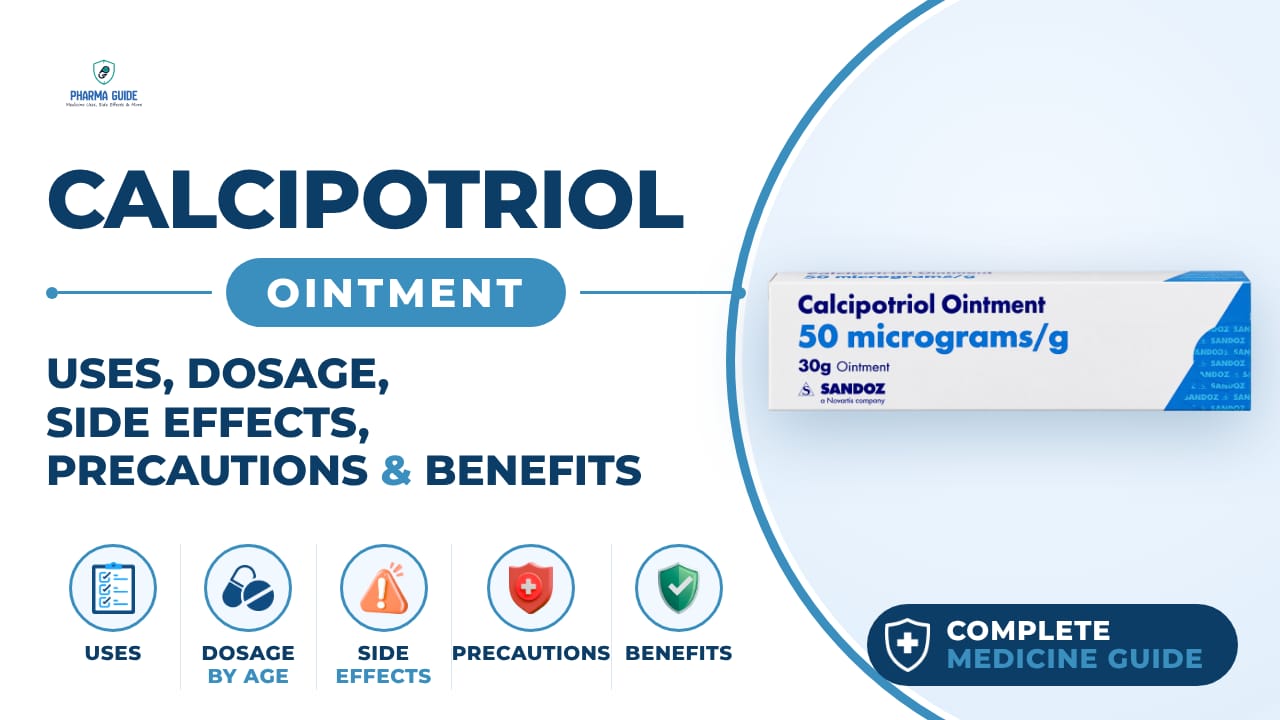
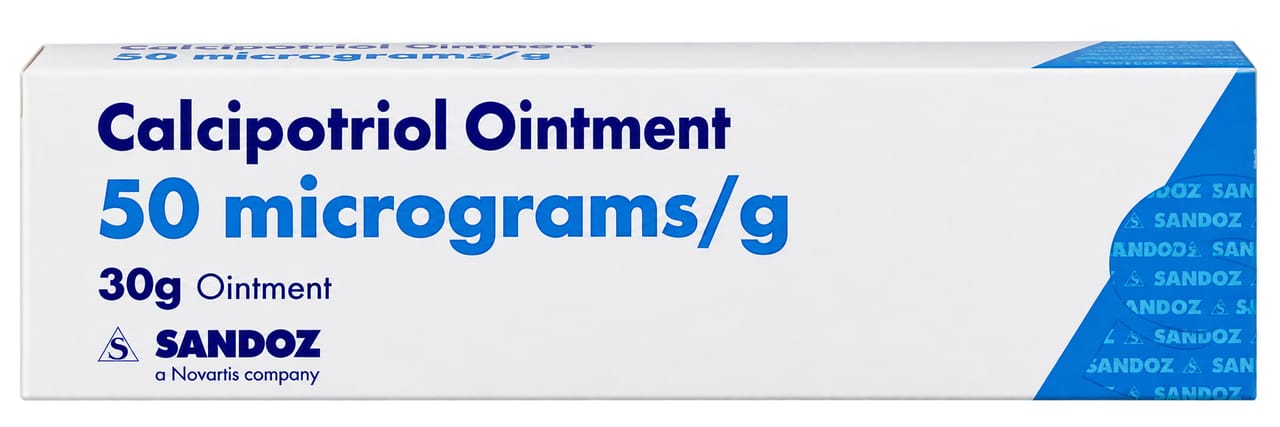
Calcipotriol Ointment: Uses, Dosage, Side Effects, Precautions and Alternates
| Generic name | Calcipotriol |
|---|---|
| Drug class | Topical Non-Steroidal Antipsoriatic Agent |
| Forms | Ointment, Cream, Scalp solution |
Quick overview
Calcipotriol Ointment contains calcipotriol, a man-made form of vitamin D used on the skin to treat psoriasis. It is not a steroid, and it works by slowing down the overactive skin cell growth that causes scaly red patches. It is applied directly to affected skin and can be used alone or together with certain other psoriasis treatments.
What is Calcipotriol Ointment
Calcipotriol is a man-made form of vitamin D used on the skin to treat psoriasis. It is not a steroid. It belongs to the topical non-steroidal antipsoriatic agent drug class.
Calcipotriol Ointment uses
- Topical treatment of psoriasis on the body
- Topical treatment of scalp psoriasis (scalp solution)
- Can be used together with a moderate to very potent topical corticosteroid, cyclosporin A (oral), or acitretin (oral)
Benefits of Calcipotriol Ointment
- Helps bring the rate of skin cell growth back to normal
- Reduces thickness, redness, and scaling of psoriasis plaques
- Clinical improvement usually occurs within 2 weeks, with best results by 6-8 weeks
- Non-steroid topical treatment
- Can reduce plaque thickness and scaling
- Can be combined with topical corticosteroids
- Suitable for longer-term psoriasis management in selected patients
How Calcipotriol Ointment works
Psoriasis happens because skin cells grow and divide too fast, causing scaly red patches. Calcipotriol is made from vitamin D and works by slowing down this overactive growth and helping skin cells mature normally.
Calcipotriol Ointment dosage
At the start of treatment, rub the ointment onto affected skin areas twice a day, in the morning and evening. Once psoriasis improves, your doctor may reduce use to once a day for maintenance. If used together with a steroid, apply each medicine once a day at different times, one in the morning and the other in the evening. It can be used twice daily in combination with cyclosporin A or acitretin.
Wash your hands after applying to avoid spreading it to your face. No special dressing or cover is needed, and you can wear your usual clothes. If it gets on surrounding healthy skin or your face by accident, wash it off right away. It is not recommended for use on the face.
Children aged 2 to 14 should only apply the cream or ointment under adult supervision. Do not use in children under 2 years of age. If you forget a dose, apply it as soon as you remember, then continue as before.
| Age group | Dose |
|---|---|
| Under 6 years | Safety and effectiveness are not well established; specialist-directed only |
| 6–11 years | Usually a thin layer to affected skin once or twice daily, depending on the specific product and local labeling |
| 12–17 years | Usually once or twice daily to affected areas; total weekly amount should be limited according to the product label |
| 18–64 years | Usually apply a thin layer once or twice daily to affected plaques |
Available forms and strengths
- Ointment
- Cream
- Scalp solution
Side effects of Calcipotriol Ointment
Common
- Local skin irritation, usually mild and temporary
- Face and scalp irritation (usually from accidental transfer from other body parts)
Serious
- High blood calcium levels (hypercalcaemia), which can cause fatigue, depression, mental confusion, loss of appetite, nausea, vomiting, constipation, increased urination, and in some patients irregular heartbeat
- Rare allergic reactions
Warnings and precautions
- Using calcipotriol together with ultraviolet (UV) light treatment may increase the risk of skin cancer caused by UV exposure. Calcipotriol on its own does not cause cancer.
- Do not use on the face, as it may cause irritation and redness. Wash your hands after use to avoid accidentally transferring it to your face.
- Use carefully in skin folds, since the natural covering there can increase skin irritation.
- Using more than the maximum recommended weekly amount increases the risk of high blood calcium levels.
- Not generally recommended for severe, widespread psoriasis; talk to your doctor before use in this case.
- Do not use in the eyes.
- Children aged 2 to 14 should only use the cream or ointment under adult supervision; the scalp solution is not recommended under age 18, and the product should not be used in children under 2.
- Calcipotriol should only be used during pregnancy if the expected benefit clearly outweighs the possible risk to the baby. Tell your doctor if you are pregnant or become pregnant during treatment.
- It is not known if calcipotriol passes into breast milk. It should only be used while breastfeeding if the benefit clearly outweighs the possible risk to the baby.
- Significant kidney disease may increase concern about calcium balance if large amounts are used.
- No routine liver-specific adjustment is generally required.
- No major direct interaction with alcohol is expected.
- Does not normally affect driving.
Storage
- Store at room temperature (15-25°C)
- Do not refrigerate (this is to prevent pulling of delicate skin)
- Keep in a safe place where children cannot reach it
- Keep away from pets — dogs like the taste but it can be fatal to dogs if eaten; contact a veterinarian immediately if a dog eats it
- Do not use past the expiry date marked on the tube
When to see a doctor
- If you think you have used too much and are showing signs of high calcium (such as fatigue, confusion, nausea, vomiting, constipation, or increased urination), contact your doctor or go to the nearest hospital emergency department.
- Stop use and tell your doctor right away if you notice a severe allergic reaction, such as swelling of the face, mouth, or throat, or trouble breathing.
- Contact your doctor for any unexpected effects while using this medicine.
Alternatives
- Calcipotriene cream
- Calcitriol ointment
- Tazarotene
Watch the video
FAQs
What is Calcipotriol Ointment used for?
It is used for topical treatment of psoriasis on the body and scalp, and can be combined with a moderate to very potent topical corticosteroid, oral cyclosporin A, or oral acitretin.
Is Calcipotriol Ointment a steroid?
No, it is not a steroid. It is a man-made form of vitamin D belonging to the topical non-steroidal antipsoriatic agent drug class.
How long does it take for Calcipotriol Ointment to work?
Clinical improvement usually occurs within 2 weeks, with best results seen by 6-8 weeks.
Can Calcipotriol Ointment be used on the face?
No, it is not recommended for use on the face, as it may cause irritation and redness. If it accidentally gets on your face, wash it off right away.
What are the serious side effects of Calcipotriol Ointment?
Serious side effects include high blood calcium levels (hypercalcaemia), which can cause fatigue, depression, confusion, loss of appetite, nausea, vomiting, constipation, increased urination, and irregular heartbeat, as well as rare allergic reactions.
General information, not medical advice
Your prescriber and the leaflet in your pack know your situation. This page does not.
- Follow your prescriber and the leaflet
- Don't start, stop, or change a dose on your own
- Doses and warnings differ by country and product
Sources
Video
Related medicines

Injectafer Injection: Uses, Dosage, Side Effects, Precautions and Alternates
Iron products
Injectafer (ferric carboxymaltose) treats iron deficiency anemia and heart failure-related iron deficiency via IV. Learn uses, dosage, side effects, and

Gliclazide Tablet: Uses, Dosage, Side Effects, Precautions and Alternates
Sulfonylurea (hypoglycemic/antidiabetic agent)
Gliclazide Tablet is a sulfonylurea for type 2 diabetes that boosts insulin release. Learn about dosage, side effects, warnings, and precautions.