
Safety
General information, not medical advice
Your prescriber and the leaflet in your pack know your situation. This page does not.
- Follow your prescriber and the leaflet
- Don't start, stop, or change a dose on your own
- Doses and warnings differ by country and product
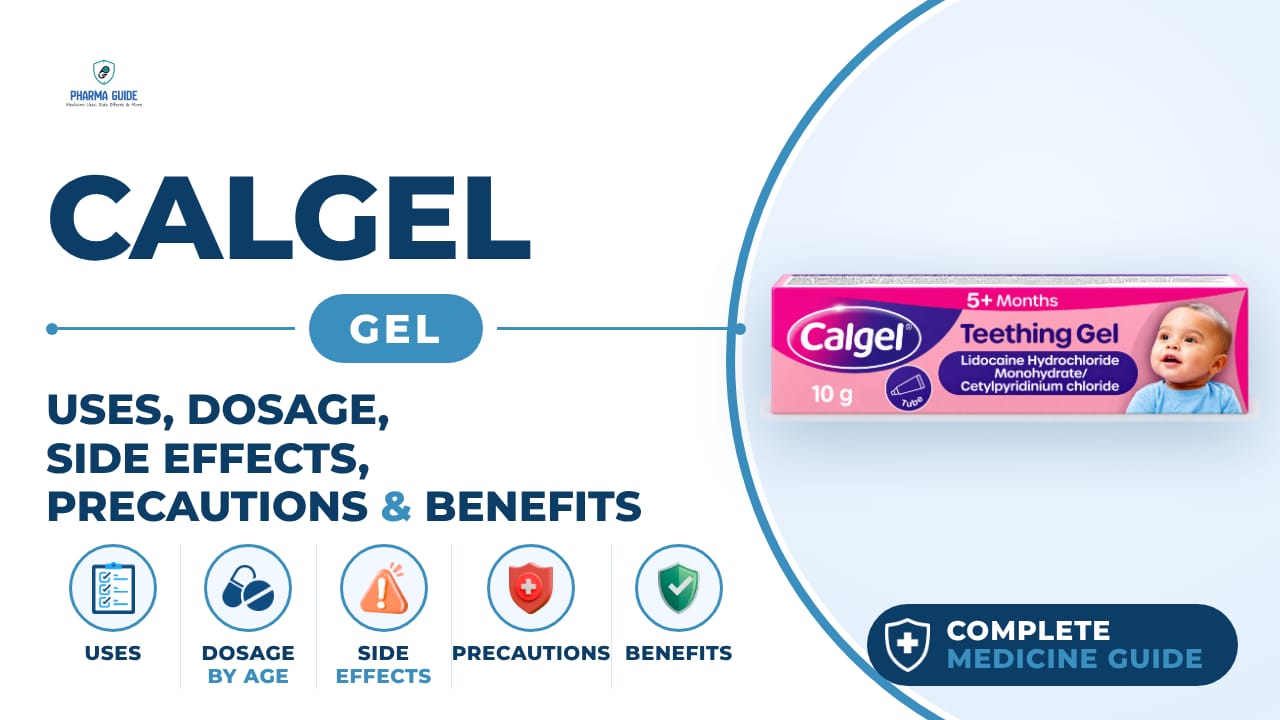
Calgel Gel: Uses, Dosage, Side Effects, Precautions and Alternates
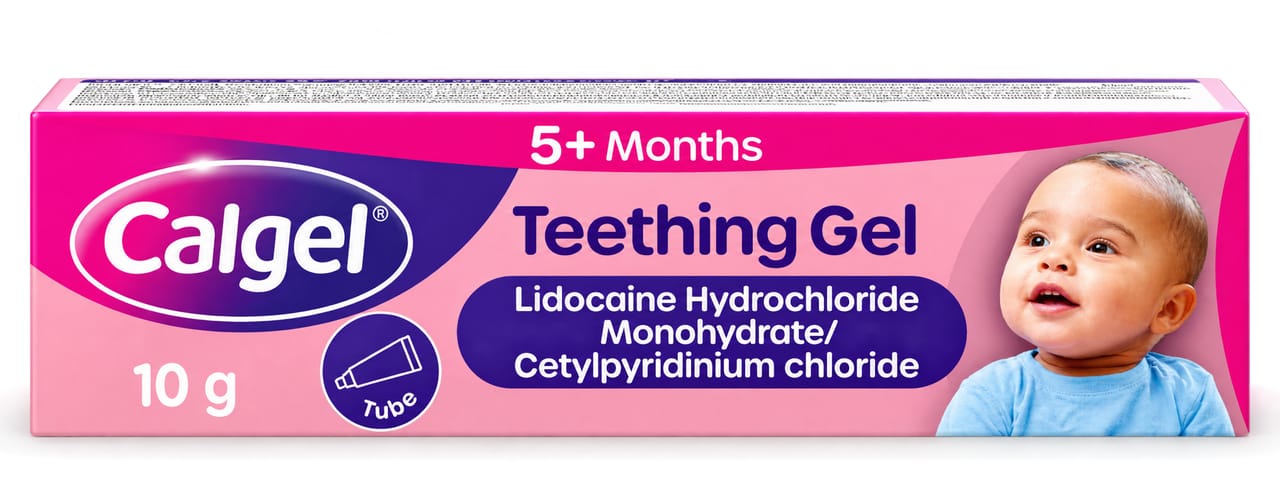
| Generic name | lidocaine hydrochloride, cetylpyridinium chloride |
|---|---|
| Drug class | local anaesthetic with mild antiseptic |
| Forms | gel (10 g tubes) |
Quick overview
Calgel Gel contains lidocaine hydrochloride and cetylpyridinium chloride, a local anaesthetic combined with a mild antiseptic. It is applied to a baby's gums to relieve the pain and discomfort of teething and to help prevent minor infection in the mouth. The gel is for gum use only and should be used according to the age-based directions and maximum duration described below.
What is Calgel Gel
Calgel Teething Gel is a topical gel applied to a baby's gums to relieve the pain and discomfort of teething. It contains a local anaesthetic to numb the pain and a mild antiseptic to help prevent infection.
Calgel Gel uses
- Relieves pain and discomfort associated with teething when gum massage or teething rings are not enough
- Helps soothe sore or irritated gums in babies
- Helps prevent minor infection in the mouth
- Relieves teething pain
- Reduces gum discomfort
Benefits of Calgel Gel
- Provides relief from teething pain
- Contains a mild antiseptic to help prevent infection
- Works quickly when applied directly to the sore area
- Acts directly on the affected gum
- Contains a local anesthetic for pain relief
How Calgel Gel works
The gel contains a local anaesthetic that numbs the gum to relieve pain, along with a mild antiseptic that helps prevent infection in the mouth.
Calgel Gel dosage
For use on the gums only, not for swallowing. Place the gel onto a clean pad of cotton wool or a clean fingertip and gently rub onto the sore area of the gum. Wait a few hours before giving another dose if needed, and do not use more than the maximum number of times per day stated on the label. Do not use at the same time as other products that also contain a local anaesthetic.
Stop using once your child's teething symptoms settle, and do not use for more than one week for each teething episode. If your child vomits, spits out, or swallows the gel, do not reapply right away — wait a few hours before using it again. This product is not recommended for very young babies below the stated minimum age.
| Age group | Dose |
|---|---|
| Under 5 months | Do not use |
| 5–11 months | Apply a pea-sized amount (0.2 g) to the affected gum; may repeat after 3 hours if needed |
| 1–5 years | 0.2 g per application, repeat after at least 3 hours if needed |
| 6 years and older | Calgel is primarily a teething product; use should be based on the product indication rather than age alone |
Available forms and strengths
- Gel (10 g tubes)
Side effects of Calgel Gel
Common
- Transient stinging, burning, or tingling sensation right after application
- Mild gum redness
Serious
- Swelling of the mouth, gums or tongue
- Difficulty in breathing
- Rash
- Inflammation of the skin
- Reddening of the skin
Warnings and precautions
- Do not give this medicine to anyone who has ever had an allergic reaction to the product, chamomile, or any of its ingredients.
- Do not use this gel at the same time as other products that also contain lidocaine.
- This product contains sorbitol, so talk to a doctor before using it if there is an intolerance to some sugars, now or in the past.
- The xylitol in this product may cause a laxative effect, and the castor oil ingredient may cause stomach upsets and diarrhoea.
- Do not give more gel than the stated dose, and do not use it for longer than one week for each teething episode.
- Swallowing large amounts of the gel or applying too much can cause dangerous side effects affecting the heart or nervous system.
- If you are pregnant, only use this medicine on the advice of your doctor.
- If you are breast-feeding, only use this medicine on the advice of your doctor.
- Extra caution is advised with significant kidney disease if prolonged or excessive exposure occurs.
- Significant liver disease warrants medical advice because lidocaine and some excipients may accumulate with excessive use.
- This product contains a small amount of alcohol (less than 100 mg per dose).
- Calgel itself has no expected effect on driving ability.
Storage
- Keep this medicine out of the sight and reach of children.
- Do not store above 25ºC.
- Keep the tube tightly closed.
- Store in the original package.
- Do not use your medicine after the date shown as an expiry date on the packaging.
- Do not throw away any medicines via wastewater or household waste. Ask your pharmacist how to throw away medicines you no longer use.
When to see a doctor
- Stop using the gel and get medical help right away if your child has swelling of the mouth, gums, or tongue, trouble breathing, a rash, or skin inflammation or redness.
- If your child's teething symptoms get worse, do not improve after a week of treatment, or you are worried your child seems unwell, speak to a health care professional.
- If someone uses too much of this gel, or swallows a large amount, contact a doctor or go to your nearest emergency department straight away, taking the leaflet and pack with you, even if the child seems fine.
Alternatives
- Dentinox Teething Gel
- Bonjela Junior Gel
- Non-medicinal teething rings
- Gentle gum massage
Watch the video
FAQs
What is Calgel Gel used for?
Calgel Gel is used to relieve the pain and discomfort of teething in babies and to help prevent minor infection in the mouth. It contains a local anaesthetic to numb gum pain and a mild antiseptic.
What age can Calgel Gel be used from?
Calgel Gel should not be used in babies under 5 months old. For babies aged 5–11 months, a pea-sized amount (0.2 g) can be applied to the affected gum, repeated after 3 hours if needed.
How often can Calgel Gel be applied?
Wait a few hours before giving another dose if needed, and do not use more than the maximum number of times per day stated on the label. For children aged 5 months to 5 years, doses can be repeated after at least 3 hours.
How long can Calgel Gel be used for?
Calgel Gel should not be used for more than one week for each teething episode. Stop using it once your child's teething symptoms settle.
What are the side effects of Calgel Gel?
Common side effects include transient stinging, burning, or tingling after application and mild gum redness. Serious side effects include swelling of the mouth, gums or tongue, difficulty breathing, rash, and skin inflammation or reddening, which require immediate medical attention.
General information, not medical advice
Your prescriber and the leaflet in your pack know your situation. This page does not.
- Follow your prescriber and the leaflet
- Don't start, stop, or change a dose on your own
- Doses and warnings differ by country and product
Sources
- https://www.chemist.net/media/catalog/product/file/Calgel_Teething_Gel_ds93_1.pdf?srsltid=AYCX9vKimaXIGY0olJ7RkZeD_snmYcCgUnWHYjIH7NzEzpg7x7hPVvdj
- https://www.truemeds.in/medicine/calgel-softgel-capsule-15-TM-SOLE1-000046
- https://mhraproductsproduction.blob.core.windows.net/docs/dc327fa03b4f2860f613b17b9440982f0886ad57
Video
Related medicines

Injectafer Injection: Uses, Dosage, Side Effects, Precautions and Alternates
Iron products
Injectafer (ferric carboxymaltose) treats iron deficiency anemia and heart failure-related iron deficiency via IV. Learn uses, dosage, side effects, and

Gliclazide Tablet: Uses, Dosage, Side Effects, Precautions and Alternates
Sulfonylurea (hypoglycemic/antidiabetic agent)
Gliclazide Tablet is a sulfonylurea for type 2 diabetes that boosts insulin release. Learn about dosage, side effects, warnings, and precautions.