
Safety
General information, not medical advice
Your prescriber and the leaflet in your pack know your situation. This page does not.
- Follow your prescriber and the leaflet
- Don't start, stop, or change a dose on your own
- Doses and warnings differ by country and product
Capex Shampoo: Uses, Dosage, Side Effects, Precautions and Alternates
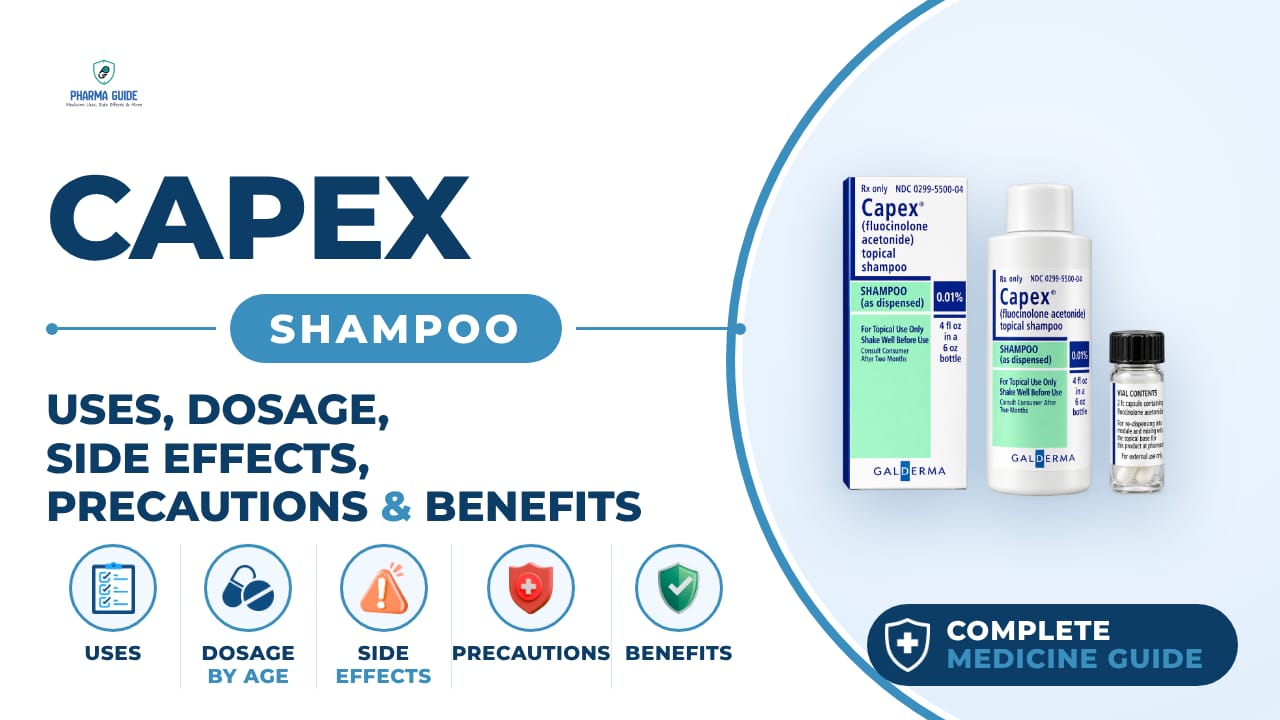
| Generic name | fluocinolone acetonide |
|---|---|
| Drug class | Corticosteroids, Topical |
| Forms | Shampoo |
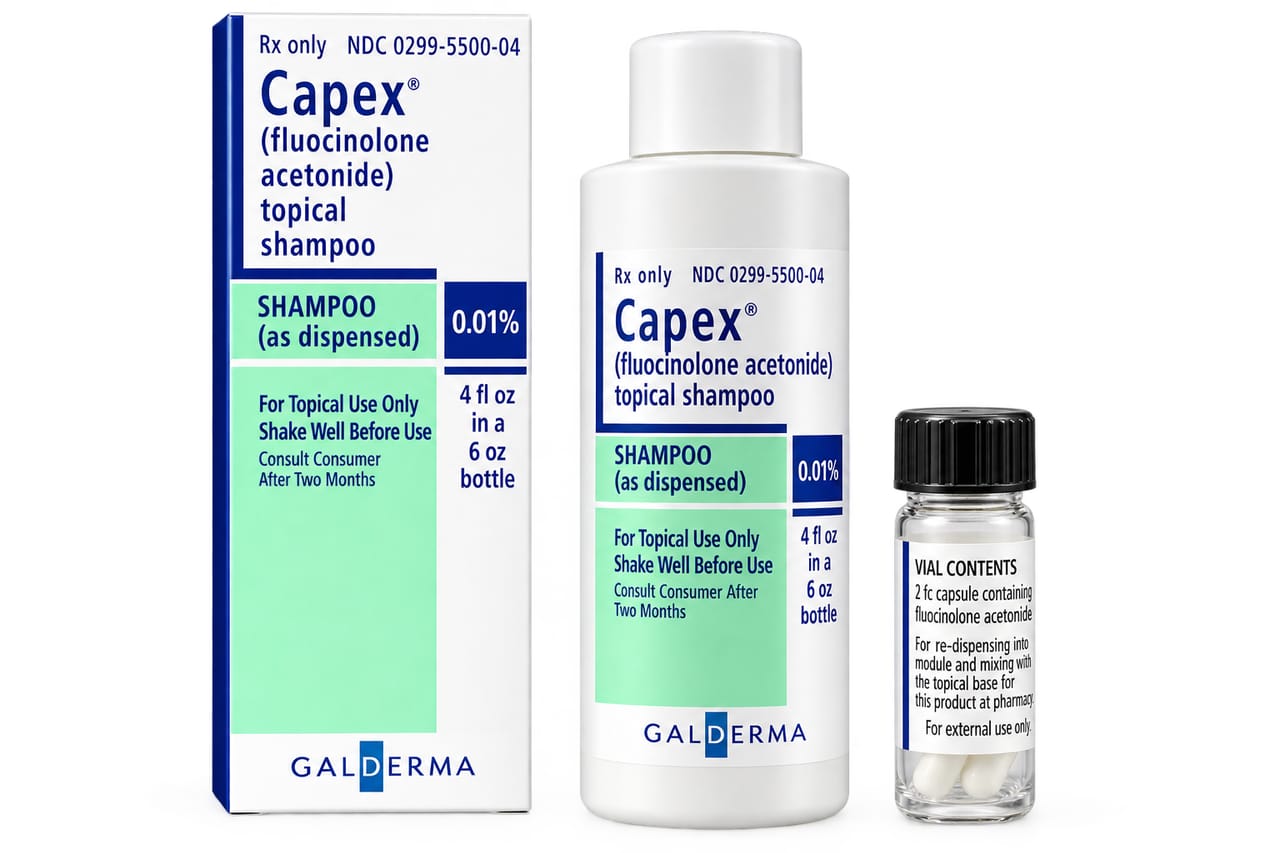
Quick overview
Capex Shampoo is a prescription medicated shampoo containing the topical corticosteroid fluocinolone acetonide. It is applied to the scalp to treat seborrheic dermatitis and to relieve related inflammation and itching. It works by reducing inflammation, narrowing blood vessels in the skin, and slowing skin cell growth, which helps control flaking and scaling.
What is Capex Shampoo
Capex Shampoo is a prescription medicated shampoo containing the topical steroid fluocinolone acetonide. It is used on the scalp to treat a skin condition called seborrheic dermatitis.
Capex Shampoo uses
- Treatment of seborrheic dermatitis of the scalp
- Relief of inflammation and itching associated with skin conditions such as moderate-to-severe allergic dermatitis, eczema, and seborrheic dermatitis
- Treats seborrheic dermatitis of the scalp
- Reduces scalp inflammation
- Relieves itching
- Helps reduce redness and irritation
Benefits of Capex Shampoo
- Reduces inflammation
- Relieves itching
- Controls flaking
- Provides corticosteroid anti-inflammatory activity
- Relieves itching associated with scalp inflammation
- Applied directly to affected scalp areas
- Has low-to-medium topical corticosteroid potency
How Capex Shampoo works
This medicine is a corticosteroid that reduces inflammation and itching, narrows blood vessels in the skin, and slows down the growth of skin cells, which helps reduce flaking and scaling.
Capex Shampoo dosage
Shake the shampoo well before using. Apply the shampoo to wet hair and scalp, work it into a lather, and leave it on the scalp for at least 5 minutes before rinsing thoroughly with water. Use this medicine on the scalp only; it is for external use. Do not bandage or cover the treated scalp area unless your doctor tells you to. Avoid getting the shampoo in your eyes; if contact occurs, rinse your eyes well with water. Do not apply this medicine to the face, groin, or underarm areas. If you miss a dose, use it the next time as scheduled; do not double up to make up for a missed application. Use exactly as your doctor tells you; do not use it for longer than prescribed or for a different condition.
| Age group | Dose |
|---|---|
| Under 17 years | Safety and effectiveness are not established |
| 18–39 years | Apply up to approximately 1 ounce to the scalp once daily |
| 40–64 years | Apply up to approximately 1 ounce once daily |
Available forms and strengths
- Shampoo
Side effects of Capex Shampoo
Common
- Mild skin itching, burning, peeling, or dryness
- Redness of the skin
- Skin rash
- Irritation around the mouth
- Swollen hair follicles (folliculitis)
- Changes in color of treated skin
- Blisters
- Pimples/acne
- Dry skin
- Shiny skin
Serious
- Hives, difficulty breathing, swelling of the face, lips, tongue, or throat (allergic reaction)
- Worsening of the skin condition
- Redness, warmth, swelling, oozing, or severe irritation of treated skin
- Increased thirst or urination, dry mouth, fruity breath odor
- Weight gain, especially in the face or upper back and torso
- Slow wound healing
- Thinning or discolored skin, easy bruising, stretch marks
- Increased body hair
- Muscle weakness
- Nausea, diarrhea, tiredness, mood changes, menstrual changes, or sexual changes
- Signs of high corticosteroid levels: blurred vision, dizziness or fainting, fast or irregular heartbeat, increased thirst or urination, irritability, unusual tiredness or weakness
- Bulging soft spot on the head (fontanelle) in infants
- Severe headache or vision changes in children
- Skin infection
Warnings and precautions
- Do not use this medicine if you are allergic to any of its ingredients, including possibly peanut oil in some formulations, or if you have certain skin infections caused by viruses (such as herpes simplex, chickenpox) or untreated fungal or bacterial skin infections, or tuberculous skin lesions.
- Using too much of this medicine, or using it for a long time, can increase the risk of adrenal gland problems, especially in children and people using large amounts for a long time.
- Long-term use of this topical steroid can cause the skin to thin or soften, or cause stretch marks. Stopping the medicine suddenly may cause the skin condition to come back.
- Avoid getting this medicine near or in the eyes, as it may cause glaucoma; cataracts have also been reported with corticosteroid use.
- This medicine may increase the risk of developing a skin infection.
- The safety and effectiveness of this medicine in children have not been established, and children may be more prone to side effects such as slowed growth or delayed weight gain from this class of medicine. Use in children should be limited to 4 weeks.
- This medicine should not be used during pregnancy unless the benefits outweigh the risks. Tell your doctor if you are pregnant or planning to become pregnant.
- It is not known whether this medicine passes into breast milk in amounts that could affect a nursing baby. Talk to your doctor about the best way to feed your baby if you use this medicine.
- People with kidney issues should speak with their doctor before starting this medication.
- People with liver issues should speak with their doctor before starting this medication.
- No significant direct alcohol interaction is established.
- Topical Capex is not expected to impair driving.
Storage
- Store at room temperature between 68°F to 77°F (20°C to 25°C).
- Keep the bottle tightly closed.
- Protect from light and moisture.
- Keep out of the reach of children.
- Throw away (discard) the bottle after 2 months, even if there is medicine left in it.
- Do not dispose of medications in wastewater (e.g. down the sink or in the toilet) or in household garbage; ask your pharmacist how to dispose of medicines that are no longer needed or have expired.
When to see a doctor
- Stop using this medicine and get medical help right away if you develop a skin rash, burning, stinging, swelling, or irritation on the treated skin.
- Get medical help right away if you have symptoms of a serious allergic reaction, such as difficulty breathing, dizziness, itching, rash, or swelling.
- Seek immediate medical attention for bulging of the soft spot on an infant's head, or for severe headache or vision changes in children.
- Get medical help right away if you notice signs of high corticosteroid levels in the blood, such as tiredness, increased thirst and urination, irritability, or muscle weakness.
- Seek medical care immediately for serious eye symptoms such as sudden vision loss, blurred vision, tunnel vision, eye pain or swelling, or seeing halos around lights.
- Seek medical care immediately for serious heart symptoms such as a fast, irregular, or pounding heartbeat, fluttering in the chest, shortness of breath, or sudden dizziness or fainting.
- Seek medical care immediately for a severe headache, confusion, slurred speech, arm or leg weakness, trouble walking, loss of coordination, feeling unsteady, very stiff muscles, high fever, profuse sweating, or tremors.
- If someone has used too much of this medicine, contact a doctor or your local poison control center immediately.
Alternatives
- Ketoconazole shampoo
- Ciclopirox shampoo
- Selenium sulfide shampoo
- Zinc pyrithione shampoo
Watch the video
FAQs
What is Capex Shampoo used for?
Capex Shampoo is used to treat seborrheic dermatitis of the scalp and to relieve related inflammation and itching, as well as conditions like moderate-to-severe allergic dermatitis and eczema.
How do you use Capex Shampoo?
Shake well, apply to wet hair and scalp, lather, and leave on for at least 5 minutes before rinsing thoroughly. It is for external scalp use only and should not be used on the face, groin, or underarm areas.
What are the common side effects of Capex Shampoo?
Common side effects include mild skin itching, burning, peeling, or dryness, redness, skin rash, irritation around the mouth, folliculitis, changes in skin color, blisters, acne, and shiny skin.
Can children use Capex Shampoo?
Safety and effectiveness in children under 17 have not been established, and if used, treatment should be limited to 4 weeks because children may be more prone to side effects like slowed growth.
How should Capex Shampoo be stored?
Store at room temperature between 68°F to 77°F, keep the bottle tightly closed, protect from light and moisture, and discard after 2 months even if medicine remains.
General information, not medical advice
Your prescriber and the leaflet in your pack know your situation. This page does not.
- Follow your prescriber and the leaflet
- Don't start, stop, or change a dose on your own
- Doses and warnings differ by country and product
Sources
Video
Related medicines
Westcort Cream: Uses, Dosage, Side Effects, Precautions and Alternates
Corticosteroids, Topical
Westcort Cream (hydrocortisone valerate) treats eczema, dermatitis, and psoriasis by reducing skin inflammation, itching, and redness. Learn dosage, uses, and
Lidex Cream: Uses, Dosage, Side Effects, Precautions and Alternates
Corticosteroids, Topical
Lidex Cream (fluocinonide) is a strong topical steroid for eczema, dermatitis, and psoriasis. Learn dosage, side effects, and precautions here.