
Safety
General information, not medical advice
Your prescriber and the leaflet in your pack know your situation. This page does not.
- Follow your prescriber and the leaflet
- Don't start, stop, or change a dose on your own
- Doses and warnings differ by country and product
Ciclesonide Inhaler: Uses, Dosage, Side Effects, Precautions and Alternates
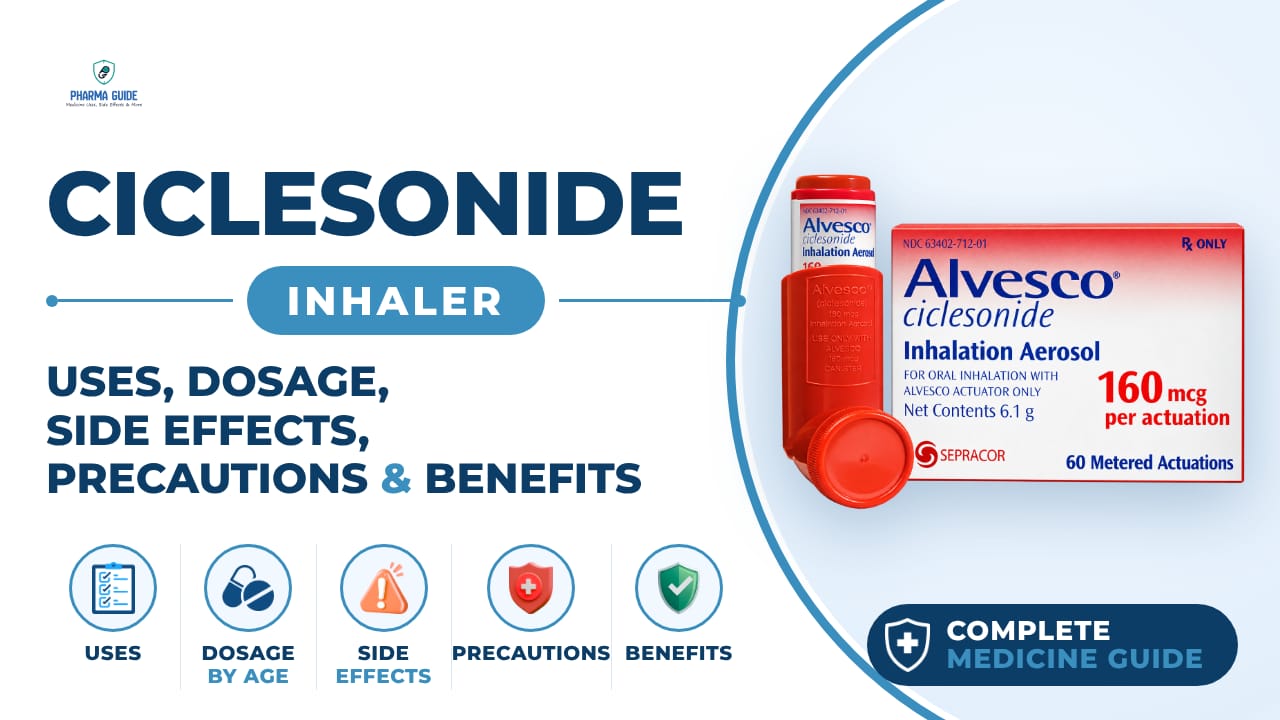
| Generic name | ciclesonide |
|---|---|
| Drug class | Corticosteroid for oral inhalation (inhaled corticosteroid) |
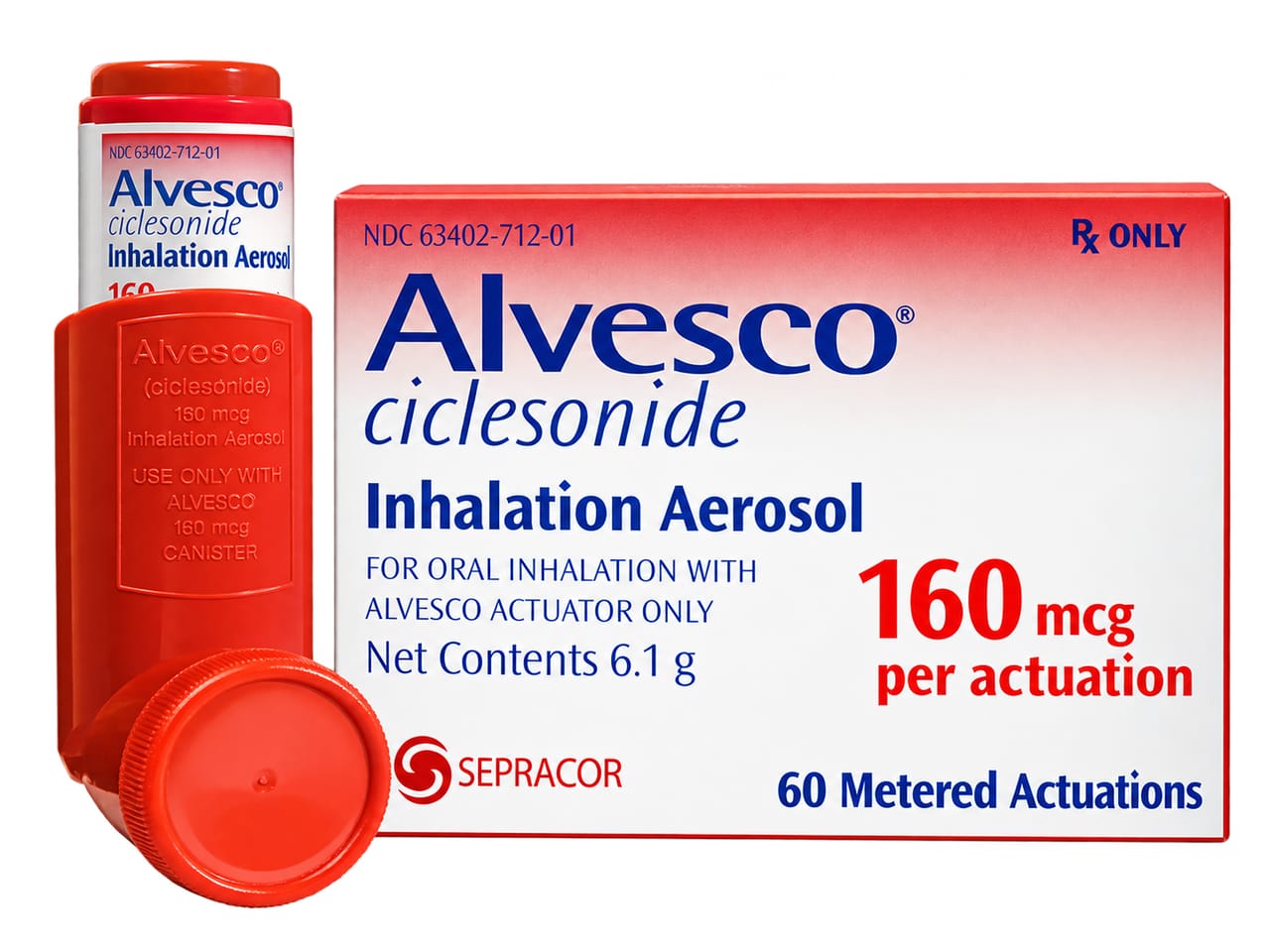
| Forms | Inhalation aerosol (metered dose inhaler), available in strengths of 50, 100, and 200 micrograms per actuation (Canadian product) or 80 and 160 micrograms per actuation (US product) |
Quick overview
Ciclesonide Inhaler (ciclesonide) is a corticosteroid for oral inhalation used as a daily preventive treatment for asthma. It is not a rescue medicine and will not stop a sudden asthma attack. It works by reducing swelling and irritation in the airways of the lungs after being activated by enzymes in the lungs. It is used in adults, teenagers, and children six years of age and older, depending on the product.
What is Ciclesonide Inhaler
This medicine is a man-made corticosteroid that you breathe in using an inhaler. It is used every day to help prevent asthma symptoms by reducing swelling and irritation in the airways of the lungs. It is not a quick-relief medicine and will not stop a sudden asthma attack.
Ciclesonide Inhaler uses
- Daily preventive treatment of asthma in adults, teenagers, and children 6 years of age and older (Canadian product)
- Maintenance treatment of asthma in adults and adolescents 12 years of age and older (US product)
- Controls persistent asthma
- Reduces airway inflammation
- Helps prevent wheezing
- Helps prevent shortness of breath
- Reduces the frequency of asthma symptoms
Benefits of Ciclesonide Inhaler
- Helps control asthma symptoms with regular daily use
- Can improve breathing tests (like lung function) over time
- May reduce how often asthma flares up
- May reduce the need for fast-acting rescue inhalers
- Provides long-term asthma control
- Reduces airway inflammation
How Ciclesonide Inhaler works
The medicine itself is inactive. After you breathe it in, enzymes in the lungs change it into an active form. This active form attaches to receptors in the lungs and reduces swelling and irritation in the airways, which are involved in asthma.
Ciclesonide Inhaler dosage
This medicine is for breathing in through the mouth only — do not swallow it or use it any other way. Use it every day at regular times, even when you have no symptoms, because it works to prevent attacks rather than treat them. Do not use it to treat a sudden asthma attack — keep a fast-acting rescue inhaler with you for sudden breathing problems.
If your inhaler is new or has not been used for a week or more, spray it three times into the air before using your dose. You do not need to shake the inhaler before use since it is a solution, not a suspension.
To use the inhaler: remove the cap, place the mouthpiece in your mouth and close your lips around it, breathe in slowly and deeply while pressing down on the top of the inhaler, move the inhaler away from your mouth, hold your breath for about 10 seconds or as long as comfortable, then breathe out slowly without breathing into the inhaler.
Rinse and gargle with water after each use and spit it out without swallowing, to help prevent mouth and throat infections. Clean the mouthpiece once a week with a dry tissue or cloth, both inside and out — do not wash it or put it in water.
If you miss a dose, just take your next dose at the regular time — do not take a double dose. Do not stop using this medicine suddenly, even if you feel better — your doctor will tell you how to reduce the dose slowly if needed. If you do not notice improvement within one to two weeks, talk to your doctor.
| Age group | Dose |
|---|---|
| Under 12 years | Safety and effectiveness are not established for Alvesco; no standard labeled dose |
| 12–17 years | Usually 80 mcg twice daily |
| 18–39 years | Usually 80 mcg twice daily |
| 40–64 years | Usually 80 mcg twice daily; maximum labeled dose may reach 320 mcg twice daily |
Available forms and strengths
Inhalation aerosol (metered dose inhaler), available in strengths of 50, 100, and 200 micrograms per actuation (Canadian product) or 80 and 160 micrograms per actuation (US product).
Side effects of Ciclesonide Inhaler
Common
- Hoarseness or difficulty speaking
- Cough after inhaling
- Nausea or vomiting
- Fungal infection in the mouth (thrush)
- Headache
- Bad taste, burning, inflammation, irritation, or dryness of the mouth or throat
- Skin rash or eczema
- Sore throat or tongue
- Nasal and throat swelling (nasopharyngitis)
- Sinus swelling (sinusitis)
- Joint pain
- Nasal congestion
- Pain in arms, legs, or back
Serious
- Sudden wheeziness and chest pain or tightness shortly after using the inhaler
- Swelling of eyelids, face, lips, tongue, or throat (allergic reaction)
- Lumpy skin rash or hives anywhere on the body
- Irregular heartbeat (palpitations)
- High blood pressure
- Abdominal discomfort or pain
- Signs of adrenal insufficiency such as tiredness, weakness, dizziness, nausea, or vomiting that does not go away
- Eye problems such as increased eye pressure, glaucoma, or cataracts
- Reduced growth rate in children
- Decreased bone density
Warnings and precautions
- This medicine must be taken every day as directed by your doctor — it is a preventive treatment, not a rescue medicine for sudden asthma attacks.
- Do not stop this medicine suddenly. The dose must be reduced gradually under a doctor's supervision.
- Do not use this medicine if you have an untreated fungal, bacterial, or tuberculosis infection in the lungs or airways.
- People switching from steroid tablets to this inhaler need careful monitoring, as deaths from adrenal gland problems have happened during this kind of switch.
- This medicine may cause thrush (a fungal infection) in the mouth and throat. Rinsing your mouth with water after each use can help prevent this.
- Taking this medicine can occasionally cause sudden wheezing right after a dose (called paradoxical bronchospasm). If this happens, use your fast-acting rescue inhaler right away and tell your doctor.
- People taking medicines that weaken the immune system are more likely to get infections. Chickenpox and measles can be more serious or even fatal in people on corticosteroids who haven't had these illnesses before.
- Long-term use at high doses may increase the chance of eye problems such as cataracts or glaucoma, slowed growth in children, and thinning of the bones.
- This medicine is only meant for the person it was prescribed for. Never share it with someone else, even if they have similar symptoms.
- There isn't enough research on using this medicine during pregnancy. Because very little of the drug reaches the blood, the risk to the baby is thought to be low, but you should only use it if your doctor decides the benefit is greater than the risk.
- It is not known whether this medicine passes into breast milk in humans. It should only be used while breastfeeding if your doctor decides the benefit to you outweighs any possible risk to your baby.
- No dose change is needed for people with kidney problems, though specific studies in this group have not been done.
- People with severe liver disease may absorb more of the medicine into their body and should be watched for side effects, although no dose change is usually needed.
Storage
- Store at room temperature between 15°C and 25°C (or up to 30°C for the US product)
- Do not freeze
- Do not puncture or burn the canister, as it contains pressurized liquid
- Do not store near heat or open flame; temperatures above 50°C (or 120°F) may cause the canister to burst
- Do not throw the canister into a fire or incinerator
- Keep out of reach of children
- Safely throw away medicine that is out of date or no longer needed
When to see a doctor
- Get medical help right away if your breathing suddenly gets worse or you start wheezing badly shortly after using your rescue inhaler or this medicine.
- Seek help if your fast-acting relief medicine doesn't work within 10 minutes, or the relief doesn't last at least 3 hours.
- Seek help if your peak flow meter reading is less than 60 percent of your predicted or personal best value.
- Seek help if you are short of breath even while resting, or if your pulse is faster than 120 beats per minute.
- Contact your doctor if your asthma symptoms get worse, such as more coughing, wheezing, chest tightness, or waking up at night with breathing problems, or if you're using your rescue inhaler more often.
- Stop using this medicine and contact your doctor immediately if you have signs of an allergic reaction, such as swelling of the eyelids, face, lips, tongue, or throat, or a lumpy skin rash (hives).
- Call your doctor right away or go to the nearest hospital emergency department if you accidentally take more than the maximum recommended daily dose.
Alternatives
- Budesonide
- Fluticasone
- Beclomethasone
Watch the video
FAQs
What is Ciclesonide Inhaler used for?
It is used as a daily preventive treatment for asthma in adults, teenagers, and children six years of age and older, depending on the product. It helps control persistent asthma, reduces airway inflammation, and helps prevent wheezing and shortness of breath.
Is Ciclesonide Inhaler a rescue inhaler?
No, it is not a rescue medicine and will not stop a sudden asthma attack. It is a preventive treatment used daily, and a fast-acting rescue inhaler should be kept on hand for sudden breathing problems.
How do I use Ciclesonide Inhaler correctly?
Breathe it in through the mouth only, using it every day at regular times. If the inhaler is new or unused for a week or more, spray it three times into the air first. After use, rinse and gargle with water and spit it out to help prevent mouth and throat infections.
What are the common side effects of Ciclesonide Inhaler?
Common side effects include hoarseness, cough after inhaling, nausea or vomiting, thrush, headache, bad taste or dryness of the mouth or throat, skin rash, sore throat, nasal congestion, and joint or body pain.
Can I stop using Ciclesonide Inhaler suddenly?
No, you should not stop this medicine suddenly even if you feel better. Your doctor will tell you how to reduce the dose slowly if needed.
General information, not medical advice
Your prescriber and the leaflet in your pack know your situation. This page does not.
- Follow your prescriber and the leaflet
- Don't start, stop, or change a dose on your own
- Doses and warnings differ by country and product
Sources
Video
Related medicines

Injectafer Injection: Uses, Dosage, Side Effects, Precautions and Alternates
Iron products
Injectafer (ferric carboxymaltose) treats iron deficiency anemia and heart failure-related iron deficiency via IV. Learn uses, dosage, side effects, and

Gliclazide Tablet: Uses, Dosage, Side Effects, Precautions and Alternates
Sulfonylurea (hypoglycemic/antidiabetic agent)
Gliclazide Tablet is a sulfonylurea for type 2 diabetes that boosts insulin release. Learn about dosage, side effects, warnings, and precautions.