
Safety
General information, not medical advice
Your prescriber and the leaflet in your pack know your situation. This page does not.
- Follow your prescriber and the leaflet
- Don't start, stop, or change a dose on your own
- Doses and warnings differ by country and product
Clotrimazole Vaginal Tablet: Uses, Dosage, Side Effects, Precautions and Alternates
| Generic name | Clotrimazole |
|---|---|
| Drug class | Antifungal (imidazole) |
| Forms | Vaginal tablet, Vaginal cream |
Quick overview
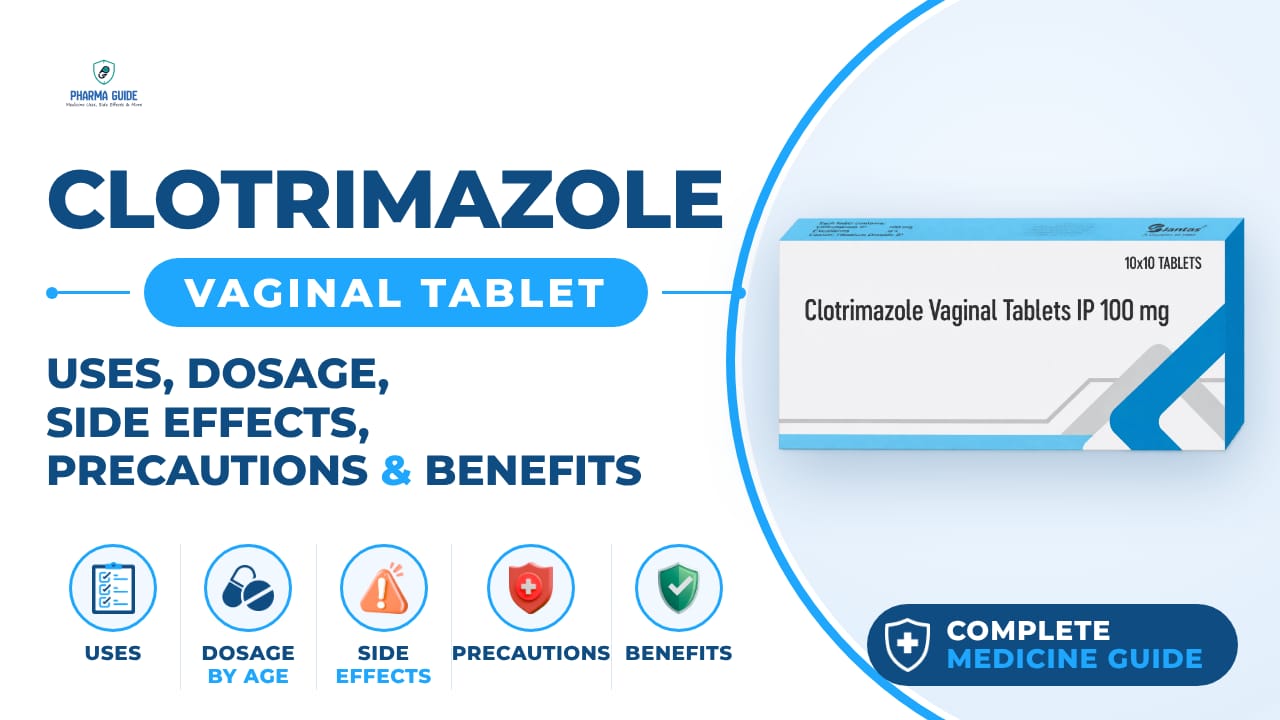
Clotrimazole Vaginal Tablet is an antifungal medicine from the imidazole class, used to treat vaginal yeast infections (vaginal candidiasis). It works by damaging the outer covering of yeast cells, stopping their growth and clearing the infection. It is used in the vagina only and is available in different strengths and treatment lengths, with common side effects including local irritation and important precautions around pregnancy and vaginal product use.
What is Clotrimazole Vaginal Tablet
Clotrimazole is an antifungal medicine used to treat vaginal yeast infections. It comes in different vaginal cream/tablet strengths and treatment lengths, and may also be used as a cream around the outside of the vagina to relieve irritation.
Clotrimazole Vaginal Tablet uses
- Treats vaginal yeast infections (vaginal candidiasis)
- Relieves external irritation and itching caused by a vaginal yeast infection
Benefits of Clotrimazole Vaginal Tablet
- Can cure most vaginal yeast infections
- Helps relieve itching, burning, and discomfort caused by a yeast infection
How Clotrimazole Vaginal Tablet works
Clotrimazole damages the outer covering of the yeast cells, stopping them from growing and eventually killing them, which clears up the infection.
Clotrimazole Vaginal Tablet dosage
This medicine is for use in the vagina only; do not take it by mouth. Wash your hands before and after use, and read the package directions carefully before using. Unwrap the tablet and place it in the applicator, then lie on your back and gently insert the applicator high in the vagina before pushing the plunger to release it. Wash the applicator with warm water and soap after use, or throw it away if it is disposable.
Use at regular intervals and finish the full course even if you feel better. Do not stop using this medicine if your period starts during treatment; treatment should be finished before your period begins. It is best to avoid vaginal intercourse and not use tampons, douches, or spermicides during treatment, since tampons may absorb the medicine and this medicine may weaken condoms or diaphragms. Wearing clean cotton underwear (not synthetic) may help clear the infection.
Talk to your pediatrician about use in children; it may be prescribed for girls as young as 12 years for certain conditions. This medicine is only for you; do not share it with others.
| Age group | Dose |
|---|---|
| Under 12 years | Not routinely recommended; medical assessment required |
| 12–17 years | Use under medical guidance; regimen depends on product strength |
| 18–64 years | 100 mg nightly for 6–7 nights, 200 mg nightly for 3 nights, or 500 mg once |
| 65+ years | Generally the adult regimen after medical assessment |
Available forms and strengths
- Vaginal tablet (100 mg, 200 mg, or 500 mg)
- Vaginal cream
Side effects of Clotrimazole Vaginal Tablet
Common
- Vaginal irritation, itching, or burning
- Increased burning, itching, or irritation of the vagina
Serious
- Allergic reactions like skin rash, itching or hives, swelling of the face, lips, or tongue
- Pain or trouble passing urine
- Vaginal pain
- Hives
- Stomach pain
- Fever
- Chills
- Nausea
- Vomiting
- Foul-smelling vaginal discharge
- Severe allergic reactions (swelling of face, eyes, mouth, hands and feet)
Warnings and precautions
- Do not use this medicine if you have stomach/lower abdominal pain, fever, or a bad-smelling vaginal discharge, as these could mean a more serious condition.
- Do not use tampons, vaginal douches, or other vaginal products while using this medicine.
- Yeast infections do not normally cause fever, chills, nausea, vomiting, diarrhea, back or shoulder pain, or vaginal bleeding. If you have these symptoms, or a bad-smelling discharge, see your doctor right away.
- This medicine may weaken condoms or diaphragms and reduce the effectiveness of spermicides, so do not rely on these to prevent pregnancy or sexually transmitted infections during treatment.
- Avoid getting the cream in your eyes; rinse thoroughly with water if this happens.
- Taking this medicine along with oral tacrolimus or sirolimus (immune-suppressing medicines) might raise the levels of those medicines in the blood.
- Tell your doctor if you are pregnant, plan to become pregnant, or become pregnant while using this medicine. It should not be used in the first three months of pregnancy unless your doctor decides it is necessary.
- Breastfeeding should be stopped during treatment with this medicine.
Storage
- Store at room temperature below 30 degrees C (86 degrees F)
- Store between 15°C and 30°C
- Do not freeze
- Throw away any unused medicine after the expiration date
- Keep out of the reach and sight of children
When to see a doctor
- Call your doctor if your symptoms do not improve within three days or have not gone away after seven days, since you may not have a yeast infection.
- Call your doctor if your symptoms get worse.
- Tell your doctor if your symptoms return within two months, or if you have frequent yeast infections.
- Tell your doctor if you think you have been exposed to HIV, the virus that causes AIDS.
- If you accidentally swallow this medicine, contact your local emergency room or poison control center right away.
- If you experience a rash or new irritation while using the product, stop use and contact your doctor.
Alternatives
- Miconazole Vaginal
- Terconazole Vaginal
- Butoconazole Vaginal
- Tioconazole Vaginal
- Fluconazole Oral
Watch the video
FAQs
What is Clotrimazole Vaginal Tablet used for?
It is used to treat vaginal yeast infections (vaginal candidiasis) and relieves external irritation and itching caused by the infection.
How is Clotrimazole Vaginal Tablet used?
It is for vaginal use only, not to be taken by mouth. The tablet is placed in an applicator and inserted high in the vagina while lying on your back, then the plunger is pushed to release it. The full course should be finished even if symptoms improve, and treatment should be completed before your period begins.
What is the adult dosage of Clotrimazole Vaginal Tablet?
For adults aged 18 to 64, the regimen is 100 mg nightly for 6 to 7 nights, 200 mg nightly for 3 nights, or 500 mg as a single dose.
Can Clotrimazole Vaginal Tablet be used during pregnancy?
You should tell your doctor if you are pregnant, plan to become pregnant, or become pregnant during treatment. It should not be used in the first three months of pregnancy unless your doctor decides it is necessary.
What should I avoid while using Clotrimazole Vaginal Tablet?
Avoid vaginal intercourse and do not use tampons, douches, or spermicides during treatment, since this medicine may weaken condoms or diaphragms and reduce spermicide effectiveness.
General information, not medical advice
Your prescriber and the leaflet in your pack know your situation. This page does not.
- Follow your prescriber and the leaflet
- Don't start, stop, or change a dose on your own
- Doses and warnings differ by country and product
Sources
Video
Related medicines

Daktarin Oral Gel: Uses, Dosage, Side Effects, Precautions and Alternates
Antifungal (imidazole)
Daktarin Oral Gel contains miconazole to treat oral thrush and fungal infections of the mouth and throat. Learn uses, dosage, side effects, and warnings.

Clotrimazole Cream: Uses, Dosage, Side Effects, Precautions and Alternates
Antifungal (imidazole)
Clotrimazole Cream treats fungal and yeast skin infections like ringworm, athlete's foot, and thrush. Learn uses, dosage, side effects, and precautions.