
Safety
General information, not medical advice
Your prescriber and the leaflet in your pack know your situation. This page does not.
- Follow your prescriber and the leaflet
- Don't start, stop, or change a dose on your own
- Doses and warnings differ by country and product
Cocois Ointment: Uses, Dosage, Side Effects, Precautions and Alternates
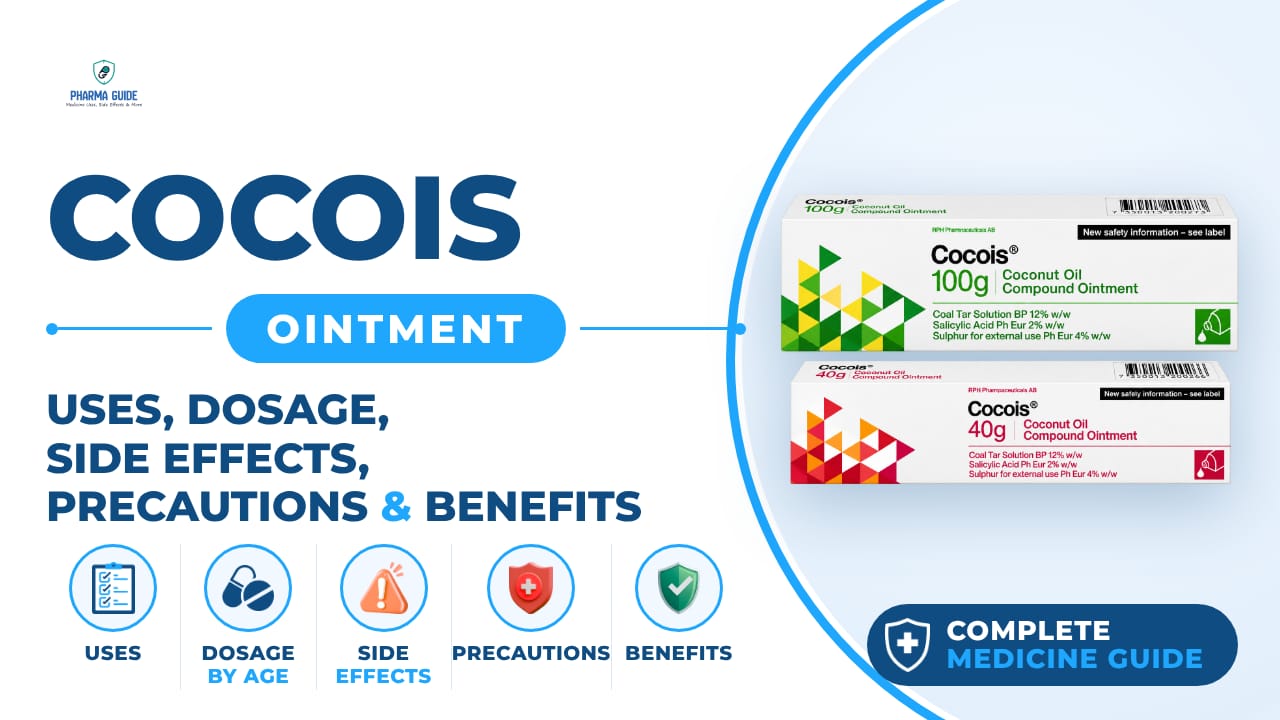
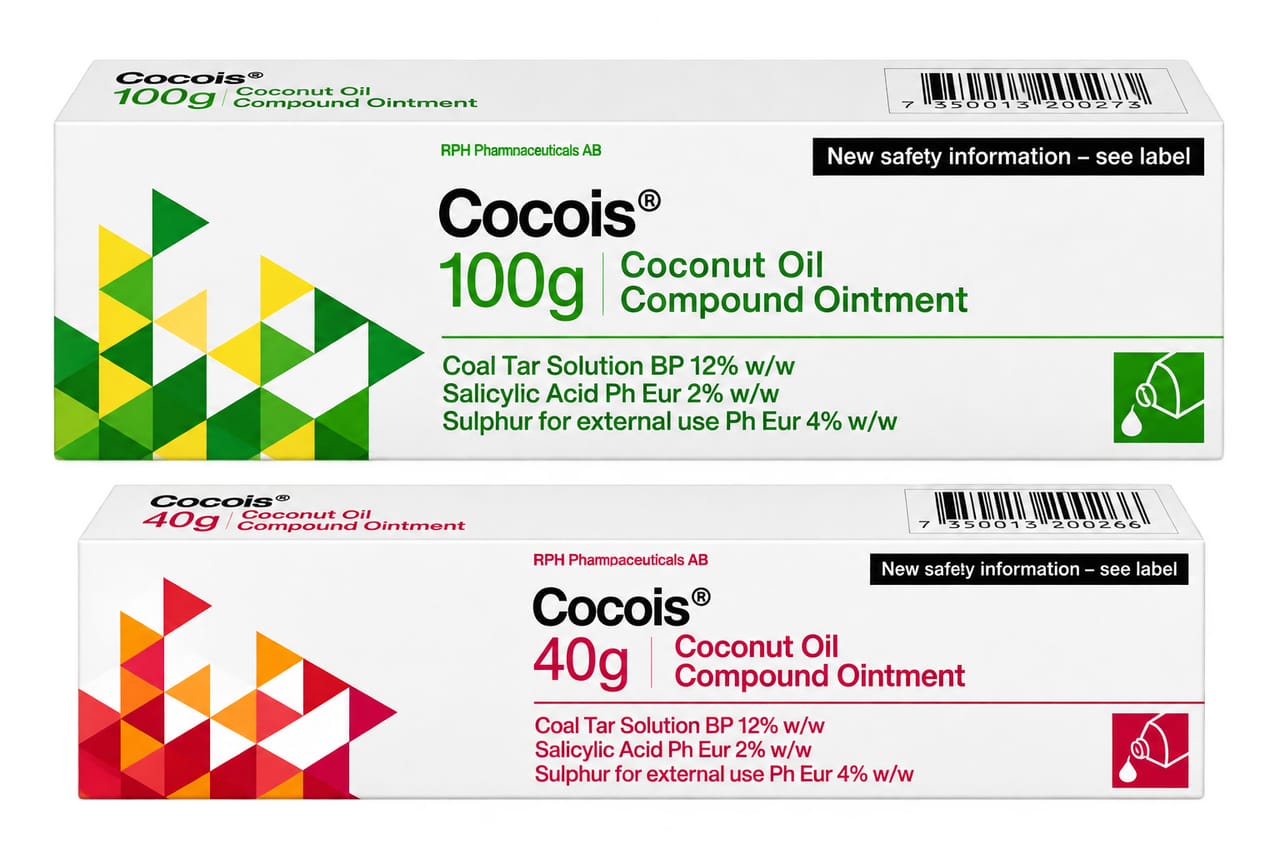
| Generic name | Coal tar solution, salicylic acid and sulphur |
|---|---|
| Drug class | Antipruritic, antiseptic and keratolytic |
| Forms | Ointment (scalp application with applicator nozzle), 100g tube |
Quick overview
Cocois Ointment contains coal tar, salicylic acid and sulphur in a coconut oil base, and works as an antipruritic, antiseptic and keratolytic. It is used to treat irritation, itching and scaling of the scalp caused by conditions such as psoriasis, eczema, seborrhoeic dermatitis or dandruff. The ointment is applied directly to the scalp, left on for a period of time, and then washed out with shampoo.
What is Cocois Ointment
Cocois Ointment contains coal tar, salicylic acid and sulphur in a coconut oil base. It is used to treat irritation, itching and scaling of the scalp caused by conditions such as psoriasis, eczema, seborrhoeic dermatitis or dandruff.
Cocois Ointment uses
- Scalp psoriasis with thick, built-up plaques of scale
- Seborrhoeic dermatitis of the scalp with heavy, greasy scaling
- Severe or stubborn dandruff that medicated shampoos have not shifted
- Scaly scalp eczema where dead skin has become compacted
- Mild dandruff, used once a week as needed
Benefits of Cocois Ointment
- Helps treat scalp psoriasis and reduce thick, scaly patches.
- Helps control dandruff and seborrheic dermatitis.
- Helps relieve itching and scalp irritation.
- Salicylic acid helps loosen and remove stubborn scales and dead skin.
- Coal tar and sulphur help reduce excessive skin thickening and scaling.
- Has mild antiseptic and antifungal properties, which may help improve certain scaly scalp conditions.
How Cocois Ointment works
Cocois combines three ingredients that work together on the scalp: coal tar and sulphur reduce inflammation and excessive scaling of the skin and have mild antiseptic effects, while salicylic acid softens and helps lift away built-up scale so it can be washed off and other treatments can reach the skin.
Cocois Ointment dosage
Wash your hands before and after use. Apply to dry hair, working section by section, placing the ointment directly on the affected areas of scalp, not on the hair itself. Gently massage the ointment into the scale with your fingertips rather than picking or scratching at plaques.
Leave the ointment on the scalp for about an hour; for thicker scale it can be left on longer or overnight under a shower cap. Wash out thoroughly with a mild shampoo and warm water; you may need to shampoo twice to remove the oily base.
For severe scaling, apply daily for three to seven days then reduce to once weekly as maintenance; for milder scaling, use about once a week. Avoid contact with the eyes and mouth.
Not recommended for children aged 12 or under in some product information, while other sources allow use from age 6 with medical supervision between ages 6 to 12; follow your product's specific age guidance. If you forget a dose, apply it as soon as you remember and continue as before.
| Age group | Dose |
|---|---|
| Under 6 years | Generally not recommended unless specifically advised by a doctor |
| 6–11 years | Use only under medical supervision |
| 12–17 years | Apply a thin layer to affected scalp areas, leave for about 1 hour, then wash out with shampoo |
| 18–64 years | Apply a thin layer once daily to affected scalp areas, usually leave for about 1 hour, then shampoo out |
| 65+ years | Same general use; use cautiously if the scalp is fragile or irritated |
Available forms and strengths
- Ointment (scalp application with applicator nozzle), 100g tube
Side effects of Cocois Ointment
Common
- Skin irritation (stinging or redness)
- Inflammation of the hair follicles (folliculitis)
- Acne-like eruptions or rash
- Hair loss
- Discolouration of skin or hair
Serious
- Sensitivity to sunlight (rare)
- Difficulty breathing or chest tightness in people with asthma or a family history of aspirin allergy (very rare)
Warnings and precautions
- Do not use on broken, infected or acutely inflamed skin.
- Do not use if you have a form of psoriasis that causes pus-filled blisters (pustular psoriasis).
- For external use only. Do not swallow, and avoid contact with the eyes and mouth.
- The ointment may be flammable. Avoid smoking or naked flames while using it, as fabric that has come into contact with the ointment can catch fire more easily.
- The ointment can stain clothing, bedding and jewellery, and may discolour blonde, grey or dyed hair.
- Coal tar can make treated skin more sensitive to sunlight, so avoid strong sun on the scalp during treatment and wear a hat outdoors.
- If you have asthma or a family history of aspirin allergy, speak to a doctor or pharmacist before use, as it may irritate the airways.
- Speak to a doctor or pharmacist before using this ointment if you have recently stopped taking or are currently taking any other prescription or non-prescription medication, including other topical scalp treatments.
- Cocois should not be used during pregnancy, and some product information specifically warns against use in the last three months of pregnancy. Speak to your doctor or pharmacist about treatment options if you are pregnant and have scalp scaling.
- Cocois should not be used while breastfeeding. Speak to your doctor or pharmacist about other treatment options.
- No specific kidney-related dose adjustment is listed for normal topical use, but avoid excessive or prolonged application without medical advice.
- No specific liver-related precautions are listed for normal topical use.
- There are no known issues with drinking alcohol while using this ointment.
- Does not affect the ability to drive or operate machinery.
Storage
- Store below 25°C (77°F) or as directed on the product label.
- Keep in a cool, dry place away from excessive heat.
- Protect from direct sunlight and extreme temperatures.
- Keep the tube or container tightly closed after each use.
- Do not freeze and avoid storing in very hot areas.
- Keep out of reach of children.
When to see a doctor
- Seek urgent medical attention if you develop widespread pus-filled spots on the scalp or body, a fever with a rapidly spreading red rash, or signs of scalp infection such as swelling, weeping or severe pain.
- If you develop side effects such as irritation, stop using the ointment straight away, wash your scalp with warm water, and speak to a doctor or pharmacist if symptoms do not improve.
- If your condition does not improve after the first week of use, or symptoms persist after four weeks, consult your doctor.
- If you think you or anyone else has swallowed this ointment, contact your doctor or your local poison control centre immediately for advice, or go to your nearest emergency department.
Alternatives
- Salicylic Acid Scalp Preparations
- Ketoconazole Shampoo
- T/Gel Shampoo
- Polytar Shampoo
- Capasal Therapeutic Shampoo
Watch the video
FAQs
What is Cocois Ointment used for?
It is used to treat irritation, itching and scaling of the scalp caused by conditions such as psoriasis, eczema, seborrhoeic dermatitis or dandruff.
How do you use Cocois Ointment?
Apply it to dry hair directly on the affected scalp areas, not the hair itself, massage in gently, leave on for about an hour (longer or overnight for thicker scale), then wash out thoroughly with a mild shampoo, shampooing twice if needed to remove the oily base.
What are the side effects of Cocois Ointment?
Common side effects include skin irritation, folliculitis, acne-like eruptions or rash, hair loss, and discolouration of skin or hair. Rarely, it can cause sensitivity to sunlight or breathing difficulty in people with asthma or aspirin allergy.
Can Cocois Ointment be used during pregnancy?
Cocois should not be used during pregnancy, and some product information specifically warns against use in the last three months of pregnancy, so speak to your doctor about treatment options.
Can children use Cocois Ointment?
It is generally not recommended for children aged 12 or under in some product information, while other sources allow use from age 6 with medical supervision between ages 6 to 12, so follow your product's specific age guidance.
General information, not medical advice
Your prescriber and the leaflet in your pack know your situation. This page does not.
- Follow your prescriber and the leaflet
- Don't start, stop, or change a dose on your own
- Doses and warnings differ by country and product
Sources
- electronic medicines compendium (emc). Cocois Ointment — Summary of Product Characteristics.
- NICE Clinical Knowledge Summaries. Psoriasis: management of scalp psoriasis. 2025.
- NICE Clinical Knowledge Summaries. Seborrhoeic dermatitis. 2025.
- British National Formulary. Coal tar with salicylic acid and precipitated sulfur.
- Psoriasis Association. Scalp psoriasis.
- Cocois Ointment Patient Information Leaflet.
Video
Related medicines

Injectafer Injection: Uses, Dosage, Side Effects, Precautions and Alternates
Iron products
Injectafer (ferric carboxymaltose) treats iron deficiency anemia and heart failure-related iron deficiency via IV. Learn uses, dosage, side effects, and

Gliclazide Tablet: Uses, Dosage, Side Effects, Precautions and Alternates
Sulfonylurea (hypoglycemic/antidiabetic agent)
Gliclazide Tablet is a sulfonylurea for type 2 diabetes that boosts insulin release. Learn about dosage, side effects, warnings, and precautions.