
Safety
General information, not medical advice
Your prescriber and the leaflet in your pack know your situation. This page does not.
- Follow your prescriber and the leaflet
- Don't start, stop, or change a dose on your own
- Doses and warnings differ by country and product
Comtess Tablet: Uses, Dosage, Side Effects, Precautions and Alternates
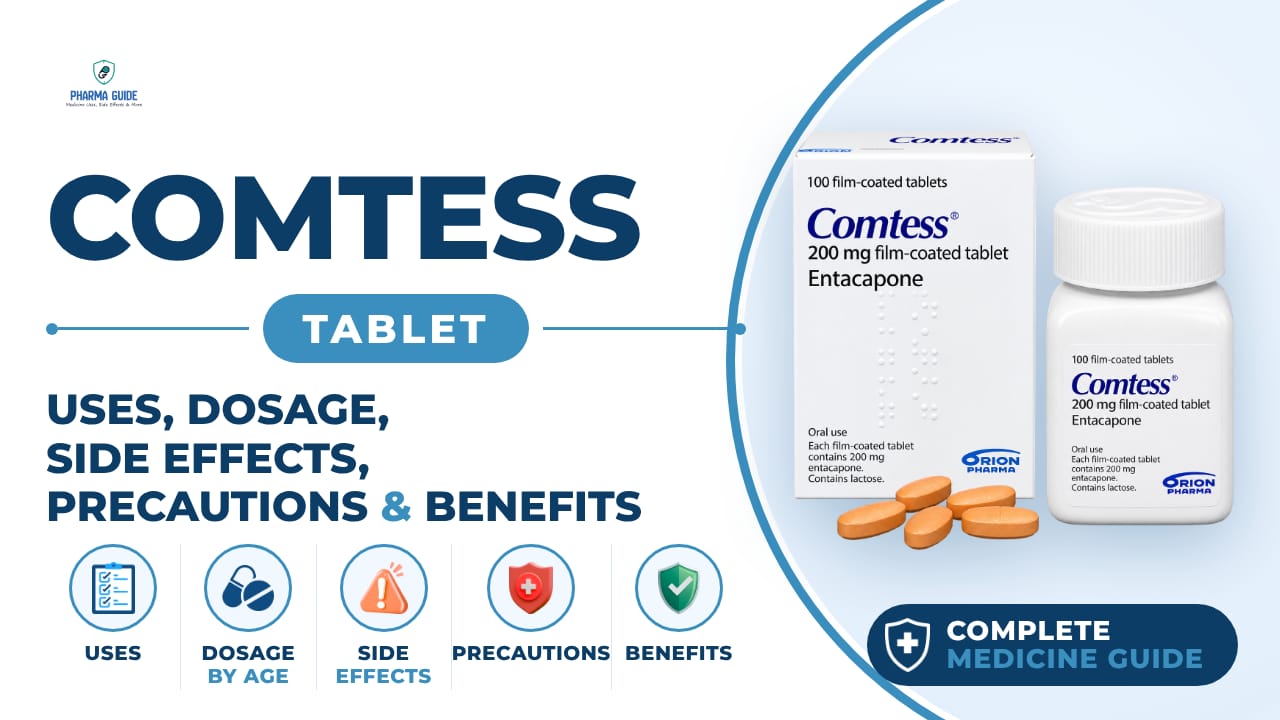
| Generic name | Entacapone |
|---|---|
| Drug class | Catechol-O-methyl transferase (COMT) inhibitor, antiparkinsonian medicinal product |
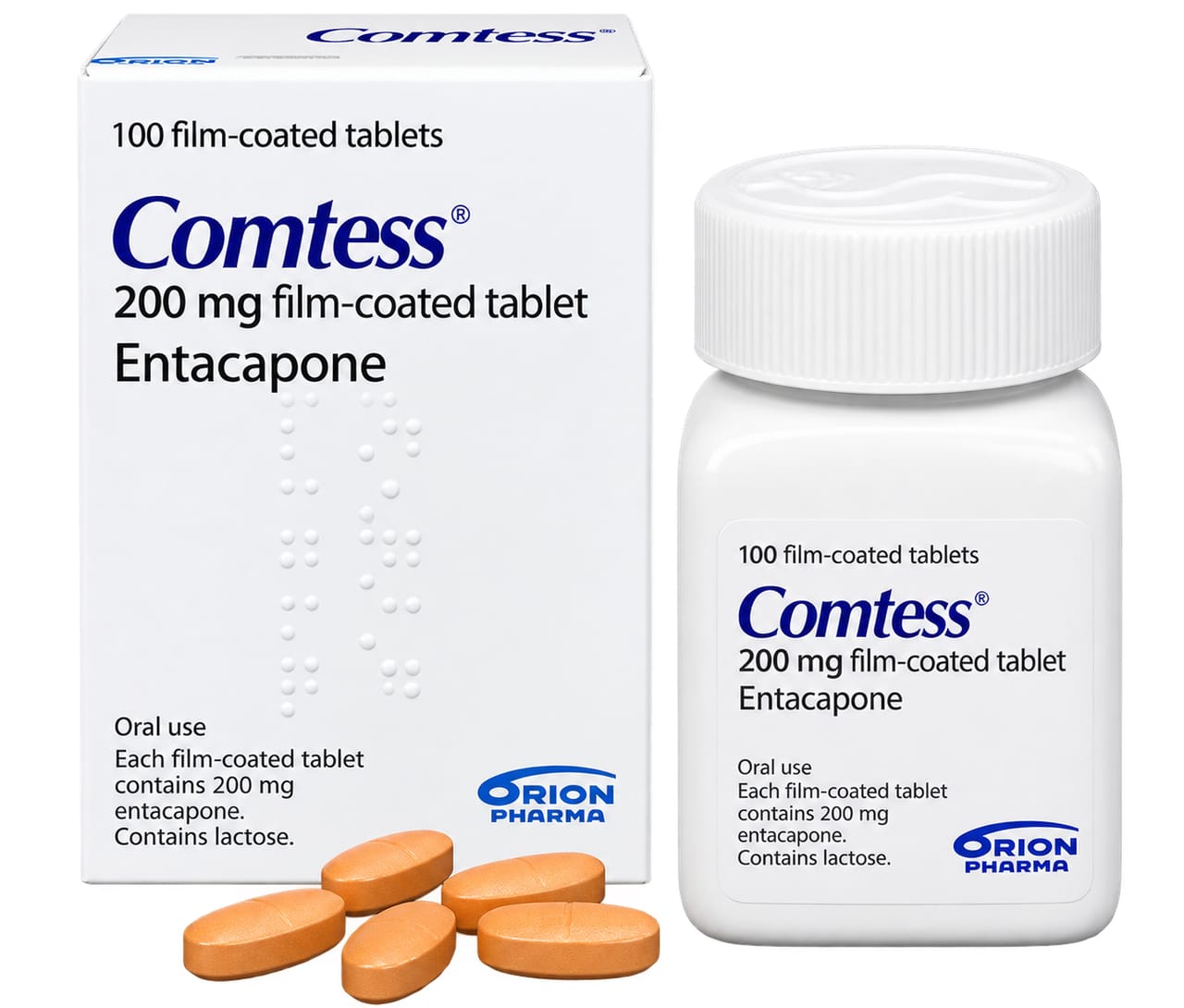
| Forms | Film-coated tablet |
Quick overview
Comtess Tablet contains entacapone, a catechol-O-methyl transferase (COMT) inhibitor used together with levodopa to treat Parkinson's disease. It has no effect on Parkinson's symptoms unless taken with levodopa. Comtess works by prolonging the effect of levodopa, helping reduce the "wearing-off" periods between doses.
What is Comtess Tablet
Comtess tablets contain entacapone and are used together with levodopa to treat Parkinson's disease. Comtess has no effect on relieving the symptoms of Parkinson's disease unless taken with levodopa.
Comtess Tablet uses
- Treats end-of-dose motor fluctuations in Parkinson's disease
- Prolongs the effect of levodopa
- Helps reduce "wearing-off" periods
- Improves control of Parkinson's motor symptoms
Benefits of Comtess Tablet
- Extends levodopa activity
- May reduce periods when Parkinson's symptoms return between doses
- Taken together with each levodopa dose
- Can improve overall motor control in appropriate patients
How Comtess Tablet works
In Parkinson's disease, dopamine levels drop in certain parts of the brain, so levodopa is given to make up for this. An enzyme breaks down part of the levodopa dose before it reaches the brain. Comtess blocks this enzyme, so more levodopa reaches the brain and levodopa's effect lasts longer.
Comtess Tablet dosage
Take one Comtess tablet together with each dose of your levodopa medicine, not on its own. It can be taken with or without food. Always take it together with a levodopa/carbidopa or levodopa/benserazide medicine; you may also take other Parkinson's medicines at the same time.
If you forget a dose, just take the next Comtess tablet with your next levodopa dose — do not take a double dose. If you are on dialysis for kidney problems, your doctor may tell you to space out your doses more. This medicine is not recommended for use in children or people under 18 because it has not been studied in this group. No dose change is needed for elderly patients.
Do not stop taking this medicine suddenly without talking to your doctor, as this can cause unwanted effects and may require adjusting your other Parkinson's medicines.
| Age group | Dose |
|---|---|
| Under 18 years | Safety and effectiveness are not established; no standard pediatric dose |
| 18–64 years | 200 mg with each levodopa dose |
| 65–74 years | Usually 200 mg with each levodopa dose; no routine age-based adjustment |
Available forms and strengths
- Film-coated tablet
Side effects of Comtess Tablet
Common
- Involuntary movements (dyskinesia)
- Nausea
- Reddish-brown discoloration of urine (harmless)
- Vomiting
- Diarrhoea
- Abdominal pain
- Constipation
- Dry mouth
- Dizziness
- Tiredness
- Increased sweating
- Falls
- Hallucinations
- Insomnia
- Vivid dreams
- Confusion
- Worsening of Parkinson's symptoms
- Excessive movements (hyperkinesia)
- Prolonged muscle cramps (dystonia)
- Heart or artery disease events such as chest pain
Serious
- Heart attack (myocardial infarction)
- Rashes and abnormal liver function test results
- Agitation, decreased appetite, weight loss, hives
- Inflammation of the colon (colitis)
- Inflammation of the liver (hepatitis) with yellowing of skin and eyes
- Discoloration of skin, hair, beard and nails
- Neuroleptic Malignant Syndrome (NMS) - stiffness, muscle twitching, shaking, agitation, confusion, coma, high body temperature, fast heart rate, unstable blood pressure
- Rhabdomyolysis (severe muscle breakdown) causing muscle pain, tenderness and weakness, which may lead to kidney problems
- Sudden excessive daytime sleepiness or sudden sleep onset
- Pathological gambling or increased sexual desire and urges
Warnings and precautions
- Do not take Comtess if you are allergic to entacapone or any ingredient, have a tumor of the adrenal gland (pheochromocytoma), are taking certain antidepressants without checking with your doctor, have liver disease, or have a history of Neuroleptic Malignant Syndrome or non-injury-related rhabdomyolysis.
- If you suddenly stop taking Comtess or other Parkinson's medicines, or reduce the dose suddenly, you can develop a rare but serious reaction called Neuroleptic Malignant Syndrome.
- If you get prolonged or persistent diarrhea, tell your doctor, as it could be a sign of bowel inflammation (colitis), and your weight should be monitored to avoid excessive weight loss.
- Tell your doctor if you notice urges to gamble excessively or unusual increases in sexual desire while on this medicine.
- If you lose your appetite, feel weak or exhausted, and lose weight quickly over a short time, your doctor should check your general health including liver function.
- Take Comtess at least 2 to 3 hours apart from iron supplements, as it can reduce how well iron is absorbed.
- Use this medicine cautiously if you have had a heart attack or other heart disease, or if you take medicines that can cause dizziness or low blood pressure on standing.
- Do not use Comtess if you are pregnant. Do not use Comtess if you are breast-feeding.
- Kidney problems do not affect how the body processes entacapone, so no dose change is usually needed. If you are on dialysis, your doctor may extend the time between doses.
- Comtess must not be used if you have liver disease.
- Alcohol may worsen dizziness or drowsiness.
- This medicine combined with levodopa can cause dizziness, low blood pressure on standing, drowsiness, or sudden sleep onset. Do not drive or use machines if you experience these effects.
Storage
- Keep out of the reach and sight of children
- Do not use after the expiry date shown on the carton and bottle label; the expiry date refers to the last day of that month
- This medicine does not require any special storage conditions
When to see a doctor
- If you take more Comtess than you should, or in case of accidental overdose, contact your doctor, pharmacist, or nearest hospital right away. Tell your doctor if any side effect becomes serious, or if you notice any side effect not mentioned in this leaflet.
- Get medical attention if you develop signs of Neuroleptic Malignant Syndrome, such as muscle stiffness, twitching, shaking, agitation, confusion, coma, high fever, fast heartbeat, or unstable blood pressure.
- Seek medical help if you develop muscle pain, tenderness, and weakness, which could be signs of a rare but serious muscle breakdown condition that may affect the kidneys.
Alternatives
- Opicapone
- Tolcapone
Watch the video
FAQs
What is Comtess Tablet used for?
Comtess Tablet contains entacapone and is used together with levodopa to treat Parkinson's disease. It has no effect on Parkinson's symptoms unless taken with levodopa, as it prolongs levodopa's effect and helps reduce wearing-off periods between doses.
How should I take Comtess Tablet?
Take one Comtess tablet together with each dose of your levodopa medicine, not on its own. It can be taken with or without food. If you forget a dose, take the next Comtess tablet with your next levodopa dose without doubling up.
What are the common side effects of Comtess Tablet?
Common side effects include involuntary movements, nausea, reddish-brown discoloration of urine, vomiting, diarrhoea, abdominal pain, constipation, dry mouth, dizziness, tiredness, increased sweating, falls, hallucinations, insomnia, vivid dreams, and confusion.
Can I take Comtess Tablet if I have liver disease?
No, Comtess must not be used if you have liver disease.
Does Comtess Tablet interact with iron supplements?
Yes, Comtess should be taken at least 2 to 3 hours apart from iron supplements, as it can reduce how well iron is absorbed.
General information, not medical advice
Your prescriber and the leaflet in your pack know your situation. This page does not.
- Follow your prescriber and the leaflet
- Don't start, stop, or change a dose on your own
- Doses and warnings differ by country and product
Sources
Video
Related medicines

Injectafer Injection: Uses, Dosage, Side Effects, Precautions and Alternates
Iron products
Injectafer (ferric carboxymaltose) treats iron deficiency anemia and heart failure-related iron deficiency via IV. Learn uses, dosage, side effects, and

Gliclazide Tablet: Uses, Dosage, Side Effects, Precautions and Alternates
Sulfonylurea (hypoglycemic/antidiabetic agent)
Gliclazide Tablet is a sulfonylurea for type 2 diabetes that boosts insulin release. Learn about dosage, side effects, warnings, and precautions.