
Safety
General information, not medical advice
Your prescriber and the leaflet in your pack know your situation. This page does not.
- Follow your prescriber and the leaflet
- Don't start, stop, or change a dose on your own
- Doses and warnings differ by country and product
Cosentyx Injection: Uses, Dosage, Side Effects, Precautions and Alternates

| Generic name | secukinumab |
|---|---|
| Drug class | Interleukin inhibitors |
| Forms | Cosentyx Sensoready pen, UnoReady pen, Cosentyx prefilled syringes, Cosentyx single-dose vial for intravenous infusion |
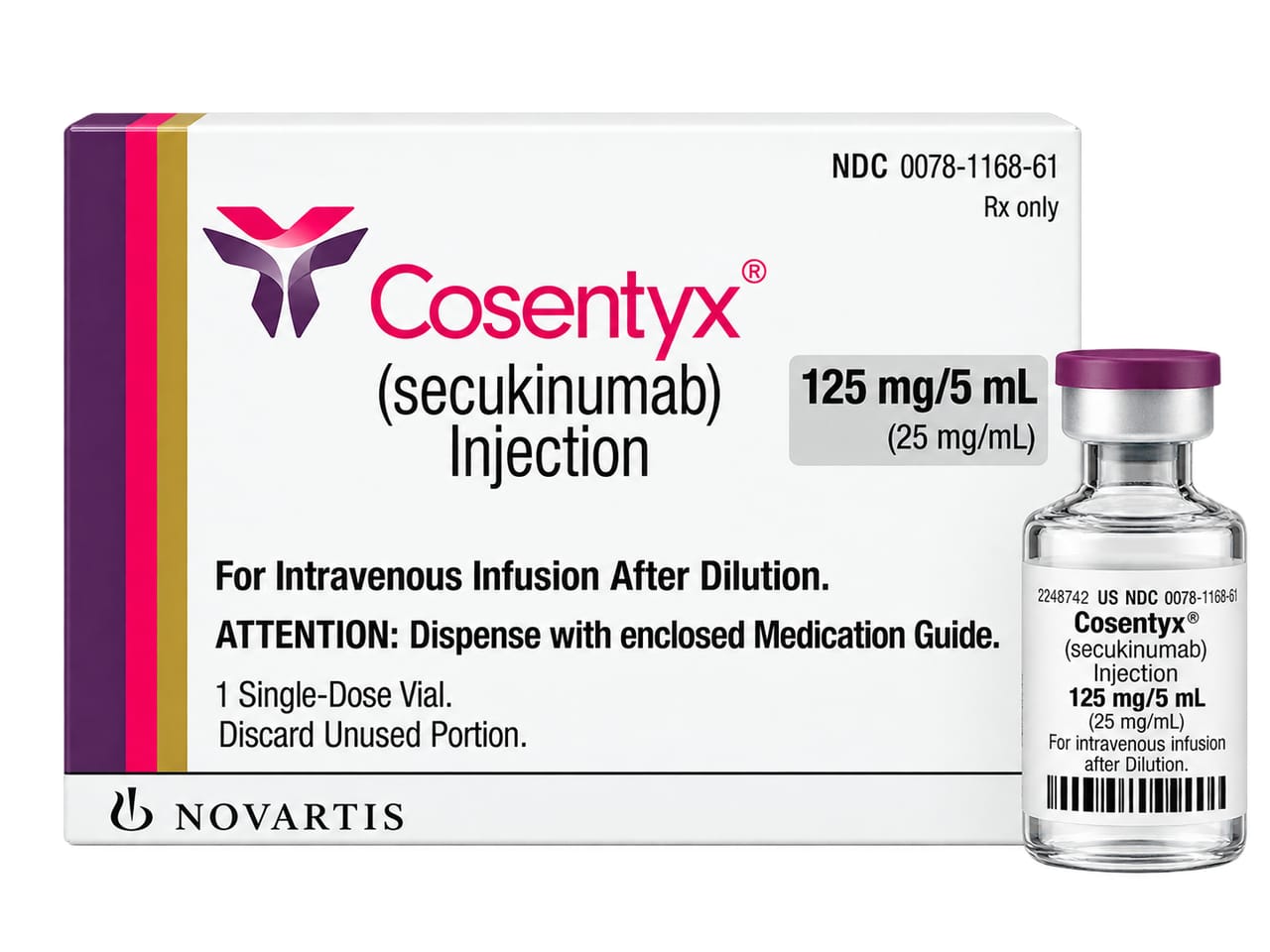
Quick overview
Cosentyx (secukinumab) is a prescription injectable medicine that belongs to the interleukin inhibitor class. It is used to treat moderate to severe plaque psoriasis, psoriatic arthritis, ankylosing spondylitis, non-radiographic axial spondyloarthritis, enthesitis-related arthritis, and moderate to severe hidradenitis suppurativa. It works by blocking a protein called IL-17A to calm an overactive immune system and reduce inflammation. It is given as a subcutaneous injection and, for certain conditions in adults, as an intravenous infusion.
What is Cosentyx Injection
Cosentyx (secukinumab) is a prescription medicine given by injection that treats plaque psoriasis, psoriatic arthritis, ankylosing spondylitis, and other long-term autoimmune conditions. It works by calming an overactive immune system to reduce inflammation.
Cosentyx Injection uses
- Moderate to severe plaque psoriasis in people 6 years and older
- Active psoriatic arthritis in people 2 years and older
- Active ankylosing spondylitis in adults and children 12 years and older
- Non-radiographic axial spondyloarthritis in adults with signs of inflammation
- Active enthesitis-related arthritis in children 4 years and older
- Moderate to severe hidradenitis suppurativa in adults and children 12 years and older
Benefits of Cosentyx Injection
- Reduces skin lesions, joint pain, swelling, and spine inflammation
- Helps control flare-ups in long-term immune-mediated conditions
- Targets the underlying cause of inflammation rather than just masking symptoms
How Cosentyx Injection works
In autoimmune diseases, the immune system makes too much of a protein called IL-17A, which causes inflammation, pain, and tissue damage. Cosentyx attaches to IL-17A and blocks it, which calms the immune system, lowers inflammation, and helps relieve symptoms.
Cosentyx Injection dosage
Cosentyx can be self-administered or given by a caregiver at home; children should not inject themselves, and an adult caregiver should be trained to give the injection. Take the pen or syringe out of the refrigerator and let it reach room temperature before use, keeping the cap on while it warms. Do not try to warm the medicine in a microwave, in hot water, or by any other method.
Prepare an injection only when you are ready to give it; some doses require two injections. The liquid should be clear or light yellow; call your pharmacist if it looks cloudy, has changed color, or has particles in it. Do not shake the syringe or injection pen.
Inject into the front of the thighs or the abdomen, avoiding the navel and the area around it; a caregiver or provider may also inject into the upper outer arm. Do not inject into the same spot two times in a row, and avoid skin that is hard, red, bruised, swollen, tender, or affected by psoriasis.
Throw away a prefilled syringe or pen after one use, even if medicine is left inside. Do not reuse a needle or syringe; place used needles and syringes in a puncture-proof sharps container. It can also be given as a slow infusion into a vein by a healthcare provider for certain conditions in adults.
Use exactly as prescribed and follow all directions on your prescription label and medication guide.
| Age group | Dose |
|---|---|
| 6–11 Years | 75–150 mg subcutaneously, depending on body weight and indication |
| 12–17 Years | 75–300 mg subcutaneously, depending on body weight and indication |
| Adults (18+ Years) | 150–300 mg subcutaneously, depending on the condition and prescribed treatment schedule |
Available forms and strengths
- Cosentyx Sensoready pen
- UnoReady pen
- Cosentyx prefilled syringes
- Cosentyx single-dose vial for intravenous infusion
Side effects of Cosentyx Injection
Common
- Diarrhea
- Upper respiratory tract infections
- Cold symptoms such as a stuffy nose, sneezing, and sore throat
Serious
- Serious infections, including tuberculosis and infections from bacteria, fungi, or viruses
- Severe allergic reactions
- Skin rashes that look like eczema, sometimes needing hospital care
- Worsening of inflammatory bowel disease (Crohn's disease or ulcerative colitis)
- Reactivation of hepatitis B in people who have had it before
Warnings and precautions
- This medicine affects the immune system and can make serious infections more likely, including tuberculosis and infections caused by bacteria, fungi, or viruses. Some people have died from these infections.
- You will be checked for tuberculosis before starting treatment, and may need TB medicine first if you're at risk. Do not use this medicine if you have an active TB infection.
- New cases of inflammatory bowel disease or flare-ups of existing disease can happen and can sometimes be serious.
- Severe skin reactions that look like eczema can occur from days to months after the first dose, and some cases have needed hospital treatment.
- Make sure you are up to date on all recommended vaccines before starting, since you should avoid live vaccines while on this medicine.
- Do not use this medicine if you have had a severe allergic reaction to secukinumab or any of its ingredients.
- People with a latex allergy should avoid handling the needle cap on certain pens and syringes, since it contains natural rubber latex.
- Tell your doctor if you are pregnant or planning to become pregnant. It isn't known if Cosentyx can harm an unborn baby, so you and your doctor should decide together whether to use it.
- Tell your doctor if you are breastfeeding or plan to breastfeed. It isn't known if Cosentyx passes into breast milk.
- Your dose does not need to be changed for kidney problems; studies on how kidney impairment affects the medicine have not been done.
- Your dose does not need to be changed for liver problems; studies on how liver impairment affects the medicine have not been done.
- Tell your doctor if you have Crohn's disease or ulcerative colitis because IL-17 inhibition can worsen or trigger inflammatory bowel disease.
- Tell your doctor about all medicines and supplements you take.
Storage
- Store this medicine in a refrigerator between 36°F to 46°F (2°C to 8°C). Do not freeze this medicine.
- Keep this medicine in the original carton until ready for use to protect it from light.
- If necessary, the Sensoready pen and prefilled syringes (150 mg/mL, 75 mg/0.5 mL) may be stored at room temperature, up to 86°F (30°C), for up to 4 days.
- Write the date the medicine was removed from the refrigerator in the space provided on the carton.
- If unused and stored below 30°C (86°F), the Sensoready pen and prefilled syringes (150 mg/mL, 75 mg/0.5 mL) may be returned to the refrigerator only one time. Throw them away if they have been kept outside of the refrigerator and have not been used in over 4 days.
- Do not shake this medicine.
- Keep all medicines out of the reach of children.
When to see a doctor
- Get emergency medical help right away if you have signs of a serious allergic reaction, such as hives, chest tightness, trouble breathing, feeling faint, or swelling of the face, lips, tongue, or throat.
- Call your doctor right away if you notice signs of infection, such as skin sores, cough with bloody mucus, painful or frequent urination, mouth sores, new or worsening diarrhea or stomach pain, or fever, chills, sweating, muscle pain, or weight loss.
- Tell your doctor if you get dry, itchy, scaly skin patches that blister or peel, since this can be a sign of a severe skin reaction.
- Seek emergency care right away for sudden or severe stomach pain, bloody diarrhea, fever, nausea, or vomiting, which could be signs of bowel disease flaring up.
- If you think you may have taken too much of this medicine, get emergency medical help or contact your local poison control center right away.
Alternatives
- Guselkumab
- Risankizumab
- Ustekinumab
- Ixekizumab
Watch the video
FAQs
What conditions does Cosentyx Injection treat?
Cosentyx treats moderate to severe plaque psoriasis, active psoriatic arthritis, ankylosing spondylitis, non-radiographic axial spondyloarthritis, enthesitis-related arthritis, and moderate to severe hidradenitis suppurativa.
How does Cosentyx work?
Cosentyx contains secukinumab, which attaches to and blocks a protein called IL-17A. This calms an overactive immune system, lowers inflammation, and helps relieve symptoms.
Where should Cosentyx be injected?
Cosentyx is injected into the front of the thighs or the abdomen, avoiding the navel and surrounding area. A caregiver or provider may also inject into the upper outer arm. Avoid injecting into the same spot twice in a row or into skin that is hard, red, bruised, swollen, tender, or affected by psoriasis.
How should Cosentyx be stored?
Store Cosentyx in a refrigerator between 36°F to 46°F (2°C to 8°C) and do not freeze it. Keep it in its original carton to protect it from light. The Sensoready pen and prefilled syringes (150 mg/mL, 75 mg/0.5 mL) may be stored at room temperature, up to 86°F (30°C), for up to 4 days if needed.
What are the serious side effects of Cosentyx?
Serious side effects include serious infections such as tuberculosis, severe allergic reactions, eczema-like skin rashes that may need hospital care, worsening of inflammatory bowel disease, and reactivation of hepatitis B in people who have had it before.
General information, not medical advice
Your prescriber and the leaflet in your pack know your situation. This page does not.
- Follow your prescriber and the leaflet
- Don't start, stop, or change a dose on your own
- Doses and warnings differ by country and product
Sources
Video
Related medicines
Stelara Injection: Uses, Dosage, Side Effects, Precautions and Alternates
Interleukin inhibitors
Stelara (ustekinumab) treats plaque psoriasis, psoriatic arthritis, Crohn's disease, and ulcerative colitis by blocking inflammation-causing proteins. Learn

Injectafer Injection: Uses, Dosage, Side Effects, Precautions and Alternates
Iron products
Injectafer (ferric carboxymaltose) treats iron deficiency anemia and heart failure-related iron deficiency via IV. Learn uses, dosage, side effects, and