
Safety
General information, not medical advice
Your prescriber and the leaflet in your pack know your situation. This page does not.
- Follow your prescriber and the leaflet
- Don't start, stop, or change a dose on your own
- Doses and warnings differ by country and product
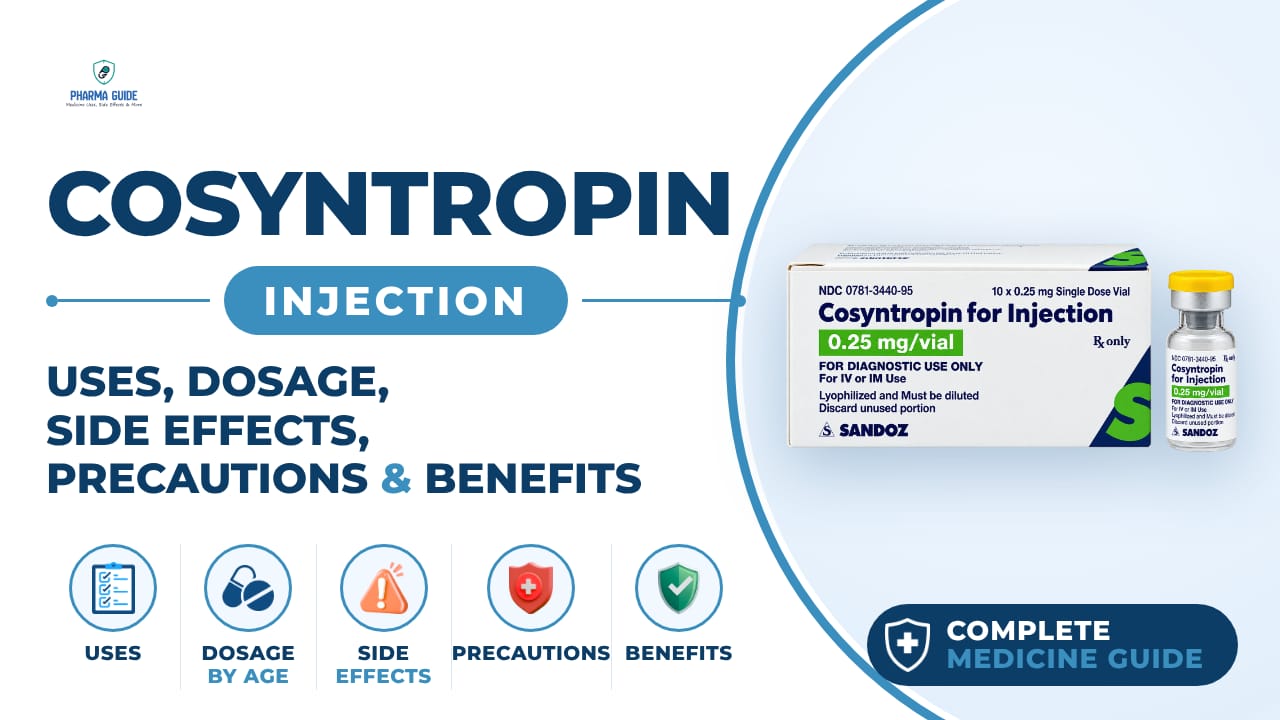
Cosyntropin Injection: Uses, Dosage, Side Effects, Precautions and Alternates
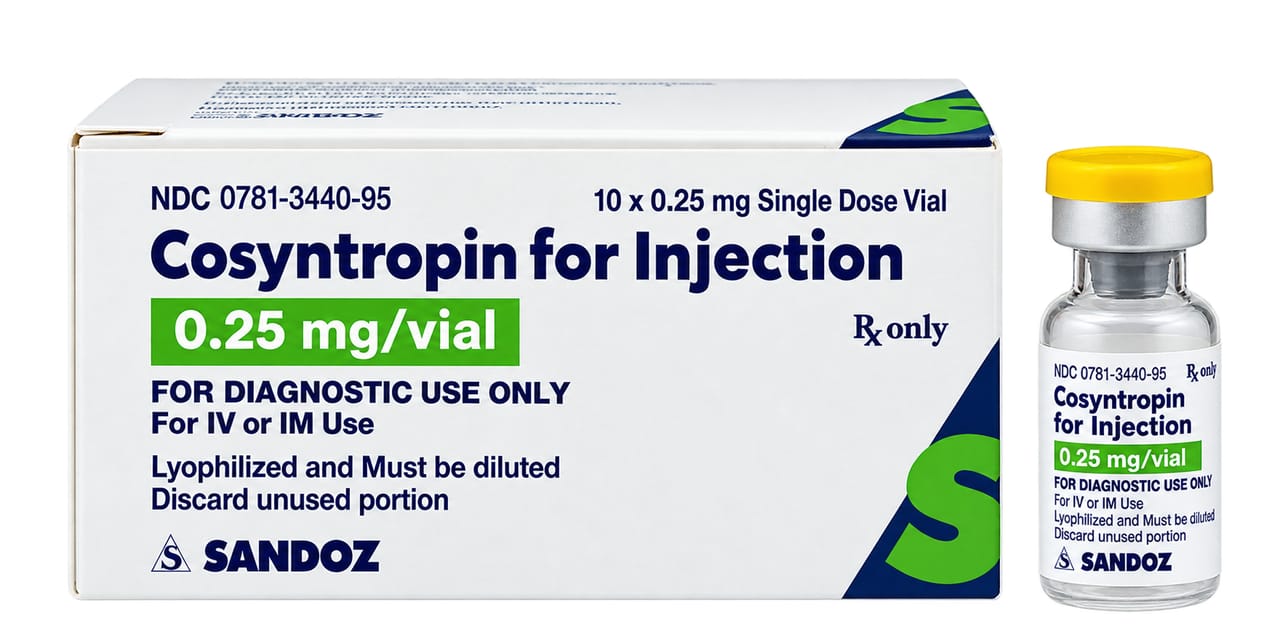
| Generic name | cosyntropin |
|---|---|
| Drug class | Corticotropin |
| Forms | Powder for solution (lyophilized powder for injection), Solution for injection |
Quick overview
Cosyntropin Injection is a man-made form of ACTH used as part of the ACTH stimulation test to help diagnose adrenal gland disorders and screen for adrenocortical insufficiency. It works by stimulating the adrenal glands to produce cortisol, which is then measured to assess adrenal function. It is given as a one-time injection into a vein or muscle by a healthcare provider.
What is Cosyntropin Injection
Cosyntropin is a man-made form of a hormone called adrenocorticotropic hormone (ACTH), which is normally made by the pituitary gland in the brain. It acts like natural ACTH to make the adrenal glands produce cortisol.
Cosyntropin Injection uses
- Used as part of a medical test called an ACTH stimulation test to help diagnose adrenal gland disorders such as Addison's disease, Cushing syndrome, or hypopituitarism
- Used to screen patients who are thought to have adrenocortical insufficiency
Benefits of Cosyntropin Injection
- Gives a rapid way to test adrenal gland function using only two blood draws
- Has very little immune-triggering activity compared with natural ACTH, making it less likely to cause allergic reactions
How Cosyntropin Injection works
Cosyntropin acts like natural ACTH, stimulating the adrenal gland to produce cortisol, which doctors can then measure to see how well the adrenal glands are working.
Cosyntropin Injection dosage
Cosyntropin is given as a one-time injection into a vein or into a muscle by a healthcare provider. Your doctor will measure your cortisol levels before the injection and again later to compare results.
You may be asked to stop taking certain medicines for a period of time before the test, including spironolactone, corticosteroid medicines, or estrogen-containing medicines. If you take spironolactone, you should not take it on the day of the test. If you take a corticosteroid medicine, ask your doctor how long to stop it before the test. If you take estrogen-containing medicine such as hormonal contraceptives or hormone replacement therapy, you should stop taking it several weeks before the scheduled test. Unless your doctor tells you otherwise, continue your normal diet before the test.
| Age group | Dose |
|---|---|
| Infants and young children | Dose is specialist-directed; some protocols use 0.015 mg/kg IV or IM, up to the standard maximum |
| Children and adolescents | Common standard test dose: 0.25 mg IV or IM once |
| 18–64 years | Standard dose: 0.25 mg IV or IM once |
| 65–74 years | Usually 0.25 mg IV or IM once; no routine age-based adjustment |
| 75 years and older | Usually 0.25 mg once, with clinical monitoring; no specific geriatric dose is established |
Available forms and strengths
- Powder for solution (lyophilized powder for injection)
- Solution for injection
Side effects of Cosyntropin Injection
Common
- Allergic reaction
- Fast or slow heartbeat
- Increased blood pressure
- Rash
- Swelling in hands or feet
- Redness at the injection site
- Lightheadedness
Serious
- Hives, itching, or rash
- Swelling of the face, lips, eyes, tongue, or throat
- Wheezing or trouble breathing
- Weak or rapid pulse with lightheadedness
- Rare anaphylactic (severe allergic) reactions
- Chest pain, discomfort, or tightness
- Difficulty swallowing
- Irregular heartbeat
Warnings and precautions
- Do not receive this medicine if you have ever had an allergic reaction to it.
- This medicine can cause serious allergic reactions, including anaphylaxis, which can be life-threatening and needs immediate medical attention.
- Tell your doctor about all medical conditions, including any electrolyte imbalance such as low potassium or magnesium, and any allergic reaction during a prior ACTH stimulation test.
- It is not known whether cosyntropin can harm an unborn baby. Tell your doctor if you are pregnant.
- It is not known whether cosyntropin passes into breast milk, so it should be used with caution while breastfeeding, weighing the benefits against the risks.
- No routine renal dose adjustment is generally required for a single diagnostic dose. No standard liver-specific dose adjustment is established.
- Discuss with your healthcare professional whether it is safe to use alcohol around the time of this test, since interactions may occur.
- This medicine usually has little direct effect on driving, although dizziness can occasionally occur.
Storage
- Store at controlled room temperature, with brief excursions to a wider temperature range allowed, as listed on the product label
- Cosyntropin powder should be stored at room temperature; the reconstituted solution should not be kept for later use and any unused portion should be discarded
When to see a doctor
- Get emergency medical help right away if you have signs of an allergic reaction, such as hives, trouble breathing, or swelling of the face, lips, tongue, or throat.
- Call your doctor right away if you have a rash, itching, trouble breathing, trouble swallowing, or swelling of the hands, face, or mouth after receiving this medicine.
- Call your doctor immediately or get emergency treatment if you have hives, itching, rash, swelling of the face, lips, eyes, or throat, wheezing, trouble breathing, a weak or rapid pulse, or lightheadedness.
Alternatives
- Cortrosyn
- Insulin tolerance test
- Metyrapone stimulation test
Watch the video
FAQs
What is Cosyntropin Injection used for?
It is used as part of the ACTH stimulation test to help diagnose adrenal gland disorders such as Addison's disease, Cushing syndrome, or hypopituitarism, and to screen for adrenocortical insufficiency.
How is Cosyntropin Injection given?
It is given as a one-time injection into a vein or muscle by a healthcare provider. Cortisol levels are measured before the injection and again later to compare results.
How does Cosyntropin Injection work?
Cosyntropin acts like natural ACTH, stimulating the adrenal glands to produce cortisol, which doctors then measure to assess how well the adrenal glands are working.
What medicines should be stopped before a Cosyntropin test?
You may need to stop spironolactone, corticosteroid medicines, or estrogen-containing medicines such as hormonal contraceptives or hormone replacement therapy before the test, as directed by your doctor.
What are the serious side effects of Cosyntropin Injection?
Serious side effects include hives, swelling of the face, lips, eyes, tongue, or throat, wheezing or trouble breathing, weak or rapid pulse with lightheadedness, chest pain, difficulty swallowing, irregular heartbeat, and rare anaphylactic reactions.
General information, not medical advice
Your prescriber and the leaflet in your pack know your situation. This page does not.
- Follow your prescriber and the leaflet
- Don't start, stop, or change a dose on your own
- Doses and warnings differ by country and product
Sources
Video
Related medicines

Injectafer Injection: Uses, Dosage, Side Effects, Precautions and Alternates
Iron products
Injectafer (ferric carboxymaltose) treats iron deficiency anemia and heart failure-related iron deficiency via IV. Learn uses, dosage, side effects, and

Gliclazide Tablet: Uses, Dosage, Side Effects, Precautions and Alternates
Sulfonylurea (hypoglycemic/antidiabetic agent)
Gliclazide Tablet is a sulfonylurea for type 2 diabetes that boosts insulin release. Learn about dosage, side effects, warnings, and precautions.