
Safety
General information, not medical advice
Your prescriber and the leaflet in your pack know your situation. This page does not.
- Follow your prescriber and the leaflet
- Don't start, stop, or change a dose on your own
- Doses and warnings differ by country and product
Cresemba Capsule: Uses, Dosage, Side Effects, Precautions and Alternates
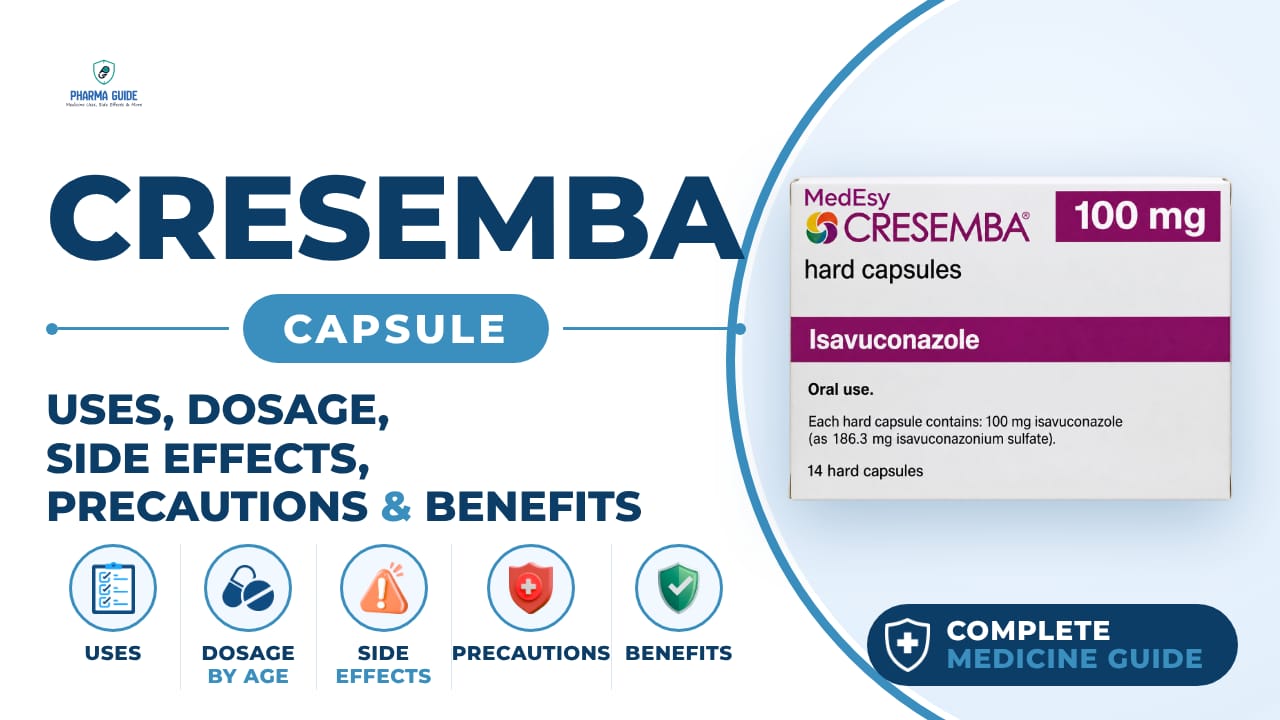
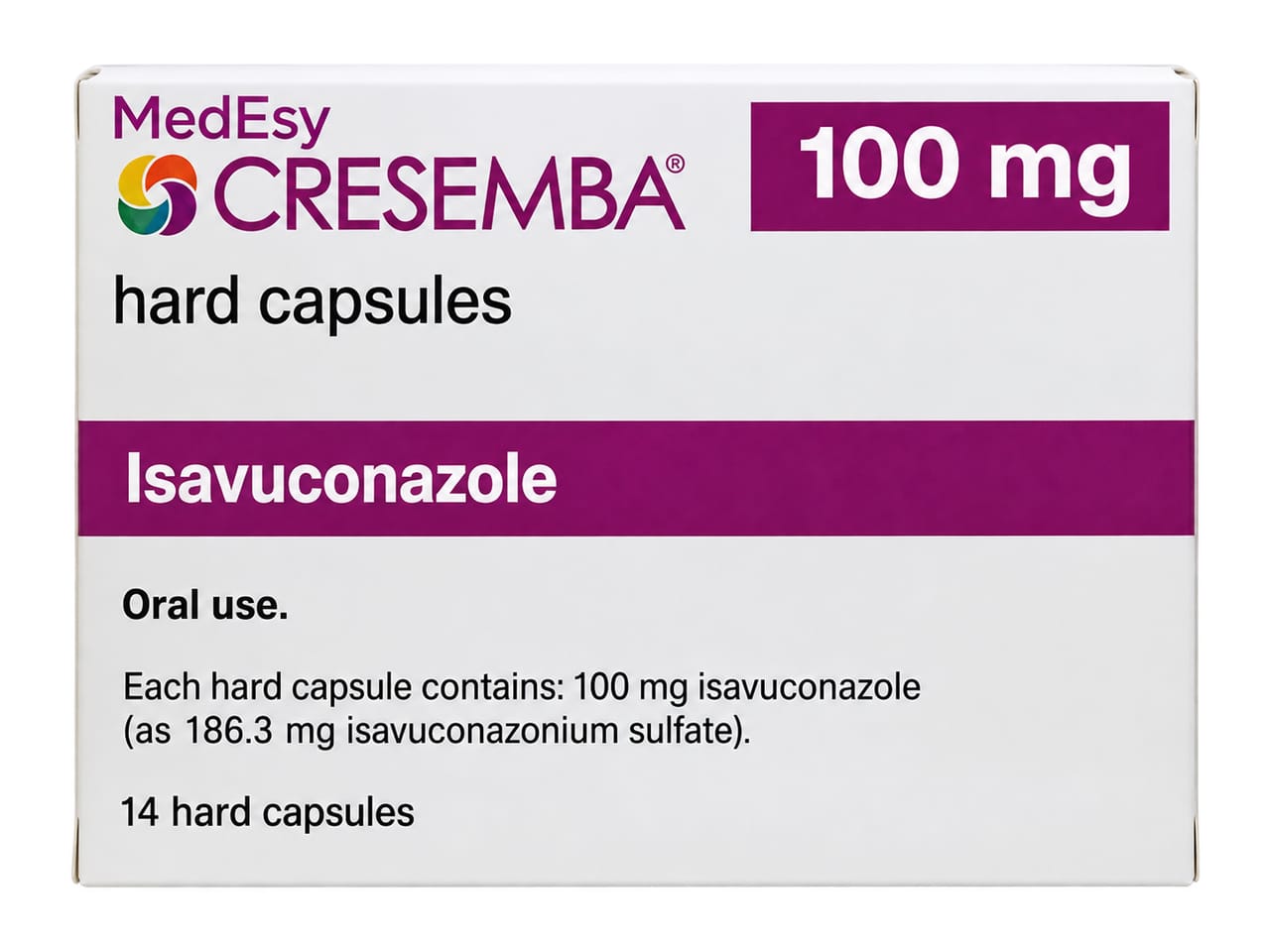
| Generic name | isavuconazonium sulfate |
|---|---|
| Drug class | azole antifungal (triazole antifungal) |
| Forms | Capsule (74.5 mg), Capsule (186 mg), Powder for injection (for intravenous use) |
Quick overview
Cresemba Capsule contains isavuconazonium sulfate, a triazole antifungal medicine that is converted in the body into its active form, isavuconazole. It is used to treat invasive aspergillosis and invasive mucormycosis, two serious fungal infections, in adults and children. The capsules are taken once daily and must be swallowed whole.
What is Cresemba Capsule
Cresemba is a prescription antifungal medicine. It is the prodrug of isavuconazole, which is converted in the body into its active form to fight serious fungal infections.
Cresemba Capsule uses
- Treats invasive aspergillosis, a fungal infection caused by Aspergillus mold, in adults and children
- Treats invasive mucormycosis, a fungal infection caused by Mucorales mold, in adults and children
Benefits of Cresemba Capsule
- Treats invasive aspergillosis.
- Treats certain cases of mucormycosis.
- Helps control serious fungal infections.
- Provides an oral treatment option for eligible patients.
- Helps treat fungal infections in high-risk patients.
How Cresemba Capsule works
The medicine stops the fungus from building a substance called ergosterol, which it needs for a healthy cell wall. Without it, the fungal cell wall weakens and the fungus cannot survive. Human cells are much less affected by this process.
Cresemba Capsule dosage
Capsules can be taken with or without food. Swallow capsules whole; do not chew, crush, dissolve, or open them. Do not give capsules through a nasogastric tube. Take the medicine at about the same time each day. Only open one blister pocket at a time, right before taking the dose; do not puncture or swallow the desiccant pocket next to the capsule. Keep taking the medicine for as long as your healthcare provider tells you, even if you feel better. If you miss a dose, take it as soon as you remember, but skip it if it is almost time for the next dose; do not double up.
| Age group | Dose |
|---|---|
| Under 18 years | Not recommended |
| 18–64 years | 200 mg, once/day |
| 65+ years | 200 mg, once/day |
Available forms and strengths
- Capsule (74.5 mg)
- Capsule (186 mg)
- Powder for injection (for intravenous use)
Side effects of Cresemba Capsule
Common
- Nausea
- Vomiting
- Diarrhea
- Headache
- Changes in liver enzyme levels in the blood
- Low potassium levels
- Constipation
- Shortness of breath
- Cough
- Swelling in the arms or legs
- Back pain
- Stomach pain (more common in children)
- Rash (more common in children)
- Itching (more common in children)
Serious
- Liver problems, including hepatitis, gallbladder problems, liver failure, or death
- Severe allergic (anaphylactic) reactions, which can be fatal
- Severe skin reactions, such as Stevens-Johnson syndrome
- Infusion-related reactions during IV use, such as low blood pressure, trouble breathing, chills, dizziness, numbness, or tingling
- Increased levels of cyclosporine, sirolimus, or tacrolimus in the blood, which can harm the kidneys or brain
Warnings and precautions
- Serious liver reactions have happened with this medicine, including hepatitis, liver failure, and death in some patients with other serious illnesses. Your doctor will check your liver function before and during treatment.
- Serious allergic reactions, including some that were fatal, have occurred with this medicine. Severe skin reactions have also been reported with similar antifungal medicines.
- Do not take this medicine with certain other drugs, including ketoconazole, high-dose ritonavir, rifampin, carbamazepine, St. John's wort, or long-acting barbiturates, because they can seriously change how this medicine works.
- This medicine should not be used by people with a rare heart rhythm condition called familial short QT syndrome.
- The IV form of this medicine may form small particles after mixing, so it must be given through a special in-line filter.
- This medicine may harm an unborn baby and should not be used during pregnancy unless your doctor says otherwise. Women who can become pregnant should use effective birth control during treatment and for 28 days after the last dose.
- Breastfeeding should be stopped during treatment with this medicine because it can pass into breast milk and may harm the baby.
- No dose change is needed for people with kidney problems, including those with end-stage kidney disease.
- People with severe liver problems should only use this medicine if the benefits outweigh the risks, and should be monitored closely. No dose change is needed for mild or moderate liver problems.
- There is no specific information on whether alcohol affects this medicine, but heavy drinking can weaken your immune system and make it harder to fight infection.
This medicine may cause confusion, tiredness, or sleepiness. Do not drive or use machinery if you feel this way.
Storage
- Store capsules at room temperature between 68°F to 77°F (20°C to 25°C) in the original packaging to protect from moisture
- Brief temperature changes between 59°F to 86°F (15°C to 30°C) are allowed, such as during travel
- Do not remove capsules from the original packaging until you are ready to take them
- Do not store capsules in a standard pill box or organizer
- Keep out of reach of children
- Safely throw away medicine that is out of date or no longer needed
When to see a doctor
- Get emergency help right away if you notice signs of a severe allergic reaction, such as swelling of the face, lips, mouth, or tongue, wheezing, trouble breathing, fast heartbeat, severe itching, dizziness, or fainting.
- Call your healthcare provider right away if you notice signs of liver problems, such as itchy skin, nausea or vomiting, yellowing of the eyes, feeling very tired, or flu-like symptoms.
- Tell your healthcare provider right away if you develop swelling in your arm or leg or shortness of breath, which could be a sign of high levels of certain other medicines in your blood.
- If you develop a rash, stop the medicine and call your healthcare provider right away, as this could be an early sign of a severe skin reaction.
- Tell your healthcare provider right away if you have symptoms during an infusion, such as low blood pressure, difficulty breathing, chills, dizziness, numbness, or tingling.
Alternatives
- Voriconazole
- Fluconazole
- Posaconazole
Watch the video
FAQs
What is Cresemba Capsule used for?
Cresemba Capsule is used to treat invasive aspergillosis and invasive mucormycosis, two serious fungal infections, in adults and children.
How should Cresemba Capsule be taken?
Capsules should be swallowed whole with or without food at about the same time each day. Do not chew, crush, dissolve, or open them, and do not give them through a nasogastric tube.
What is the dosage of Cresemba Capsule for adults?
Adults aged 18-64 years and those 65 years and older take 200 mg once daily. It is not recommended for children under 18 years.
What are the common side effects of Cresemba Capsule?
Common side effects include nausea, vomiting, diarrhea, headache, changes in liver enzyme levels, low potassium levels, constipation, shortness of breath, cough, and swelling in the arms or legs.
Can Cresemba Capsule be used during pregnancy?
Cresemba may harm an unborn baby and should not be used during pregnancy unless a doctor says otherwise. Women who can become pregnant should use effective birth control during treatment and for 28 days after the last dose.
General information, not medical advice
Your prescriber and the leaflet in your pack know your situation. This page does not.
- Follow your prescriber and the leaflet
- Don't start, stop, or change a dose on your own
- Doses and warnings differ by country and product
Sources
Video
Related medicines
Triflucan Capsule: Uses, Dosage, Side Effects, Precautions and Alternates
Azole antifungal (triazole antifungal)
Triflucan Capsule (fluconazole) treats fungal and yeast infections like vaginal candidiasis, oral thrush, and cryptococcal meningitis. Learn dosage, side
Noxafil Tablet: Uses, Dosage, Side Effects, Precautions and Alternates
Azole antifungal (triazole antifungal)
Noxafil Tablet (posaconazole) prevents and treats serious fungal infections in immunocompromised patients. Learn about dosage, side effects, and precautions.