
Safety
General information, not medical advice
Your prescriber and the leaflet in your pack know your situation. This page does not.
- Follow your prescriber and the leaflet
- Don't start, stop, or change a dose on your own
- Doses and warnings differ by country and product
Cuplex Gel: Uses, Dosage, Side Effects, Precautions and Alternates
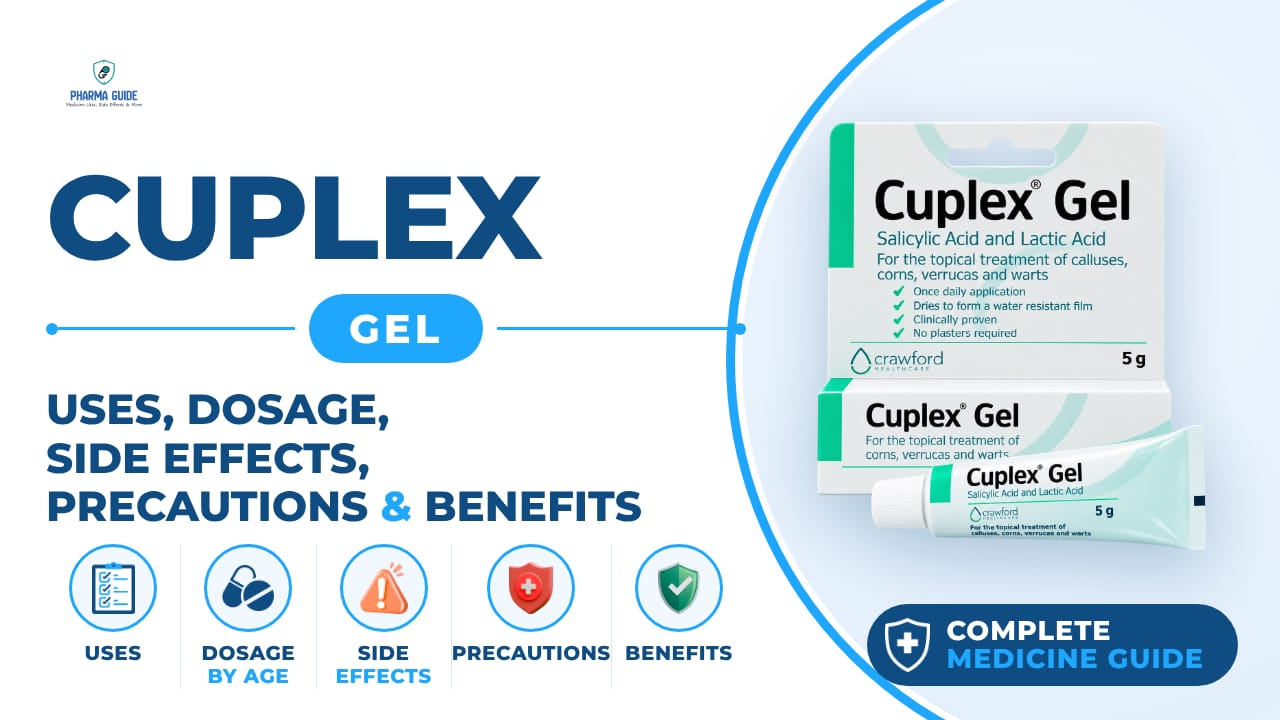
| Generic name | Salicylic acid and lactic acid |
|---|---|
| Drug class | Keratolytic (skin-softening) topical treatment |
| Forms | Gel |
Quick overview
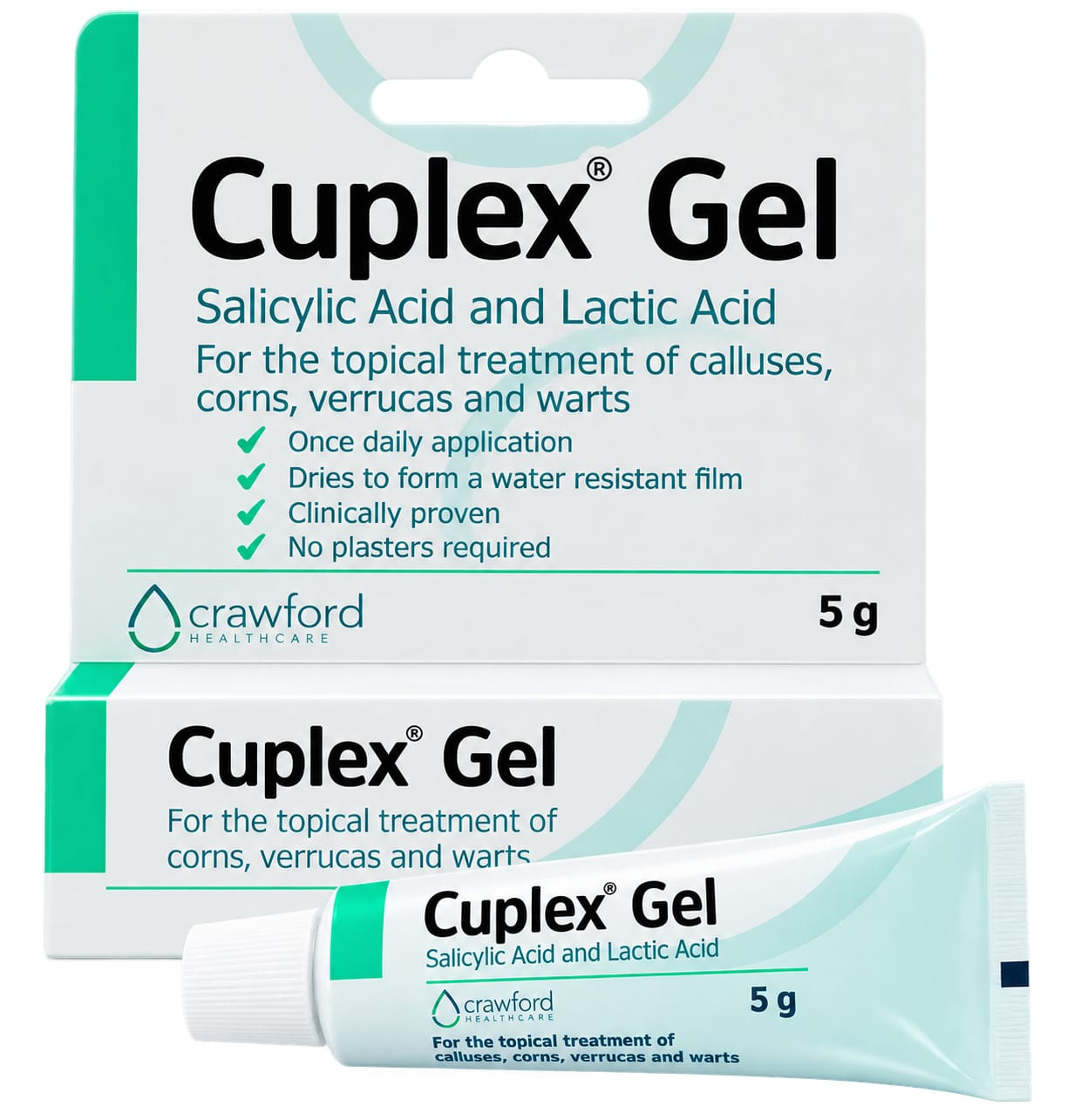
Cuplex Gel contains salicylic acid and lactic acid and belongs to the keratolytic (skin-softening) class of topical treatments. It is used to treat calluses, corns, verrucas and warts by softening hard skin growths and helping to kill the virus that causes warts and verrucas. It is for external use only and is applied once daily, usually in the evening, directly to the affected area.
What is Cuplex Gel
Cuplex Verruca Gel is a treatment for calluses, corns, verrucas and warts. It contains salicylic acid and lactic acid, which soften hard skin growths and help kill the virus that causes warts and verrucas.
Cuplex Gel uses
- Treating calluses
- Treating corns
- Treating verrucas
- Treating warts
Benefits of Cuplex Gel
- Helps treat common warts and verrucas (plantar warts).
- Helps remove corns and calluses.
- Salicylic acid softens and breaks down thickened, hardened skin.
- Lactic acid supports removal of excess dead skin from the affected area.
- Gradually helps reduce the size and thickness of warts with regular use.
- Can be used for plantar, mosaic, and juvenile warts as directed.
How Cuplex Gel works
The active ingredients soften the hard skin growth, making it easier to remove with a pumice stone or emery board, and help kill the virus that causes warts and verrucas.
Cuplex Gel dosage
Cuplex Gel is for external use only and must not be taken by mouth. Apply only to the callus, corn, verruca or wart, not to surrounding healthy skin. Use once every day, usually in the evening, until the growth disappears.
Soak the affected area in warm water for a few minutes before applying, then dry the area thoroughly with your own towel used only for the affected site. Apply a small amount of gel to the affected area only and let it dry to form a film. Avoid spreading the gel onto surrounding normal healthy skin; wipe off any excess with a tissue and wash if needed. No sticking plaster is required.
The next evening, remove the dried film and reapply following the same steps. If the film is hard to remove, you can reapply directly over it and let it dry. Once a week, gently rub away the surface of the callus, corn, verruca or wart with an emery board or pumice stone. Do not let anyone else use the same emery board or pumice stone, as this may spread infection.
Replace the cap tightly and wash your hands thoroughly after use. This product is suitable for adults, the elderly, and children over 2 years old. Children under 12 should be treated under supervision, and it is not recommended for infants under 2 years old. If you forget a dose, use it when you remember.
| Age group | Dose |
|---|---|
| Under 2 years | Not recommended |
| 2–11 years | Apply once daily under adult supervision |
| 12–17 years | Apply once daily directly to the wart, verruca, corn or callus |
| 18–64 years | Apply once daily directly to the affected area |
| 65+ years | Same adult application; protect surrounding healthy skin |
Available forms and strengths
- Gel
Side effects of Cuplex Gel
Common
- Mild tingling at the treated area
- Temporary tenderness
- Mild skin irritation
- Occasionally a temporary skin blemish may develop
Serious
- Significant or persistent skin irritation
- Allergic contact dermatitis, including possible sensitivity to colophony in the formulation
- Severe rash, swelling, or blistering
- Signs of a serious allergic reaction, such as facial/throat swelling or difficulty breathing
Warnings and precautions
- Do not use if you are allergic to salicylic acid, lactic acid, or any other ingredient in the product.
- Do not use if you are diabetic or have poor blood circulation to your hands or feet.
- Do not use on or near your face, armpits, breasts, bottom or genital area.
- Do not use on birthmarks, moles (especially pigmented moles), warts with hairs growing from them, facial warts, or other spots.
- Apply the gel carefully only to the affected area and avoid contact with surrounding healthy skin, as it can cause irritation or pain.
- Do not apply excessive amounts of gel, and keep it away from eyes, nose, mouth, and broken skin, cuts and grazes.
- Avoid spilling the gel as it can damage clothing and other belongings.
- Do not fold the tube, as this can damage it and cause leaking.
- The gel is volatile and highly flammable; do not use it near flames or ignition sources, and avoid inhaling its vapour.
- Ask your doctor or pharmacist for advice before using this medicine if you are pregnant or breastfeeding.
- No specific kidney-related dose adjustment is normally required with small-area topical use; avoid excessive application, especially on broken skin.
- No specific liver-related precautions are normally required when used correctly on a small affected area. There is no known interaction with drinking alcohol, though the gel itself contains ethanol and is highly flammable.
- Using this product is not known to affect your ability to drive or use machinery.
Storage
- Store at room temperature or as directed on the product label.
- Keep in a cool, dry place away from excessive heat.
- Protect from direct sunlight and high temperatures.
- Keep the tube or container tightly closed after each use.
- Do not freeze and avoid storing in very hot or humid areas.
- Keep out of reach and sight of children.
When to see a doctor
- If the gel gets into your eyes or mouth, it may cause harm. Rinse with plenty of water, avoid rinsing product into the other eye, do not induce vomiting, and contact your doctor or local hospital for further advice.
- If the vapour is inhaled and causes light-headedness, get plenty of fresh air.
- Stop using the product and tell your doctor or pharmacist if you experience unacceptable discomfort, continuing irritation, or any serious or unlisted side effects.
- If the callus, corn, verruca or wart gets worse or has not disappeared after about 12 weeks of treatment, ask your doctor for advice.
Alternatives
- Cryotherapy
- Verrugon Ointment
- Salicylic Acid Wart Remover
- Duofilm
- Salatac Gel
Watch the video
FAQs
What is Cuplex Gel used for?
Cuplex Gel is used to treat calluses, corns, verrucas and warts. It contains salicylic acid and lactic acid, which soften hard skin growths and help kill the virus that causes warts and verrucas.
How do you apply Cuplex Gel?
Soak the affected area in warm water, dry thoroughly, then apply a small amount of gel only to the callus, corn, verruca or wart once daily, usually in the evening, letting it dry to form a film. Once a week, gently rub away the surface with an emery board or pumice stone.
Who can use Cuplex Gel?
Cuplex Gel is suitable for adults, the elderly, and children over 2 years old. Children under 12 should be treated under supervision, and it is not recommended for infants under 2 years old.
What are the side effects of Cuplex Gel?
Common side effects include mild tingling, temporary tenderness, mild skin irritation, and occasionally a temporary skin blemish. Serious effects can include significant skin irritation, allergic contact dermatitis, severe rash, swelling or blistering, and signs of a serious allergic reaction.
What if the wart or corn does not go away?
If the callus, corn, verruca or wart gets worse or has not disappeared after about 12 weeks of treatment, you should ask your doctor for advice.
General information, not medical advice
Your prescriber and the leaflet in your pack know your situation. This page does not.
- Follow your prescriber and the leaflet
- Don't start, stop, or change a dose on your own
- Doses and warnings differ by country and product
Sources
Video
Related medicines

Injectafer Injection: Uses, Dosage, Side Effects, Precautions and Alternates
Iron products
Injectafer (ferric carboxymaltose) treats iron deficiency anemia and heart failure-related iron deficiency via IV. Learn uses, dosage, side effects, and

Gliclazide Tablet: Uses, Dosage, Side Effects, Precautions and Alternates
Sulfonylurea (hypoglycemic/antidiabetic agent)
Gliclazide Tablet is a sulfonylurea for type 2 diabetes that boosts insulin release. Learn about dosage, side effects, warnings, and precautions.