
Safety
General information, not medical advice
Your prescriber and the leaflet in your pack know your situation. This page does not.
- Follow your prescriber and the leaflet
- Don't start, stop, or change a dose on your own
- Doses and warnings differ by country and product
Dacomitinib Tablet: Uses, Dosage, Side Effects, Precautions and Alternates
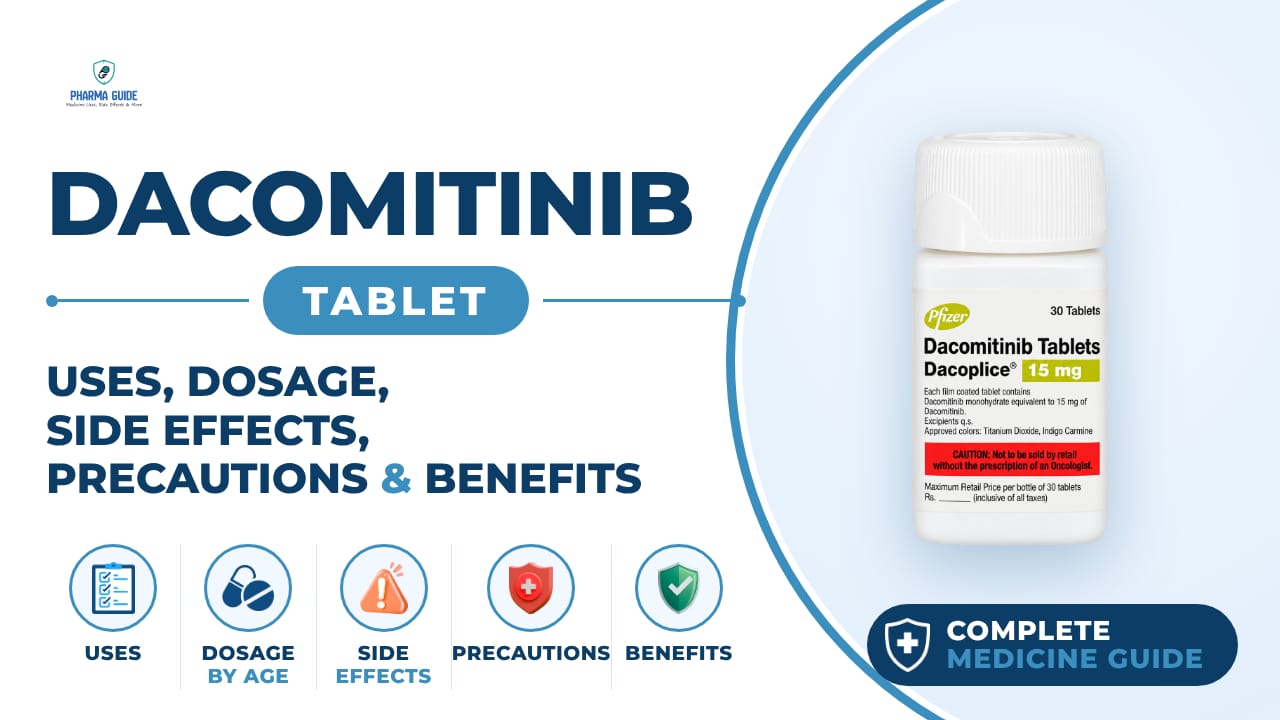
| Generic name | dacomitinib |
|---|---|
| Drug class | EGFR inhibitors, HER2 inhibitors (protein tyrosine kinase inhibitor) |
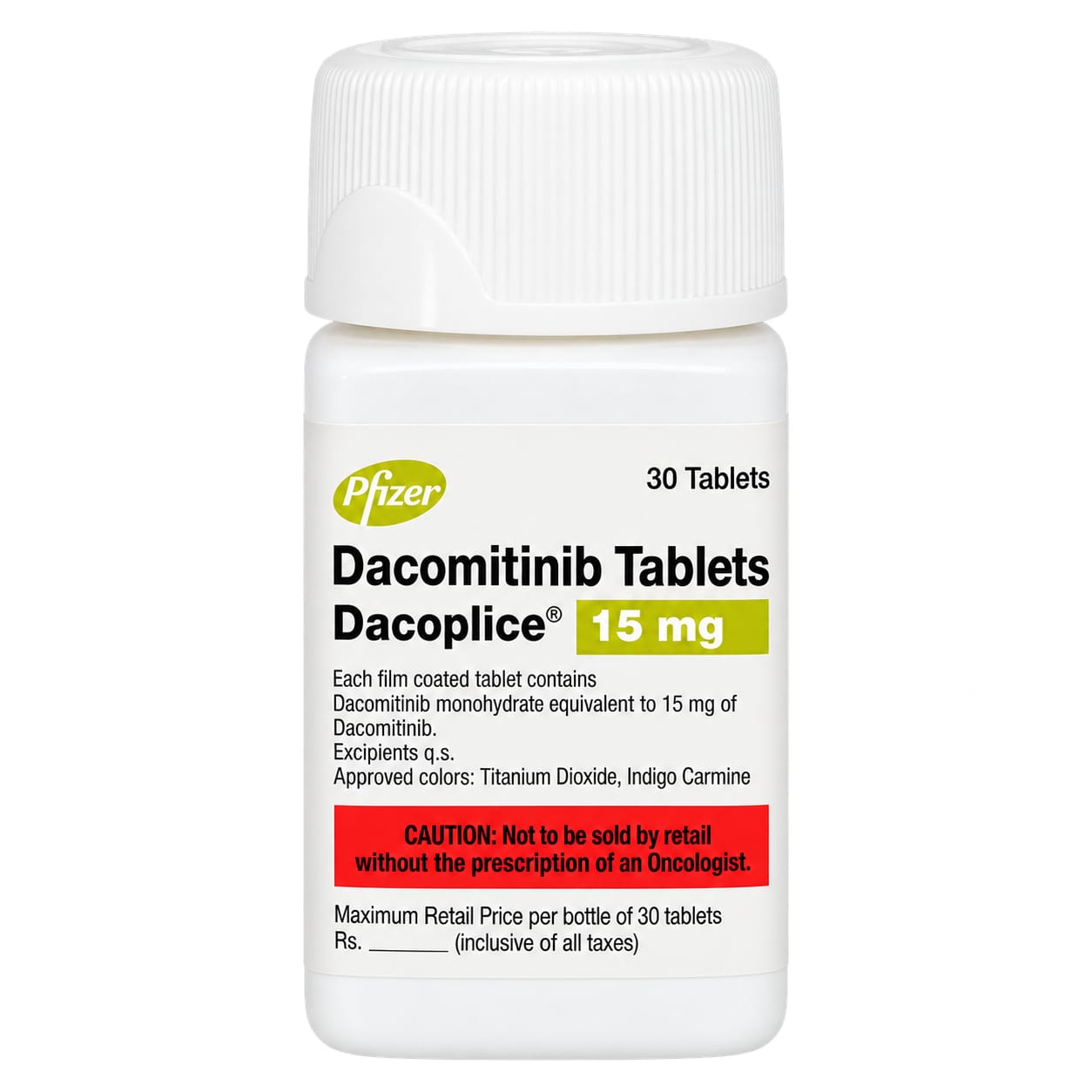
| Forms | Film-coated tablet (15 mg, 30 mg, 45 mg) |
Quick overview
Dacomitinib Tablet (Vizimpro) contains dacomitinib, a protein tyrosine kinase inhibitor used to treat adults with non-small cell lung cancer (NSCLC) whose tumors have certain EGFR gene mutations and have spread to the other lung or other organs. It works by blocking EGFR signals that cancer cells need to grow. It is taken once daily as a tablet, and it carries warnings about lung inflammation, severe diarrhoea, and skin reactions.
What is Dacomitinib Tablet
Vizimpro is a targeted cancer medicine that contains dacomitinib. It belongs to a group of medicines called protein tyrosine kinase inhibitors, which are used to treat cancer by blocking signals that cancer cells need to grow.
Dacomitinib Tablet uses
- Treats adults with a type of lung cancer called non-small cell lung cancer (NSCLC)
- Used when tests show the cancer has certain changes (mutations) in the EGFR gene and has spread to the other lung or other organs
- Can be used as the first treatment once the lung cancer has spread
- Treats EGFR-mutated metastatic NSCLC
Benefits of Dacomitinib Tablet
- Helps block signals that tell EGFR-mutated cancer cells to grow, which can slow or stop cancer growth
- In a clinical trial, people taking dacomitinib had a longer time without their cancer getting worse compared to another EGFR medicine (gefitinib)
- Targets abnormal EGFR signaling
How Dacomitinib Tablet works
Dacomitinib blocks a protein called EGFR that is found on cells. When EGFR has certain changes, it can help cancer cells grow and spread. By blocking this changed EGFR, the medicine can help cancer cells die and slow down or stop the cancer from growing.
Dacomitinib Tablet dosage
Take the tablet at about the same time each day. Swallow the tablet whole with a glass of water. It can be taken with or without food. If you miss a dose or vomit after taking it, do not take an extra dose — just take the next dose at the usual time the next day. Do not stop taking this medicine unless your doctor tells you to. Drink plenty of liquids while taking this medicine. Wash your hands after taking your tablets, and other people should avoid direct contact with the tablets. This medicine is not for use in children or adolescents under 18 years of age.
| Age group | Dose |
|---|---|
| Under 18 years | Safety and effectiveness are not established; no standard pediatric dose |
| 18–39 years | 45 mg once daily |
| 40–64 years | 45 mg once daily |
| 65–74 years | Usually 45 mg once daily; no routine age-based adjustment |
Available forms and strengths
- Film-coated tablet (15 mg, 30 mg, 45 mg)
Side effects of Dacomitinib Tablet
Common
- Diarrhoea
- Rash, acne, itching, or dry skin
- Loss of appetite
- Weight loss
- Hair loss
- Nail problems
- Mouth sores or mouth pain
- Eye redness, dryness, or itching
- Feeling tired or weak
- Nausea or vomiting
- Altered sense of taste
- Flushed or painful palms or soles
- Cracks in the skin
- Cold-like symptoms such as stuffy nose, sneezing, sore throat
Serious
- Inflammation of the lungs (interstitial lung disease/pneumonitis) causing breathing problems, cough, or fever — can be fatal
- Severe or ongoing diarrhoea that can cause dehydration and kidney problems — can be fatal
- Severe skin reactions including peeling, cracking, or blistering skin
- Swelling, redness, or infection under or around fingernails or toenails
- Signs of liver problems such as yellowing of skin or eyes, dark urine, or pale stools
- Signs of an allergic reaction such as hives, difficulty breathing, or swelling of the face, lips, tongue, or throat
- Signs of a blood clot such as leg or arm swelling, pain, redness, sudden breathlessness, or chest pain
Warnings and precautions
- This medicine can cause lung inflammation (interstitial lung disease), which can be fatal. Tell your doctor right away if you have new or worsening breathing problems, cough, or fever.
- Severe diarrhoea is very common with this medicine and can lead to dangerous dehydration and kidney problems if not treated quickly.
- Skin rash and other skin reactions are common and may get worse in sunlight. Use protective clothing and sunscreen.
- This medicine can affect liver function. Periodic liver tests are recommended, and treatment may need to be stopped if liver enzyme levels rise too much.
- Avoid taking proton pump inhibitors (long-acting stomach acid reducers) while on this medicine, as they can make it less effective.
- This medicine contains lactose. People with rare hereditary problems such as galactose intolerance or glucose-galactose malabsorption should not take it.
- Do not take this medicine if you are pregnant, as it may harm the unborn baby. Use effective contraception during treatment and for at least 17 days after the last dose. Tell your doctor immediately if you become pregnant.
- Do not breastfeed while taking this medicine, because it is not known if it can harm the baby.
- No starting dose changes are needed for mild or moderate kidney problems, but there is limited information for severe kidney impairment, and none for people needing dialysis.
- No starting dose changes are needed for mild or moderate liver problems. This medicine has not been studied in people with severe liver impairment, so it is not recommended for them.
- This medicine has a minor effect on your ability to drive or use machines. If you feel tired or have eye irritation, be careful when driving or operating machinery.
Storage
- This medicine does not require any special storage conditions
- Keep out of the sight and reach of children
- Do not use after the expiry date on the carton and blister
- Keep tablets in the original package, at room temperature, away from moisture, heat and direct sunlight
- Do not throw away medicines via wastewater or household waste; ask your pharmacist how to dispose of medicines you no longer use
- If treatment is stopped, return any unused tablets to the hospital pharmacist
When to see a doctor
- Get emergency help if you have signs of a serious allergic reaction, such as hives, difficulty breathing, or swelling of the face, lips, tongue, or throat.
- Contact your doctor immediately if you have difficulty breathing, shortness of breath, cough (with or without mucus), or fever — these could be signs of lung inflammation that can be fatal.
- Contact your doctor immediately if you develop diarrhoea, as early treatment is important to prevent dehydration and kidney problems.
- Tell your doctor immediately if a skin rash starts or gets worse, especially if the skin is peeling or cracking, since treatment may need to be stopped.
- Tell your doctor if you notice signs of a liver problem, such as yellowing of the skin or eyes, dark urine, or pale stools.
- If you take too much of this medicine, see a doctor or go to a hospital right away.
Alternatives
- Osimertinib
- Gefitinib
- Erlotinib
Watch the video
FAQs
What is Dacomitinib Tablet used for?
It is used to treat adults with non-small cell lung cancer (NSCLC) whose tumors have certain EGFR gene mutations and have spread to the other lung or other organs, including as a first treatment.
How does Dacomitinib Tablet work?
It blocks a protein called EGFR that, when changed by certain mutations, helps cancer cells grow and spread. By blocking this changed EGFR, the medicine helps cancer cells die and slows or stops cancer growth.
What is the dosage of Dacomitinib Tablet?
The usual dose is 45 mg once daily, taken at the same time each day, swallowed whole with water, with or without food. It is not recommended for use in children or adolescents under 18 years.
What are the serious side effects of Dacomitinib Tablet?
Serious side effects include lung inflammation (interstitial lung disease) causing breathing problems, cough, or fever; severe diarrhoea leading to dehydration and kidney problems; severe skin reactions; nail infections; liver problems; allergic reactions; and blood clots. These can be fatal in some cases.
Can Dacomitinib Tablet be taken during pregnancy?
No, it should not be taken during pregnancy as it may harm the unborn baby. Effective contraception should be used during treatment and for at least 17 days after the last dose, and breastfeeding should be avoided.
General information, not medical advice
Your prescriber and the leaflet in your pack know your situation. This page does not.
- Follow your prescriber and the leaflet
- Don't start, stop, or change a dose on your own
- Doses and warnings differ by country and product
Sources
Video
Related medicines

Injectafer Injection: Uses, Dosage, Side Effects, Precautions and Alternates
Iron products
Injectafer (ferric carboxymaltose) treats iron deficiency anemia and heart failure-related iron deficiency via IV. Learn uses, dosage, side effects, and

Gliclazide Tablet: Uses, Dosage, Side Effects, Precautions and Alternates
Sulfonylurea (hypoglycemic/antidiabetic agent)
Gliclazide Tablet is a sulfonylurea for type 2 diabetes that boosts insulin release. Learn about dosage, side effects, warnings, and precautions.