
Safety
General information, not medical advice
Your prescriber and the leaflet in your pack know your situation. This page does not.
- Follow your prescriber and the leaflet
- Don't start, stop, or change a dose on your own
- Doses and warnings differ by country and product
Daktarin Cream: Uses, Dosage, Side Effects, Precautions and Alternates
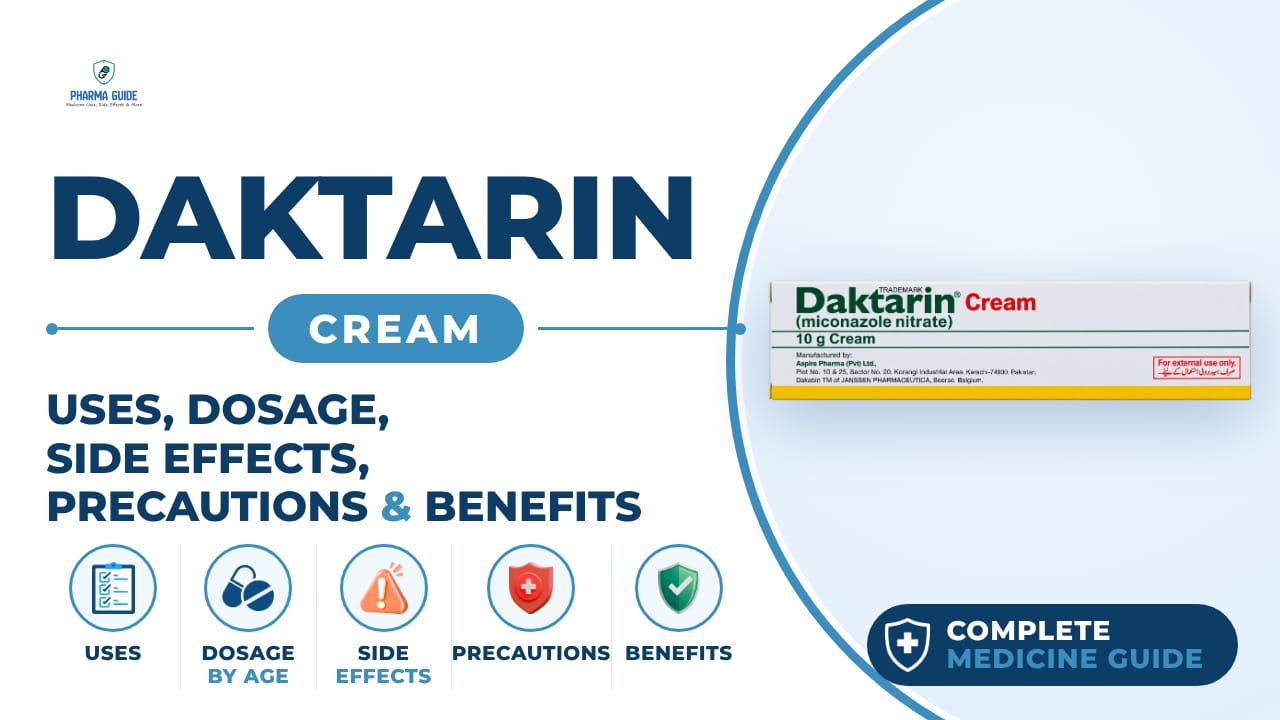
| Generic name | Miconazole Nitrate |
|---|---|
| Drug class | Imidazole antifungal / Topical antifungal agent |
| Forms | Cream, Gel |
Quick overview
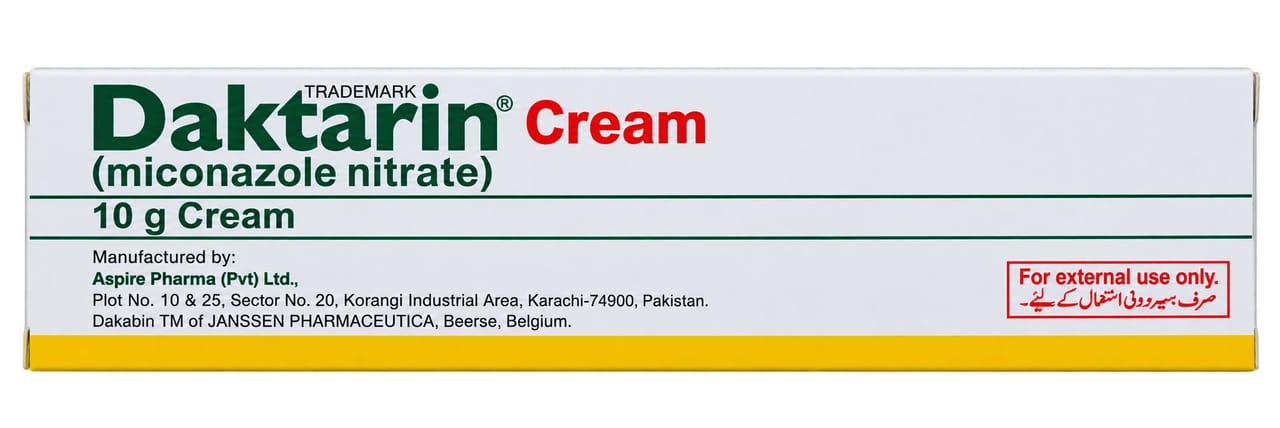
Daktarin Cream contains miconazole nitrate, an imidazole antifungal, and is applied to the skin to treat fungal and yeast infections such as athlete's foot, ringworm and thrush. It works directly on the skin with minimal absorption into the bloodstream, easing itching, redness and scaling within the first week of use. The cream is applied once or twice daily depending on the infection being treated, with courses typically lasting two to six weeks.
What is Daktarin Cream
Daktarin Cream is a topical antifungal cream containing miconazole nitrate. It is used to treat fungal and yeast infections of the skin, such as athlete's foot, ringworm and thrush.
Daktarin Cream uses
- Treats athlete's foot, tinea, ringworm and thrush infections of the skin caused by fungi, including yeast
- Treats ringworm infections on the skin, including tinea corporis, tinea cruris and tinea pedis
- Manages athlete's foot caused by fungal overgrowth between the toes
- Controls jock itch and other fungal rashes in warm, moist body folds
- Treats pityriasis versicolor, a fungal condition causing patchy skin discoloration
- Helps clear cutaneous candidiasis, a yeast infection of the skin
- Treats conditions including athlete's foot, ringworm, thrush, jock itch, nappy rash and nail infections
Benefits of Daktarin Cream
- Works directly on the skin, so very little medicine enters the bloodstream
- Eases itching, redness and scaling within the first week of regular use
- Covers a broad range of fungal species, including yeasts and dermatophytes
- Simple once or twice daily application fits easily into a daily routine
- Available without a prescription for most mild fungal skin infections
- Combines antifungal properties with moisturising effects
How Daktarin Cream works
The medicine targets the outer covering (cell membrane) of the fungus and stops it from making a substance called ergosterol, which the fungus needs to keep its cell membrane intact. This causes holes to form in the fungus, making it fall apart and die. It may also act against some bacteria by blocking enzymes they need to multiply.
Daktarin Cream dosage
Wash and dry the affected area thoroughly before applying the cream, and use a towel kept just for this purpose. Apply a thin layer to the affected area and rub it in with your finger until fully absorbed.
For skin infections, apply twice daily; for nail infections, apply once or twice daily. Keep using the cream for at least 10 days after symptoms have cleared to help stop the infection coming back, with most courses lasting two to six weeks depending on the infection.
Wash your hands before and after applying, unless the hands are the area being treated. Avoid contact with the eyes and mucous membranes (mouth, nose, eyes); rinse with water right away if this happens. Do not apply moisturisers to the infected area as this can encourage fungal growth.
If a dose is missed, apply it as soon as you remember, then continue as normal - do not apply two doses at once. For use on the skin only - do not swallow. Use in young children only under a doctor's guidance.
| Age group | Dose |
|---|---|
| Under 2 years | Not recommended |
| 2–17 years | Thin layer, 2 times/day |
| 18–60 years | Thin layer, 2 times/day |
| 60+ years | Thin layer, 2 times/day |
Available forms and strengths
- Cream
- Gel
Side effects of Daktarin Cream
Common
- Mild skin irritation, resulting in burning, itching, redness or rashes at the application site
- Skin discolouration, inflammation or increased warmth
- Dry skin or peeling of the treated skin
- Contact dermatitis in sensitive individuals
Serious
- Mild skin redness
- Burning or stinging
- Itching at the application site
- Skin irritation or rash
- Dryness or peeling of the skin
Warnings and precautions
- Do not use the cream if you are allergic to miconazole, other imidazole antifungals (such as ketoconazole), or any of its ingredients.
- Avoid getting the cream in your eyes or on mucous membranes (lining of the mouth, nose and eyes), as it can cause irritation there.
- Don't share this cream with anyone else, even if they have similar symptoms, as this can spread infection.
- Tell your doctor if you are taking warfarin or other blood-thinning medicines, diabetes medicines taken by mouth, or phenytoin for epilepsy, as this cream may affect how they work.
- In rare cases, ingredients in this cream have been linked to jaundice (yellowing of skin and eyes) in newborn babies.
- Do not use on broken skin or open wounds without medical advice.
- Talk to your doctor before using this cream if you are pregnant; it is considered relatively safe but should only be used if clearly needed and advised by a doctor, especially in early pregnancy.
- Speak with your doctor before using this cream while breastfeeding. Avoid applying it directly on or near the nipple area, as this may increase the risk of diarrhoea in a breastfed infant.
- Tell your doctor if you have liver problems before using this medicine. It is not recommended if you have severe liver problems because it may increase the risk of your condition worsening.
- There are no known issues with drinking alcohol while using this cream, though the interaction is not fully known, so it's best to check with your doctor.
Storage
- Keep in a cool dry place where the temperature stays below 25°C
- Do not store it or any other medicine in the bathroom or near a sink, as heat and dampness can destroy some medicines
- Keep it where young children cannot reach it - a locked cupboard at least one and a half metres above the ground is a good place to store medicines
- Do not use beyond the expiry date printed on the pack, even if it has been stored properly
- Keep the tube tightly closed after each use
- Do not freeze
- If your doctor tells you to stop using this medicine or the expiry date has passed, ask your pharmacist what to do with any medicine left over
When to see a doctor
- If you notice a severe allergic reaction - such as swelling of the face, lips, mouth, tongue or throat, trouble swallowing or breathing, or an itchy rash - stop using the cream and get emergency medical help straight away.
- If your symptoms do not improve after using the cream, see your doctor or healthcare professional.
- If severe skin irritation or signs of an allergic reaction occur, stop treatment and speak to your doctor or pharmacist.
- If someone swallows a large amount of this cream by accident, contact your doctor, pharmacist, or local poison control center for advice.
- Tell your doctor if your condition has not improved even after six weeks of treatment.
Alternatives
- Miconazole Cream
- Terbinafine Cream
- Clotrimazole Cream
Watch the video
FAQs
What is Daktarin Cream used for?
It is used to treat fungal and yeast infections of the skin such as athlete's foot, ringworm, thrush, jock itch, nappy rash, pityriasis versicolor and nail infections.
How often should I apply Daktarin Cream?
For skin infections, apply twice daily; for nail infections, apply once or twice daily. Courses typically last two to six weeks, and you should continue for at least 10 days after symptoms clear.
How does Daktarin Cream work?
It targets the fungal cell membrane and stops production of ergosterol, which the fungus needs to keep its membrane intact, causing the fungus to fall apart and die. It may also act against some bacteria.
Can I use Daktarin Cream while pregnant or breastfeeding?
Talk to your doctor first. It is considered relatively safe in pregnancy if clearly needed, especially in early pregnancy, and should be discussed with a doctor before use while breastfeeding, avoiding the nipple area.
What are the common side effects of Daktarin Cream?
Common side effects include mild skin irritation such as burning, itching, redness or rash at the application site, skin discolouration or warmth, dryness or peeling, and contact dermatitis in sensitive individuals.
General information, not medical advice
Your prescriber and the leaflet in your pack know your situation. This page does not.
- Follow your prescriber and the leaflet
- Don't start, stop, or change a dose on your own
- Doses and warnings differ by country and product
Sources
Video
Related medicines

Injectafer Injection: Uses, Dosage, Side Effects, Precautions and Alternates
Iron products
Injectafer (ferric carboxymaltose) treats iron deficiency anemia and heart failure-related iron deficiency via IV. Learn uses, dosage, side effects, and

Gliclazide Tablet: Uses, Dosage, Side Effects, Precautions and Alternates
Sulfonylurea (hypoglycemic/antidiabetic agent)
Gliclazide Tablet is a sulfonylurea for type 2 diabetes that boosts insulin release. Learn about dosage, side effects, warnings, and precautions.