
Safety
General information, not medical advice
Your prescriber and the leaflet in your pack know your situation. This page does not.
- Follow your prescriber and the leaflet
- Don't start, stop, or change a dose on your own
- Doses and warnings differ by country and product
Dalteparin Injection: Uses, Dosage, Side Effects, Precautions and Alternates
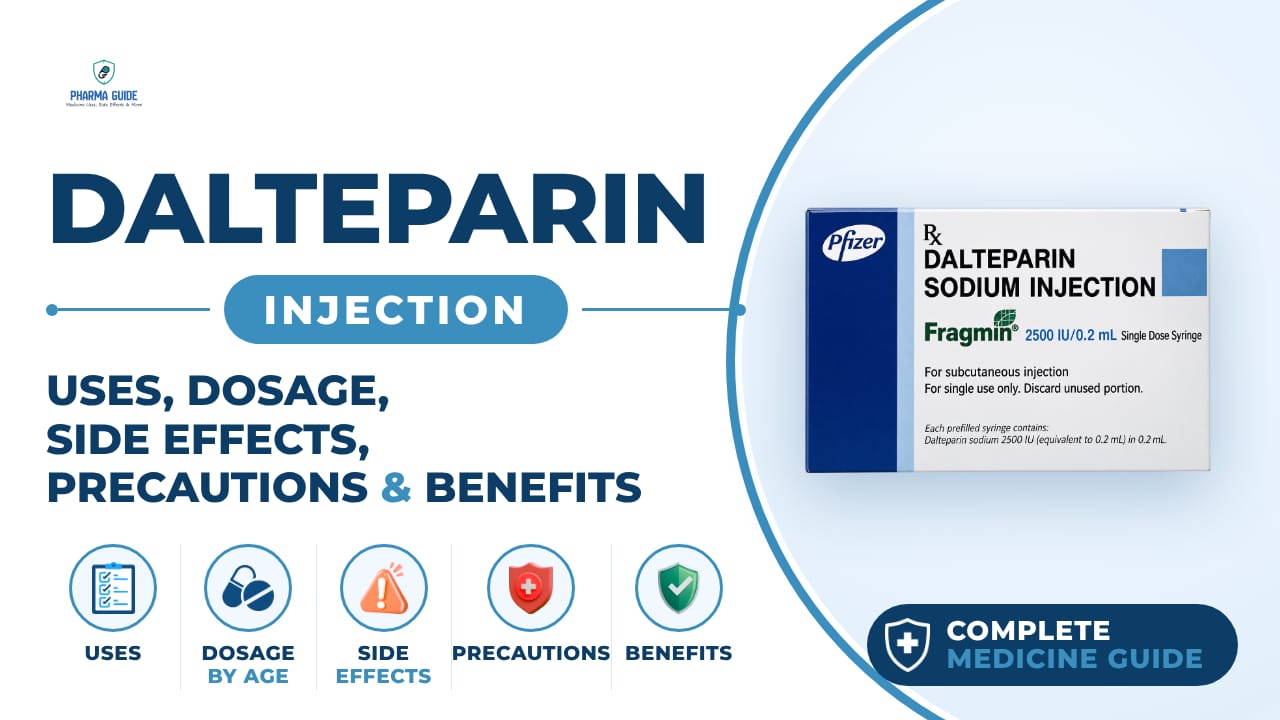
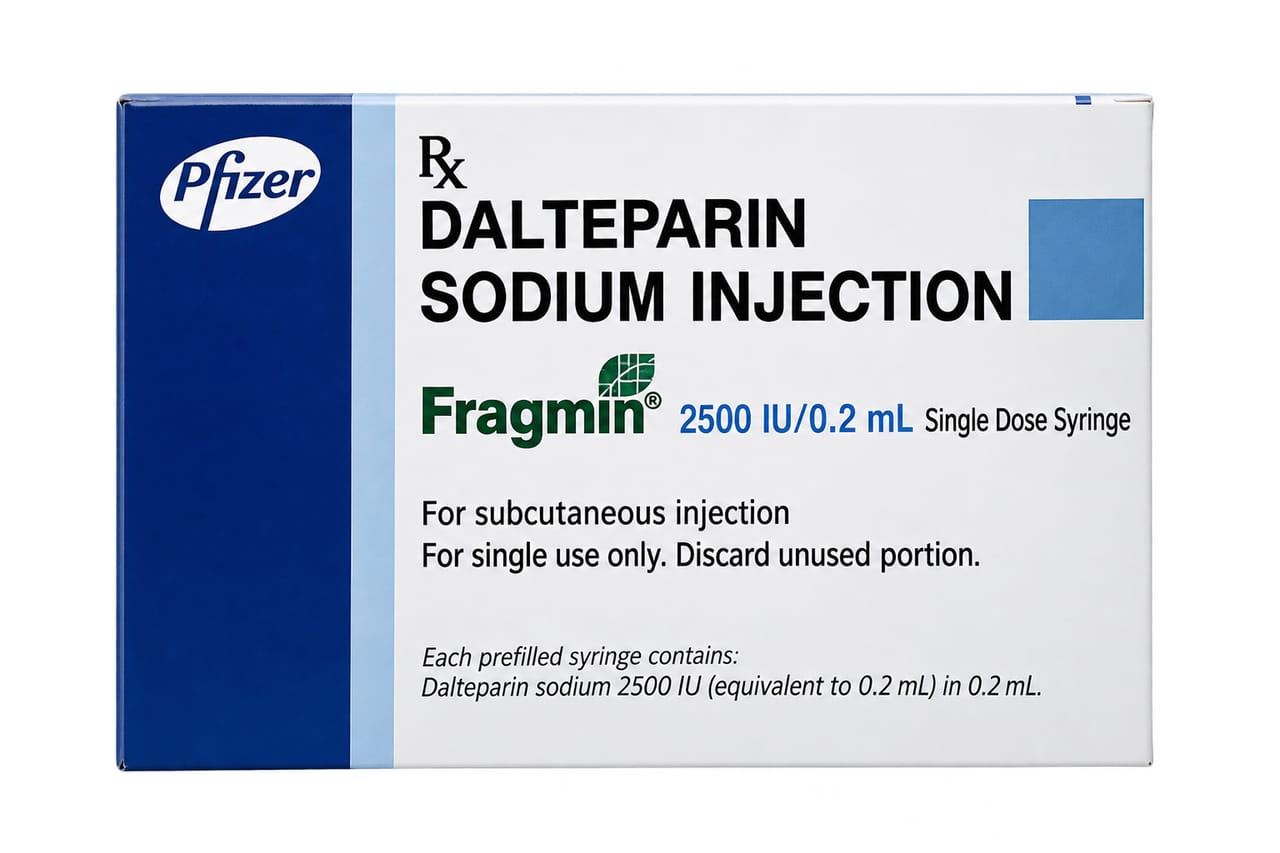
| Generic name | Dalteparin sodium |
|---|---|
| Drug class | Heparins (low molecular weight heparin) |
| Forms | Injection |
Quick overview
Dalteparin Injection (dalteparin sodium) is a low molecular weight heparin, a type of anticoagulant or "blood thinner," given as an injection under the skin. It is used with aspirin to help prevent complications from angina and heart attacks, to prevent deep vein thrombosis (DVT) in people on bedrest or having certain surgeries, and to treat or prevent recurrent DVT or pulmonary embolism in children and in adults with cancer. It is not used to treat an active blood clot.
What is Dalteparin Injection
Dalteparin is a low molecular weight heparin, a type of medicine called an anticoagulant or "blood thinner." It is given as an injection under the skin to help prevent and treat harmful blood clots.
Dalteparin Injection uses
- Used with aspirin to prevent serious or life-threatening complications from angina (chest pain) and heart attacks
- Used to prevent deep vein thrombosis (DVT), a blood clot usually in the leg, which can lead to a blood clot in the lung (pulmonary embolism), in people on bedrest or having hip replacement or abdominal surgery
- Used to treat DVT or pulmonary embolism and prevent it from happening again in children one month of age and older
- Used in adults with DVT or pulmonary embolism who have cancer, to prevent clots from coming back
- Not used to treat an active blood clot (DVT or PE)
Benefits of Dalteparin Injection
- Helps lower the chance of dangerous blood clots forming after surgery or during periods of reduced movement
- Reduces the risk of clots returning in people with cancer-related blood clots
- Can be dosed once or twice daily, allowing more flexible treatment compared to some other blood thinners
How Dalteparin Injection works
Dalteparin works by boosting the activity of a natural substance in the blood called antithrombin III, which then blocks clotting factors (mainly factor Xa and thrombin) that are needed to form blood clots.
Dalteparin Injection dosage
Dalteparin is given as an injection under the skin (subcutaneous), not into a muscle. It may be given once a day or, for certain conditions, twice a day in adults; children usually receive it twice a day. Inject at about the same time each day as directed by your doctor. A healthcare provider will show you how to give the injection at home if needed; do not change how you use it without talking to your doctor.
Choose a different injection site each time (such as around the navel, outer thigh, or outer buttock) and do not inject into the same spot twice in a row. Check the liquid before use; do not use it if it looks cloudy, has changed color, or has particles in it. Throw away a prefilled syringe or single-use vial after one use, even if medicine remains. Do not reuse needles or syringes; dispose of them in a puncture-proof sharps container.
Tell your surgeon or dentist you are using dalteparin before any procedure, as you may need to stop it for a short time. Continue your normal diet unless your doctor tells you otherwise.
| Age group | Dose |
|---|---|
| Under 18 years | Not recommended |
| 18–64 years | 5,000 IU, once/day |
| 65+ years | 5,000 IU, once/day |
Available forms and strengths
- Injection
Side effects of Dalteparin Injection
Common
- Bleeding
- Low platelet levels in the blood
- Bruising, swelling, warmth, redness, pain, or bleeding at the injection site
- Abnormal liver function test results
- Nosebleeds
Serious
- Signs of an allergic reaction: hives, difficulty breathing, swelling of the face, lips, tongue, or throat
- Signs of a spinal blood clot: back pain, numbness, tingling, muscle weakness in the lower body, or loss of bladder or bowel control
- Bleeding that will not stop, such as nosebleeds, bleeding gums, or abnormal vaginal bleeding
- Easy bruising, unusual bleeding, or purple or red spots under the skin
- Bloody or tarry stools, coughing up blood, or vomit that looks like coffee grounds
- Urine that looks red, pink, or brown
- Headache, weakness, dizziness, or feeling like you might pass out
Warnings and precautions
- Using dalteparin while having spinal or epidural anesthesia or a spinal tap can cause a blood clot to form around the spinal cord, which could lead to long-term or permanent paralysis. Tell your doctor right away about any back pain, numbness, tingling, muscle weakness, or loss of bladder or bowel control.
- Do not use dalteparin if you have uncontrolled or active bleeding, a history of low platelet counts caused by heparin, or an allergy to dalteparin, heparin, or pork products.
- Dalteparin is not meant to be injected into a muscle, and it cannot be swapped unit-for-unit with regular heparin or other low molecular weight heparins.
- Multi-dose vials of this medicine may contain a preservative that can cause serious harm or death in very young or premature babies; a preservative-free form should be used in these infants.
- Taking NSAIDs (like aspirin or ibuprofen), other blood thinners, or antiplatelet medicines along with dalteparin can increase the risk of bleeding.
- It is not known if dalteparin will harm an unborn baby. Tell your doctor if you are pregnant or planning to become pregnant, since having a blood clot during pregnancy can also cause problems, so the benefits of treatment may outweigh the risks.
- Ask your doctor if it is safe to breastfeed while using this medicine. Small amounts of the drug have been found in breast milk, but no harm to breastfed babies has been reported.
- Tell your doctor if you have kidney disease. People with reduced kidney function may need extra monitoring because the medicine can build up in the body.
- Tell your doctor if you have severe liver disease, as this can increase bleeding risk with dalteparin.
Storage
- Store at room temperature away from moisture and heat
- Some multi-dose vials may be stored at room temperature for up to 2 weeks after first use; discard any unused medicine after 2 weeks
- Keep out of the reach of children and pets
- Dispose of used needles and syringes in a puncture-proof sharps container following local laws
- Do not flush this medication down the toilet; use a medicine take-back program when available
When to see a doctor
- Get emergency help right away if you notice hives, trouble breathing, or swelling of the face, lips, tongue, or throat — these can be signs of a serious allergic reaction.
- Seek emergency care or call your doctor immediately if you notice back pain, numbness, tingling, muscle weakness in your lower body, or loss of bladder or bowel control, as these can signal a serious spinal blood clot.
- Call your doctor right away if you notice bleeding that won't stop, easy bruising, blood in your urine or stool, black tarry stools, or vomit that looks like coffee grounds.
- If you think you've taken too much, seek emergency medical help right away, as an overdose may cause excessive bleeding.
Alternatives
- Enoxaparin
- Arixtra
- Heparin
Watch the video
FAQs
What is Dalteparin Injection used for?
It is used with aspirin to help prevent complications from angina and heart attacks, to prevent deep vein thrombosis (DVT) in people on bedrest or having certain surgeries, and to treat or prevent recurrent DVT or pulmonary embolism in children and in adults with cancer. It is not used to treat an active blood clot.
How is Dalteparin Injection given?
It is given as an injection under the skin (subcutaneous), not into a muscle. It may be given once a day or, for certain conditions, twice a day in adults; children usually receive it twice a day, at about the same time each day as directed by your doctor.
What are the serious side effects of Dalteparin Injection?
Serious side effects include signs of an allergic reaction (hives, difficulty breathing, swelling of the face, lips, tongue, or throat), signs of a spinal blood clot (back pain, numbness, tingling, muscle weakness, or loss of bladder or bowel control), bleeding that won't stop, easy bruising, bloody or tarry stools, coughing up blood, and red, pink, or brown urine.
Who should not use Dalteparin Injection?
Do not use dalteparin if you have uncontrolled or active bleeding, a history of low platelet counts caused by heparin, or an allergy to dalteparin, heparin, or pork products.
How should Dalteparin Injection be stored?
Store at room temperature away from moisture and heat. Some multi-dose vials may be stored at room temperature for up to 2 weeks after first use; discard any unused medicine after 2 weeks, and keep out of the reach of children and pets.
General information, not medical advice
Your prescriber and the leaflet in your pack know your situation. This page does not.
- Follow your prescriber and the leaflet
- Don't start, stop, or change a dose on your own
- Doses and warnings differ by country and product
Sources
Video
Related medicines

Injectafer Injection: Uses, Dosage, Side Effects, Precautions and Alternates
Iron products
Injectafer (ferric carboxymaltose) treats iron deficiency anemia and heart failure-related iron deficiency via IV. Learn uses, dosage, side effects, and

Gliclazide Tablet: Uses, Dosage, Side Effects, Precautions and Alternates
Sulfonylurea (hypoglycemic/antidiabetic agent)
Gliclazide Tablet is a sulfonylurea for type 2 diabetes that boosts insulin release. Learn about dosage, side effects, warnings, and precautions.